Sunday, July 31, 2011

Friendly Butterflies

Beauty with a Crescent beauty
What can bring more joy to a child than a butterfly willing to rest on her finger?  We had a lot of Silvery Crescents on the rocky bank of Bull Creek last weekend and they were patient enough to climb on your finger if you held it down to them.

Most butterflies spend some time on moist soil, gravel and even dung, a behavior called puddling.  They are collecting minerals they fail to get with the pure carbohydrate in nectar.  This behavior can lead to large collections of different species, all gathering on a small area like college kids at a bar.

Great Spangled Fritillary  "Scalping"
Human sweat also provides these salts.  Some butterflies seem more likely to land on us, whether by their perception of odor or colors.  My odor on a hot steamy day would not ordinarily be an attractant, but then as I mentioned, they also will land on dung.  Wood Nymphs, Painted and American Ladies and American Snouts seem to be the most often attracted to me.


American Snout
The American SnoutLibytheana carinentais one of the most interesting butterflies to see up close.  Their mouth parts (labial palps) are greatly elongated, creating their long snout that could remind you of  Cyrano de Bergerac  or Jimmie Durante, depending on your age.  Long pointed protruberances on either end of an insect causes people to fear a bite or sting, but this butterfly is simply looking for salt and other nutrients.

The snout gives them additional camouflage with their leaf-like wings appearing to be attached to a stem, their snout.  They frequently add to the deception by hanging upside down from a stem.

The larval host plants for Snouts are Hackberry species- Celtis spp.  In the South, they occasionally have population explosions, followed by mass migrations which have been known to darken the sky.  These occur when a specific Hackberry leafs out following late summer rains in Texas.  In 1921 a migration lasting 18 days was estimated to include more than 6 billion butterflies.  (How do you count that many butterflies?  Easy- you count their wings and divide by two.)

If you haven't had your snout full yet, there are great pictures at http://www.cirrusimage.com/butterfly_snout.htm.

p.s. Did you know there is a snout moth?  Neither did I.  See Mobugs

Friday, July 29, 2011

Japanese Beetles

Beetles take in a little grape
Japanese Beetles have a sweet tooth, or at least a sweet mandible.  While they seemingly can eat anything (400 species and counting), on Bull Creek they are often found most predictably on wild grape.  Unlike Dracula, they avoid the leaf veins, leaving a clean reticulated pattern like they were carefully dissecting the circulatory system.

They are thought to have arrived in the US in 1916.  They have become an urban and garden problem in recent years, matching the observation that most invasive species take around a hundred years to spread and become a major problem.

Now they are facing the government.  It turns out that they, like a turn of the century Ozarker, have developed a taste for corn.  If they were eating just the leaves, it might not be as big a problem.  It turns out that they specialize in nibbling the corn silk, the plant's source of pollination.  This in turn prevents the development of the kernel our society has become so dependent on for food, sweetening and now fuel.

Researchers suspect that it will be 5 to 7 years of progressive problems before nature begins to reach an equilibrium.  There are many factors that can begin to control a new invasive species.  If new predators which are uncommon now develop a taste for them, the predators success can lead to proliferation of their numbers.  Diseases that are selective for them could also reduce their numbers.

Nature always finds a way to restore the balance.  Unfortunately the process is slow in human terms so don't expect them to fade away any time soon.

More information is available in this News-Leader article

Wednesday, July 27, 2011

Weaver Ants

Weaver ant gluing leaves
The May issue of National Geographic had a fascinating article on weaver ants.  Mark Moffett captures incredible images of their teamwork in weaving their colonial homes.  These denizens of Southeast Asia and Australia have one of the most complex societies known.

Among their many skills they can:
  • Create nests the size of soccer balls by stitching together leaves.
  • Create a city of these nests, up to 100 which are linked socially by their own brand of communication.
  • Hold and squeeze larva like a tube of glue to bind leaves together.
  • Stretch over a third of an inch to pull leaves together before weaving them into a home.
  • Attack intruders, including photographers by biting with a toxic substance and spraying formic acid to burn the nostrils.
The article describes the beginning of a construction project this way.
Pulling leaves together
"A single worker stands on a leaf and reaches to grasp the edge of another leaf nearby. If the span is too great, a second worker climbs over the first, and the bottom ant grasps the newcomer by its wire-thin waist and holds it out closer to the goal. Still not enough? A third ant clambers over the first two and is lifted out farther yet. Ant by ant, a living chain grows into thin air like the arm of a construction crane. Once the distant leaf is grabbed, the squad pulls in unison, often with nest mates that have formed parallel chains and reinforcing cross-links, to draw the leaves' edges together. Workers begin to array themselves like live staples along the seam between the leaves, legs holding on to one edge, jaws gripping the other."
Read this National Geographic.com website article for all the details.

Monday, July 25, 2011

Deer Exclosure

Jeff's Nature Home Page
Linda Chorice of the Springfield Conservation Nature Center pointed me to a story on a deer exclosure on NPR.  Exclosure refers to the eight foot high fencing used keep deer out of an area.  Although this could be used to protect plants or gardens, this particular exclosure was created to study the habitat changes brought on by a heavy population of deer.

Whitetail deer were a daily sight when Henry Rowe Schoolcraft traversed southern Missouri in 1818.  There were also numerous wolves, bear and even panther which served as predators to keep the deer population in balance, and a whole country for them to roam and browse.  In current times their primary predators (hunters and vehicles) haven't kept them in check.

The deer habitat has changed with agriculture and hay fields taking over past forests and savannas.  Browsing opportunities have been somewhat limited so they nibble a higher percent of new young trees in the islands of woodlands surrounded by fields.  Meanwhile they have adapted quite well to the more urban life where they are relatively free from hunting pressure.  They have developed a more sophisticated taste in dining including table decorations and salads, i.e. flowers and vegetable gardens.

Urban Deer- Outdoorcentral.com
The NPR story highlights the habitat changes seen by excluding deer from 10 acres. There was considerably more diversity in the protected area with a wider variety of forbs and shrubs as well as young trees.  This provided for more favorable habitat for mice and chipmunks which are a natural part of the food chain for snakes, foxes, etc.

There are two small exclosures along the trails at the Springfield Conservation Nature Center.  Next time you pass by, stop and check out any differences between the plants inside and outside the fence. You may notice a relative absence of new growth trees and shrubs outside as deer browse tender young shoots.  Without a chance to develop young trees, we end up with open woods lacking the habitat needed by many small mammals.   As the trees age and die, there are no young and teenage trees to take their place.  Deer also browse the shrubs which produce berries that feed birds and too many for this urban island of nature eliminates this food source for birds.

The effects of too many deer living on this protected urban island doesn't threaten the survival of birds and our forests.  It simply highlights the more widespread effects as habitat is consumed by human activities and deer numbers increase in the absence of natural predators.  Hunting controls the population in the wild.  In our expanding urban areas...not so much.

MSU conducts studies of the flora in and outside of the exclosure at the Nature Center. Take time to compare this with the surrounding woods at the Nature Center the next time you walk the trails.


* Checkout Jeff's Nature Home Page to view some of his incredible nature photography.

Thursday, July 21, 2011

Green June Beetle-NOT!

Note:
Our beetle- Click pictures to enlarge
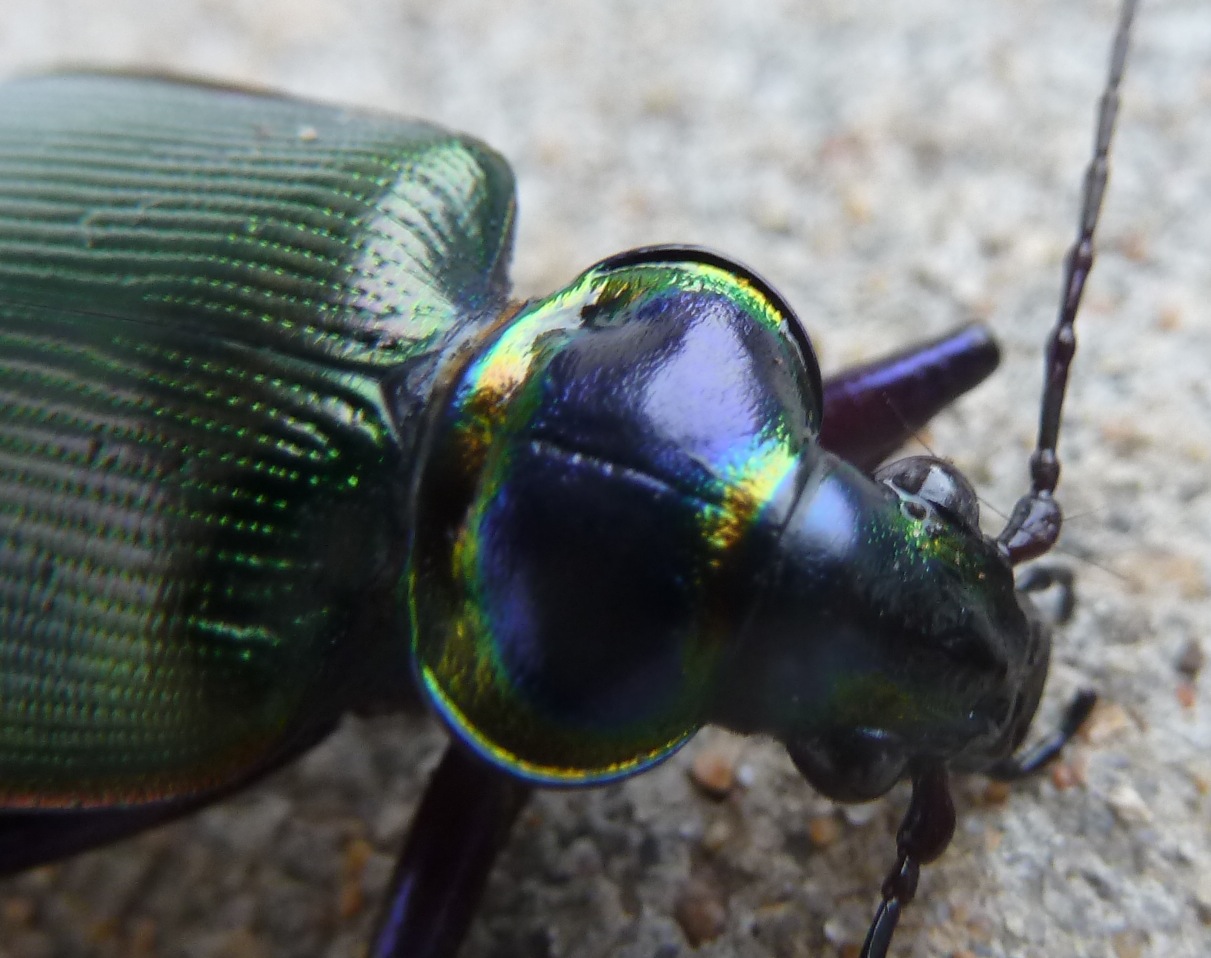
Thanks to an alert Shelly Cox* from MDC we have a new ID below.  I posted a Green June Beetle story this morning which was all correct except it wasn't the right beetle!  Within a few hours of the posting, Shelly read it and identified the beetle as a Fiery Searcher, a.k.a.  Caterpillar Hunter.  First the differences.
  • Note that my beetle pictures, like the Fiery Searcher, show long thin antennae and legs that are smooth.  The wing covers are streaked with long furrows and scattered tiny pits.
  • The Green June Beetle picture shows short broad antennae, clubbed at the end, and legs with curved spines on the tibia.  Its wing covers are perfectly smooth.
Fiery Searcher- Calosoma scrutator
Green June Beetle - Continis nitida
Note smooth legs,long antennae
Note wing cover grooves and pits


The beetles of the Calosoma genus are large beetles which hunt caterpillars, both good and bad from our myopic human perspective.  Most of the 167 known species are black but Calosoma scrutator is a colorful exception.  It gets respect from its mandibles which nip prey, predators and unwary bipeds which pick them up.  They also can produce a foul smelling spray from glands at the tip of their abdomen.

Both the beetles and their larvae climb trees in search of caterpillars.  They are active from May, when the trees leaf out, through the fall.  They winter as adults and can live up to three years.

An animal's role in nature is all in the eye of the beholder.  The Fiery Searcher is generally considered a beneficial insect, eliminating destructive caterpillars although some lepidopterists and caterpillars may disagree.


Click to enlarge
The lesson here is to observe small details carefully.  Had I taken the time to draw my beetle, the details would have jumped out at me.  Notice the fiery rim around the dorsal thorax in the picture below taken by Jon Rapp of Columbia, MO.

**Shelly Cox writes my new favorite blog, http://mobugs.blogspot.com/.  She started out as a Missouri Department of Conservation volunteer in 2003 and lost her "amateur status" when she was hired by MDC as a Naturalist in January of this year. She posts to her blog with regularity and she has the advantage over me of knowing what she writes about (although this weakness will not stop me from writing).

Saturday, July 16, 2011

Terrible Hairy Fly

Hairy Fly- AFP- BBC
You want rare?  How about the wingless Terrible Hairy Fly, Mormotomyia hirsutaThis wasn't written by our Buck Keagy but it could have been.  It had been found only twice,  in 1933 and in 1948.  It is found only on a single 20 meter high rock in Kenya, in a cleft with a bat roost.  In the words of Dave Barry, "...and I am not making this up."  It is a story worthy of Buck Keagy.

It has small non-functional wings and tiny eyes.  Its long hairy legs give it the appearance of a spider.  It breeds in bat guano which is also where the larva have been collected.   Scientists believe the adults live on bat secretions.

A BBC report on a 2010 expedition that found the fly again and collected it for study.  They hope that DNA studies will tell more about its evolutionary history.

Unable to fly, its only means of dispersal would be to cling to a bat that moved to another location.  They feel that this rock may house the only specimens.  It is the only member of its new family and is probably the only fly species which is limited to Africa.
 
Editor's note:
If you have never read any of Buck Keagy's Sigh-n-tific discovery stories, now would be a good time to ..... watch the Weather Channel for a few hours or listen to some talk radio.  If however you insist, you can check out the April 1, 2011 and April 1, 2010 stories. 
Remember- I warned you!

Friday, July 15, 2011

Rattlesnake Master

Click to enlarge
It is always exciting to find a new species on Bull Creek.  We just found the first Rattlesnake Master on our place.  You have to love a name like that.

The ball at the top of the stalk is made up of lots of tiny white flowers surrounded by sharp bracts (specialized leaves below the flower heads).  The leaves are very distinctive with long parallel veins and long thin teeth which are curved like a rattlesnakes fangs.

Leaves with long hair-like teeth
Rattlesnake Master (Eryngium yuccifolium) almost resembles a yucca but it is actually a member of the carrot family.  It is normally a tallgrass prairie species, although ours was in the  woods along a north facing trail.  This location may be related to the fact that most of the hills like ours were "barrens" several hundred years ago.  Schoolcraft traveling through in 1818 consistently described the hills as open grasslands with only a few scattered trees.

According to Illinoiswildflowers, Native Americans used the dried seedheads as rattles.  It received its name from the pioneers who claimed the roots were an effective snakebite antidote.  In addition to a garden plant, it is promoted for sale in websites like herb-magic.com.
"Wear RATTLESNAKE MASTER, Red Pepper, and Salt in your Shoes, and you can walk with impunity where people have laid down crossing powders and where poisonous Snakes dwell. A living RATTLESNAKE MASTER plant near your front door -- especially the strong-smelling Eryngium foetidum -- is said to keep snakes away."
"We make no representations for RATTLESNAKE MASTER, and sell as a Curio only."
Timber Rattlesnake- Click to Enlarge
Try telling that to this guy we found by our garage door last week!  See him laughing?  Me neither.