Tuesday, January 31, 2012

Good News


The Official Mike
Mike Kromrey has been named as the Executive Director of the Watershed Committee of the Ozarks, Inc.  We know Mike as an outstanding water educator, a virtual Pied Piper when it comes to teaching kids both big and little.

Mike will bring the same passion to the organization that Loring Bullard instilled over his 22 years as Executive Director.  Hopefully he will have time to still harass-a-bass in occasional free moments.

The Real Mike- Click to enlarge
Mike has been with the organization for the past six years as the Education/Outreach Coordinator. In addition, Kromrey has been the Co-Chair of the Natural Environment Committee for the City of Springfield's Strategic Plan and has also served on the Springfield/Greene County Environmental Advisory Board.

Spider Brain

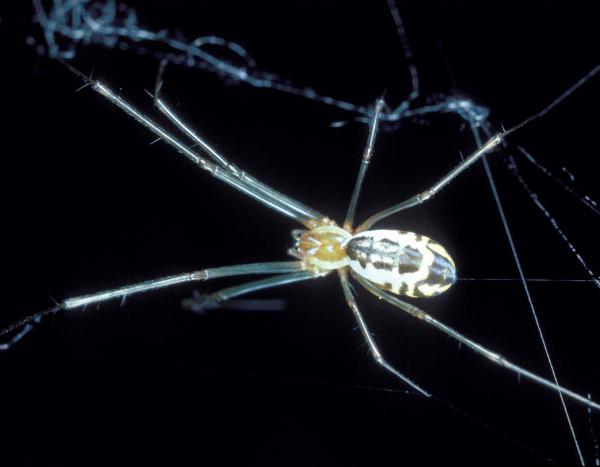
Filmy Dome Spider - MDC
Ever wonder how a tiny spider's brain can perform the same tasks as a much larger spider species?  Our common Filmy Dome Spider for instance creates a complex snare web which looks like an upside-down silk bowl.

Part of their secret may be where to keep a big brain too big to fit in their heads.  Eurekalert.org describes research by the Smithsonian Tropical Research Institute in Panama which found that the smaller the spider the bigger their brain is in proportion to their body.  When the brain is too big for the head it is stored in body cavities.  In the smallest spiders, the brain filled 80% of the body cavity with 25% of it in their legs.

There is only so much miniaturization that neural tissue can stand.  Neurons and axons cannot be shrunk and still carry the signal.  Therefore, the spider has to devote more body space to their nervous system.

The study was done in Panama and Costa Rica where a tremendous diversity of spiders allowed for a broad range of comparisons.  The giant spider Nephilia  clavipes weighs 400,000 times as much as the smallest spider in their study.

There is Haller's rule which states that as body size decreases, the proportional mass of the brain goes up.  In a human the brain is only 2-3% of our body mass compared to 15% in ants and even a greater proportion in spiders.  Now if I could just figure out how to use more of it.

Sunday, January 29, 2012

Winter Tree Identification

Virginia Tech
As Francis Skalicky wrote in the Thursday News-Leader article, identifying trees in the winter can be a challenge.  I set out this year to learn to identify bark, which is possible on many big mature trees, but the saplings and small trees remain a challenge.  Dr. Michelle Bowe, a botanist from Missouri State University gave us a great session on winter twig identification at the Missouri Native Plant Society meeting this week.*

To many of us, even the names of twig structures are new.  The US Forest Service drawing will help.  A basic description is at this Virginia Tech site.  Once you look carefully at a few twigs, you will be amazed at the differences you can find in buds and scars.

US Forest Service-TAMU

There are a couple of ways you can approach this subject.
  1. The Springfield Conservation Nature Center’s “Nature Journaling – Winter Tree Identification” program will be held from 10 a.m. to noon this Saturday.  Participants should dress for a short time outdoors. To register for this program or to find out about other Nature Center events, call 417-888-4237.
  2. There is a good key to get you started at VTree ID Twig Key.  A list of twig characteristics is available at this MDC link.  These will help with common native trees but to learn more including the smaller trees you will need a good resource such as Frances Main's Fifty Common Trees of Missouri, available at some MDC offices.

    * Dr. Bowe will be presenting twig ID at the January 2013 Master Naturalist meeting.

Thursday, January 26, 2012

An Ode to Caterpillars

Red Spotted Purple caterpillar
As a cold morning melts into the sunny 40's, a walk in the woods, albeit with a chainsaw, reminds us that spring will eventually be here with the reawakening of the insects that are in hiding.  As a further reminder, Kevin Firth of Friends of the Garden sent me an Ode to Caterpillars.

This NPR Living on Earth interview with Dave Wagner mentions several critical roles that caterpillars play in addition to their final stage as a butterfly or moth that provides beauty to our world and pollination of our plants.  By laying hundreds of eggs, lepidoptera are preparing a smorgasbord.  These eggs and the resultant caterpillars are an important food source for many birds, bats, and other animals.

Less obvious is the caterpillar's indirect contribution to medicine.  As Wagner explains:
"There’s another important role that caterpillars have played. Because plants can’t run away from caterpillars, they’ve evolved a battery of chemicals to protect themselves. Wagner says these secondary chemicals are the basis for drugs and medicines—like opium in poppies and salicylic acid in willows that’s used in aspirin."
It won't be long before we will start to see caterpillars emerge.  When you see the first one, you might want to tell it "thanks".

Tuesday, January 24, 2012

Grading Our Streams

Ozarks Water Watch's newsletter this week features an article, How's The Water?, that shows the grades of our streams draining into the White River system.  Just like school there are some bright spots and some failures.

One of the most asked questions at local water meetings is "what happens to our stream team data?"  This is frustrating to many who diligently wade the streams and kick gravel into nets to capture the macroinvertebrates to be counted but never get to see the big picture.

Click to Enlarge


Past reports have been based on data from MSU, University of Arkansas,  and the US Geological Survey.  Ozarks Water Watch is going to be incorporating more data from the extensive stream team network in the future.

The scorecard to the left is just an overview of the data.  Click on it to see how your favorite stream rates.  There are several detailed papers describing the process and results which are available through links in the How's The Water? article.

If you haven't had a chance to kick gravel and count critters, now would be a good time to visit the Missouri Stream Team web page and see how you can get involved.  There is a nearby stream awaiting your visit.

Saturday, January 21, 2012

Eagles

Bald Eagle- MDC Gallery
We are all aware of the decline in eagle populations in the mid-century and the dramatic recovery of our American emblem.  I usually think of their return from near extinction as a product of the banning of DDT which was used to poison many animals in the food chain.  Eagles accumulated DDT predominately from eating carrion of poisoned animals, and the toxin weakened their egg shells.  Francis Skalicky reminds us in Thursday's News-Leader story that humans had an even more direct hand in the threat to eagles in the first half of the century.
"The eagle is a curse to the rest of the animal kingdom and the sooner it is exterminated, the better off the game will be."  -Valdez Miner newspaper, Alaska, 1920 
From 1913 through 1953 Alaska actually had a bounty on eagles which some thought were destroying the salmon fishing industry.  In a two year period alone they paid bounties on 27,843 eagles.  Subsequent studies showed eagles had little effect on salmon fishing.

Meanwhile, in western states they were blamed for the deaths of young lambs.  Their main diet is fish and carrion and being found eating a dead lamb was considered evidence of their guilt.  Seven hundred dead bald eagles were found on a Wyoming sheep ranch, the victims of poison and shooting from a helicopter.  It is now well accepted that they don't significantly prey on lambs.

We have come a long way in conserving wildlife since then, although local debates still occur over restoration of predators such as wolf and otter.  At least we are now having the conversations.

Friday, January 20, 2012

The Birth of Missouri Conservation

I came across an interesting video on conservation in Missouri.  In 1950, the Missouri Department of Conservation (MDC) produced a film which described the birth of the Department.  It has the nostalgia of the old newsreels with dramatic music and stilted camera shots of events.  I expected to see a Superman serial to start up at any moment.

Missouri's good old days had some bad old moments.  Like much of the United States, the early twentieth century in Missouri was a time of growth.  Much of the forests had been cut to supply lumber for the expanding railroads and the booming Midwest population.  The deforested hills were plowed for crops, creating erosion.  Deer, turkey and bass populations were depleted due to uncontrolled hunting and fishing.

These unintended consequences of growth led to the creation of the Missouri Conservation Commission which evolved into the Missouri Department of Conservation.  Now MDC has posted the film as an 18 minute Youtube video.  Butter up the popcorn and turn it on.