Friday, June 28, 2013

Exploring a Glade


While most of the people at the Missouri Native Plant Society trips are looking for rare plants, sedges and grasses, some of us on the fringe are exploring for other species.  I joined Brian Edmond and his young assistant Julian in a search for herps and insects.

We found this creature under a rock while looking for scorpions.  Looking at its jaws, I was reluctant to make it mad.  I sent the picture to Chris Barnhart who got right back with the suggestion that it was a ground beetle larva, probably of the Carabidae family.  I sent the picture to Bugguide.net and received a quick response the next morning that it was indeed in this family, and a member of the Calosoma genus.

Calosoma beetles are large ground beetles, also known as searchers or caterpillar hunters.  You may recall a past blog on the beautiful Fiery Searcher that was also a guest at our last MN chapter meeting.  Both the beetle and their larvae (grubs) climb trees in search of caterpillars, and one species was even imported in 1905 to hopefully attack Gypsy Moth larvae.  While I can't be sure, this looks just like the Fiery Searcher grub pictured eating a caterpillar on this beetleforum.net site.  There is more about it in the 2011 blog.

Fiery Searcher beetle- Click to enlarge
Its fiery name comes from the dramatic colors.  At first glance it is just another green beetle, but on close inspection it shows its true colors.  I find it hard to capture all the iridescent colors of this beetle with a camera, especially the glowing red hues around the edge of its wing covers.  This dead beetle gives you some idea of the blue-green and orange highlights.

We did find some scorpions but no snakes or collared lizards.  Unlike the movies, these scorpions were very laid back, just wanting to be left alone.  Life on the glade is hard and they need their undisturbed rest.  We were careful to put the rocks back down where we found them, as hiding places on a glade are at a premium.

The highlight of the hike for Julian was the tarantula.  It again was found under a rock. What creature wants to be exposed to a human on a glade around high noon?  The spider, relatively small for its species, was docile and not bothered by gentle handling.  They don't look at humans as food and won't waste their precious venom on us unless they are threatened,


Tarantulas get a bad rap in the movies, but they won't kill you unless you find the ones that James Bond or Indiana Jones encountered.  When threatened, a tarantula gives a warning like other animals, in this case by rearing up on its back legs and baring its fangs.


Its bite can give you a nasty swelling like a bee sting and it can release urticating hairs which can sting and cause a rash.  I wouldn't advise handling one unless you are experienced, very calm, and keep the spider mellow.  If you yield to the temptation, some pointers are here.  For me, observation or a gentle pet on the back is enough.

Brian and his assistant Julian demonstrate safe handling in this video.

Most spider bites aren't spiders anyway.  See this site.

Wednesday, June 26, 2013

Hairstreaks

When it comes to glamorous butterflies, large swallowtails and fritillaries get all the attention.  It is easy to overlook some of the tiny species fluttering a few inches off the ground, nectaring on flowers almost too small to see.  On close examination, these have their own beauty.


Tiny brown butterflies were almost the only thing flying the other day, soil colored and hard to see in the tall grass.  Swinging the net through the weeds I came up with a mixture of grass seeds, gnats and ticks and one lone butterfly.


It was a Banded Hairstreak, Satyrium calanus, easy to ignore with a wingspan of only 1.5 inches.  Examined closely, it has two tiny tails on each hindwing, one long and one short.  There are several hairstreak butterflies with similar markings but the banded hairstreak has a pale blue spot on the hindwing tip which lacks an orange center spot.

The Banded Hairstreak can be found this time of year hanging out like this one on shrubs, waiting for females to fly by like college students sitting along the campus walks.  (I am probably dating myself with this analogy in the age of Facebook and Twitter).  Their eggs are laid on oaks, hickories and walnuts where their larvae will eat the leaves and catkins, then overwinter in the chrysalis before hatching next spring.

Walking a trail with an expert like Phil Koenig of BAMONA*, I am amazed with his ability to identify these tiny butterflies in flight on the basis of a distant glance, their habitat and flight patterns.  Much like birds, they have their distinct behavioral characteristics, but without the identifiable songs and calls.  (No help there - I can't identify bird calls either.)

Another species flying now is the Northern Pearly-eye, Enodia anthedon.
In addition to the distinctive eyespots with the central white "iris" which gives it its name, there is a black band just below the white tip of the antennae club.

Northern Pearly-eye
After hanging in the bushes looking for ladies, they mate and the eggs are laid on a variety of grasses.  After three moults (see the last blog) the final instar of the caterpillar overwinters before forming a chrysalis and emerging as an adult.  Surviving the winter as a fragile caterpillar seems a bit risky but they apparently know what they are doing, as there are a lot of them flying right now.

Like some other butterflies and some notorious celebrities, Pearly-eyes are beautiful but lacking in good taste.  Instead of seeking out delicious sweet nectar, they feed on tree sap, rotting fruit, dung and carrion.  This sounds like a story in "People Magazine," doesn't it?

If you have never used BAMONA, I would encourage you to try it.  In addition to identification information, you can send in your pictures and even submit data to record species not previously identified in your county.  It is like bird watching with nets.

Monday, June 24, 2013

Shedding Snakes

Like a fish picture, it probably isn't that long.
We commonly find snake skin sheds in and around our Bull Creek house, usually contributed by the resident black rat snakes.  These are dry and crinkly like tissue paper and are frequently chewed up in fragments.  This week was different.

Shed wrapped around the foundation
Barb was behind the house when she saw a black rat snake snuggled in close to the foundation at the corner.  It was in the act of shedding and it wiggled through an impossibly small hole in the well house wall to escape, undoubtedly embarrassed by its state of undress.

The skin was remarkable when fresh, more like the consistency of damp Saran Wrap.  All the external features of the snake were preserved including the eyes and nostrils.

The process of moulting includes the shedding of skin by amphibians, reptiles or the exoskeleton by insects and arachnids.  The exercise requires energy and leaves the animal vulnerable to predators but is necessary for the animal to grow into a larger covering.

The snake starts the process of moulting by rubbing the tight skin against a hard object until it splits.  The first rents commonly occur around the lips.  It generally sheds its skin in one continuous piece, peeling it off inside out like removing a sock.  This leaves all the features including their ocular scale (called a brille), a snake's version of our cornea, attached. 

Shed with the old ocular scale intact
A few days prior to shedding, a snake's vision is impaired, possibly to the point of blindness.  A layer of air separates the old and newly developed  layers of scale, clouding its vision.  Snakes tend to hide and not hunt during this pre-moulting period.

Barb saw the snake the next day and said it wasn't as long as we had thought.  She was right again.  The nearly transparent shed had folds from the overlapping scales, and when stretched out as it is peeled off, it is about a third longer than the snake itself.  Rattlesnakes are the exception as the shed ends at the rattle and the remaining skin adds thickness and segments to the hard rattles.

Left to nature (or in our closet) the skin is chewed by insects, moths and probably rodents as animals and plants leave little to be wasted in nature.  Humans seem to be a striking exception to this rule.

Life is short but snakes are long has information on identifying snakes by their sheds.


Friday, June 21, 2013

Vultures In The Tree

The last three years we have been posting stories following the progress of black vultures which nest in a stall in our century old barn.  Perhaps "nest" is too strong a word as they simply lay their two eggs on the bare ground in thickets, rock piles or caves.  In this story, they chose a hollow tree.

Young Vulture- 2012
Last year we were cruising along pond trail when our friend spotted a pair of immature vultures sitting on a broken upright tree trunk.  As we slowly walked closer, they dropped down inside the hollow trunk with a deep "thump."  Over the next few weeks we watched as they shed the few remaining white down feathers from their necks and then they were gone.  The tree was only a thin rim of wood with several holes and I didn't expect it to last the winter.

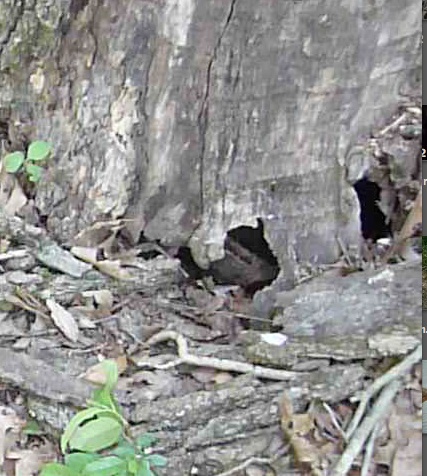
Yesterday as I drove the pond trail, I stopped to check out the old tree.  The hollow trunk is a little shorter now, just over 6 feet tall, a thin barrel of wood with cracks in the sides.  I tapped it lightly with my knuckle and it resonated with a deep pitch.  Then I heard a soft low-pitched hiss, the distinctive sound of a vulture chick warning me to get away.

Vulture Tree Base
The current digital boom has provided many wonders, such as the pocket camera.  I found a small opening in the base of the tree made by wood slowly being digested into soil.  With my camera in movie mode, I lowered it blindly into the opening to record the sound.  Each light tap on the trunk brought forth another hiss.

Although I couldn't see the screen on my camera, I decided to try taking some pictures blindly.  Each flash of the camera brought on another warning hiss.  To my surprise I managed to get several decent portraits of the chicks.

 
"HISS- I'm big and I'm BAAD!"
In addition to capturing the sound with the video, I actually got some pictures inside their decaying tree house.  They will be there for several months, fed digested dead flesh by their parents until they are strong enough to go up through the hollow trunk to the top.  Meanwhile, you can get a glimpse of life in a tree trunk with this video.


Wednesday, June 19, 2013

Tale of a Skink

Male five-lined skink- Patrick Coin
This time of year, five-lined skinks, Eumeces fasciatus, run daily around on our deck.  Most sources say they prefer moist rocky areas and forests.  On Bull Creek they seem to specialize in our house deck, rock garden and occasionally the interior of the house.  The males vigorously defend their portion of the deck against other males.

Adult females are dark brown with five yellow lines along their bodies while the males are more tan to light brown.  In mating season the males' throats and jaws turn a bright orange, advertising their availability.  They begin chasing the females as spring first arrives, grabbing their necks with their jaws; a real love bite.

Egg laying occurs from April through June with the female brooding the 8-12 eggs.  If she detects a defective egg, she bites the end, sucks out the contents and then eats the shell.  Soon the black colored babies are running around, flashing their long bright blue tails.  Some think the blue tails protect them from the larger aggressive males.  I wonder if this doesn't also serve as an advantage to young vulnerable skinks avoiding predators.

The bright blue tail also may be an advantage in escaping predators.  It might attract them to a non-essential feature they can afford to lose.  Skinks, like some lizards, have an interesting way of escaping predators.  When caught by the tail, they simply self amputate it, a process called autotomy.  The blood vessels immediately clamp down and the body seems none the worse for wear. When this occurs, the tail continues to twitch, hopefully distracting or satisfying the predator while the victim runs for cover.

When they are spotted by a predator, young five-lined skinks will sometime twitch their tails enticingly, a distracting invitation to lunch for the attacker, allowing them to live to grow a new one.  This regrowth requires a lot of energy and the tail is never as long or as decorated as the original, the the animal doesn't seem to miss the original.

Last week I netted an adult female as she ran by.  Planning to photograph her, I was holding her by the body and used my finger to straighten out her tail for a picture.  Without any pressure, the entire tail fell off onto the deck.  This has been occasionally reported to occur even when the skink presses its tail against something solid.  The skink was still laying calmly in my hand as the tail danced on the deck.  I switched to video and watched the tail twitch just like any other predator would.  You can see the tail twitch on this video.

Once I put the skink on the deck it skittered off to grow a new tail.  No skinks were injured in making this video, although one was shortened temporarily,

Addendum, 5-10-2015:
A question was raised about the difference between a lizard and a skink.  

Encyclopedia Britannica give a worldly view.
"Skinks are morphologically distinct from other lizards in their almost cylindrical body with no marked neck, long tail, short or even absent limbs, and scales that are smooth, semicircular and imbricated (overlapping)."
 More practical from our mid-western point of view, our resident herpetologist Brian Edmond gave me this description. 
"A skink is the common name for a successful family of lizards (Scincidae) that is worldwide in distribution. They are distinguished in Missouri from other lizards by having smooth, shiny, scales. This probably doesn't serve to physically distinguish skinks from other groups everywhere in the world."
"All skinks are lizards, but not all lizards are skinks."  That, I can remember.
Thanks to Patrick Coin for use of his photographs.  More are at this Flickr.com site.
More pictures are at fcps.edu.

Monday, June 17, 2013

Dog Vomit


A while back Gala Solari sent me the picture above, asking what it is.  Her description:
"Goopy mushroom thingy. Grows on the mulch. Size ranges from 3" to 18" with irregular shapes. In this pic, it's drying out, when new it's smooth on top, with kind of a skin and goopy inside. When dried out, it's dusty and black-ish. Something eats it. What is it?!"
The consensus of George Lantz and soon to be Master Naturalist Mark Bower was that it is a slime mold, mostly likely Fuligo septica - better  known as dog vomit slime mold or scrambled egg slime.  Interesting juxtaposition of names, eh?   George had this further comment.
"You say that something is eating it? Believe it or not, Fuligo septica is edible. Native people in parts of Mexico gather and scramble similar to eggs. I would not gather and try it myself."
As in Gala's case, it is commonly found on wood mulch after watering or a rain. It is typically 1 to 8 inches in diameter and up to an inch thick.

Slime molds aren't fungi although they have some similarities.  Unlike most fungi whose spores drop down from the forming structures, F. septica's spores are produced on or in aerial sporangia and are spread by wind.  Gardening sites are peppered by questions about how to prevent them from recurring and many people try to hose them off.  Guess what? That just spreads their spores all over the mulch.  Tom Volk suggests learning to love them or paving over your garden.

F. septica has several interesting talents.  For one, it is able to absorb massive amounts of zinc that would be toxic to any other living thing.  It does this by producing fuligorubin A, a yellow pigment which chelates metals into an inactive form.  This has some potential for detoxifying soil.

Mark Bower is a good source of slime mold stuff.  His email prompted a slime mold blog in 2011 and he just did it again with this Scientific American article.  This further describes the ability of the mold to negotiate complex mazes.  Maybe some day we will have a self propelled soil detoxifier.  I have the perfect name... the blob!

Tom Volk has an interesting article on Fuligo septica including the fact that it was the inspiration for the classic 1958 SciFi thriller The Blob staring Steve McQueen.  I am waiting for a morel spinoff.


Friday, June 14, 2013

Mason Bees


Hornfaced bee Osmia cornifrons- from Wikimedia
      -By Jennifer Ailor, Springfield Master Naturalist

Mason Bee "house"
This spring I purchased two mason bee “houses” from Gardeners Supply Co. and check them nearly every day for activity. You’ve no doubt seen their nests of mud inside hollow reeds or holes in wood. The bees are terrific pollinators and may visit as many as 1,000 blooms a day or 20 times more than a honeybee. I placed one of the bee houses on the southwest corner of my barn near the garden and another at the house, where I have lots of flowers and flowering shrubs.

According to Wikipedia's article on the subject and other sources, mason bees are in the genus Osmia of the Megachilidae family. There are more than 130 species in North America alone, active in temperate zones from spring through late summer. Mason bees are solitary. Every female is fertile and makes her own nest in a hollow cavity created by a wood-boring insect or bird or in hollow reeds. They don’t produce honey or beeswax.

Males hatch first and then hang around potential nests waiting to mate. Once that’s occurred, the female backs into the hole and lays an egg on the top of a mass of pollen/nectar she’s collected. She then creates a mud partition, which fills in the back of the cavity. She’ll continue laying eggs until the cavity is filled, then plug the entrance to the tube and seek another nest location.

By summer, the larva has consumed all of its provisions and begins spinning a cocoon around itself and enters the pupal stage. The adult matures in the fall or winter, hibernating inside its cocoon until it emerges in the spring.

If you’d like to order a house, Gardeners Supply has them for $18.95 each. You also can build your own. Here are two links to sites that have lots of information about building nests and about mason bees in general: http://masonbee.blogspot.com/ and http://www.crownbees.com/mason-bee-tubes-and-straws-which-are-best/.

Editor's Note:
We have a large supply of various bamboo-like reed grass which are cut annually from the beautiful Grass Garden at Close Memorial Park.  They are perfect for the job and if you are interested in making your own mason bee house and are in the Springfield area, I will be glad to supply you some.  It just takes some reed segments and a can.
I Bee-live in Pollinators- Quick and cheap