Monday, July 4, 2016

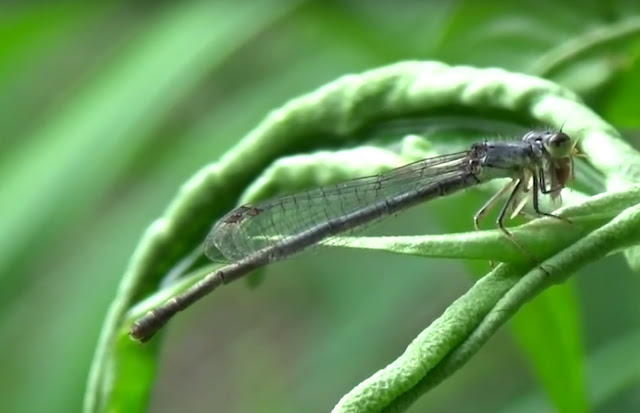
Fragile Forktail Damselfly

Fragile Forktail female- Linda Bower
Dragonfly naiad - REK
If you ever wondered how an aquatic naiad (larva) of a damselfly can transform into an adult like the one above, this is your chance to see it happen.  You can watch as it pumps fluid into wing veins to expand them, then air into the abdomen.

Linda Bower of our Master Naturalists sent me the following study and videos of  her Fragile Forktail Damselfly, Ischnura posita.

If you spend any time at a local pond, you may miss the well-named Fragile Forktail Damselfly (FFD). It is almost the size of a straight pin, at less than an inch long. I found it with binoculars and the zoom on my camcorder and then became obsessed with filming it’s various activities. Admittedly, my camcorder faced it’s limitations with the FFD’s size, distance, and preference to stay in the shade.

FF male - Patrick Murray
The Fragile Forktail is distinguished from the very common Eastern Forktail by the shoulder stripes. The FFD’s stripes look like exclamation points. Additionally, the Eastern has blue at the tip of its abdomen, the FFD doesn’t. The females of the two species are almost identical and duller than the males. The FFD female also has interrupted shoulder stipes, but it is more difficult to see them. Don’t be fooled, these are voracious predators capable of capturing prey of their own size, including other damselflies.

Eastern Forktail - Fyn Kynd
This video shows a Fragile Forktail emerging from its larval stage (photo of emerging).  It was filmed from about 7 feet away, with my tripod stuck deep in the mud a few feet from shore. The process took a couple of hours. With editing software, I cut out all but 18 minutes and then sped up most of the clips. This reduced the video length to 1 minute 40 seconds. And then I added music to cover up my gasps and shrieks as I watched this happen for the first time in my life.

I have hours and hours of video showing the Fragile Forktail laying eggs and I’m still not satisfied with the footage. Apparently they don’t like to lay eggs near the shore. Still, it is fascinating to watch this video, which shows her size relative to a tiny Juniper berry.


Happily, I found a female eating lunch right next to where I was sitting. Any parent would be proud of how well she cleaned her face and hands after eating in this video.


My obsession will certainly continue through the summer. Stay tuned to my YouTube channel for more views of dragonflies and damselflies!

The process is explained by Naturally Curious with Mary Holland:

"At the end of its larval stage, a dragonfly larva crawls out of the water where it’s been living and climbs up onto emergent vegetation, or a nearby rock, where it clings as its skin splits along its back and head.  The adult winged dragonfly pulls itself out of its larval skin through this hole, and grasps the skin (or vegetation or rock) while it pumps its body full of air and sends fluid into its wing veins.  This fluid causes the wings to enlarge — the wing expansion that is evident in these two photographs took place in less than ten minutes.  When it first emerges from its skin, a dragonfly is pale and soft, and the wings have a characteristic pearlescent sheen, as in these photographs.  Within a day or so the wings lose this sheen, the body hardens and colors start to develop."

Saturday, July 2, 2016

Red Harvestman

Hanging out in the shade  -  REK
There are lots of these harvestmen along a small stream entering Bull Creek.  They are all clinging to leaves, many still moist from this morning's rain.  They posed for pictures as long as I didn't get too close.

A closer look - note the two small black eyes above the pedipalps - REK
This is Hadrobunus grandis, a species that ranges from Maryland to Oklahoma.  Adults are a darker brown and will be seen commonly hunting along the leaf duff on the ground.  The central marking on the back is sometimes absent and they have no dorsal spines like the similar H. maculosus.  The specimens I saw today were sub-adults, still an orange-red color that was muted by the overcast sky and the shaded woods.

Hadrobunus grandis from Wikipedia
Visitors frequently freak out at the sight of a harvestman crawling nearby on our deck.  A widespread myth that they are "the most poisonous spider in the world" is wrong on all accounts.
  • No spider is "poisonous."  That would mean that you would get sick if you ate one.  Spiders do have venom which they inject into prey through hollow fangs and are therefore venomous.
  • Harvestmen (Opiliones) are not spiders.  The most distinguishing characteristic is their unified body, without the separation of the cephalothorax (head and chest combined) from the abdomen like spiders.
  •  Harvestmen have neither hollow fangs or venom.  Their fangs are used to hold their prey.

Wednesday, June 29, 2016

Dogwood Leaf Gall

I found this gall on the underside of a Gray Dogwood leaf tonight. The upper side had only a faint dimple on the surface. This was the only one I found.  A review of Bugguide identified it as Craneiobia tuba,  one of the many gall midges (Cecidomyiinae).  The larva are said to be orange and the adults haven't been raised.  And that was the end of what is known about them.


Tiny gall midge 0.1 inch- Wikipedia
Gall and wood midges (Cecidomyiidae) are a large family with over 1000 species in our area.  Bugguide describes them as "minute, delicate flies (1-5 mm) with long legs and usually relatively long antennae, and with reduced wing venation.  With their tiny size and cryptic lifestyle, it is no surprise that  so little is known about most species.  Even photographing their larva in the galls is a major challenge.


Gall Midge adult- Charley Eiseman
The Wikipedia article has more than you want to know about their genitalia and other anatomical structures.  It is sufficient to say that they have a broad range of lifestyles and some are even predators or parasitoids of crop pests such as aphids and scale insects.  Most however lay their eggs on plants, forming galls where their larva develop using the plants resources.  Given my passion for galls, 1000 species to learn should last me a while.

This gall lives on a very common but economically unimportant species, the Cornus or Dogwoods.   Research is funded primarily by studying insects that affect agricultural plants, or "follow the money" as they said in All the Presidents Men.  It is unlikely that a formal study will focus on this species in the near future.  Not that C. tuba cares.  It is doing quite well without our attention.

Tuesday, June 21, 2016

Not a Wasp

Eastern Amberwing Dragonfly - female - REK
When I saw this small insect sitting on a sage in our backyard, I assumed it was a wasp with its coloration and twitching wings and abdomen seeming to explore the blossoms.  I took a quick series of pictures before it could fly away.  Only enlarging the pictures later did I discover what a treasure I had captured.


This is an Eastern Amberwing Dragonfly, Perithemis tenera, the second smallest in the US.  Measuring less than an inch long, its size and colorful wings are said to look like nothing else in the region.  The abdomen is narrow at the base (connection to the thorax) and then widens out. Its appearance and movements mimic a wasp, felt to be a defensive advantage.

Male Amberwing - Stan Gilliam CC
The males have orange to golden wings with small black spots.  The females' wings are clear to amber with larger black splotches or bands.  The females' abdomen is thicker, not body shaming as the males seem to go for this look.

Their mating and reproduction has been extensively studied in amazing detail considering how small and quick these dragonflies are.  It is described here at Odonatacentral.
The male "patrols and defends these territories, as potential egg laying sites, where they regularly perch on emergent sticks or twigs. These small territories, less than 5 square m, are only accepted by the male if he is not disturbed and there is no competition from other males. Females appear and are courted by the male. He will fly out to her and lead her back to his prospective oviposition site, hovering with his abdomen turned up. Upon acceptance by the female, signaled by a slower wing beat, the pair perch on a twig and mate, taking 20-30 sec."
Only a few dragonfly species actively mimic wasps.  Unlike most dragonflies, Eastern Amberwings are "perchers," frequently found sitting on flowers while ignoring any pollen or nectar, posing just like wasps.  They will sometimes adjust their body and wings to absorb the least amount of the sun's heat on a sunny day. They prey upon mosquitoes, flies, ants and wasps that crawl over our flowers.  Good hunting, little lady.

The UWM Bug of the Week has more details and is worth a read.  (Now he tells me!)
Also see Odonatacentral.org.

Sunday, June 19, 2016

A Lesson in Fluff

Mystery Fluff
I had been noticing tiny white particles drifting in the air like the white seed pods from our willow trees, but occasionally they would seem to change direction.  I caught a few in insect boxes and identified them under the microscope as woolly aphids of the sub-family Eriosomatinae.

Wooly aphid - Mark Bower
Before removing some fluff
Mark Bower had introduced me to these aphids with his beautiful photographs a few years ago but I wanted a closeup experience.  After a brief chilling in the refrigerator I persuaded them to pose for pictures under the microscope.  As I moved them into different poses with a toothpick I could remove bits of the waxy fluff as seen in this video.


These are plant sucking "true bugs" (Hemiptera).  Many species have only one specific host plant or alternate generations between two different species.  The fluffy larvae feed on the plants and the adults fly to new locations with their eggs to start a new family.  Their slow wandering flight has earned them names such as "angel flies" and "fluff bugs."   Once back out in the sun my specimens took off, slightly lighter but presumably still egg-laden.

Mystery Fluff
Now back to the "Mystery Fluff."  Saturday on an early morning hike through the deep valley at Pickle Springs CA, I found the leaf above.  At first I thought it was a spider egg case or some type of gall but then it moved slightly.  After getting this video I decided to leave it alone to munch away.

Underside view - George Hoffman
I tried to identify it but couldn't come up with a perfect fit so I contacted Bi-State Bugs with a tentative ID of a woolly aphid.  Ilona Lozer quickly came to the rescue with a better choice, a green lacewing debris-carrying larva.  It isn't always what you know but who you know!

This was a little embarrassing as the last blog mentioned lacewing larvae decorating their back, but the green lacewing examples I had found were brown.  Once again color isn't everything.  Now Ilona has introduced me to a great resource, Bugguide's 14 pages of Debris-Carrying Larvae photographs.  Good hunting!

Woolly Aphids from Charley Eiseman
This debris-carrying is nothing new. Evidence of it millions of years ago is preserved in amber as discussed in National Geographic.

Monday, June 13, 2016

Tortoise Beetles

 
On the MPF Bioblitz, Christine presented me with the challenge above.  They appeared to be a beetle larvae, but which ones and what is with the black flags?  After thumbing through the usual sources, I sent it to Bi-State Bugs.  Helen Wilbers pointed me in the right direction with Tortoise Beetle larvae, famed for collecting their fecal material on their backs as a shield.  She suggested Physonota unipunctata as a likely suspect. 

   P. helianthi - Bugguide -Tom Murray CC
Bugguide showed pictures of P. unipunctata which were a good match but stressed the similarity to the Sunflower Tortoise Beetle (STB), Physonota helianthi, whose larval host plants are members of the aster family, Asteraceae.  James Trager meanwhile suggested that the leaf in the picture looked like Berlandiera texana (an Asteraceae) that we had been seeing on the prairie.  The leaf is a perfect fit so I am settling on a STB until others vote me down.

Sunflower Tortoise Beetle - Tom Murray
Mature beetle - Kerry Yurewicz
The STB and its larvae feed on the underside of sunflower (Helianthus) leaves.  The beetle goes through some interesting color changes once it emerges.  It starts a dingy white, then becomes black and white for three weeks.  Finally it reaches its final adult stage as a bright metallic green.  The progression continues after death to a pale yellow to brownish gray.

Tortoise Beetle larvae have an interesting defense as described in Bugguide. 
"The larvae carry their cast skins and fecal material attached to spines arising from the posterior end of their body, a structure called an "anal fork." The anal fork is movable, and is used to hold the debris over the back of the body, forming a "shield" which deters predation."
View of head with black anal forks naked - REK
Fecal shield on an "anal fork"
This type of shield defense is not unique to tortoise beetles' larvae.  Lacewing larvae decorate the hairs on their backs with trash including remnants of their aphid prey.  One species of West African assassin bug carries its ant victims on its back to ward off spiders.


More on fecal shields on this blog.

Friday, June 10, 2016

Rust-ication

Carolina Buckthorn rust - Lisa Berger
Rusticate - go to, live in, or spend time in the country.

When we first acquired our tree farm at Bull Mills, our neighbor Harry would call out "Rusticating again?" as we packed up for the weekend.  The implication was heading out for a life of leisure although over time it morphed into more work as most things do. 

"Rusticating again" come to mind in an email from Lisa Berger with the picture above of a Carolina buckthorn (Rhamnus caroliniana) leaf showing a plant rust.  Spring and early summer is the time when leaves show the signs of rusts, plant diseases caused by fungi of the order Pucciniales.  Over 180 genera  and 7,000 species of these fungal parasites exist, damaging leaves but rarely killing their victims.  Our concerns are more cosmetic while farmers suffer far more in crop losses.
Life cycle - Forests CC
Rusts fungi have a complicated life cycle, producing up to five different spore types depending on the species and circumstances.  Most of the literature focuses on agricultural species because of their economic importance.  A typical life cycle is shown above for stem rust caused by  Puccinia graminis whose host shrub is barberry Berberis vulgaris (barberry).

Lisa's rust agent is likely Puccinia coronata, first found on barley in 1922.  It also attacks oat and rye grass and causes oat and barley crown rust.  Its alternate host plant is common buckthorn, Rhamnus cathartica, the same genus as Lisa's Carolina buckthorn, Rhamnus caroliniana. 

Buckeye rust - underside of leaf
Top side


I first got interested in rusts with the yellow bumps on buckeye leaves that I saw all along the Ozark Mail Trace road last spring.  These yellow spots are the aecial stage of the rust Puccinia andropogonis. 

This rust uses grass as an alternate host, probably the big four species of warm season grasses we had planted nearby.  The common alternative host plant is big bluestem (Androposen gerardii).  The effect on our buckeyes is cosmetic only, in our case adding a bit of color and a lot more interest to the variety of life along Bull Creek.