Monday, October 3, 2016

Wasps You Can Dig


We are having lots of reports of this Blue-winged Wasp, Scolia dubia, on Goldenrod. This plant is a favorite of this Digger Wasp which gets most of its energy from nectar. Most of the Internet photographs show them on White Clover and Goldenrod or other yellow blossoms. This is a gorgeous wasp with its colorful abdomen and metallic blue wings.

The male S. dubia has a more slender body and longer antennae but with nothing to compare it to, I wasn't able to make the distinction. The give away would be the tail end. Males have a distinctive three-pronged pseudostinger and can't harm you. Females have the ability to sting but rarely do unless held. The males will hover just above the ground in the morning, awaiting an innocent newborn female to mate with. By evening they give up and congregate in a "boys club" to roost with their buddies before trying again in the morning. 
Scolia dubia on Goldenrod - REK


The real beauty of this digger wasp is what it digs. The female digs into the soil after grubs, especially of Cotinis, June Beetles. These are common in our front yard where they feed the moles that tunnel subsurface like a border drug cartel. Even better, they have developed an appetite for invasive Japanese beetle larva. They will sting the larva to paralyze it, then dig down farther and lay an egg on its prey. The wasp larva is an external parasite that will eat on the grub, then spin a cocoon and remain in a prepupal state (still a larva) until summer when it pupates and finally emerges late summer as an adult.* This probably accounts for why we see so many in Goldenrod season.* 
See "Bug Eric" Eaton for details.

Thursday, September 29, 2016

Chimney Swifts


You may have seen some strange people hanging around Columns IV on East Sunshine, all craning their necks up. If you joined them you too could have had a stiff neck and the awe inspiring vision of chimney swifts swarming and plunging into one of the columns.

Barn Swallows on a fence - REK

Clinging to a chimney - Birdpix.com
People tend to lump swifts and barn swallows together but there are significant differences. They both migrate to South America and build their nests on vertical surfaces but that is where the resemblance ends.  Swifts are unable to perch on a branch, wire or even land on a flat surface. They spend their entire life either flying or clinging to a perpendicular surface.  They migrate to North America from Bolivia, Peru and the Upper Amazon River Basin in the spring, frequently seeking out their previous nesting sites. They are frequently described as "flying cigars" or "bow and arrows" for their shape as they fly frantically across the sky. 
Flying Cigar - Birdpix.com

Swifts historically have built their nests in hollow trees, forming a community that is frequently quite crowded. Life was good for a swift until the arrival of European settlers. As they expanded westward, they cut down trees, especially dead ones for fuel, a wholesale removal of nesting sites. The only good news was the stone chimneys they built on their cabins, providing a convenient nesting substitute.


In a swift tower - Birdpix.com
The population of chimney swifts has declined precipitously across the majority of their range which extends across North America and Southern Eastern Canada. Home construction has changed and urban homes have started capping their chimneys to prevent nestings. Many of the old industrial smokestacks such as those in downtown Springfield have been torn down.  Also a change in the insect populations due to insecticides has likely affected their diet.

Swifts can entertain your pet
We always enjoy the return of the swifts to our chimneys. They make a faint twittering sound, barely audible through the fireplace doors, entertaining our schnauzer Shiann for hours at a time.  They arrive in late spring after fireplace season and after their brood has fledged they leave our chimney to gather in large numbers in larger structures.  Even then, they return to circle our house in the fall as an encore before heading to literally "hang out" with their friends.

Watershed Center towers under construction
Now there is a movement to construct nesting towers for swifts.  There are plans and videos for these structures, lined with wood and to resemble a chimney without the fireplace.  In Springfield this has been promoted and sponsored by Jim Fossard, an active GOAS (Greater Ozarks Audubon) member and passionate advocate for chimney swifts.  Towers are now in place at the Watershed Center at Valley Water Mill Park and at the Springfield Botanical Gardens. 

Chimney towers on a home
You to can have both an active fireplace for use in the winter and a home for swifts in the summer as described in this link.  How?  Don't cap your chimney and if you have a cap, take it off.  Meanwhile, you can see the swifts in action at some of the few remaining large collecting sites next year.  Bob and Beth Kick of our MN Chapter took this video which shows the action at Columns IV this week. The show starts 30 minutes before sunset and although most of the swifts are headed south for the winter some may remain.  Enjoy.

Thanks to John Schwartz of Birdpix.com for generously sharing his photographs, and to Jim Fossard for educating all of us.

Wednesday, September 28, 2016

Hibiscus Plant Bug

Colorful bugs in a seed head - REK
At the Master Naturalist Bioblitz last Saturday, one of my favorites was spotted by Linda Ellis who was leading the plant team.  There were a lot of seed heads on the the Halberd-leaf Rosemallow, Hibiscus militaris, aka H. laevis,  along the bridge over the water garden.  While she was collecting seed she noticed these tiny beetles.

Multiple instars- REK
The bugs that I shook out of the seed heads were too small for my macro and traveled too fast for the microscope so they went into my tolerant loving wife's refrigerator.  These are Scentless Plant Bug larvae, formally called Niesthrea louisianica.  They are very colorful and noted to have a wide range of colors.

Chilling out under the microscope
Like their stink bug cousins they have a proboscis that drills into the plant and sucks out its juices.  We are plagued by Box Elder bugs with similar habits but these don't come inside to overwinter in our houses.  Instead they stay in the duff, mate in the spring and raise several generations over the summer. 

There are lots of mallows in nature including cotton and okra.  I wear cotton but have a pathological aversion to okra to the point that I delighted in brush hogging the plants that remained in our garden at the end of the season.

H. militaris larva on a toothpick
On the other hand, there is the invasive Velvetleaf (Abutilon theophrasti) which was introduced to the US from China in the 1750's to make rope but failed to be popular.  It can be eaten with some effort but so can many weeds.  It is a pest in agricultural fields and our little H. militaris has developed an appetite for it.  Introduction into fields has reduced the population of these weeds.

I didn't find any adults among the two dozen I collected but I am sure they are out there.  They didn't seem to have any noticeable impact on our mallow which were going to seed quite successfully.  This is just one more example of a food web, for good or bad, under our radar.

Details at Bugoftheweek.com

Tuesday, September 27, 2016

Fungi Fotos

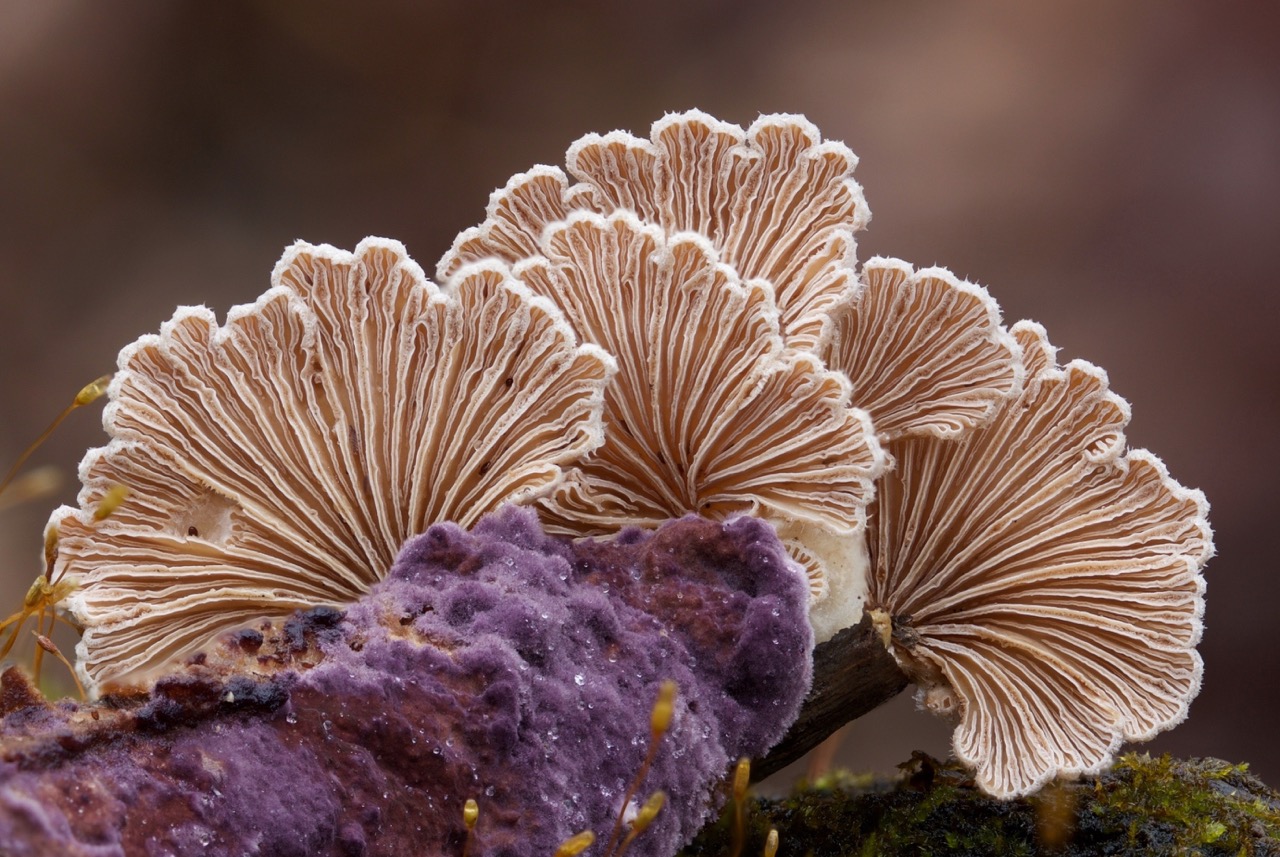
Split Gill (Schizophyllum commune)
The North American Mycological Association (NAMA) annually conducts a photography contest with entries from all over the world.  Here in Springfield we are familiar with Mark Bower's beautiful fungi photographs from his books and the exhibits that have toured the MDC Nature Centers.  He recently received three awards from the NAMA 2016 contest.

Red Raspberry Slime Mold (Tubifera ferruginosa)
The Split Gill (Schizophyllum commune) on the top of the page and the Red Raspberry Slime Mold (Tubifera ferruginosa) immediately above each got honorable mention in the pictorial category.

Aminita the snowman
My personal favorite was the Aminita snowman and the judges must have agreed as they gave him first place in the judge's option category.  It combines technique, art and whimsy.

There were "close to 1000" entries and only 24 awards given so he took home more than his share.  You can see the first through third place winners at this link.

The photographs that he submitted to the contest are all in this Flickr album including another favorite, "Dead Man's Toes."

"Dead Man's Toes" - click to enlarge
Mark's other albums are here on Flickr.

Tuesday, September 20, 2016

Monarch Followup

We recently posted Monarch Watch-out describing the Monarch adventures of Holly Welch and her sons, Ethan 11 and Caleb 13.

I asked for a followup on the family and they put together this show which ends with a video of the premier flight of one of their brood.  This is a great example of citizen science and I suspect will stick with the boys throughout their life.  You can see this very personal journey of two Monarchs and two boys at this link.

Saturday, September 17, 2016

Long-jawed Orbweaver


Long jaws below - Linda Bower
Linda Bower sent me her latest video showing a Long-jawed Orbweaver cutting prey remains out of a web and other behaviors.  The first thing you will notice is that the spider is hanging upside down and moving across a horizontal web. It is taking up and presumably digesting the web material, the ultimate in recycling when she makes her next web.

"My, what big palps you have!"  REK
Long-jawed Orbweavers (LJO), aka Stretch Spiders are members of the Tetragnathidae family.  Their webs are parallel to the water's surface, built on grasses, reeds and other structures.  The design is perfect for capturing their main prey, insects such as mayflies, gnats and midges rising off the surface of the water. 

We previously wrote more details on the LJO including their habit of  "lip-locked" mating in this 2014 blog.

You can see all of Linda Bower's nature video's at this Youtube link.