Wednesday, March 28, 2018

Ephemeral Mayfly


We were standing near the creek when my wife, Barb, started giving me a strange look.  I get a lot of those looks from her but in this case she said, "There is an interesting bug on your hat."  We then did what any Master Naturalists would do, she held my hat while I photographed it.

This was our first mayfly of the season.  There are 6,000 species of them worldwide which make up the order Ephemeroptera.  Surprisingly their closest relatives are dragonflies.  The "ephemer" comes from the Greek "living a day" and that pretty much sums up the life span of the adult, a trait noted as far back as Aristotle.

They come out suddenly in large numbers and tend to occur in swarms just above the water after emerging.  With such a short lifespan they don't waste time eating or drinking but get right to business in the mating game.  It is described like this in Wikipedia.
"Each insect has a characteristic up-and-down pattern of movement; strong wingbeats propel it upwards and forwards with the tail sloping down; when it stops moving its wings, it falls passively with the abdomen tilted upwards. Females fly into these swarms, and mating takes place in the air. A rising male clasps the thorax of a female from below using his front legs bent upwards, and inseminates her. Copulation may last just a few seconds, but occasionally a pair remains in tandem and flutters to the ground."
Mayfly nymph - Tom Murray
The female will then lay 400 to 3,000 eggs on the surface of the water.  After anywhere from a few days to a year, the larvae, called nymphs, will emerge and begin a series of 10-50 moults, more than almost any other order of insects.  It is these critters that we count in our stream team surveys.  The next step toward adulthood gets very interesting.  I will yield to UC Berkeley to describe it.
When it comes time for the last nymph stage to molt into a subimago (the first flying stage), the guts empty out and the mid-gut section fills with air. Often, many nymphs will then simultaneously let go of their hold on their anchor in the water and float up to the top. Once they reach the air, the cuticle splits open on the thorax and the wings come out. This is the time of greatest vulnerability in their lives as they float on the water before they are strong enough to fly. The subimago has short hairs on the wings and on the body; the wings are dull and pigmented.
Once it gains some strength, it flies from the water to some form of shelter such as a tree, long grass, or the underside of a bridge and molts again within 24 to 48 hours. This additional molt to an adult called an imago allows the legs and tails of the insect to grow more. Longer tails give more stability in flight, and longer legs make it easier for the male to grasp the female in mating."
The adult on my hat took off, either headed back to the creek to look for love or else ready to give it up.  The species depends on high volume reproduction for survival as the eggs and larvae are an important link in the food chain.  The eggs are eaten by aquatic snails and caddisfly larvae and the nymphs feed flies, water beetles, fish, frogs, and birds, as well as fly fishing fanatics who will spend more time tying the perfect imitation mayfly than the original does mating.

Prong-gilled mayfly - Linda Bower
Rhithrogena germanica subimago on Equisetum hyemale.jpg
 Equisetum - Richard Bartz CC
Linda Bower MN has this video of a Prong-gilled Mayfly (Leptophlebia intermedia) larva feeding and, of course, her trademark  "pooping."

I am including this March brown mayfly resting on a rough horsetail, Equisetum hyemale, stem, because it is resting on a scouring rush, a plant species coming soon to a blog near you.


Friday, March 23, 2018

Microblog Volvox


Our micro-videographer Linda Bower is producing fantastic videos with her microscope at a rate I will never be able to keep up with.  We will start posting her videos with her comments and a listing of their length under the title Microblog.  I plan to write on topics such as cladocera and water bears when I "get around to it."  And don't bother sending me one, I will have to find the time on my own.

===================
 Volvox birthing 3:50

This Volvox mother colony was found in farm pond water located in the Missouri Ozarks, USA. Guest appearances by Cladocera and a variety of plankton.

New to Volvox? No Linda, Barb and I talk about them every day at breakfast!

Volvox is a genus of some 20 species of freshwater green algae (division Chlorophyta) found worldwide. Volvox form spherical or oval hollow colonies that contain some 500 to 60,000 cells embedded in a gelatinous wall and are often just visible with the naked eye.  Read more here: at Britannica.com's Volvox entry.

Sunday, March 18, 2018

Soused Mouse


Chardonnay de mus

A friend who shall remain unnamed had a half full wine bottle left open on his kitchen cabinet in his cabin for a week.  When he returned he found a mouse floating in the chardonnay quite glassy-eyed.  How he got in there is the big mystery.  Yes it was a male," Barb said, "What else did you expect, probably did it to impress a buddy."

The internal diameter of the bottle neck is 3/4" which looks like a tight fit.  Schwartz's Wild Mammals of Missouri says that a House Mouse,
Mus musculus, can fit through an opening 1/2" in diameter.  The real question I have is how did it climb up the slick glass bottle?  It must have had a powerful thirst!

Unlike the other 12 mouse species listed for Missouri, the House Mouse is an invasive species.  Mus domesticus, western European house mice, and Mus castaneus, southeastern Asian house mice are two of the seven different strains that have adapted quite well to life with humans.  As a group they tend to breed year around, leading to high numbers in our structures.

They are more omnivorous than the native mouse species, adapted to a wide variety of insects as well as our stored and prepared foods, soap, glue, and apparently white wine.  They have a wide variety of predators but most of them don't have access to our structures.  In our creek house, its main threats are the resident Black Rat Snake and Barb.

Mus domesticus, western European house mice, and Mus castaneus, southeastern Asian house miceThey are 
I broke the bottle open as my friend said he didn't want to save the wine.  The mouse was totally pickled and quite relaxed. His next stop is in a flower pot in the garlic field to give insects a chance to clean the skeleton.  A story like that is worth preserving.
Lisa Berger's note:
Bouquet: Notes of 3-day old toast, and pickled mus-kleberries
Mouth feel: Exquisitely full bodied, especially if the mouse is in your first sip

Editor's note:
We have named the mouse George in honor of George, Duke of Clarence who was said to be executed by drowning in a butt of malmsey wine, as it is described in Shakespeare’s play Richard III.  This link describes the controversy over this which I think is confusing with facts a better story.  Long live George, but not in our case.

Friday, March 16, 2018

Leucistic Cardinal

Cardinal of a different color - Andy Schiller
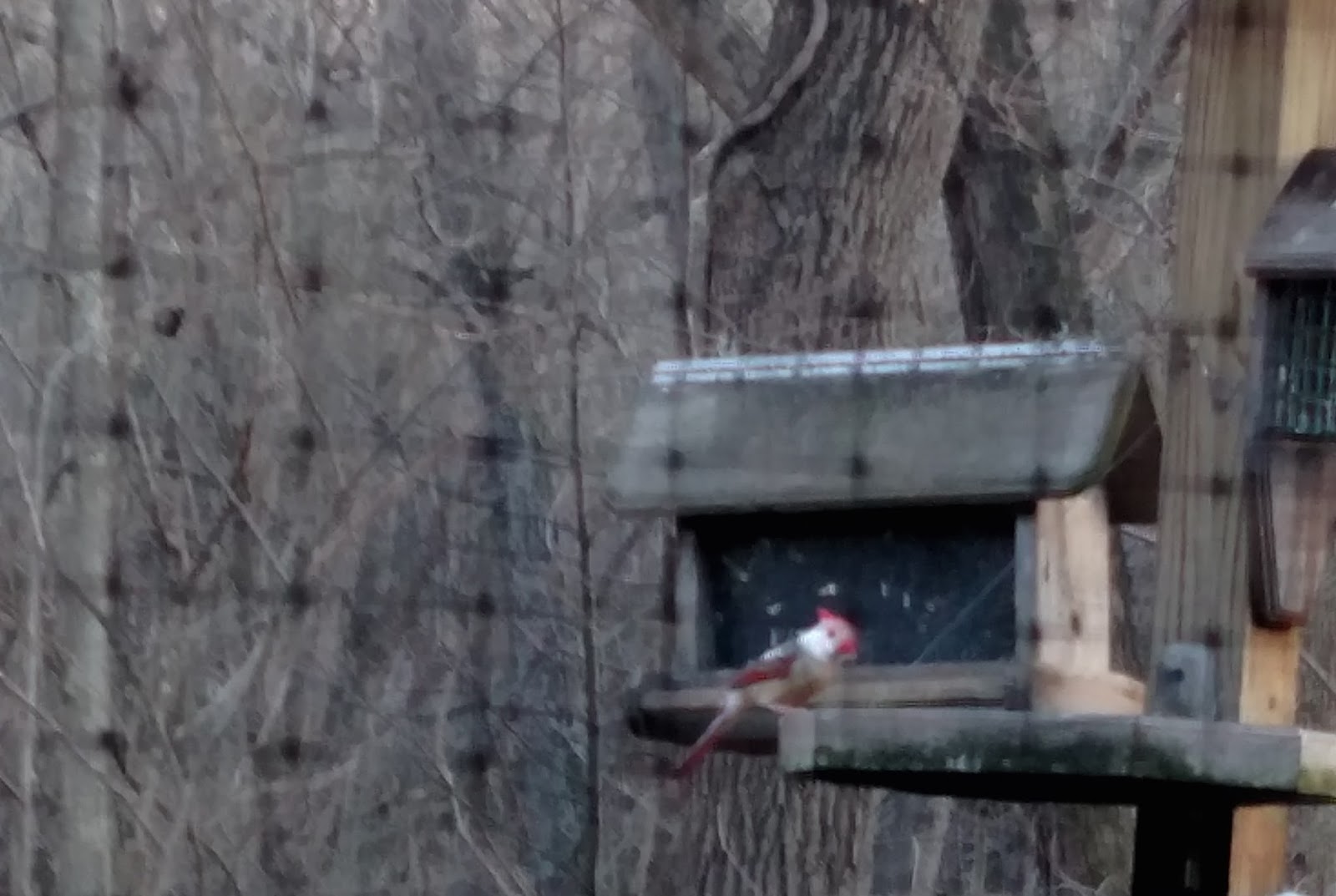
We had a strange visitor hanging around the Stream Team meeting at the Watershed Center Thursday evening.  Andy Schiller spotted it and managed to get a cellphone snapshot.  It was competing with cardinals and chickadees for feeder space, looking somewhat like a cross between a cardinal and a cockatoo.
Same bird earlier - Charley Burwick
I first called it piebald, a common word, better described as leucistic.  While albino is used to describe the total loss of pigmentation, including pale red eyes reflecting the color of blood, leucistic can be various shades from spotty like our friend to nearly complete.  It gets a lot more complicated as described in Sibleyguides.com's Abnormal Coloration in Birds page.

In addition to drawing the attention of birders, leucism has other disadvantages.  Since melanin is structural as well as a pigment, feathers may wear out sooner, affecting flight and temperature control.  The reflection of heat can be a big disadvantage when facing cool spring winds.

Piebald, leucistic, you name it. - Pinterest
The more obvious problem is looking different.  It might affect survival, especially in more camouflaged birds like a sparrow although a male cardinal can hardly be called cryptic.  Attracting a mate may also be a problem in Spring when all the other guys are bright red, although who knows, maybe looking different helps - think of teenagers with tinted hair.

Be on the lookout at Monday's meeting and maybe we will get a chance to see it alive and in color, sort of.
======
3-20-2018 addendum
Dave Shanholtzer shared with me that he was a passionate birder with Greater Ozarks Audubon Society in the 1980s, the lone kid on their field trips.  He had a leucistic cardinal at his backyard feeder that he followed.   This is little David out with GOAS in the 80s and that might be Burwick in the skirt.

Thursday, March 15, 2018

Two Hepaticas

Liverleaf (Hepatica) found by Jill Hays
Jill Hayes was down prowling the creek today with her friend Hannah and sent me pictures of the first hepatica of Spring.  Another common name is liverleaf and both names refer to the deep beef red color of the leaves in winter.  The leaves are three lobed and stand up on a hairy stalk.  As spring warms up the leaves will turn green as it produces chlorophyll to start the new growing season.  The brownish green basal leaves are said to be poisonous and it seems unlikely that they are eaten by mammalian herbivores to any significant extent.

Hepatica leaves green up later in the spring.  Note the hairy stalks - REK
According to the USDA Forest Service link "the flowers are most commonly blue or lavender, although white forms may be common locally, especially in southern areas, and there may be various shades of pink." They too are on a hairy stalk. Missouri is in the southwestern edge of its range.

Liverleaf is also commonly called hepatica because of its previous species name Hepatica nobilis var. obtusa.  That was in the "good old days," but since it was one of the few plant names I knew, they had to change it to Anemone americana to confuse me as rationalized here.

One of the cool things about liverleaf is its propagation.  While it is self-pollinating and doesn't need insects for that step, it depends on ants to move and plant its seeds.  Each seed has an elaiosome, a small, soft appendage that contains fatty nutrition.  Ants pick up the seed and take it home with them, eating their treat while not harming the seed, a process called myrmecochory.  Frequently it ends up in a pile of ant poop, dispersed and fertilized at the same time.

A hepatica of a different color - and family - REK
Liverleaf is not the only hepatica you can see at Bull Mills.  This is Fistulina hepatica, commonly called the beefsteak or oxtongue fungus.  It is a polypore fungus that is primarily saprophytic, growing on tree trunks and stumps, a sign that the tree has seen its better days.  The flesh is soft and when cut or squeezed it exudes a blood like juice.  And no, it is not edible, not that anyone I know would be even tempted.
=====
More on liverleaf is at skymea  dows.info.

Wednesday, March 14, 2018

Timberdoodle Love Song

Timberdoodle - Paco Lyptic
This time of year Timberdoodles (American Woodcocks) pass through Bull Mills on their way north to find nesting sights and wait for the ladies who will follow.  A few years ago we wrote about research several of us participated in to better understand the habitat they choose for their overnight stop.

The Timberdoodle is a fascinating bird and I don't have the words to describe it.....at least not as well than our favorite Bug Lady.  Linger not here, go straight to her description at this Bug of the Week link.

Tuesday, March 13, 2018

Missouri's Smallest Bears

SEM image of Milnesium tardigradum in active state - journal.pone.0045682.g001-2.png
Scanning electron microscope view of a tardigrade - Wikipedia
Linda Bower found some "water bears" (tardigrades) in a spoonful of farm pond water/muck and has been filming their antics. These are tiny, water-dwelling, eight-legged, segmented animals ranging from 0.05 millimeters to 1.2 mm (0.002 to 0.05 inches) long.  From Livescience.com*:
"Tardigrades, often called water bears or moss piglets, are near-microscopic animals with long, plump bodies and scrunched-up heads. They have eight legs, and hands with four to eight claws on each. While strangely cute, these tiny animals are almost indestructible and can even survive in outer space. Tardigrades eat fluid to survive. They suck the juices from algae, lichens and moss. Some species are carnivores and even cannibals."
Their fame comes from their survival skills.  They are among the "Most Likely to Survive" contestants in the case of a catastrophic Earth event such as a massive asteroid strike.  Some of their survival records:
  • 300 degrees Fahrenheit (water boils at 212)
  • -328 degrees Fahrenheit
  • Pressure 6 times greater than the deepest part of the ocean.
More to the point, they are really cute!  Linda says of her recent Youtube video:
 “This footage offers a view of tardigrades moving freely among a variety of plankton. It is fun to watch them walking around underwater although they are too tiny to get much detail with my current equipment. Seeing how they move may help if you are going to try to find them yourself.”
The Livescience posting on tardigrades is an excellent overview of these cute yet indestructible critters including images and video links.