Thursday, August 27, 2020

Scoliid Wasp Week

Blue-winged Scoliid Wasp - Patty Hatcher

Patty Hatcher posted this picture of a blue-winged scoliid wasp on our MN Photos page.  This is Scolia dubia which in this case can be differentiated from the other other Scolia sp. because the yellow spots on segment 3 are sometimes very faint or absent.

I was preparing a blog on the double-banded scoliid wasp, Scolia bincincta which Ben Caruther's had photographed earlier in the month so this is our Scoliid Special.


The Scoliidae family of wasps has 20 species in the US.  According to UF Featured Creatures,

"The family Scoliidae is composed of fairly large, stout-bodied wasps, often brightly patterned in shades of red and yellow, white, or one of these colors in combination with black. These wasps are parasitoids of soil-inhabiting scarab beetle larvae. "

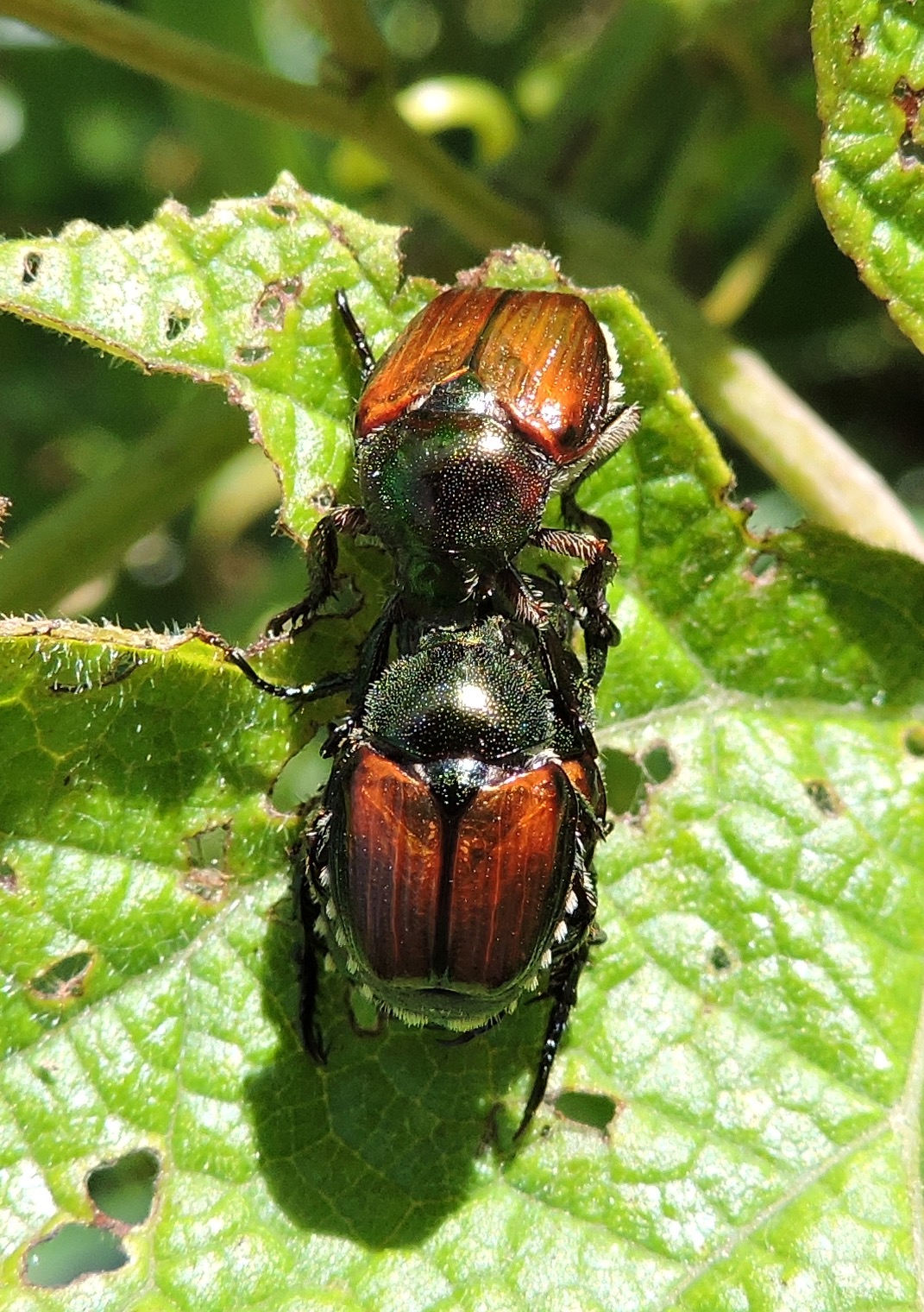
 

Scarab beetles are in a large family with 1400 species to choose from in the US, some of which are shown on this Bugguide link.  There are many common species including the May and June beetles, Hercules beetles, dung beetles and the never popular pesky Japanese beetles.

All have in common grubs that live underground until emerging, sometimes damaging lawns.  In their defense I would point out that they were here 270 million years before the invention of the lawnmower.

The female Scoliid wasp uses her special powers to locate the grub underground, find and sting it into a zombie-like state and lay her egg on it, leaving it buried.  The larva emerges from the egg, feeds on the immobile but living grub for two weeks and then forms its cocoon where it spends the winter.*  When the adult  wasps emerge they consume nectar and pollen, incidentally moving pollen from plant to plant. 

*The whole Scoliid life cycle is described in detail by Bug Eric.

Monday, August 24, 2020

Spider Wasp

Ben Caruthers was able to photograph this wasp and identify it as the Elegant Tarantula Hawk, Pepsis menechma.   Ben reports: 

"I have seen these flying through my yard all summer. They are very wary and difficult to photograph. I had to use my 600mm zoom to capture this one. Those yellow antennae are really eye-catching. I usually spook them from their hunting spot on the ground. I saw this one land and went to grab my camera. It hunts on the ground through the grass. It moves quickly and I never got to see it catch anything."

Like Spiderman, spider wasps have special powers.  They are able to track down and catch spiders including some like wolf spiders that are larger than they are.  They paralyze the spider and haul it off to a nest which they have appropriated from another animal. There they leave it as food for their young.  The adults stick to nectar for fuel, drinking Kool Aid while the kids eat.....Yuck!  You can see all this action in this video.

E. fulvicornis - Wikimedia

Discover Nature also discusses the spider wasp family, Pompilidae.  They mention identifying features found by stretching the hind leg out, something that sounds dangerous to me.  I will stick with photographs and live observation.

"The extra long, spiny hind legs that often dangle downward in flight, and the nervous flicking of the wings are helpful characters for identification at a glance. The spider-hunting behavior, often on the ground, is another strong clue."

There are over 5,000 species of spider wasps world wide.  The Godzilla of them all is the tarantula hawk which we discussed in this 2013 blog.  Schmidt in his now famous pain scale ranked it with the gusto of a food critic as the second worst sting.  We don't have any data on Ben's spider wasp and anxiously await his report on picking one up.

Friday, August 21, 2020

Ants in the Saddle - Part 2

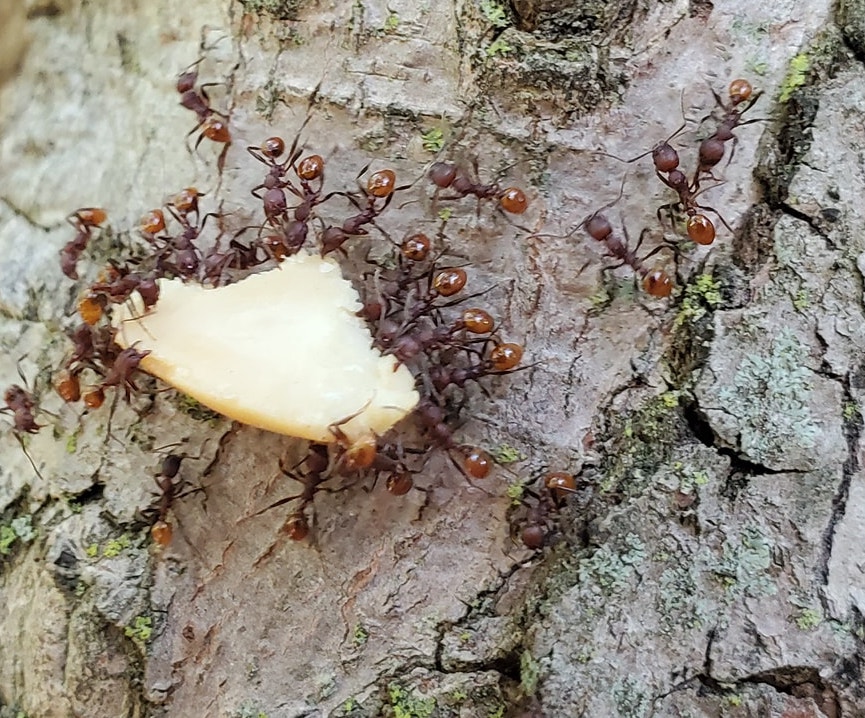
Jean Parker posted several picture of a Dryad's saddle mushroom in her tree, shown in the last blog.  This and a few ants crawling it have made a story that requires two blogs for the telling.  Jean goes on to say, "I look closely and see ants busy taking pieces of it UP the tree. Probably penthouse spoils. They came down from the rotted knot in tree then went to right then up up and far away.   Wow, nature never ceases to amaze."


Most amazing is the little ants measuring 4-5mm are able to work as a coordinated team of 20+ to chew a piece of the fungus from the edge and then haul it up the tree!  It reminds us of the rubber tree in the song High Hopes.

I sent this photograph to James Trager who responded:

"This ant - Aphaenogaster tennesseensis - is omnivorous, though perhaps more predatory-carnivorous than most in its genus. I commonly see them on a variety of recently formed fungal fruiting bodies, and presume they are taking home bits to feed their larvae. I have not actually seen the larvae chewing on mushroom bits given to them by their older sisters, but I'll just bet if you could peer into the brood chamber after the adults bring this material home, that is what you would see."

To illustrate AT's carnivorous side, James sent along a photograph from the St. Louis area of the same species a few days later.  These ants were hauling in a millipede for supper.  This is the underside, a white and no doubt juicy teneral, having just emerged from its molted skin.  Ordinarily it would toughen and develop color over the next few days but this one may not live that long.  Meanwhile some were carrrying a piece of bark up the tree as seen in Jean's video.

Meanwhile, back at the fungus,  Antwiki says A. tennesseensis, "Nests may be in rotting stumps or logs, in standing dead trees, and in dead portions of live trees (Smith 1965). Mature colonies have several hundred to several thousand individuals (Smith 1965). The latter estimate would be unusually high for a species of eastern Aphaenogaster. Foraging is usually on the ground, where the workers collect small arthropods" 

Diving deeper, we hit pay dirt.   Food-webs posted research showing this is a common finding in Aphaenogster sp.

"Previous accounts of fungivory in ants outside these fungal-feeding specialists have been questioned due to whether or not ants consume fungal tissue or prey on mycophagous insect larvae present in or on mushrooms. Here we show that ants in the widespread genus Aphaenogaster recruit to mushroom baits in the field regardless of whether or not mushrooms contained insects upon which ants might prey. When dye-stained mushrooms were provided to colonies in the lab, ants fed on mushroom tissue and dye was visible throughout their digestive tract."

To quote our fellow naturalist Jean, "nature never ceases to amaze."

Thursday, August 20, 2020

#Ants in the Saddle -Part 1


Jean Parker posted several pictures of a Dryad' Saddle mushroom in her tree.  This and a few ants crawling on it have made a story that requires two blogs for the telling.  First Jean's story.

"I had a tree removal service come by to give me a quote to remove a big old silver maple. He showed me how it was rotting by stabbing in a hole with his pen to demonstrate how soft it was. Falling apart.

So....a week later I have a fungi! No doubt in protest to the stabbing. My Seek app says its a Dryad's Saddle. I want Mark proud of me!!  I look closely and see ants busy taking pieces of it UP the tree. Probably penthouse spoils. Wow nature never ceases to amaze."

Dryad's Saddle (Cerioporus squamosus) is a polypore bracket fungus which is well described in this MDC Discover Nature Field Guide.
"This species lives as a network of cells (mycelium) within living trees as a parasite, and dead trees as a saprobe, that digests and decomposes the wood. When ready to reproduce, the mycelium develops the bracket that emerges from the log—this is the reproductive structure. In polypores, spores are produced in the pores beneath and are released to begin new mycelia elsewhere."

This one grew out of a living tree.  In this case it is a parasite, attacking the heartwood of a weakened tree that is dying.  They are often found where branches have been sawed or broken off at the trunk as you see above

Dryads in Greek literature were wood nymphs, specifically the nymphs of oak  trees, though the term has come to be used for all tree nymphs in general.  The saddle shape of this mushroom was felt to be just the right size for a wood nymph.  The Greek gods punished any mortals who harmed trees without first giving gifts to the tree-nymphs.  The god's certainly resented the poking a pen into the tree!  What would be an appropriate gift for a tree god is Greek to me.

Dryad's Saddle-  Wikimedia
Like many other fungi, it is valuable in the woods, decomposing wood.  Just imagine what our woods would look like if fungi didn't start breaking down dead trees - dead tree trunks stacked hundreds of feet high?  This polypore especially likes elms but also works on maples, poplar, willow, beech and ash.
The body can be yellow to brown and has "squamules" or scales on its upper side. On the underside one can see the pores that are characteristic of the genus Polyporus; they are made up of tubes packed together closely. The tubes are between 1 and 12 mm long. The stalk is thick and short, up to 5 cm (2.0 in) long.  -Wikipedia 
Mark Bower

Andy Vernon- Wikimedia


Another common name is "pheasant back". 

The most intriguing part of this mushroom was its odor, a nearly perfect mimic of watermelon rind!  The fresh tender edges are considered edible and Maxine Stone in Mushrooms of Missouri describes a way to turn it in to a mimic of watermelon candy!

Coming next, Ants in the Saddle Part 2


Mushroom-collecting.com has pictures and cooking suggestions.  Never eat any mushroom unless you are absolutely sure of its identification.

Sunday, August 16, 2020

Butternut Woollyworm

 
Along our lane I came across a little walnut with badly chewed leaves and this on a petiole.  I found two others on the underside of leaf remnants, all immobile until I annoyed them.  This is a butternut woolyworm, Eriocampa juglandis.  It is a sawfly, the combined name signalling that it isn't really a "fly."  It is actually a member of the wasp family only with a thicker waist.
 
 
In a closeup side view you can make out the legs on the thorax.  The larva is covered with a white material thought to deter parasitoids and predators and it certainly isn't very appetizing to me. I could find white patches of fluff covering exuviae as they molted but it clings onto the larva unless scrapped away as you see in this video as I annoyed it into action.
 
BWW larva and exuviae

Walnut sphinx moth - Shelly Robertson


The BWW caterpillar-like larvae have a voracious appetite but are picky eaters, only feeding on walnut and hickory.  Walnuts produce a chemical called juglone that is allelopathic and inhibits a lot of competing plants in the vicinity.  It is also a natural insecticide, warding off predators.  Species like the BBW and walnut sphinx moth can detoxify juglone, converting it into a harmless chemical.
 
Sawflies have their own fan club.  Most species are picky eaters with specific plants they use.  They get the "saw" from the female's ovipositor used to insert eggs into the plant tissue.  There is a lot of variation in the organ and how deeply they plant the eggs.  The Bug Lady describes how they use their little saw and create their waxy disguise.


"Females saw into the mid-rib of leaflets and deposit 20 to 30 eggs, one at a time, which eventually causes the leaflet to droop or fold and the midrib to turn pale; and while small larvae chew random holes in leaves, larger ones may finish them off entirely, leaving bits of the larger veins behind.
 
Unadorned larvae hatch in about a week and commence producing waxy, white fronds to adorn themselves. Each molt leaves the feathery skin behind, and the larva must cloak itself anew. Finished growing, they drop to the soil. The pre-pupal larva forms a cocoon in which it overwinters in a state of suspended animation (aestivation), pupating in spring. The cycle is completed when adults emerge in early summer."

The next time you see white bird dropping on a leaf, look a little closer.

Saturday, August 15, 2020

Wren Housekeeping

Richard Locke posted this Youtube video of a wren feeding its chicks which finishes up with the scene above.  Check it out now as we will repeat the final scene below at length.  Then, if the last 5 seconds offend you, close this window.

As a reformed gastroenterologist this was too good an opportunity to pass up.  As you may have guessed by now, this isn't dinner for a chick but the remains of dinner past.  Many of the feeding trips the parents make end in hauling out the waste, the bird equivalent of changing disposable diapers.  Fortunately these are biodegradable disposables.  The very act of eating can stimulate the gut urge to empty.  This is called the gastrocolic reflex in humans and probably something worse in bird language.  If you are still with us, Audubon describes this more scientifically.

"Perhaps you’ve glimpsed the process before: A nestling turns its rear end to mom or dad and ejects a floppy white bag of poop encased in mucous: a fecal sac. The parent then flies away to dispose of it. Or scarfs it down as a snack.

Fecal sacs, which only nestlings produce, are common among passerines like robins, bluebirds, and other “altricial” birds (species that require around-the-clock parental care at birth).   According to Michael Murphy, a biologist at Portland State University and a fecal-sac expert, only a handful of studies have been done on the subject."

OK, maybe not pure science but you get the idea.  Fecal sacs are encased in mucus.  This requires protein which is a valuable resource.  Journey North  has a lot more detail on the sacs to describe the process.  Once the chicks fledge, they stop wasting protein on making the sac and poop freely anywhere they want.

Richard Louv describe the large numbers of caterpillars a chickadee feeds its young every day.  Imagine how deep a pile of feces would pile up in a nest over several days.  The parents hauling out the diapers serves multiple purposes.  The obvious one is hygiene, reducing the material that support bacteria.  Another unproven theory is that it prevents predators from finding the nest by its odor.


If you are still with us, watch this two minute video condensing fecal sac removal by Richard's wren, a phoebe caring for a parasitic cowbird chick,* and a pileated woodpecker. Sometimes the chick actually backs up to the edge of the nest and lets fly over the side.  Occasionally the parent consumes the sac.

So why do the parents sometimes eat the fecal material?  Baby birds' guts don't start with all the bacteria necessary for complete digestion of the food.  There can be a lot of available calories in poop if you hold your nose and birds can't hold their noses but they can reduce the number of hunting trips needed for their own nutrition.  Once the bacteria in the feces build up the parents stop eating it, apparently "a matter of taste."

* The phoebe and cowbird footage is by Linda Bower, skillfully photographing poop once again.

Thursday, August 13, 2020

Odorous ants

3 mm ant on counter

Last month we started to notice a couple of these small black ants exploring our kitchen countertop in Springfield.  Out in nature at the creek we are very tolerant of even this wildlife but this was too much.  We put a few drops of Terro out where they seemed to come in through a window sill.  After a week of taking it home to feed the family, they disappeared.  We sent some photographs to James Trager who provided us an education.

"Those are "odorous house ants" - Tapinoma sessile (Remember to pronounce every vowel in Latin names. )  A very abundant, ecologically catholic (including a wide variety of things; all-embracing), and widely distributed North American "species".  A recent genetic study indicates it has in fact four different geographical-genetic populations that are likely distinct species, but so nearly identical in appearance and habits that no one has yet discerned how to separate them by eye.

They come into my house around now, too, one of the few native ants that remains abundant post invasion of my yard by the Asian pavement ant - Tetramorium tsushimae. In recent years, a colony has daily occupied my mailbox then retreated to the grass below in the evening, during the time of year when daytime air temperatures are higher than those of the soil below, and vice versa at night. " - James Trager

We too have opened the mailbox to find a huge swarm of T. sessile reading our junk mail.  Nests can contain multiple queens and thousands of workers.  For their tiny size they are very rapid, especially when disturbed.  The "odorous" title comes from a smell released from their abdominal glands which has been likened to that of rotten coconut.


T. sessile from Antwiki CC

Antwiki.org ("Every Ant Tells a Story - And Scientists Explain Their Stories Here") is always a great place to start finding information on ants.  They have a huge article on our odorous visitor.  Here is the opening chapter.

"This species is extremely adaptable, nesting in a wide range of sites and being found in numerous habitats. Nests in open soil, under stones and logs or in dead wood, under loose bark, in cavities of plants or in plant galls, under leaves and rubbish piles and even bird nests. The site of the nest is changed often. Nests are populous with size varying with age (from 2,000-10,000 workers) and contain multiple queens. Brood is found in nests from April until September. Reproductives are found in nests from May until October, flights occur in June and July. This species forages singly from trails and are active during both day and night. They tend Homoptera and feed on dead insects or the juices of decaying fruits and vegetables. It is strongly attracted to sweet substances. It is a common house-infesting ant. "  Antwiki

This just shows just how adaptable species like odorous ants, wood rats and recluse spiders can be, learning how to live on society if not in it.