![]() |
| Cross section of a layer of algae just under the surface (cortex) of the fungus. |
Editors note:
In most relationships including lichens, there is a fine line between a parasitic and symbiotic relationship.
Springfield Plateau Chapter of the Missouri Master Naturalist™ is a community based natural resource education and volunteer program. Its purpose is to develop a corps of well-informed volunteers to provide education, outreach and service dedicated to the beneficial management of natural resources and natural areas within their communities for the State of Missouri.
![]() |
| Cross section of a layer of algae just under the surface (cortex) of the fungus. |
Editors note:
In most relationships including lichens, there is a fine line between a parasitic and symbiotic relationship.
![]() |
Our friend Judy Freeman told us about a lightning strike that destroyed a large red oak on the land she and her husband Steve own near Seymour. I contacted our new friend Dr. James Guldin* (a forest ecologist) and we drove out to see it. It was even more impressive than Judy had described. Before going further, review Jim's report on the site at this link.
It was roughly estimated to be 34 inches in diameter. Any estimation would make it well over 120 years old as confirmed by a tree ring count. Standing by the cemetery and the site of historic New Grove School, since then rebuilt, I can only imagine all the stories it could tell.
![]() |
| Click to enlarge |
The other most impressive debris was this piece impaled 16" into the ground, 345 feet from the tree site! The angle gives some idea of its direction and altitude. The dark area was underground.
![]() |
| Judy and Jim |
This led me into a deep dive into lightning effects on a tree, and the results were truly shocking! (Sorry) First take a look at my video compilation of some strikes available on the web.
A lightning strike can carry 100 million volts and reach 5 miles long. It can produce instantaneous temperatures in excess of 50,000 degrees Fahrenheit. The science behind the various types of lightning and its effects is complex and beyond the limits of this blog (and its blogger). This Wikipedia link summarizes a lot of the lightning science
The effect lightning has on a tree has a lot to do with the conditions. If the bark is wet from rain, the strike may travel over the bark, not producing visible damage. In the first example in the video above the current passed down through the xylem and phloem, the vascular system under the bark. Since the sap is a poor conductor, it rapidly boils, producing the explosion of bark. I suspect that in Judy's case, the tree had moisture in the trunk. This would allow the instantly boiling liquids to expand dramatically, exploding the tree.
My parents told me 70+ years ago to never stand under or around a tree in a thunderstorm but apparently this isn't common knowledge. Lightning spreading through the soil around the tree base can pass through the a person's legs, up one and down the other causing collapse or worse. If you are preparing to be struck by lightning, hold your legs together Who knew! This dramatic video demonstrates what happens if you violate these rules.
Finally, if you haven't seen enough, here is video of dramatic strikes captured by a lightning aficionado. Lightning struck a tree on the ridge above Bull Creek last fall which you can see here.
________________________________________________________________Thanks to Judy Freeman for sharing this amazing story with us.
![]() |
| Becky Swearingen |
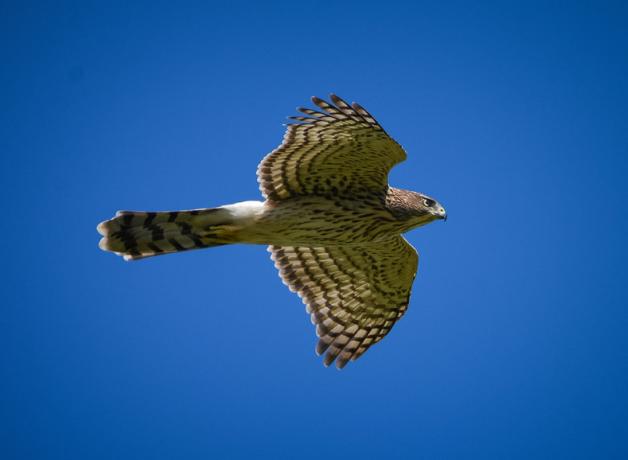
In our last blog we discussed the virtues of native plants in an urban yard which attract a large variety of birds during winter. This apparently came to the notice of a Cooper's hawk that appeared soon after the blog was published. Here is where it flew off to a neighbor's tree above our yard to keep an eye on the feeders.
This hawk isn't here for the veggies. As a strict carnivore, it is looking for meat with feathers. Although they are commonly thought of as a bird specialist, they will also feast on rodents and other small mammals. Many other birds of prey dispatch their prey with their beaks. For example falcons tend to kill their prey by biting it. This hawk has a different method. A Cooper's hawk captures a bird with its feet, holding it in front of its body and kills it by repeated squeezing. They’ve even been known to drown their prey, holding a bird underwater until it stopped moving.

Jen Goellnitz CC-Becky
This video discusses their feeding techniques and the dangers faced when flying in among branches of trees. "In a study of more than 300 Cooper’s hawk skeletons, 23 percent showed old, healed-over fractures in the bones of the chest, especially of the furcula, or wishbone." Cornell Lab's All About Birds
Initially Cooper's were birds in the wild but like we humans, they have become urbanized, likely giving up rural life for good hunting. In our open back yard, birds can see for a hundred feet in all directions so a hawk has clear sailing but a challenge to sneak up on a bird. They would be welcome to a few of the 30-40 starlings that descend on our feeders frequently, but they tend to flush in a confusing mass that even startles our guard dog Duke when I send him out after them.
You can watch a Cooper's in action at feeders in a closed yard at this Youtube link.
Cornell Lab's All About Birds has a lot more details on the subject. Thanks also to Lisa Berger and Becky Swearingen.
![]() |
| Hermit Thrush |
Looking out on our backyard I could watch robins, cardinals, bluejays, wrens, doves, house finches and sparrows taking turns at the heated birdbath. Barb has created an island of 100 native plant species in a neighborhood sea of sterile mowed yards. While the plants are barren except dried seed heads which the finches feast on, they still provide a degree of shelter while waiting their turn at the feeder
As we tell the WOLF students, "Everything has to survive winter.....or else..." Whether by hibernation, migration or adaptation, every living thing has to survive winter or go extinct. Our migrants have already left for their southern vacation and the only bird that hibernates is the Common Poorwill which doesn't live in Missouri. That leaves the hearty adapters that we see around our feeders.
Although several sources say the Poorwill hibernates, it actually goes into torpor. Three things differentiate hibernation from torpor. Hibernation is voluntary, is driven by shorter daylight hours, and waking up can take hours and use a lot of energy. Torpor is involuntary, and results from falling temperatures (regardless of daylight hours), and the animal wakes rapidly by shivering, which expends energy, but conserves a lot more than hibernators use.
There are things that we advanced bipeds can do to increase their odds, improving their quality of life and benefiting from watching them in winter. You can keep water sources open, provide higher energy feeds (suet, black oil sunflower, shelled peanuts, etc.), and maybe leave a little extra on the ground for squirrels if using squirrel “proof” feeders.
![]() |
| Photo - Steve Martin |
![]() |
| Teeth marks- click to enlarge |
Down on Bull Creek it is time to hang up the feeders again. A bear on our deck reminded us this year that we hung up our feeders a little too early. It tore down a feeder hanging on a wire five feet above the deck, leaving its tooth prints as dents in the hard plastic. Now that Bruno is hibernating, or at least doing the intermittent Missouri version, it is time to hang them out again.
On our deck above the creek a lot of other critters don't understand the "bird" part of bird feeder. We have a special squirrel feeder with a spring bar that closes the feeder when any weight is on it. The squirrels have learned to put a paw in first to keep it open while they gorge. For a while we had a battery operated feeder that was supposed to give a little shock to a squirrel. I took it down before these smart little rodents could run a wire out to an nearby drey for lighting.
My favorite visitor was this opossum. I was able to walk out on the deck and get within two feet of it for closeup photos before it turned around and got back to business licking the suet feeder.
Bill Bryson says: "Life just wants to be." Lets help it all the way up and down the food chain.
I received a gift of owl pellets from Ben Caruthers. While this might not excite you, it got a rousing welcome from our friends in the 5th grade WOLF School. I asked Ben for the backstory.
"The barn is on a cattle ranch where my father-in-law works as a cowboy. I asked the owner if I could place an owl nest box in the old barn. I had not seen any sign of an owl. This was just in the hopes that an owl would find the box and nest there. At the same time I placed a trail camera to monitor any bird activity. It took two years, but the barn owls finally showed up."
The most recent check I made of the owl box I got to see the barn owl above in person. It flew right over the top of my head!"
=========================================
Ben collected over one hundred owl pellets on the floor of the barn below the nest box and from two other cross beam perch areas. He delivered them to me separated in paper egg cartons. Note to self - don't eat any eggs shared by Ben. The contents were dry for months and some had been cleaned by some clothing moth larvae described in this previous blog.
Barn owls are carnivores, specializing in mice, moles, voles and birds. Since they swallow their prey whole, passage of bones through the intestine is impossible. Even the thought of that hurts! The food bolus goes first into a glandular stomach for digesting with enzymes, acids and mucus. Next, on to the muscular stomach (gizzard) where it is mechanically mashed up and the digestible portion move down the tract. Fur, bones, teeth and feathers are retained until they are hungry later when they will be compressed into a "pellet" pushed out.*
By now, I am sure you are anxious to see what is in a pellet. The photo above is a single pellet which also had some leg bones, ribs, etc. With the charts below* you can begin to determine which rodents passed on (or in this case passed up) after encountering an owl. Biologist can even survey rodent populations by studying the pellets in the area.
______________________________________________________________
* Hungry for more details? Check out this World of Owl site. More on studying owl pellets is at this site. A key to identification is here.
This is a vicarious two-part digital field trip to Rocky Barrens Conservation Area with Kevin Firth and Chris Barnhart. This find led me and the WOLFs on a deep dive.
They photographed this cute little creature which has the typical features of a scorpion, immediately recognizable to most of us who have never seen one in the wild. It has a long tail with a stinger curved over the body and large pincers in front like a beached crayfish.
This is a striped bark scorpion, Centruroides vittatus, the most common and widely distributed scorpion species in the US. MDC says "This is the only species of scorpion in Missouri. It occurs in glades and other dry, warm, rocky areas, and sometimes in buildings and shelters and under piles of wood, brush, or garbage."
Scorpions are arachnids like the ever popular spiders, ticks and mites.They all have an exoskeleton and 8 legs unlike the insects' 6 legs. They also have a pair of chelicerae for feeding and defense and a pair of multipurpose pedipalps.
They consume soft-bodied prey such as spiders, cockroaches, ants, crickets, beetles,
and butterflies. Grabbing the prey with their pincers, they sometimes use
their stinger to subdue it.
The tail and stinger was familiar to me from childhood where every cowboy worth his saddle would encounter them in the movie westerns. Although they had a deadly reputation on film only 25 of the 2,500 known species have venom capable of killing a human. Usually a sting is mild although allergic reactions can cause more severe problems. Mexico on the other hand is one of the most affected countries, with the highest biodiversity of scorpions in the world, some 200,000 envenomations per year and at least 300 deaths.*
I enjoy Fun Facts just like my 5th grade WOLF School colleagues. Here are a few:
Thanks to Kevin and Chris for the glade trip. We hope to tag along again sometime.
Chris Barnhart was hiking Rocky Barrens Conservation Area with Kevin Firth when he got these pictures of a tarantula. Kevin goes there regularly to check on burrows that hold them, knowing which rocks to lift up where they are hiding.
This is the Texas brown tarantula (TBT) Aphonopelma hentzi. There are over 900 tarantula species world wide. The MDC website says it is the largest spider in Missouri and the only species of tarantula found in Missouri versus 50 species in the US, mostly in the southwest. The female's body length averages 2" so you can imagine the length of the legs above.
![]() |
| Tarantula in hole to left, note silk lining |
Our TBT spends its days in its silk lined hole, predominately on rocky barren glades. They use holes created by rodents and reptiles and provide their own lining. Emerging at night to hunt, they predominately feed on crickets which they paralyze with venom, then chew while mixing their digestive juices with it before slurping up the liquid dinner.
After mating, the male pushes away vigorously, at times even causing her to fall on her back. He is avoiding the female's attack as he is no longer useful except as dinner where he would be nourishing his future offspring. He doesn't live long after that anyway so she likely considers him disposable.
She will lay out a sheet of silk and deposit her eggs with a nutritious fluid. She then guards the egg sac and even moves it to maintain the best temperature. Some tarantula species carry their egg sac for three months before the eggs hatch into the post embryo stage. They remain in that sac that Cowels describes in Amazing Arachnids as "eggs with legs." Once they absorb the rest of the egg juice they proceed to molt many times as they grow to adulthood.
Like all other arthropods, molting consists of growing a new larger cuticle under the old, then splitting out of the old outer coat with enzymes that break it down. Molting also renews the inner surfaces, such as the mouth, as well as external and for a period of time they can't eat during each molt. They are also softer and more vulnerable during this time. The good news is that with molting they can regrow a damaged or missing leg.
![]() |
| Fishing for a tarantula with grass |
Kevin was able to draw this tarantula out with a strand of grass. It grabbed on and he could slowly pull it out. This requires some patience as their bodies are somewhat fragile. They are covered with urticating barbed hairs that are stinging or irritating to the skin. Some species can shake these loose when irritated and inhaling them can be dangerous so don't make a habit of sniffing a tarantula.
They are slow moving and near-sighted. They sense the world largely through vibrations felt in another type of hair on their legs. To escape they can move more rapidly but not with accuracy. Many species are able to make sounds by rubbing their hairs on their legs together, called stridulation similar to crickets and some other insects.
*Fun fact. Female TBT have been known to live 30 years. Chris raised one as a pet for 10 years early in his marriage to the ever-patient Deb.
_________________________________________________________________
This is a vicarious two-part digital field trip to Rocky Barrens Conservation Area with Kevin Firth and Chris Barnhart. Next up, the Striped Bark Scorpion Centruroides vittatus.