Wednesday, August 31, 2016

Black Swallowtail Paint Job

r
Black Swallowtail - Chris Barnhart
Amy Tyndall brought this beauty into the Butterfly House for identification.  It probably is familiar to some of you Butterfly House docents and lepidopterophiles but just looks a little off.  Chris Barnhart identified it as an aberrant Black Swallowtail (BS), Papilio polyxenes asterius.  It looks like an chemically impaired painter did the markings.  Lets compare them to the normal BS (pardon the abbreviation.)

Aberrant Male BS- dorsal view
Male Black Swallowtail - Donald Hall


All of the yellow decorations on the male on the left are blurry on the upper medial portion and frankly smeared into lines along the trailing edges.

Aberrant ventral view -CB
Normal ventral - Donald Hall

The ventral view above shows that the genetic painter hadn't sobered up yet when it turned the butterfly over.  Notice again that the discrete orange decorations are smeared as well as the white decorations on the wing and even the swallow tail.

Aberrant butterflies can occur with extreme stress or nonlethal damage within the chrysalis.  Consistent color changes in a small isolated breeding population can lead to distinctive "forms" as a result of persistent inbreeding.

The Monarch page of Butterflyfunfacts.com has pictures of aberrant Monarchs found in the breeding stock at Shady Oak Butterfly Farm.  The mating of a normal and an aberrant produced a few aberrants.  Two aberrants monarchs breeding produced all aberrants.  This fun fact serves to illustrate just one of the dangers of inbreeding in commercially raised populations.  For this reason we discourage the release of commercially propagated butterflies by well-meaning people at the Roston Butterfly House.

Monday, August 29, 2016

Soil Centipede


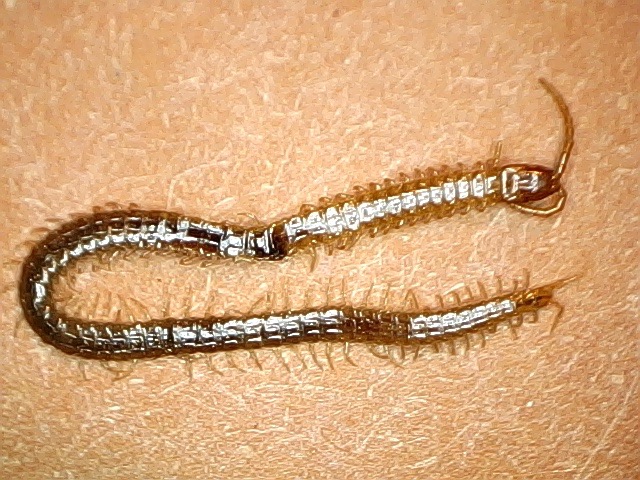
No insect is safe from capture now that the WOLF School is back in session.  At our first meeting today there were cicada, bagworms and this tiny centipede which McKenna brought in from a recess hunt.  It was 3" long and very delicate.

It moved slowly like a millipede but without the wavelike motion of the legs.  Without magnification I couldn't tell if there was one or two pair of legs per segment.  We talked about the difference between millipedes (two pair of legs per segment) and centipedes (one pair of legs per segment.)  This is a soil centipede in the order Geophilomorpha.  There are 1,100 species identified world wide.

Geophilomorpha (GM) are extremely skinny, an important trait for a centipede hunting through narrow spaces in the ground substrate.  This order has species with 27 to 191 pairs of legs - our specimen has 56 pairs.  Unlike other centipedes that are built for speed, they move slowly through the soil by their legs and their ability to contract and elongate the body like the earthworms they hunt.

Fangs and antennae with 14 segments - REK
Back legs are antennae!
Like all other centipedes they are predators, eating earthworms, snails and small arthropods.  They lack eyes which would be worthless underground anyway.  They "see" the world through their antennae which are in 14 segments.  Their back legs are modified into antennae as well.

Earthworms are GM's specialty, captured with their fangs that inject venom.  They chew them up with small mandibles which have ducts secreting digestive juices, its enzymes digesting the food before taking it in.  If that sounds disgusting, recall that they are eating a worm.

Dorsal view of eyeless head
Their underground courtship begins with mutual tapping of antennae.  The female guards her eggs in the soil until the miniature GMs appear, looking just like the adults that they will become after several morphs.

 More details are at lucidcentral.org.

Tuesday, August 23, 2016

Cloudless Sulfur Migration

Cloudless Sulfur - Bob Moul
In recent weeks we have been seeing a sulfur butterfly, larger than the usual varieties of small yellow sulfur butterflies flitting around our plantings.  This is the Cloudless Sulfur, a visitor that migrates to Missouri and neighboring states from the south in late summer.

When it comes to insect migration, we think of the dramatic Monarch migration, one of the wonders of nature.  Dragonflies like the Green Darner can sometimes be seen migrating in dramatic numbers.  There are however a lot of other smaller scale migrations that are so subtle they are often overlooked.  Most migrations of insects are noted by the appearance of seasonal increases in a regional population.

The Cloudless breed continuously in the tropics and twice a year in the southern US.  Some migrate north as far as Canada in middle summer where they find the warmth they need.  They feed on woody and herbaceous legumes which span from alfalfa and soybeans to the leaves of black locust.  Whether they are driven to migrate north by host plant availability or by temperature gradient is known only by the butterflies and they aren't talking.

The migration of Monarchs tends to occur at higher altitudes while the Cloudless travel in a zone from within 10 feet of ground level.  When they encounter a house or some other obstacle they tend to fly over it rather than temporarily change direction.* 

Cloudless survive the winter as adults and they don't tolerate cold.  In the fall, large numbers move south in response to cooling temperatures.  Those that chose not to go or take off too late will mostly perish.

The Cloudless sulfur, Phoebis sennae, looks superficially like other sulfur butterflies in its usual wing folded position.  The underside of the wings is between a yellow to pale green color with two small silver spots and a black rim on the hind wing which defy the naked eye when they are resting.

Dogface Sulfur - REK
Clouded Sulfur - Wikimedia


The upper wing surface is easier to identify but virtually impossible to photograph without capturing the insect.  The above chilled and released Southern Dogface shows its namesake and the Clouded Sulfur has "clouds" on the dorsal wing edges.  The Cloudless shows the clouds are gone.
 Cloudless Sulfur - ColtonEnto
The caterpillars are usually light green with a yellow stripe on the sides.  If they feed on a host plant's yellow flowers they are yellow with transverse black bands in later instars.

  Terry Schiff CC
  Sue Carnahan CC


Many other lepidoptera migrate including the Red Admiral, Common Buckeye, American Lady and the colorful Alianthus Webworm Moth.

* More details of Cloudless Sulfurs and their migration is at this University of Florida Entomology site.

Friday, August 19, 2016

Dog Bane

Silvery Checkerspot on early dogbane blossoms - REK
There are scattered patches of dogbane in our grassland, a species that most true farmers would consider a weed and try to kill but we save it for fiber.  Its scientific name is Apocynum cannabinum, the Apocynum meaning "poisonous to dogs," hence the bane of dogs.  It can also be toxic to cattle so we hay around the patches.

Milky latex
Its reddish stems ooze a white milky latex which can cause skin blisters. It is described as bitter tasting (there is always someone to try tasting) and contains cardiotoxic glycosides, the same family of chemicals as digitalis.  The roots had been used therapeutically in the past to treat heart failure.  With its bad taste, only a desperate horse or cow would continue eating it, but 15-30 grams of dried leaves reportedly will kill one.

Dogbane grows freely in fields and open areas, prefers moisture but is thriving on our upper hayfield.  The "cannabinum" might stir excitement in a lawman's heart but it comes from Cannabis as a fiber plant like hemp, and fiber is one reason why we protect it, but more on that later.


Spittlebug home - REK
There are a lot of insect associations with dogbane which add diversity to our otherwise boring fescue and Johnsongrass fields.  In spite of its toxicity, spittle bugs seem to love dogbane.

During the early summer most of the dark red stems have a little bit of drool concealing a tiny green bug, butt up in the air, blowing froth of dilute digested xylem out its rectum.  If you set aside the yuck factor and wipe away the bubbles, the little guys are actually cute!  These are the nymphs of froghoppers, little athletes capable of hopping 2 feet in the air.  They are well worth the blog focused on them alone.


Spittlebug exposed - REK


The broad head of flowers attracts a wide variety of pollinators including bees, flower flies, wasps, butterflies and moths.  The USDA/ NRCS ranks its value to pollinators as "very high."  Pennsylvania leatherwings (Chauliognathus pensylvanicus) are attracted to their pollen and their larvae attack many other insects.  Tachinid flies visit the flowers and lay their eggs on stinkbugs, Japanese beetles and other pests where their larvae grow up eating inside them until they die or at least don't reproduce.  Birds even use the fibrous fluff of the seeds for nesting material.

Milkweed is in the dogbane family (Apocynaceae), and a variety of "milkweed" insects visit ogbane as well.  Small milkweed bugs (Lygaeus kalmii) are attracted to them.  Dogbane is a host plant for several caterpillars including our beloved snowberry clearwing moths that mimic hummingbirds, nectaring without touching down.  Monarchs nectar on the flowers but their caterpillars can't survive by feeding on the plant.
Dogbane Beetle
I have left out one of the best for last, the dogbane beetle.  This gem literally changes color depending on the angle of the light, its metallic green sheen blending into gold and all shades in between.  According to Illinois State Museum:
"Chrysochus auratus iridescence "changes color because of stacks of tiny slanting plates, under which is a pigment.  Some light rays reflect from the surface of the plates, and other light rays reflect from the pigment underneath. At different angles, the light reflects at different speeds, causing interference and resulting in our seeing different colors that shine."
The eggs are laid in the soil or on the plant and the larvae tunnel in the soil to feed on dogbane or milkweed roots.  The adults are able to defend themselves by giving off a foul odor like many other beetles.  The best approach to them is to photograph them and enjoy them at a distance.

Colors we can't reproduce -  Nature Web
Dogbane cordage - REK
Ah yes, the fiber!  Hemp dogbane has been used for cordage by Native Americans for at least several thousand years.  The individual fibers that are found under the dry bark in the fall are stronger than cotton of the same size and found multiple uses from bowstrings to sandal soles.  Primitive skills instructors demonstrate the process at the Nature Center each year and you can learn to make your own cordage at this site.  We will be harvesting the dogbane this fall for the Wonders of Wildlife classes.

Wednesday, August 17, 2016

Thread-waist Wasp

Thread-waist wasp - Eremnophila aureonotata - REK
Silver-white shoulder patches
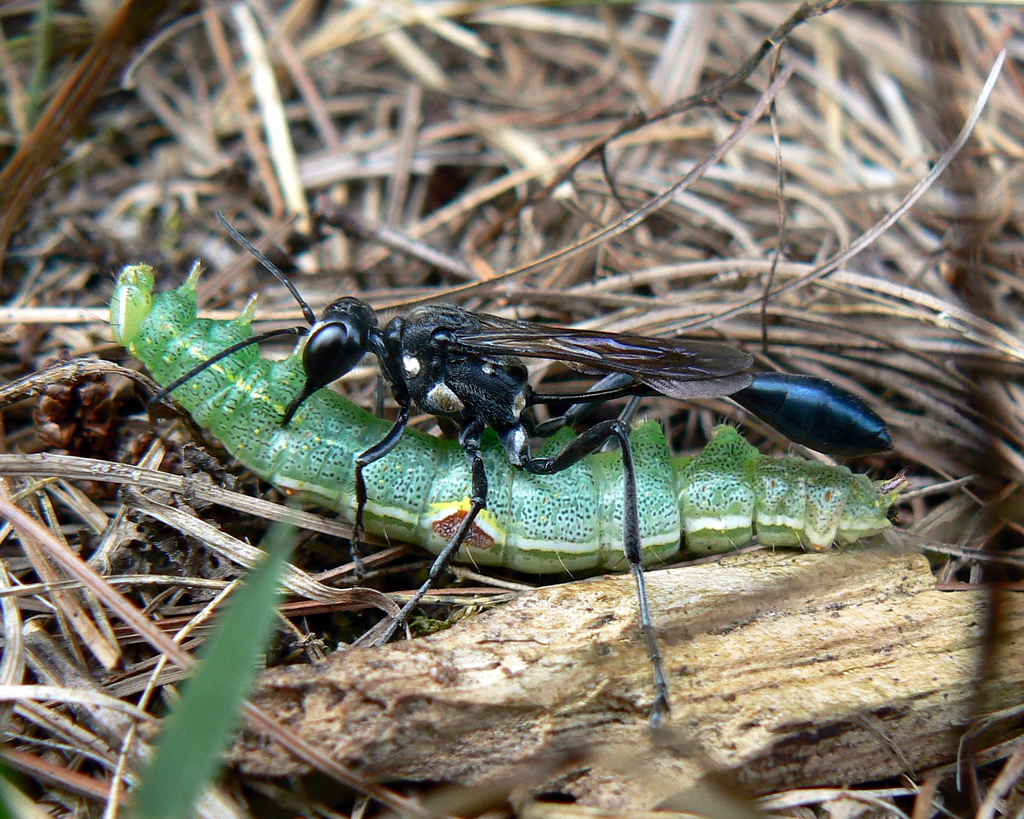
I watched this dainty insect flying slowly around at knee height for some time.  Finally it got tired of looking around and landed on the deck to rest. The long thin stalked abdomen put it in the Sphecidae family of Thread-waist wasps.  The silver-white patches on the side of the thorax is diagnostic of the genus Eremnophilia. and Eremnophila aureonotata is the only species north of Mexico.

Satellite fly - Patrick Coin
This species is commonly found in old fields near woodlands.  Adults feed on nectar while the larvae are fed moth and skipper caterpillars.  The female digs a burrow, places an egg in it and delivers a large caterpillar, a long term provision.  Some satellite flies commonly follow them, sneaking in to lay their eggs on the caterpillar.

Capturing a Notodontidae Moth caterpillar - Benny Mazur CC
I was fortunate this specimen landed on our deck for pictures.  Many of the online photographs are of mating couples on large flower heads such as Queen Anne's Lace, both slowing them down and getting them at camera height.  Rather than nibbling on her ear, the male grasps the female's neck with his mandibles and hangs on.

"This won't hurt much" - Grasping the female's neck -  Tam Stewart

Monday, August 15, 2016

Fuzzy Orange Galls


Callirhytis furva - R. Curtis
I found a few of these galls on a bur oak leaf.  A photograph online identified them as Spiny Oak galls and said they were caused by a Cynipid wasp, Acraspis prinoides,but nothing else was available on it.  Another white oak leaf gall that might be confused with it is produced by Callirhytis furva, but this one is more hairy than spiky.

 Acraspis erinacei - Charley Eiseman
I would have described them as hedgehog galls so on a whim I searched that name and hit the jackpot.  Charley Eiseman, who has literally written the book on galls and other signs* as usual had  described my gall on Bugguide.   He identified the Hedgehog Gall Wasp as Acraspis erinacei and even had a photograph of the wasp.


The life cycle is a bit complicated.  The process begins when a fertilized female lays eggs on an oak leaf.  The hatchlings cause some damage and the leaf responds by creating the gall around them. The gall contains three to five larval cells, each holding a female that will emerge in the fall and lay eggs on leaf buds without mating.  After being exposed all winter, the larvae stimulate other galls, and adult males and females will emerge to mate and start the cycle over again.

The gall looks delicate but don't let that fool you.  Cutting through one with a razor blade requires a lot of pressure.  What you see is below.
Opened gall- REK

Gall larva with toothpick - REK


*  Tracks and Signs of Insects and Other Invertebrates: A Guide to North American Species

Thursday, August 11, 2016

Ganoderma On Our Roots


I generally like to see various fungi on the ground but this is not one of them, especially when it is in our front yard.  We had a large native thorn-less honeylocust tree when we moved into our new house in 1973.  Over the years it has provided shade and served as a perch for many different birds.  Now these are appearing on the exposed roots.

Mark Bower confirmed that this is Ganoderma sessile, a parasitic fungus on hardwoods.  Species names get dicey as they frequently change or get reassigned by DNA.  As some have suggested, naming a new species is frequently making a species hypothesis.  In this case a related species Ganoderma curtisii looks somewhat like it.

Ganoderma fungi are white-rot saprophytes living on dead organic material in the soil.  They produce enzymes that digest lignin and cellulose that provide the structural strength of wood.  When it encounters cut or damaged roots it can parasitize the living tree, its hyphae spreading through the roots.  When it gains a sufficient spread it is ready to reproduce, creating its "flower," the mushroom that will produce spores, its method of spreading to other areas.

Our tree has been struggling in its urban setting for years  It was growing on a thin layer of soil before we came, its roots extending well beyond the diameter of the crown.  First the street and then our house and driveway construction constrained the root expansion.  Next a sweetgum was planted to the south that slowly encroached on its sun.  It grew anyway, loyally providing afternoon shade to the house.

Ganoderma - Mole's eye view
The thin layer of added topsoil supported a lawn but provided no depth for growth of the feeder roots.  They reached the surface 20 years ago where they were occasionally scarred by lawnmowers.  This likely provided the entrance wounds for Ganoderma to attack the roots.

Shallow soil, uprooted trees
In recent years the tree started to lose branches.  Ganoderma will also spread into the structural roots that hold the tree upright.  Our locust tree is plagued with rocks and shallow, poorly drained clay soil that prevents deep root penetration any way, increasing the risk of uprooting in a storm.  Now our arborist, Chris, has delivered the "last rites."

The tree shaded us for over 40 years, reducing air conditioning bills and providing a refuge for squirrels.  Now with the tree gone, Ganoderma will continue its role of saprophyte, converting the remaining roots into soil nutrients to feed the tree we will be planting soon.