Showing posts sorted by relevance for query spittlebug. Sort by date Show all posts

Sunday, July 21, 2019

Two-lined Spittlebug

 Our Master Naturalist Mothing last Friday included lots of non-moths like this Two-lined Spittlebug, Prosapia bicincta.  It is really a beauty as bugs go, spittlebug but it retains the spittlebug name because of its misspent youthful habits.  You probably have seen hundreds in their childhood.


Home sweet home.
Spittlebug are common in grasslands.  As all true bugs in the Order Hemiptera, they have sucking mouth parts to extract juice from grasses.  Most people have seen the signs of them but few have bothered to search out the bug, a somewhat distasteful endeavor, so  I will save you the time and the mess.

"No spit!  I really feel naked."
Spittlebugs that we find are actually the nymphs of froghoppers, in the order Hemiptera, a diverse group that includes shield bugs, planthoppers, leaf hoppers, aphids and cicadas.  Froghoppers leap from plant to plant with amazing agility, with some jumping over 2 feet straight up.  They resemble treehoppers with minor differences that only an entomologist or another froghopper would notice.
Prosapia bicincta Kaldari.jpg
Two-lined spittlebug - Wikimedia- Kaldari
Many adult froghoppers can "bleed" from their tarsi (distal legs), exuding a hemolymph that is distasteful.  It is likely that their bright color as seen above send that warning message to predators considering a snack.  The adults feed on the underside of hollies.

Meanwhile back to the nymphs who are covered with froth like you might find on top of a fine ale.  You don't want to know where it comes from, but here I go anyway.  The nymphs always feed head down, an important skill if you want to cover your body from the end that is up.  They feed on sap which they pump through their intestine and out the anus at a rapid rate.  It is said to have an acrid taste, protecting them from predators.  As far as I know, the scientists who reported this have never tasting it.  To me it was tastless, but then Barb has always said I have no taste.
Feeding head down on the stalk
Now the froth.  It is thought to protect the nymphs from dehydration, heat and cold, and to hide them from predators.  In addition to housing several larvae, a glob of spittle may hold an inquiline species, another species that lives in there without contributing or harming the spittlebugs.
Stenotus binotatus
Stenotus binotatus


Wiping spittle on one blade of grass below, I uncovered several spittlebugs and a common plant bug, Stenotus binotatus.  This is a European invasive species that feeds on grasses and can be a pest on wheat.  There are no reports of it in association with spittlebugs, so it may have just been passing through.

How to explain the bubbles?  Here is one possible explanation from Northernwoodlands.org.
"The bug feeds standing on its head and excretes excess fluid from its anus. This fluid runs down and coats the spittle bug’s body. Specialized glands mix in mucilaginous compounds that increase the viscosity of the fluid and also stabilize the bubbles.  The nymph sucks air into its abdominal breathing tube and then forces it out to blow bubbles while pumping its abdomen up and down. As bubbles form, it uses its legs to pull the froth over its body. Safe within this foamy bath, the nymph grows and molts a few times, finally emerging as an adult. "
I find it interesting that the larva is sucking up xylem, the fluid coming up from the roots, delivering minerals like nitrogen incorporated in amino acids. The fluid is more dilute and not as nutrient rich as the phloem (memory tip: phloem=food flowing down) that is coming down from the leaves with nutrients to feed the roots. The larva must process lots of fluid to obtain its nutrition, expelling it continually. Some evidence suggests that they preferentially feed on legumes and nitrogen fixing grasses. Certainly it means the nymph has to suck a lot of lymph to get its nutrition. No wonder it is pushing it all out quickly!

The head down feeding is important in getting the foam to cover up the nymph.    I suspect that predators know they are all hiding in there but have heard the reports above of the acrid taste and don't bother trying. 
=========
Research in May 2020 identified 2 bacteria that spittlebugs carry that allows them to get enough nutrition from watery sap alone to survivie.

Monday, July 15, 2019

Spittlebug on a Macbook

Red cedar spittlebug - note red spot
I was working on a blog early on a cool morning, listening to the hummingbirds feeding overhead when a small dot began moving across the screen of my Macbook like an oversized period.  After enlarging a series of photographs I identified it with the help of Bugguide as a red cedar spittlebug (RCS), Clastoptera arborina.  We have written a blog on spittlebugs in their larval nymph stage, blowing bubbles out their you-know-what.

Even with my lack of entomological training, I deduced that this species is associated with red cedars (Juniperus virginiana) like the one overhead.  I found more details on the Hoppers of North Carolina web page.  (Who knew that tiny leaf hoppers had a fan club!).  Discoverlife.org has listed only 10 reported locations, but for an insect measuring only an eighth of an inch (3.5mm), that isn't particularly surprising.

It took a deep dive into Google to come up with any information on my tiny visitor.  The only in depth source I found was a 1984 paper by A. G. Wheeler in the Entomological Society of Washington, 

Spittle on juniper - Forestry Images CC
Eggs overwinter on terminal shoots of juniper.  The embryo lies in a hardened shell within the shoot until the nymph emerges and produces its spittle near the tips of the shoot.  It will pass through 5 instars, leaving small bits of powdery residue from its spittle.  Nymphs  are found from June to July, the adults from July to September.

As I reviewed the photograph above, I was curious about the out of focus red spot on several views.  RCS was patiently waiting on top of my Macbook so I took photographs from different views and BINGO, there it was, a mite! 


Part of my fascination with nature is the differences in scale.  Almost anything we see is capable of hosting another smaller creature to discover under magnification.  Consider again that this RCS was 3.5mm, the size of a small letter "o" on my computer screen.  By comparison, the mite is only 0.5mm!  Augustus De Morgan summarized this in A Budget of Paradoxes.
"Great fleas have little fleas upon their backs to bite 'em,
And little fleas have lesser fleas, and so ad infinitum.
And the great fleas themselves, in turn, have greater fleas to go on;
While these again have greater still, and greater still, and so on."
All this from a tiny dot moving across a computer screen.  Imagine what else is going on in trees and under our feet unseen every day!

Sunday, May 23, 2021

Dogwood Spittlebug

Four spittlebugs and a visitor sipping latte - REK

Walking the lane, I noticed tiny globs of white froth on the petioles of gray dogwood leaves.  This time of year we see lots of spittle bugs on grasses and soft bodied plants but I had never seen them on woody species.  Googling "dogwood spittlebug" I immediately came up with the cleverly named ........ dogwood spittlebug, Clastoptera proteus.

Wiped clean - REK
We wrote about spittlebugs in a 2015 blog, describing their sucking up dilute plant xylem and converting it to a viscous bubble solution to cover their bodies.  On most grasses and field plants they hang upside down to let gravity do the work of covering them up.  I usually find them singly on a plant, but several of these C. proteus were clustered together along a petiole.

Larva on the left still in foam - REK

Spittlebugs are the nymphs of order Hemiptera (true bugs) in the superfamily Cercopoidea (Spittlebugs).  There are more than 300 genera and 3,000 distinct species.  In addition to the common findings in our fields, there are specialists species that live on pine, alder, and of course dogwood.  All will turn into froghoppers when they grow up.  The adults are more colorful, dare I say cute, but are harder to find.

Froghoppers get their name for the frog-like facial features.  They are world class hoppers with some able to jump 28 inches vertically, higher per body weight than even fleas.  This is 100 times their length - think of you jumping 600 feet from a standing start!  physorg.com  With that tremendous acceleration they would be challenged to avoid slipping on a smooth leaf.  They overcome this by a special adaptation.

"When accelerating for jumps, froghoppers produce traction by piercing plant surfaces with sharp metal-enriched spines on their hind legs, deforming the cuticle plastically and leaving behind microscopic holes, like a biological nanoindenter. This mechanism depends on the substrate’s hardness, and requires special adaptations of the cuticle at the spine tips."  PNAS

The minuscule nymphs need to be wiped before you can photograph them.  Even then you can see them flipping their nozzle around in this video, trying to get their bubble machine started like a tiny Lawrence Welk.

 C. proteus adult, note wings - Claude Pilon
Like grasshoppers, their body shape resembles their parents although they are not exactly "spitting images."  They develop wings and fertility only when they reach adulthood in the 5th instar.   All resemble leafhoppers and most are colorful.  They measure about 1/3 inch long with wings tented over the body in a V shape. Adults feed on a range of host plants, including ornamental perennials.

Most sources point out that spittlebugs do not cause serious damage to plants.  Their pest status depends on where you live.  Along Bull Creek we have hundreds of dogwoods and I have found only 2 trees with a few spittlebugs.  On the other hand if you were in the city and it was a lone dogwood hybrid in your yard, it might warrant treatment.

If you were patient enough to get this far, here is your reward.  Ant Lab has this slow motion video of hoppers hopping.  If you still need more, check out this froghopper gallery from around the world.  Enjoy!

Friday, August 19, 2016

Dog Bane

Silvery Checkerspot on early dogbane blossoms - REK
There are scattered patches of dogbane in our grassland, a species that most true farmers would consider a weed and try to kill but we save it for fiber.  Its scientific name is Apocynum cannabinum, the Apocynum meaning "poisonous to dogs," hence the bane of dogs.  It can also be toxic to cattle so we hay around the patches.

Milky latex
Its reddish stems ooze a white milky latex which can cause skin blisters. It is described as bitter tasting (there is always someone to try tasting) and contains cardiotoxic glycosides, the same family of chemicals as digitalis.  The roots had been used therapeutically in the past to treat heart failure.  With its bad taste, only a desperate horse or cow would continue eating it, but 15-30 grams of dried leaves reportedly will kill one.

Dogbane grows freely in fields and open areas, prefers moisture but is thriving on our upper hayfield.  The "cannabinum" might stir excitement in a lawman's heart but it comes from Cannabis as a fiber plant like hemp, and fiber is one reason why we protect it, but more on that later.


Spittlebug home - REK
There are a lot of insect associations with dogbane which add diversity to our otherwise boring fescue and Johnsongrass fields.  In spite of its toxicity, spittle bugs seem to love dogbane.

During the early summer most of the dark red stems have a little bit of drool concealing a tiny green bug, butt up in the air, blowing froth of dilute digested xylem out its rectum.  If you set aside the yuck factor and wipe away the bubbles, the little guys are actually cute!  These are the nymphs of froghoppers, little athletes capable of hopping 2 feet in the air.  They are well worth the blog focused on them alone.


Spittlebug exposed - REK


The broad head of flowers attracts a wide variety of pollinators including bees, flower flies, wasps, butterflies and moths.  The USDA/ NRCS ranks its value to pollinators as "very high."  Pennsylvania leatherwings (Chauliognathus pensylvanicus) are attracted to their pollen and their larvae attack many other insects.  Tachinid flies visit the flowers and lay their eggs on stinkbugs, Japanese beetles and other pests where their larvae grow up eating inside them until they die or at least don't reproduce.  Birds even use the fibrous fluff of the seeds for nesting material.

Milkweed is in the dogbane family (Apocynaceae), and a variety of "milkweed" insects visit ogbane as well.  Small milkweed bugs (Lygaeus kalmii) are attracted to them.  Dogbane is a host plant for several caterpillars including our beloved snowberry clearwing moths that mimic hummingbirds, nectaring without touching down.  Monarchs nectar on the flowers but their caterpillars can't survive by feeding on the plant.
Dogbane Beetle
I have left out one of the best for last, the dogbane beetle.  This gem literally changes color depending on the angle of the light, its metallic green sheen blending into gold and all shades in between.  According to Illinois State Museum:
"Chrysochus auratus iridescence "changes color because of stacks of tiny slanting plates, under which is a pigment.  Some light rays reflect from the surface of the plates, and other light rays reflect from the pigment underneath. At different angles, the light reflects at different speeds, causing interference and resulting in our seeing different colors that shine."
The eggs are laid in the soil or on the plant and the larvae tunnel in the soil to feed on dogbane or milkweed roots.  The adults are able to defend themselves by giving off a foul odor like many other beetles.  The best approach to them is to photograph them and enjoy them at a distance.

Colors we can't reproduce -  Nature Web
Dogbane cordage - REK
Ah yes, the fiber!  Hemp dogbane has been used for cordage by Native Americans for at least several thousand years.  The individual fibers that are found under the dry bark in the fall are stronger than cotton of the same size and found multiple uses from bowstrings to sandal soles.  Primitive skills instructors demonstrate the process at the Nature Center each year and you can learn to make your own cordage at this site.  We will be harvesting the dogbane this fall for the Wonders of Wildlife classes.

Thursday, July 25, 2019

Mothing on Bull Creek


We held a Master Naturalist Mothing last week.  If you have never been a "moth-er" I will explain the joys and annoyances of a session.  First let's set the scene.  Imagine a white sheet on a frame with a bright mercury vapor lamp casting a strange glow.

Owlfly with mayflies and a leaf hopper
Moths, other insects and hundreds of tiny mayflies are drawn to the light, preferring this wavelength to a normal light bulb.  Why, no one knows, although a lot of theories are discussed at Live Science.  One of my favorite insects was this owlfly above, identified by the large eyes and the knob on the end of its antennae.


The only large silk moth we found was the imperial moth.  This species is also the only silk moth coming to our deck light so far this year.  For us, this was the chance to see a moth up close and personal.  The big feathery antennae identify it as a male (no surprise there!)


Bisected honey locust moth - Sphingicampa bisecta
The honey locust moth above was a new species for Bull Mills.  The first site I looked for it showed no sightings in Missouri although they were seen in surrounding states.  Other maps show it is common here, the food for another blog.  Meanwhile, I put it in a bug box to confirm its identity and an hour later found over 120 eggs.  I can just imagine her saying "Thanks, I really needed that."

Luciana underwing - Catocala luciana
Grape leaf folder moth

Banded tussock moth - Halysidota tessellaris


The mercury vapor lamp casts an eerie glow on everyone.  In addition to the ubiquitous mayflies there were lots of other tiny flying insects on the sheet, our clothes, in our hair, and more intimate locations.  This is only if you get close to the light so there are generally three strategies.  1) Ignore the tiny bugs and mayflies crawling on you and plunge in to find critters.  2)  Hang back and come in just when an interesting find is announced.  3) Flying bugs?  No way!


Two-lined spittlebug


"Mothing is like a box of chocolates." (Jay Barber)


Meanwhile, back at the lamp, we were finding lots of non-moths, ranging from 5/5 inch (70 mm) Eastern Dobsonflies to tiny 4mm leafhoppers, the Two-lined Spittlebug.  We were fortunate to have guest lepidopterist/entomologist Kevin Firth and daughter Lindsey with us to sort them out.  There is a lot more to see in this Flickr album.  We even had enough mayflies that everyone who stayed close to the sheet could take some home on and in their clothes!

Did I mention there were lots of mayflies?

Thursday, March 2, 2023

Cedar Pollen

Male cedar cones - Drew Albert
 

"In the Spring, a young man's fancy, lightly turns to thoughts of Love SNEEZING!" (with apologies to Tennyson.)

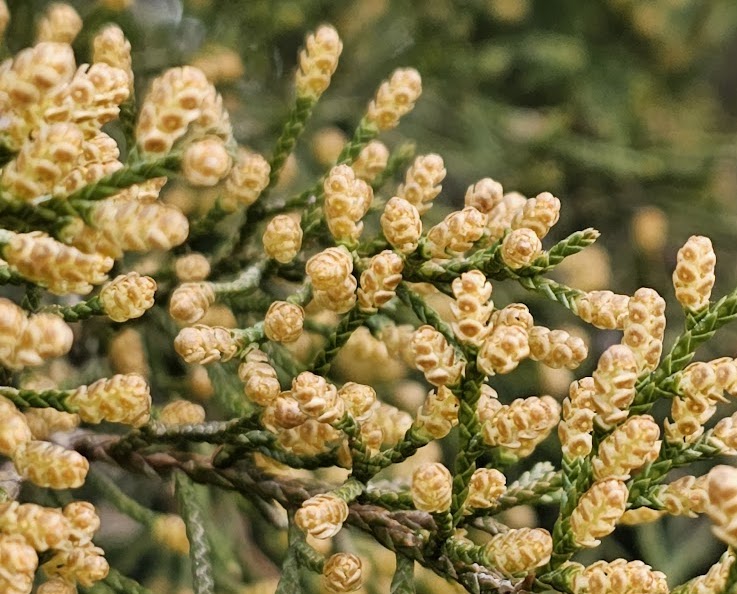
This is the time of year when male eastern red cedars (Juniperus virginiana) release their clouds of love in the form of pollen which you can see in this video.  In Texas, this is referred to as "cedar fever" which is discussed in this Texas A&M link.  Their onset occurs earlier in Texas due to their warmer climate.  Our Master Naturalist Drew Albert suggests that "After a dry, warm February day yesterday with mid-70s and afternoon humidity dropping below 20% this isn't uncommon after colder weather." The video above was shot on March 12, 2020 which supports the weather theory.

Cedar pollen is distributed by the wind and doesn't seem to care if it lands on a receptive female cone or a human nostril.  When it hits our noses, the reaction is rapid and can produce symptoms over several days.  Not everyone is affected every time.  When I demonstrated in the video the pollen clouds drifting downwind of the WOLF students, I had no reaction in spite of my usual seasonal allergies.

They have been accused of worse.  "Among the many things old-time Ozarkers used to believe brought bad luck was the transplanting of cedar trees. Folklore collector Vance Randolph described several examples of people refusing to move cedar trees because they thought it would bring an early death to them or someone in their family. It was also considered "very bad luck" to bring cedar boughs into the home — except during Christmas, and then, they had to be removed completely before 12 a.m. on January 6 (Epiphany)."  MDC Discover Nature

Our red cedars are native but aggressive growers, early colonizers of bare ground. After the cedar cone on the female tree is pollinated it turns a waxy blue and contains one to three seeds.  The seed cones fall from the trees and are also dispersed by many birds.  Cedars are especially sensitive to fire and the end of burning the glades in the past has turned our historic "balds" into hirsute hilltops.  Some "wind breaks" along fence lines are actually cedars, planted by perching birds, that escaped the blades of a mower.  Abandoned fields and glades now are covered with cedars, creating the expense of clearing them to the landowner.  

Glade restoration - 2000

There is a market for cedar, but a large number of mature trees are needed to make the harvest worthwhile.  When we cut our first glade restoration around 2000, loggers were happy to cut and haul large cedar logs for free.  Our second glade restoration had smaller timber and we had to pay for extra help.  

There was a time around 1908 when the pencil industry developed an appetite for cedar as told in a News-Leader article.

"Ozarkers had other uses for their timber, though. In 1908 the American Pencil Company of New York built a pencil factory in Branson. The pencils were made from cedar logs. Cedar was another locally abundant tree. Thousands of cedar logs were cut into rectangular slats measuring 3" x 3" x 8". The slats were then shipped across the country to factories to be made into pencils. Eventually, the supply of cedar trees was exhausted and the American Pencil Company Factory was moved to California."    ProjectTaney.org

Juniper Hairstreak
So is the spread of cedars good or bad?  As we tell our 5th grade WOLF students, the answer to that question is usually "it depends" and even mosquitoes have a place in the food chain.  In this case, cedar cones (often called berries) are nutritious and feed robins, cedar waxwings, and a wide variety of other birds feasting on their dense carbohydrate and fat load.  Many insects also feed on them including caterpillars of our favorite Juniper Hairstreak.  Meanwhile the branches and evergreen leaves provide shelter for a variety of birds as well as nesting sites for Cooper's Hawks, Blue Jays, Northern Mockingbirds, as well as many other smaller species.

Red cedar spittlebug - REK
Cedars also host other species such as cedar apple rust galls, and cute tiny red cedar spittlebugs.  Perhaps the strangest example is an invasive Callery pear that we have growing out of the trunk of a neighbor's cedar shown in this prior blog.

Another strange thing I have photographed in a cedar tree is this one below, found inside a living but hollowed out cedar on our neighbor's land.  I have tentatively identified it as a new invasive species, Barbaria kipferiae.*

Newly reported "invasive species"
*Special thanks to our editor for her skills with words and as a model.