Thursday, August 10, 2017

Cottonmouth Aggression


Western Cottonmouth  - Tom Spinker CC

We recently wrote about the death of a Northern Watersnake which was misidentified as a cottonmouth that was "coming after" a swimmer.  One of the most common snake myths that I hear is that cottonmouths (Water Moccasin) are aggressive and attack canoes, kayaks and people swimming and wading in our streams.  

Green area is our A. p. leucostoma- Wikipedia

There are three subspecies of cottonmouths, Agkistrodon piscivorus, in the US.  Our native Missouri species is A. piscivorus leucostoma (white-mouth).  They are mainly in Southeast Missouri sloughs and the rocky creeks of the Ozarks.  We haven't seen them on Bull Creek but I suspect they are here.

  MDC - Noppadol Paothong
A recent story by Francis Skalecky in the Springfield News-Leader addressed cottonmouths but I want to follow up on it. While they may be harder to intimidate, they are not out looking to waste their venom on humans, or kayaks for that matter. All of these are too big for a snake to swallow and once their venom is used, they can't subdue prey for several days while they restore the supply.

Research at the University of Georgia entitled Defensive Behavior of Cottonmouths Toward Humans tested their aggressiveness with three scenarios.
  • First they stood closely beside the snake with a snakeproof boot touching its body.  Of 13 individual cottonmouths tested, four attempted to escape, five gave some form of defensive display, and none tried to bite, although one individual feigned a bite during a strike. Only two of the snakes performed more than one defensive display.
  • Second scenario-  They stepped on the snake at midbody with enough force to restrain but not injure it.  Of the 22 that were stepped on either initially
    or secondarily, 15 gave defensive displays, including two that feigned bites.
    Nine of those stepped on were attempting to escape by crawling away and one bit the boot.
  • Third Scenario-  They picked up the snake at midbody with a pair of
    1-m snake tongs (Whitney Tongs) with a grasping handle that was modified to resemble a human arm and hand. A leather glove was fitted over the end of the tongs, with one extension covered by the thumb and the other by the middle finger. Hence, the glove could be closed around the snake’s body. A padded shirt sleeve was used to cover the remainder of the rod up to the handle.  Each treatment was carried out for 20 sec, and the behavior of each snake was recorded. 
    Of the 36 individuals held in the "hand" for 20 seconds, only13 (36%) bit the artificial hand, striking near the point of contact with the snake’s
    body.
I would not suggest that you do any of the above maneuvers with any snake.  This is unquestionably a dangerous snake, one to be respected like any other animal that can hurt or kill you.  They just want to be left alone as do we.  A frequent question we hear is "Is it illegal to kill a snake?" so here is the answer in MDC Discover Nature.

Missouri's Wildlife Code Protects Snakes

Few Missourians realize that all snakes native to our state are protected. The Wildlife Code of Missouri treats snakes, lizards, and most turtles as nongame. This means that there is no open season on these animals, and it is technically unlawful to kill them. There is a realistic exception, however: when a venomous snake is in close association with people, which could result in someone being bitten. We hope that more people realize that snakes are interesting, valuable, and, for the most part, harmless. 
=====
From Lisa Berger, a mother Cottonmouths instructions to the snakelings:  "Use venom only if you are being crushed, or if you need to subdue food; otherwise bite gingerly, and inject accordingly."

Wednesday, August 9, 2017

Porch Light Life

Laurel Sphinx, Sphinx kalmiae - REK
Moth Wall - REK
The moths have been collecting on the wall by our deck light the last week. The Laurel Sphinx Moth above is 2.5 inches long (60mm) and is always laying on the deck, unlike almost all the other species.  We have had daily visits from the Yellow-orange Imperial Moths, Eacles imperialis, some of whom are in the 'family way.'  More on that in a future blog.  The picture on the right shows 5 different species of moths in one view.  I am compiling some of the more colorful species in this Flickr album with the identification help of Kevin Firth.

Bumelia Leafworm Moth - REK


Some of the micromoths can be quite colorful and are easy to overlook, hiding in the folds of the porch swing or in the cracks of the wall.  My personal favorite is the Bumelia Leafworm Moth, Lactura pupula.  This one is very slender and measured 3/4". 


Wheel Bug Nymph- REK
There is a lot more life to find on the wall when I turn off the light in the morning.  Young pale green walking sticks, leaf-footed bugs and other curious species show up.  This wheel bug nymph was 1/2" long and easy to photograph as it is weeks away from developing its wings.

The cicada chorus is almost deafening at night and starts up again in the morning.  We are finding them around the house on the walls randomly, not apparently drawn to the light.  They are so common that I don't give them much thought, at least not as much as Linda Bower does.  If you have ever wanted to watch a cicada groom or handle essential bodily functions, her Youtube video here is your chance.  It didn't seem to be annoyed by the voyeuristic video camera until the last of the filming.  These are her notes;
"This female peed twice (repeated at 10x slow motion) and gave great views of her anatomy. Walking and climbing is shown 2-5x faster. Identified by Chao Jimmy Wu as a Neotibicen pruinosus female. He said, "This one's a bit 'different' since the ventral abdominal stripe is pretty bold and not TOO irregular (which is more of a linnei/robinsonianus trait). Female N. robinsonianus also has the paired pruinose spots. However, they tend to be a bit smaller and less bold. Lack of wing bowage (which really isn't all that great of a character though still useful), more or less rules out N. linnei." Filmed in the Missouri Ozarks, USA, on August 6, 2017."
Copperhead in a tree - Sheila Watson
If you are out at night in the rural areas, take a flashlight.  We have been seeing copperheads are out in the yard looking for dinner and John Miller tells us that cicadas are their M&Ms.  Check the trees as well because they will climb them looking for dessert.  So far none have climbed our house wall, but nothing would surprise us any more.

Monday, August 7, 2017

Northern Watersnake

Our neighbor in 2002-2017 - RIP  REK
I am sad to announce the recent accidental death of an old acquaintance of mine here at the creek, a Northern Watersnake, Nerodia sipedon sipedon.  It was more of a neighbor than a close friend, hanging out in our deep swimming hole.  One of my first encounters was watching it bask on a stump back in 2002.

It was larger than the other watersnakes and more confident, continuing to swim by as I would snorkel the pool.  Cruising the bedrock bank to investigate the fist-sized underwater openings that I never had the nerve to reach into, it would crawl halfway in, I could come up behind it and gently pet it as it froze but didn't panic, a apparent agreement we had to not harm each other.


Once my friend Larry Whiteley raced up on an ATV to get my camera.  He had seen the snake in the process of swallowing a perch at a creek crossing.  We got there just as it was finishing up, patiently working the tail into its mouth as the final bite of a dinner that could last a few weeks.  It laid patiently on the edge of the bank until it completely swallowed, then swam leisurely away, satisfied it had entertained us enough.


Just a few months ago I was startled to find it on our deck, a good 12 feet above the creek.  The vibration of my footsteps caused it to move over to the edge and slide down a pole to the ground, but not until I got a picture.

Visiting the deck - REK
Sadly it suffered an accidental death a few weeks ago at the hands of a visitor to the creek.  Many snakes are killed because of peoples' fear of any snake (Ophidiophobia), the most common of any of the phobias, reported in 1/3 of humans.  This may actually have evolutionary roots in mammals as a protective reflex.  More commonly people just "hate" snakes or aren't able to identify which ones are dangerous.

Cottonmouth - Wikipedia
In this case there were children playing in the creek when our snake was seen swimming and was mistaken for a Cottonmouth.  They get a bad rap as being "aggressive" (more on that in a future blog), creating more fear than another venomous snake would on land where we can simply step away from perceived danger. 


Texted photograph
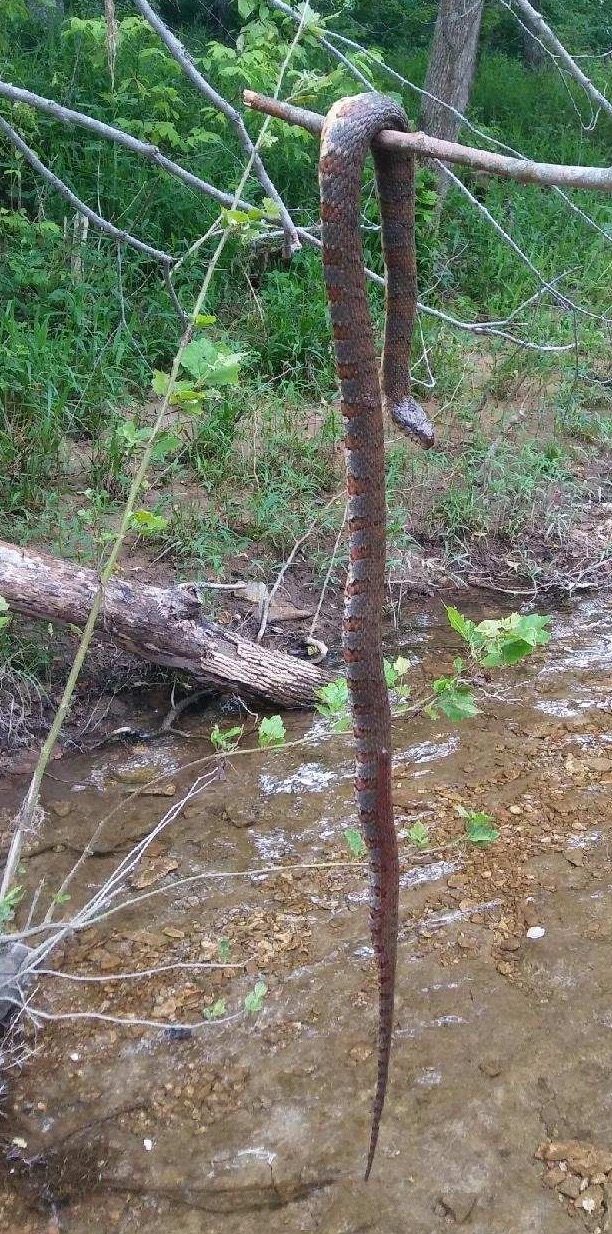
When our visitors texted me about it with a picture I was able to identify it on my phone.  It had the typical bands on the front third that became incomplete toward the tail and the familiar coloration.  I had them put it in our freezer so it wouldn't have died completely in vain and I could at least salvage the skin.  As we had stored a frozen rattlesnake there a few years ago which we had to kill on our deck, Barb was perfectly "cool" about this one.

Skin drying on cardboard - REK
Keeled scales -click to enlarge
All watersnakes, as well as many others, like the rough green snake, have rough skin when stroked.  This is caused by "keels," ridges on the middle of the scale like the keel of a canoe.  Viewed up close under magnification you can see them running down each scale.


I don't blame anyone for killing a snake that they think is a danger to themselves or others.  On the other hand, I would hope to teach avoidance of venomous snakes that fill an important niche in nature.  More importantly, being able to identify venomous* snake species can help people to protect and maybe even appreciate the many beneficial harmless species.

Can I be certain this is the same snake?  I hope some day to be proven wrong by seeing "our snake" cruising the swimming hole again.

=====
* To avoid an embarrassing correction from a naturalist, remember that these are venomous snakes - the venom in their bite is dangerous.  Snakes aren't "poisonous" which means it can kill you if you eat it.

Photographs of the venomous snakes of Missouri are on this web page starting on page 14.

Tuesday, August 1, 2017

Fireweed

A rose among the weeds - Mark Bower
  Robert Videki CC
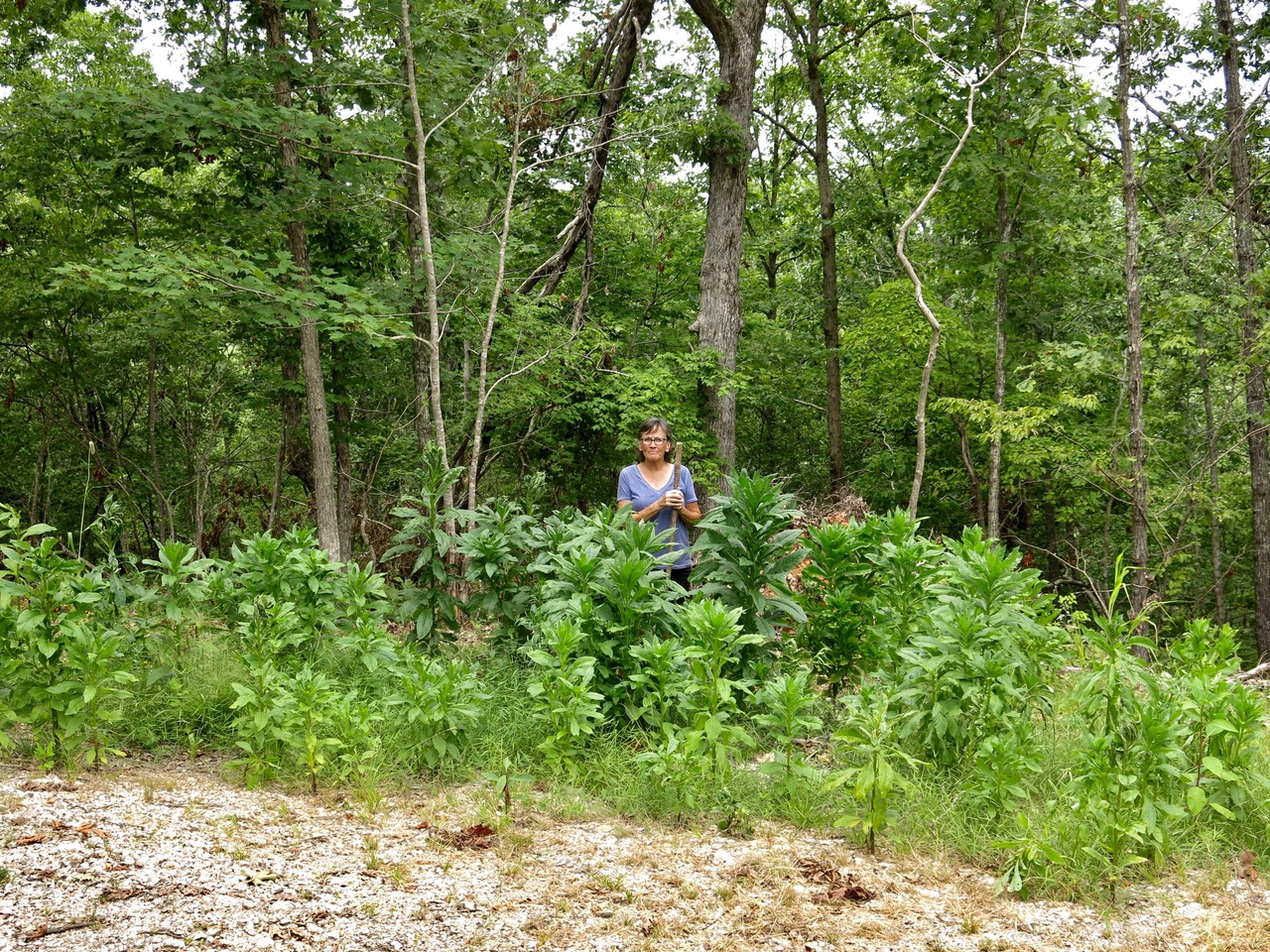
Jan Bower brought us a large specimen of a plant that was growing around their newly constructed cabin.  Her question was is it good or bad, i.e. did it have potential to produce showy flowers or feed native species?  Barb couldn't identify it right away so off it went to Linda Ellis who said, "This is a plant that likes disturbed soils, like after fire or construction, called fireweed or Erechtites hieraciifolius, no petals, just fluffy white seeds. It is an easy to pull annual." Barb groaned and said, "Ohhh yes, I should have known that."


First the fireweed name.  This is a plant that loves fire and boy, did it find the right home.  As Mark and Jan were building their new cabin, they had a new well drilled one day and the drilling rig was left on the site.  That evening a neighbor saw flames and called the fire department.  A short in the battery of the rig started a fire that burned up the rig while mercifully sparing the trees.  You can see how hot the fire was from the melted tires.   And that is where the weed is now growing.

Tiny flower heads -  Wikipedia
The reason botanists love Latin names is that common names are, well, common, and often given to multiple species.  Another fireweed species is Chamerion angustifolium.  Jan's fireweed,  E. hieraciifolius, is described fully in Illinoiswildflowers which lists its common name as Pilewort.  The distinctive flowers resemble buds and produce an achene.  (Word for the day - achene, a small, dry, one-seeded fruit that does not open to release the seed.)  Hint - use that in a sentence in conversation 3 times and you will always remember it.


 Pile on seed heads*
The name Pilewort likely refers to white hair tufts on the seed, a method of dispersal by the wind.  The tufts of hairs have been used as stuffing or "pile" for pillows and stuffed animals, perfect for Jan who is famous for her artistic pillows.  That fact alone may spare the plant from mass destruction.  On the other hand, the root system is shallow and fibrous, quick to grow but easy to pull if you tire of this "weed."

Tall plant with shallow roots
Short roots of a tall plant
Pilewort can grow from two to eight feet tall.  The flower heads are a quarter inch in diameter and covered with tiny florets, to small to appreciate.  Like most early colonizer plants, they grow quickly on bare disturbed ground before the competition moves in.  The "weed" in fireweed is a clue that they are likely to be replaced by a more "desirable" plant that we lately arrived humans decide has more value.


So what exactly is a "weed"?    My simple answer is a plant growing in the wrong place in the judgement of a lately descended bipedal ape species that itself has been growing "like a weed."  Illinoiswildflowers discusses weed criteria at length and makes an argument that sometimes we should embrace our weeds.
"...suburbia considers any plant a weed that is well-adapted to its environment, prone to reproduce itself and spread, requires little or no effort to maintain, has no obvious aesthetic or culinary properties, and doesn't require money to acquire."
Early colonizer plants on disturbed soil help to retard erosion and add nutrients to the soil when they die.  They frequently don't compete with others as the soil matures and after a few years may diminish or disappear.  Some weeds provide food for animals and insects and hemp can make human's clothes, rope and even high.
===
I would highly recommend reading the thought provoking What is a Weed from Illinois Wildflowers.

*Photo by Joseph M. DiTomaso, University of California - Davis

Monday, July 31, 2017

Pupa on a Silk Rope


On a sunny day in March we went on a long slow walk with Nels Holmberg looking at bryophytes (mosses and liverworts).  Slowing down and getting on my knees gave me a chance to see things like this half inch pupa case dangling on silk strands from a dead branch just above the ground.  It looked like it was hanging from the remnants of a spider nest.  I took it home and waited to see what might emerge.

On May 26 I found this wasp with the empty pupa case.  It had crawled out over the prior week and had a lonely death, never having found love.  After a lot of searching I sent it to Bugguide where it was identified as Acrotaphus wiltii.  This distinctive beauty is "a parasite of the arabesque orb weaver, Neoscona arabesca. The wasp stings the spider to briefly paralyze it while she lays a single egg on it. The larva is an external parasite." (Eric Eaton in Bugguide)

Female A. wiltii with ovipositor - Betsy Betros
This explains the silk rope that the pupa was dangling from.  After the larva had killed the spider it pupated and was suspended from the spider's web and the silk was twisted into a tangled cable over time.*  It survived the winter hanging close to the ground.  The wasp would normally emerge and search a mate.  The female would then search out a tiny spider and lay the fatal egg.  The larva would then cling onto the spider, feeding on it. 

Like most other Ichneumon wasps, she comes equipped with a dangerous looking but harmless ovipositor, that is harmless to us but not to the right brand of spider.  There is a bit of irony in the fearsome tailpiece that can paralyze a novice with fear.  The stingers of hymenoptera (wasps, bees, etc.) are actually modified ovipositors, now producing painful venom which can paralyze prey, such as spiders, that a wasp can take back to store as food for its emerging larva.


*Charley Eiseman has a set of photos in his Bugtracks Blog showing the larva with its spider victim before and after pupating.

Friday, July 28, 2017

Potter and Mason Wasps

Potter wasp - Monobia quadridens - female
This wasp spent a long time around our deck, crawling over the furniture and even the rim of my coffee cup.  After a long internet search, I settled on Euodynerus bidens, a potter wasp.  Two hours later, Bugguide corrected me with an ID of a Four-toothed Mason Wasp (Monobia quadridens).  There was some solace in the comment that they are almost identical, the main difference being a small white spot on the first abdominal segment and on the temples behind the eyes.  The marked similarity is even more remarkable; it developed independently as they are in separate genera.

Potter wasp nest - REK
Both of these wasps are in the Eumeninae family of potter and mason wasps. M. Quadridens is much more common compared to E. bidens.  It is usually found around open areas on flowers and the adult feeds on nectar.  The female collects caterpillars of tiny moths (microlepidoptera) such as grass moths and leaf roller moths.  She will find holes in wood or hollow stems, lay an egg in it and provision it with a caterpillar paralyzed by her sting before partitioning it off with mud, thus the name mason wasp.  The common name of mason refers to these mud walls.  A few species called potter wasps make their artistic
pottery out of mud.

Four-toothed Mason Wasp (Monobia quadridens)
This is our second encounter with M. quadridens.  Last year one was spotted at our cabin, preparing a nest in a carpenter bee hole.  They commonly use these and if occupied by the bee they will kill the bee, eggs, larvae and even pupae.  Bug Eric explains that they make an empty chamber between each egg chamber, presumably to convince predators that no one is home.  They have two broods a year, the fall class over wintering as pupae.
Home Sweet Home - REK
As they obtain their nectar, they also serve as important pollinators.  The female can sting if you grab it but is not aggressive like its look-alike baldfaced hornet.  Interestingly, the male doesn't have a stinger but can "sting" with the tip of its abdomen, a quick pain with no venom.  Over all they are good neighbors to have around your garden.  You can encourage them by making nesting sites.  Carl and Jessie Haworth have been doing this for some time with fancier designs than mine above.

And finally, where does the name Four-toothed Mason Wasp come from?  Sorry, nobody apparently knows or is talking.
Note: Ben Caruthers MN sent this photograph of mating Mason Wasps in 2020.
============
  • Bug Lady discusses the research on the nest building for "naked" larva which don't spin a cocoon.
  • As always, Bug Eric explains a lot more of the mechanics of their nests.  He suggests this video for more details.

Wednesday, July 26, 2017

Wool-sower Gall and Friends


Our friend Brandon Butler asked me if I hunt.  I initially said no, then realized that I hunt almost daily, I just don't shoot.  Sometimes I eat my finds (mushrooms), other times I photograph my prey and put them under the microscope.  I usually "catch and release" when possible but many of my prey are larvae that won't survive or occasionally die from chilling for photographing or saved as specimens.  I love the hunt.

Early summer is a great time for gall hunting.  As the leaves and buds are coming out, it is easy to spot the various oak galls which are frequently at their most colorful.  A few weeks later they are hidden in the leaves and require lots of patience to sneak up on them.  They can be very evasive, requiring lots of time to find a specimen I flagged just a week before.  This Wool Sower Gall was an excellent example.  It was the size of the tip of my thumb, obvious in the photograph but hard to recapture in the foliage.

The most distinctive oak galls are produced by  Cynipid (sin-a-pid) gall wasps.  These wasps are from 1-8 mm in length and many have a distinct hump on the back.  They lay their eggs on a specific plant and the eggs hatch as tiny larvae whose secretions cause the plant to form a gall around them.  The gall in turn provides both protection and nutrition.  How it does it remains a mystery.  Each species produces a distinctive gall and most are identified by their gall rather than their appearance.
Capsules with a larva - REK

The Wool Sower Gall (WSG) is an excellent example to study, colorful and yet infrequent enough to be elusive.  The gall looks like a cotton ball that sometimes has distinctive pink spots.  It is also called an Oak Seed gall, due to the seed-like appearance of the early larva capsules inside the gall.  The gall is produced by the secretions of the grubs of a tiny gall wasp, Callirhytis seminator.  Unlike the more common Oak Apple Gall which houses a single larva, these galls contain lots of "seeds", each containing a wasp larva.

Seed-like capsule opened to show larva - REK
After splitting one open I photographed the larvae inside.  Each lives on the nutrition produced by the oak, a special blend of sauce and spices created especially for its species.  Ordinarily it will live here until mid summer when it will emerge, but my razor blade has ended its chance to reach maturity.

Not Callirhytis seminator - REK
C seminator - Ces.ncsu.edu
The gall at the top of the page was left on the tree until it started to dry up.  I kept it in a ziplock bag for 10 days until the first wasp emerged.  It looked like a tiny black spot on the wall of the bag, measuring only 2.5 mm under the microscope.  I would have assumed under the circumstances that it would be C. seminator  but even I could tell at a glance that it isn't.  My first clue was her ovipositor which is longer than the wasp's body.

I sent pictures in to Bugguide and the response was even more interesting.  Ross Hill responded rapidly, identifying it as Torymus tubicola, "a known parasitoid of Callirhytis seminator."  He sent it on to Eric Grissell who confirmed the ID.  There are over 400 species Torymus species world wide and it takes an expert to get an identification to species level.  I didn't expect to find much more information on this species, but finally ran across this blog by who else but Eric Eaton, aka Bug Eric.  Charlie Eiseman also reported on several he raised.

Not C. seminator but still a cool find!
Meanwhile, I am continuing my attempt to photograph C. seminator when it emerges from its custom built gall.  I think it is incredibly cool that a 2.5 mm wasp can lay an egg on a mighty white oak twig, the larva then produces enzymes, hormones or who knows what combination that causes the oak to create specially designed housing for it to grow up in, protected from the elements.  There is a master's thesis in this but better yet a source of wonder for any kid like me that finds one when out hunting.