Showing posts sorted by date for query nostoc. Sort by relevance Show all posts

Wednesday, March 1, 2017

What the Rain Brings

The report on the Resurrection Fern on the last blog got me to thinking about other examples of overnight resuscitation after a little rain.  The most common example that comes to mind is another lower life form that I associate with rain after a dry spell, our beloved fungi.  Many edible species such as morels and oysters spring to life after rain.


We had a pair of logs that Mark Bower introduced me to where Oyster Mushrooms would bloom after a rain.  After a nice fall shower two years ago, I trekked up the little wet-weather creek filled with anticipation and found a large blossoming of mushrooms.  Cutting them off, one fell over the edge of the log and I reached down to retrieve it, stopping just short.  A very patient copperhead waited without moving while I grabbed my camera for a shot of a lifetime.


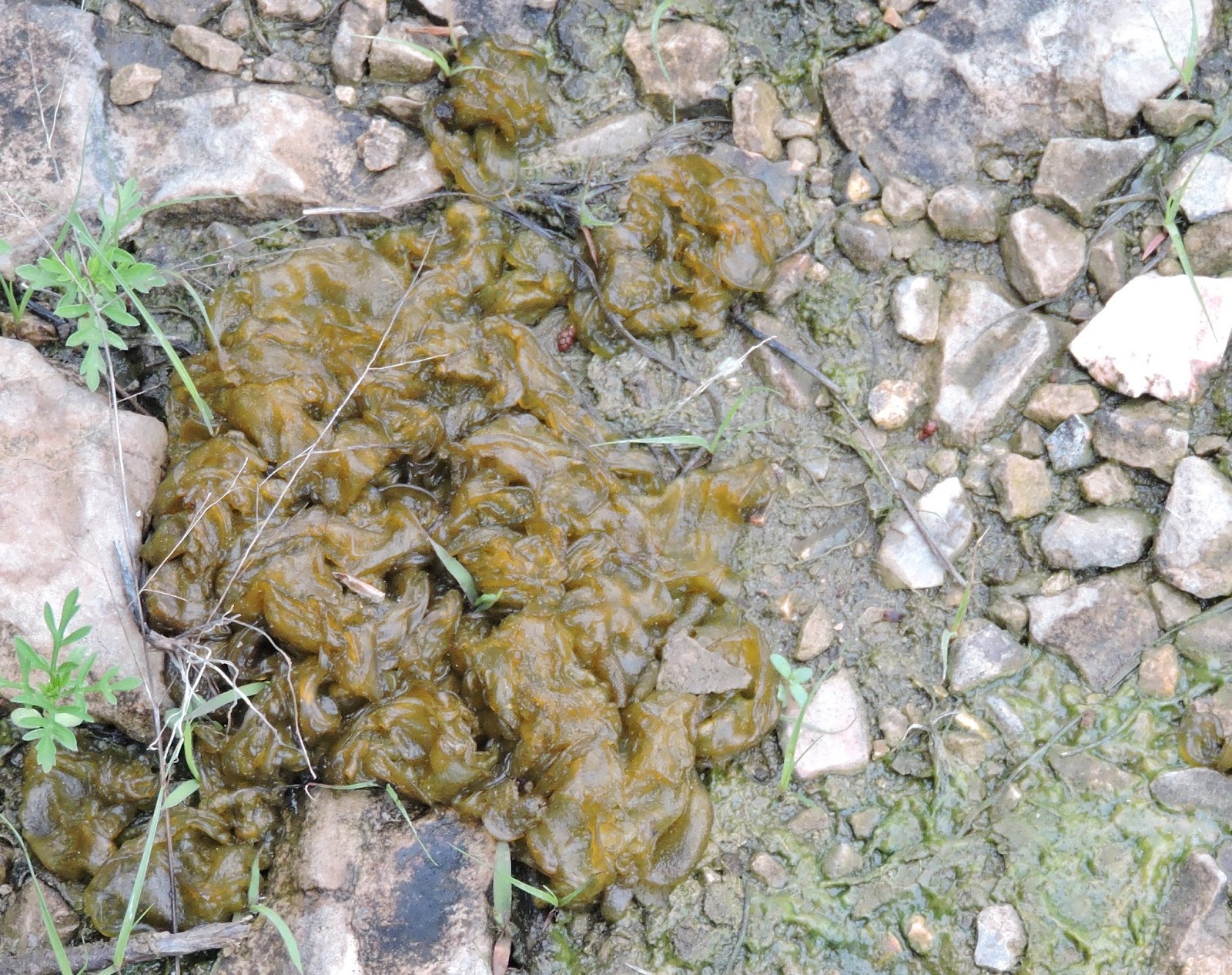
Mark Bower and I came across nostoc along the rocky glade trail Saturday.  The barren rocks look like they couldn't support any life but add a little rain (in this case just a sprinkle) and in the words of Bill Bryson in A Short History of Nearly Everything, “Life just wants to be; but it doesn't want to be much.”


As we discussed in a earlier blog, this cyanobacteria produces a rather disgusting mass, looking like a rotting plant on its way out rather than a new growth.


Another example of overnight greening after a rain will be featured in the next blog.


Friday, May 13, 2016

Nostoc


On moist areas of our glade after a rain we come across these piles in the trails.  It looks nasty, a cross between rock snot and rotting moss.  It is actually a cyanobacteria called Nostoc.  They grow in chains or filaments covered with a gelatinous sheath.  They have photosynthetic pigments which accounts for the green color.


Since it is invisible until rain causes it to blossom, it had a rich folk lore history.  It was assumed to fall from the sky with the rain, getting it named Star Jelly or Witches' Jelly.
Some species are grown and consumed as food in China, Japan and Peru where it is said to contain protein and Vitamin C.  Other sources deny any nutritional value and point to a toxic amino acid BAMA that can affect nerve cells.  Either way, I would not expect to see this in your grocery store any time soon.