Showing posts sorted by date for query vulture. Sort by relevance Show all posts

Thursday, December 1, 2022

Owl Pellets

I received a gift of owl pellets from Ben Caruthers.  While this might not excite you, it got a rousing welcome from our friends in the 5th grade WOLF School.  I asked Ben for the backstory.


"The barn is on a cattle ranch where my father-in-law works as a cowboy. I asked the owner if I could place an owl nest box in the old barn. I had not seen any sign of an owl. This was just in the hopes that an owl would find the box and nest there. At the same time I placed a trail camera to monitor any bird activity. It took two years, but the barn owls finally showed up."

There has not been any sign that they have actually nested in the box, but they used it as a perch.  Several other birds have shown interest in the box including rock pigeons, European starlings, American kestrel, and squirrels. Turkey vultures have used the barn for nesting. Once when I went to check on the nest boxes there were two large, white turkey vulture nestlings. They spread their wings and hissed when I approached. I got out of there quickly so I didn’t disturb them further. I also didn’t want to experience their alert response. 

The most recent check I made of the owl box I got to see the barn owl above in person. It flew right over the top of my head!"

=========================================

Ben collected over one hundred owl pellets on the floor of the barn below the nest box and from two other cross beam perch areas.  He delivered them to me separated in paper egg cartons.  Note to self - don't eat any eggs shared by Ben.  The contents were dry for months and some had been cleaned by some clothing moth larvae described in this previous blog.

Barn owls are carnivores, specializing in mice, moles, voles and birds.  Since they swallow their prey whole, passage of bones through the intestine is impossible.  Even the thought of that hurts!  The food bolus goes first into a glandular stomach for digesting with enzymes, acids and mucus.  Next, on to the muscular stomach (gizzard) where it is mechanically mashed up and the digestible portion move down the tract.   Fur, bones, teeth and feathers are retained until they are hungry later when they will be compressed into a "pellet" pushed out.*

By now, I am sure you are anxious to see what is in a pellet. The photo above is a single pellet which also had some leg bones, ribs, etc.  With the charts below* you can begin to determine which rodents passed on (or in this case passed up) after encountering an owl.   Biologist can even survey rodent populations by studying the pellets in the area.

______________________________________________________________

* Hungry for more details?  Check out this World of Owl site.  More on studying owl pellets is at this site.  A key to identification is here.

Wednesday, February 2, 2022

Vulture Venture

I have been short on new blog material lately.  The only interesting new finds have been swarms of midges coming out on unseasonably warm January days, a mating behavior usually scheduled for late March and April.  The only way I could catch them is by hand which squashes them too much to ID the species.

One constant finding at Bull Mills this December was the black vultures sitting on the corral rails behind our barn.  This is the 15th annual brood raised in the Vulture Obstetrical Ward (aka our 120 year old barely standing barn). Last year we didn't see any eggs or chicks and had given up on them when I suddenly saw the juvenile above, filmed in this video as it prepared to fledge.  
 
Click to enlarge
There are several stalls which I can't open due to settling and the groundhog holes are now vulture tunnels.  Back in 2013 we wrote this blog about a vulture family raised in a hollow tree which I filmed through a two inch crack.  They hiss a warning, "I am bad and will vomit on you" as seen in this video.  How the chicks managed to get up eight feet to the open top of the trunk to fledge is beyond me. 

We get a better view of them in the barn each year as seen in the Now Eat Your Carrion blog.  They hiss the first few times I open the door but soon learn to totally ignore me.  The parents would initially flush out the window but later just looked bored.
 
Last year's fledgling wasn't quite ready to take flight when I found it so I came back a few days later for its maiden voyage.  They are still hanging around the barn on the corral rail on warm days, now without their juvenile downy feathers.
 
MDC Nature Calling had a great story on vultures, everything you ever wanted to know.  I found this about killing livestock interesting.
"It can be difficult to tell if a black vulture actually killed the animal it is feeding on or found it already dead. Farm animals, especially newborns, die from many causes. But black vultures sometimes do kill newborn calves and lambs. They are attracted to the afterbirth and may try to eat a newborn that is not yet able to stand and move away. Because black vultures tend to feed in groups, it can be hard for cows or ewes to scare them off, especially if they are first-time mothers."
 
More pictures of our annual vulture adventures are seen in this Flickr album.

Monday, November 1, 2021

Vulture Migration


After several rainy cold days the sun returned for two glorious fall days.  After several hours cutting firewood, I treated myself to a nap on the newly cut hay field along the edge of the valley.  I was looking up at the blue sky and the orange and red leaves above my head and feet, with an open horizon to the north and south.

I noticed a tiny speck appear in the north.  As it came overhead I could see the typical shape of a soaring turkey vulture, its wings held above in a flat "V" shape.  It was flying higher that I had ever seen and another speck followed, then another, all spaced out but headed in the same direction.  Eventually I counted 25 over 5 minutes, with never more than 5 scattered in the visible sky at a time.

After 15 minutes my dog came over to tell me it was time to get back to work, but as I started to get up another speck came in sight.  I checked the time and start counting again, ending with 53 when the parade ended 10 minutes later.  Again, not a single wing flap the full time, and the vultures were always widely separated.  There were never more than 5 birds visible in the whole open sky at one time.

Thermal updrafts allow turkey vultures much longer flights while soaring with their wings steady.  The vultures migrate in the daytime and avoid rainy or cloudy days which don't have the updrafts that allow them to glide without flapping their wings.  In the full time that I was watching them I never saw a single wing beat, just their steady glide and distinctive teeter from side to side as described in Bird Note.

Research on turkey vulture migration included a bird fitted with a heart-rate logger during 124 hours of flight during 38 contiguous days.  That showed only a small increase in mean heart rate as distance traveled per day increased, which suggests that, unlike flapping, soaring flight does not lead to greatly increased metabolic costs.

I didn't get any pictures as I could never get more that two birds in a frame of my telephoto.  It was just one of those "you had to be there" days.


Tuesday, September 15, 2020

Burying the Beetles

MDC News Release, September 14, 2020

"The American burying beetle, reintroduced at two southwest Missouri prairies, has been down listed by the U.S. Fish and Wildlife Service (USFWS) from endangered to threatened on the nation’s endangered species list. "  MDC News Release

Back in 2013, several of us were involved in a project to restore the endangered American Burying Beetle which had been extirpated in 28 states of its native range.  This week we have been notified of the projects success in this news release.  In these trying times, we need all the good news we can get.  Below the photograph is the 2013 blog that describes what MDC and some MN volunteers were doing in this exciting ongoing project.

USFWS photo of American Burying Beetle


2013

 What excites a Master Naturalist?  Holding an endangered species in your hand ranks high, and it is even better if you are doing something to help them survive.  We had the opportunity to participate in the restoration of American burying beetles (ABB) last Tuesday. 

The American burying beetle (Nicrophorus americanus) (ABB) originally was present in 35 states.  Now it is only found in seven states and efforts are underway in several states to restore it to its native habitat.  The St. Louis Zoo's Center for American Burying Beetle Conservation has a breeding program and is actively involved in restoration efforts with the US Fish and Wildlife Service and the Missouri Department of Conservation.  Master Naturalists were invited to join the work day at Wah’Kon-Tah Prairie just north of Eldorado Springs.

The burying or sexton beetles, genus Nicrophorus, are a colorful group, shiny black with bright orange spots in patterns which identify the species.  Our ABB, N. americanus is distinguished from the other burying beetles by coloration and size.  It is the only one with an orange spot on the upper surface of its pronotum (first segment of the thorax).  It is also considerably larger that the other common burying beetles.

N. Orbicollis - Note black pronotum


The burying beetles are one of only a few groups of insects that personally nurture their young, feeding them much like a bird does.  In their case, a vulture might be a more appropriate model, as they eat a dead mammal or bird, then regurgitate it into the mouths of their emerging larvae.  Before a pair can mate they must first find a dead animal, flying up to two miles while sniffing the air with their antennae.  Just like Goldilocks, it has to be just the right size. Too big and they can't move and bury it, too small and they will run out of food. 

Mighty mites- Aussie Botanist
The Nicrophorus beetles don't do it alone.  They carry mites along, predominately on the under side of the thorax and abdomen.  Once they arrive at the animal, the mites disembark and begin eating fly eggs, larvae and other competition for the body.  Mites - don't leave home without them!  Meanwhile the beetles trim off the beak, feet and feathers or unwanted parts and bury the carcass swiftly.  Lacking refrigeration, they coat the carcass with a substance that fights off bacteria and fungus.

Click to enlarge

Why has the ABB, N. Americanus been disappearing while other Nicrophorus species have remained stable?  No one knows although there is no lack of theories.  Some include the usual suspects, habitat fragmentation and pesticide use.  The ubiquitous artificial lights may be a factor, as these beetles only fly at night, awaiting total darkness.  Another problem is finding just the right sized dead body to bury.  The loss of passenger pigeons may have eliminated a major food source of the right size, as would the loss of quail habitat. 

The St. Louis Zoo's Center for American Burying Beetle Conservation has an extensive program which propagates beetles, each individually identified by parents, generation, etc. The eventual goal is to reintroduce them into the wild and hopefully reestablish breeding self-sustaining populations.  Now it is time to get down and dirty.

Ben and friend
So how do we get the endangered American Burying Beetle (ABB) back into the wild?  By burying them!  You may remember we mentioned the importance of having a dead animal of the right size.  This is where the quail comes in.   Our job was to bury a mating (we hope) pair of ABB with a nice fresh...well more like slightly stinky... farm raised quail carcass.  Phew to us but home cooking to the beetle.  Ben Alleger, our young team member with experience in reintroducing ABB last year will lead us through the project in pictures.

We formed up in three teams, each headed by a member of the St. Louis Zoo team.  Each team would be responsible for 100 beetle pairs, each separately boxed and banded together.  Our leader gave out detailed, explicit instructions repeatedly, preventing any mistakes.  After all, these are federally endangered species and none of us wanted to end up in the pen!  Each step included another of his inspections, like a kinder and gentler drill sergeant without the expletives. 

Hole with quail in side chamber
The first task was digging 100 holes, evenly spaced along a straight line.  The hole had to be the right size and depth with a carefully removed lid of prairie turf, to be replaced when we were done.  Next a side chamber was dug out of the hole, all pointing to the same side so they could be found later.  (Editor's note- no volunteers were injured in this project)

Now came the fun- sort of.  A ripe quail was placed in each side chamber, being careful that it didn't stick out into the main hole.  We had to wear rubber gloves to handle the beetles.  Packing in the dead quail ensured that no one complained about wearing the gloves.
Male and female- separate quarters

For our burying project the beetles each had a pedigree and were carefully paired up, making sure that they were from separate families, no cousins or siblings allowed.  They were packaged in a pair of separate boxes.  They won't meet until the last minute when they get together on the quail, the ultimate of a blind date hookup.

The highlight was placing the beetles in the hole.  After determining that each pair was alive, we put them individually in the hole, herding them into the side chamber with the quail.  It is important to be sure that none of the valuable critters escapes for they have work to do.

Placing the beetles in their chambers, one at a time.
Release into the chamber


Aside from one which, after smelling the quail, was apparently considering becoming a vegetarian, they all scurried into the side chamber without encouragement, never to be seen again.  We were told that they might make audible squeaks as they mate, something that can take place almost immediately.  Since this was a family venture with pure of heart and mind MDC folks, we didn't watch.  What happens in quail chambers, stays in the chambers.

ABB male climbing over the quail into the chamber, looking for love.
Replacing the turf lid

Now back to work.  As soon as they were in the side chamber, we put the lid of turf back over the hole, using loose dirt to fill in the edges.  Once that was complete for 100 holes, we stretched chicken wire over the strip and tacked it down tight to prevent  marauding mammals from digging out the quail.

With three teams, we buried 302 pair of ABB in three separate plots.  Now it is up to the beetles.  What happens next is described on the St. Louis Zoo website.

"Pairs bury the carrion cooperatively. The female beetle lays her eggs near the preserved carcass. Within four days, the eggs hatch into larvae. Both parents feed their offspring by eating some of the dead flesh and regurgitating it into the larvae's mouths. This goes on for about 6 to 12 days, until the larvae begin their next stage of development, pupation. After 45 to 60 days, the new generation of beetles emerges from the carcass cavity. This process is repeated during the beetles’ one-year life span."
ABB Larvae- St. Louis Zoo
In ten days, the St. Louis Zoo team will return and assess one-third of the holes, carefully opening them to see if the larvae are present.  By this time they should be functioning and the male may have all ready escaped.  After last year's project, 1/3 of the beetle pairs were checked and found to have produced 395 offspring.  Future assessments will include looking for new adults on the prairie.  They have already seen one adult beetle from last year's class. 

The beetles we released have been notched, that is, marked by notching the elytra, the hard, modified forewings that encase the thin hind wings used in flight. The notch distinguishes captive-bred and wild beetles, and beetles are notched based on release location.

Rectangular notch on  right tip
If you look closely at the back tip of the elytra of the beetle on the right, you will see a tiny rectangular notch cut out.  This allows the team to determine if it is one we put in the ground or a member of the next graduating class.

More information on the project is at the St. Louis Zoo website.  A slide show from last year's reintroduction is here.


Team 2- we happy few   Click to enlarge

Details on the ABB release program are in this St. Louis Zoo PDF

Tuesday, December 11, 2018

Hattie's Scarab


Hattie's Scarab
I received this photograph from our friend Courtney who found the insect with her 3 year old assistant Hattie. They sent it in to INaturalist and got a tentative ID of Bolbocerosoma bruneri. That would put it in the Geotrupidae family, the Earth-Boring Scarab Beetles, EBSB, (also called dung beetles). 

B. bruneri - Marci Hess cc
I would agree with the genus Bolbocerosoma but have reservations on the species. All the photographs of B. bruneri on Bugguide show a thin curved black line on the thorax immediately behind the head which is missing in the picture above, so I am going to stick to Bolbocerosoma sp which gives us 12 species to choose from in the USThey all have in common the orange pronotum, black markings and five deep punctuate grooves on their elytra.


EBSB with its mound - Ag.Purdue.edu
EBSB have a very interesting life cycle. They burrow tunnels into the ground, some up to 9 feet deep. They may have multiple chambers at the bottom and the opening on top frequently has a pile up of dirt like a miniature prairie dog mound.  They deposit an egg at the bottom and then food above it forming a plug. This can include collected feces, decaying plant material, and fungus. The adults do not care for their young.  When grown, the grub will pupate, the adult emerges and climbs to the surface to fly off, probably relieved to be out in the fresh air.

They soon however return to the same old diet, eating decaying material and fungus and  and are often found on dung piles or compost heaps. Adults come to light which probably explains the one on Courtney's porch. Once you get past the "yuck" factor, remember that they are an earth-friendly species, similar to a vulture in recycling carbon and nitrogen from dead and decaying material into the soil. You didn't have any other plans for that dung, did you?

Tuesday, March 7, 2017

They're Baaack!

Black Vulture eggs
For the 7th year in a row the black vultures have chosen to raise a family in our barn along Bull Creek.  Barb had seen them hanging around for several days and on Saturday I confirmed that they had laid two eggs in the barn stall.  We have had 11 birds fledge (one egg never hatched and it disappeared a month later),

A common question we get is  are these the same parents each year.  We can't be sure as they all look alike.  The male and female sexually monomorphic (look identical unless you see their sex organs) but fortunately they appear to tell the difference.
Warming in the sun
The one thing I am confident of is that they are the same family, whether the same parents or the young coming back to their birth place.  The first year they were skittish, flying out every time we approached the barn.  Over the years they got use to us, to the point that they frequently won't get off the eggs until we stand there with camera in hand and they finally get up for the photo-op so we will go away.  Last year I was able to walk withing 10 feet to get the picture of one as it warmed up in the sun.
Chicks in a hollow tree- 2013
Since 2013 we have had a pair of chicks raised every year in a hollow tree half a mile away in the forest.  The trunk is now paper thin and I was surprised to see it standing.  I will wait a few weeks to check it again but I suspect they will have found better quarters.

Monday, July 27, 2015

Birds vs. Energy

Wind Farm - Wikipedia

A friend was recently reading about the bird deaths from wind turbines and asked how that compared to other sources of electricity The problem is that where ever we humans go, there is damage to nature as it was. It began when the first Homo species discovered fire and started to harvest the energy of wood. As we have gotten more efficient sources of energy, we have also become more efficient in disturbing the ecological system.

There is no question that we occasionally electrocute birds, and squirrels for that matter. Some years back a turkey vulture landed on the big old (1915) steel rig that holds the electric powerline from Powersite Dam to Ozark. It was electrocuted and the short dropped molten copper to the ground where is started a fire between two houses. Fortunately the homeowner saw it and we were able to extinguish it with the help of 3 fire trucks, so the vulture didn't get full revenge on humans for the lousy perch we had built.

There is no question that wind turbines kill birds by the thousands. There are all kinds of estimates out there and I don't recall the number given at a recent Audubon presentation. We are able to modify that with regulations that require factoring in the bird migratory pathways and the design of turbines. One reason you see so many in Western Kansas, in addition to wind patterns is the science involved in placing them where the migratory density is lowest. Also there is more known about the speed of the blades. Faster rotation up to a point produces more energy but beyond that point there is a rapidly diminishing return. Those slowly turning blades you typically see are actually moving at 80-90 mph at the tip!

There is no question that oil and especially coal mining kills far more birds that solar and wind combined. We could (and probably will) double or more the amount of wind power and still not reach the damage of oil for power alone, not to mention the far greater effect of burning coal. See the bird mortality data below compiled by US News and World Report.
A U.S. News and World Report chart shows estimates of how many birds are killed each year by different fuel sources.
As the link above explains, there is a wide range of results based on different methodologies as no common standards of measurement exist. Also, solar and wind based power are expanding so those numbers will go up. That said, these studies do demonstrate the hidden cost of coal and gas based power.

There is a far greater man-made or created killer of birds that we all tend to forget, Felis domesticus, the house cat that came along with our domestication of these predators into household companions. DNA studies suggest that its forbearer was the Near Eastern wildcat Felis silvestris lybica from around Israel and Saudia Arabia.

Nice indoor pets, they turn into ravaging mass murderers outside the house. The best estimates are 1.4 to 3.7 billion birds every year. Note that is a "b" not a "m" as seen with oil and gas.

As my mom used to say "You pays yur money and you makes yur choice." You can learn more about that choice at this US News and World Report article.


Wednesday, May 20, 2015

Now Eat Your Carrion

When the chick is young the parents pick up small pieces of food and feed them to the chick, but as it gets older, it picks up these regurgitated food items on its own. Chicks remain in the nest for two to three months and continue to depend on their parents for a period of time after fledging, until they learn how to find and compete for food on their own. By the time they are ready to fledge, at three to six months old, the chicks are nearly the same size as their parents and are fully feathered, but their coloration is different. - See more at: http://animals.sandiegozoo.org/animals/vulture#sthash.tegIA6vt.dpuf
"Now eat your carrion like a good little vulture chick!"
I recently had the opportunity to watch our black vulture parent introduce the chicks to solid food.  Initially chicks are fed by the parent regurgitating digested food into their open mouths.  As they get older, the parent picks up small pieces of food and feeds them to the chick, before it learns how to pick up these regurgitated food items on its own.

I opened the stall door where the 5 day old chicks and parents are living.  The adults are accustomed to my visits and ignored me, while the chicks made a soft hiss when they felt threatened.  This time there were several strips of meat on the floor.  While I got my camera out I watched one chick repeatedly pick up a piece, trying to throw its head back to get it into its mouth.  It quit in frustration just as I was ready to film it.

"Tried it, didn't like it."
I have read that vultures will occasionally glean ticks.  This parent was gleaning a lot more than ticks.  Each time I opened the door to the stall, the parent stepped back and then started picking at things in the dirt, sometimes dropping an object, other times making a movement to swallow it.  Once I could see it was a small bug or beetle.  As you will see in this video, the parent is walking around the stall, gleaning insects from the stall floor, carefully selecting what to eat and what to discard.

These chicks will remain in the nest for two to three months, continuing to depend on their parents for regurgitated food until they fledge.  Even after taking flights across the field, they will depend on parental feeding for a while although they are nearly the size of the parents. *

Eat what?
A vulture's diet is enough to gag a maggot, so how do they survive eating carrion rotting in the sun for several days?  They can tolerate large loads of bacteria growing on carrion due to their unique mix of Clostridia and Fusobacteria gut bacteria.  Also, their gastric juice is far more acid than most birds, a remarkable pH of 1 to 2.

Like mothers everywhere, the adult eventually ate the piece of carrion to clean the plate.
In some countries in Southeast Asia, vultures are dying in large numbers.  The cattle that are revered are also treated with drugs like diclofenac.  When they die natural deaths rather than being butchered by humans  they are eaten by vultures which frequently develop kidney failure from the drugs.

*Sandiegozoo.org
There is a good overview of black and turkey vultures at Trekohio.com.
When the chick is young the parents pick up small pieces of food and feed them to the chick, but as it gets older, it picks up these regurgitated food items on its own. Chicks remain in the nest for two to three months and continue to depend on their parents for a period of time after fledging, until they learn how to find and compete for food on their own. By the time they are ready to fledge, at three to six months old, the chicks are nearly the same size as their parents and are fully feathered, but their coloration is different. - See more at: http://animals.sandiegozoo.org/animals/vulture#sthash.tegIA6vt.dpuf

Friday, April 3, 2015

April Phenology 2015

Harbinger of spring
Phenology - the scientific study of periodic biological phenomena.
The harbinger of spring were hiding in the leaf litter a few days ago, announcing the arrival of the spring ephemeral wildflower season.  Within several days they are followed in rapid order by trout lily, trillium, and a variety of other tiny beauties.  To see them you have to bend over and of course, get outside!

 Noppadol Paothong
April is the time when the woods and fields come back alive.  After months of few new findings on a hike, all of a sudden everything is new as dormant life awakens and fertility cycles begin again.  Turkey are out everywhere, gobbling confidently in the knowledge that they are safe until youth season begins April 11th.

Belted kingfisher - Joe Motto
The belted kingfisher, a small bird with attitude and a bad haircut, began its loud chattering patrols up and down the creek last week, proclaiming its dominance to all within half a mile.  Birds of Missouri lists it as uncommon but we always have a pair taking possession on low slung branches above the shallow stretches of the creek.


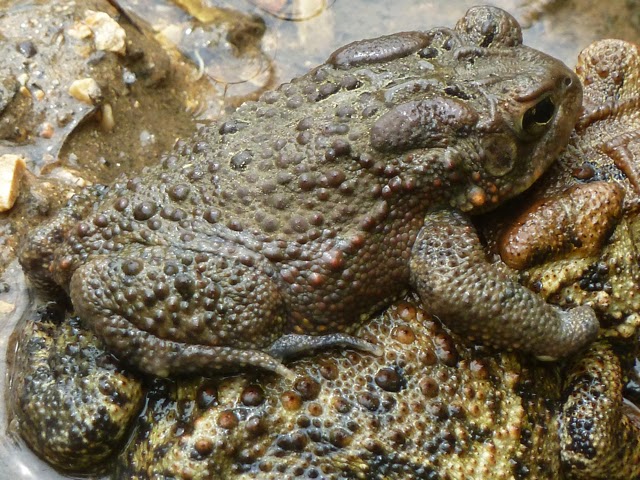
The eastern american toad usually starts calling in mid-April, but we heard a preview last week as one tried to overcome the chorus of spring peepers.  Their high pitched trilling call seems to hang on forever, up to 30 seconds, as you wait for it to stop for a breath. They will soon be mating and you can look for their distinctive long, double strands of eggs in ephemeral collections of water.

Eastern tent caterpillar egg case
Eastern tent caterpillars will emerge from their egg cases which encircle the branches of our plum trees, ready to start building their web-like homes.  These will protect them by creating many layers of walls, insulating them against the cold.  Look for the cases and you will soon see tiny holes appearing before you will find the caterpillars.  Their host trees flowers will be the first to bloom along our drive.


Hummingbirds will start arriving any day now.  They will be hungry from their trip back from their wintering grounds in Central America and most will be moving on after fueling up.  Even though it was blustery today, we have loaded up the bird feeders, as there won't be many other nectar sources around for a while until columbine starts blooming  They can also feed on tree sap and flying insects but both are hard to come by at this time of year.

Snakes begin to emerge from their hibernaculum (dens) when average temperature of the soil warms sufficiently.  Watch for copperheads - they are just minding their own business and you are too big for them to eat so they don't want to waste venom on you.  Leave them alone unless they are around your house.

Copperhead - (he was photographing the mushroom) - Mark Bower

Serviceberry blossom - Wikimedia
Dogwoods and redbuds will soon be in bloom, preceded by the delicate white serviceberry blossoms.  Nearer to urban areas you will see the early blossoms of Bradford pear trees and their invasive callery pear offspring, a reminder to plant native species in their place.
Three-toes box turtle laying her eggs
Why did the turtle cross the road?  In a few weeks it will be due to their raging hormones driving them to look for love.  This is a dangerous occupation as they commonly cross roads in their quest.  If you are lucky you might get to see a female digging a hole to deposit her eggs. 

Black vulture parent - 2015
Our annual big April event has occurred; the black vultures are brooding again in our old barn.  After five years of observing them, they look bored when I open the door to the stall.  Today he/she (they both brood the eggs) glared at me for a minutes before getting up to show me the eggs.  I think it knew the paparazzi would not leave until he had the photograph.  This weekend their seasonal neighbors the barn swallows arrived and are adding their nests in the eaves above them.