Wednesday, July 14, 2010

Armadillo- The Quattro Mom

During a drizzly morning my lovely editor read me a passage on armadillos from About Mammals and How they Live by Charles and Elizabeth Schwartz.*  Their birthing habits led me to read more about this recent Missouri intruder.
We are all familiar with these strange creatures, also known as Dasypus novemcinctus or Texas Speed-bumps.  They have an adaptive defensive strategy of jumping straight up when startled, helping them avoid the first lunge of a predator. This served them well until they encountered the automobile.  Try to avoid hitting one by straddling it and it will likely jump straight up into the bumper. Scitech/mysteries
Armadillos appear to have been created by a mammalian design committee with a majority of herpetologists and paleontologists.  There are 20 species, all native to the Western Hemisphere.  The largest is the cleverly named Giant Armadillo which can reach five feet in length and 130 pounds.  Their nearest kin are the sloths and anteaters.  In spite of their appearance, they have proven resilient and have adapted to climatic change better than many humans.
Technically,  nine-banded armadillos are not an invasive species.  They are not native to Missouri and cause economic damage to lawns and golf courses.  They avoid the "invasive" label because they arrived here on their own four legs, rather than being brought here by humans.
The passage that caught Barb's attention was this.
"Although armadillo young are well-developed at birth, the mother still prepares a nest for them in an enlarged room at the end of her tunnel.  Here her babies are born.  In the mammal world, armadillos are unusual because there are always four youngsters at a time, and they are identical in every respect, including sex.  Truly quadruplets!  The skin coat of the young is still soft as leather; its armorlike  texture does not completely harden until the young are fully grown." **
Though relatively new to the state, they are considered part of Missouri's wildlife and should not be killed wantonly. If you trap or shoot an armadillo, Missouri's Wildlife Code requires you to report the action to a state conservation agent within 24 hours.
Though some armadillos carry the bacterium that causes leprosy, the risk to humans is very small. Few cases of leprosy in the United States have been linked to contact with armadillos, and those instances involved prolonged exposure according to John Miller, a naturalist supervisor at MDC's Shepherd Hills Conservation Center.
A more likely danger, Miller said, is standing or leaning over an unsuspecting armadillo. When startled, armadillos can jump several feet straight up. (This may be one reason armadillos often end up as road kill.) Weighing up to 20 pounds and equipped with armor plates, an armadillo can pack an unintentional wallop when alarmed. Missouri Extension
With the warming trend or recent years, it seems safe to say that armadillos are with us for the long haul.  We can expect to occasionally run into their nose shaped holes as they dig out grubs and insects.  If only they would specialize in Japanese beetles.  As for the golf course problem you may soon be saying,  "Hey, you want to go shoot 40 holes today?"
(editor's note:  Ironically yesterday while I was standing near the creek, I was briefly foot to foot with one.  It ran up to me, both of us were surprised, neither of us jumped, then it charged down the stream bed.)

There is a comprehensive article from the 1997 Missouri Conservationist on line at this site.

*Charles and Elizabeth Schwartz wrote The Wild Mammals of Missouri, a beautifully illustrated encyclopedic work.  Charles was the original illustrator of Aldo Leopold's Sand County Almanac.
**   All About Mammals and How They Live, Charles and Elizabeth Schwartz, 1993 was written as a companion to Wild Mammals of Missouri.  It looks at all mammals in terms of where they live, how they get their food, care for their young, defend themselves, etc.  It is a great way to  understand mammals adaptations.
Picture from lorettasueross.com

Monday, July 12, 2010

Right Handed Snails

If you want to dig deeper into the snail shell, try this in Pubmed.  Most species are composed entirely of individuals that are one or the other type.  In exceptional cases, populations may differ in their handedness, or chirality, but within a single population, all individuals tend to be alike.  The mechanisms are spelled out in Pubmed.

* NPR story on Southpaw Snails 'Dodge' Right-Handed Crabs
You can get into counting snails with your local stream by joining a Stream Team.

Saturday, July 10, 2010

Bald Birds, etc.

I keep a close eye on the MDC Blog, and today this one jumped out at me, probably for something I have in common with an occasional bird.  Bald birds brings to mind turkey vultures and eagles, but other birds show their pate occasionally. 
The June 24th entry showed a bald cardinal on a feeder and it was one ugly bird.  It looks like a cross between a cardinal and a vulture.  Fortunately, baldness doesn't have the same effect in humans- I hope.  Tim Smith discusses how it happens.
The condition arises during the bird’s molting period, when old feathers are being replaced with a new set. In the few bald individuals, the feathers on the head are lost simultaneously. During the normal molting, with sequential replacement of feathers, the birds are never without their feathery covering. A contributing factor in the bald birds may be the birds’ rubbing their heads on objects during molting, due to itching from lice. The bald condition is temporary, as new feathers will later emerge to recover the bird’s head. It’s probably a good thing that most bird feeders don’t contain mirrors."
In Invaders at the Door on June 18th, Tim gives a nice succinct description of the life cycle of the Japanese beetle that is back plaguing the Ozarks.
 Adult beetles feed for about two months after emerging from the soil in late June. During July they mate and the females lay 40 to 60 eggs in the soil. Larvae, or grubs, emerge from the eggs in about two weeks and will feed on plant roots and decaying vegetation before overwintering in the soil and emerging as adults the next spring. The grubs can damage lawns by feeding on grass roots, leaving plants more susceptible to summer drought damage. The adults feed on the foliage, flowers and fruit of hundreds of different host plants, including fruit and ornamental trees and shrubs and agricultural plants such as corn and soybeans. When feeding on leaves, they eat the tissue between the veins, leaving mere skeletons of the former leaf.
Finally, the July 9th blog describes the two brand new publications from MDC.  Show-Me Herps covers turtles and snakes in a guide similar to the popular Show-Me Bugs.
Missouri Wild Mushrooms is a guide to 102 common mushrooms found in Missouri.  This is designed to educate without being encyclopedic.  It also has 24 recipes, which is why I am getting it for Barb for our anniversary.  An added incentive is the offer to Master Naturalists which Jay sent earlier.  Don't tell Barb it was a bargain- I want her to think I splurged for her. (editor's note: How could you think you could get away with that Bob?)

You may want to save a link to the MDC Fresh Afield blog on your browser, as we all will find something different to learn there.


Thursday, July 8, 2010

Following the Jordan Under Springfield

If you were downtown Tuesday night you would have seen an interesting sight as 15 Master Naturalists armed with flashlights and boots descended into Jordan Creek at Main Street.  Our expedition was led by Mike Kromrey of the Watershed Committee of the Ozarks.
Those who have participated in Stream Team activities are used to accessing stream health by studying flow, oxygenation, and counting macroinvertebrates living in the gravel.  Today's mission- explore the 3/4 mile of Jordan Creek under downtown Springfield which was covered over in 1928 to control flooding.
Loring Bullard's booklet, Jordan Creek- Story of an Urban Stream is a fascinating description of Springfield's history, focusing on the creek through its heart and the famous "natural well of wonderful depth" which was a factor in John Polk Campbell's decision to settle here.   
This "well" was actually an 18 inch by eight foot karst window, a surface opening into a cave below, accessing an underground stream.  This was located just across from Founders Park.  The well and the nearby springs were seminal in Springfield's development.  In addition to drinking water for humans and horses, they provided water for industry and daily activities.  Civil War soldiers washing their clothes at Fulbright Spring contaminated the downtown well with soap suds three-quarters of a mile away.  Colored water from a woolen mill on the creek in 1876  was the first locally reported chemical contamination.  By 1884 the well itself,  just south of Water Street, was covered by concrete.
Frequently wading through one to four inches of flowing water in the center channel, we could survey the drainage from the impervious surfaces of downtown Springfield.  Most street and sidewalk trash is flushed rapidly downstream by rains.  It hadn't rained in over a week but still scattered cigarette butts line the stream edge as occasional small pieces of plastic drift down stream.  White particles flushed off a newly installed nearby roof can be seen in Jordan Creek and later above on the sidewalk and street gutter.  
Our flashlights reveal scattered graffiti, drains from the street, and the old stone arches of the Campbell Avenue bridge overhead, a silent tribute to Springfield's founder.
You might expect it to be lifeless in this pitch black environment, but as Bill Bryson says, "Life just wants to be."  Flashlights reveal a few crayfish under loose rocks, then occasional  Southern Red Belly Dace swim against the current as stone rollers cling to the bottom while awaiting upstream snacks.  Later we found a green sunfish, a new species to this stream section.  Further upstream we find three six-inch Yellow Bullheads, clustered in an eddy formed by a larger rock.  All of these species survive because they are tolerant of pollution and low oxygen levels of an urban underground stream. 
Mammals occasionally pass through as evidenced by footprints left by a raccoon or opossum in some soft moist sand.   Overhead in the expansion joints of this concrete cave we find occasional big brown bats clinging the the walls and ceilings, most sleeping but this one eying us with suspicion. Click pictures to enlarge.
This grotto is a good example of the impact of dense populations on a small urban stream.  It also shows why studying stream quality is important.  The water here is headed downstream and, after all, we all live downstream.

For more on Stream Teams go to mostreamteam.org
Original source material on Springfield Water springs and wells is at Fairbanks and Tucks History.
The history of Jordan Creek booklet, a must for those interested in Springfield history is available for purchase at the Watershed Committee of the Ozarks, 320 North Main Avenue Springfield, MO 65806-1208

Wednesday, July 7, 2010

Black Bears

Seeing a black bear is Missouri is still an exciting event to most of us.  These encounters are occurring more frequently each year as the bear population is expanding north of Arkansas.  Rural and forested areas are increasingly subdivided into smaller residential plots.  A female black bear's normal range is 1 to 15 miles, while a male will cover 8 to 60 miles, looking for food and love.  As this range is increasingly broken up by human habitation, human-bear encounters are inevitable.
This week the first attack of a bear on a human was recorded in Kentucky. Western states have lots of precautions including training for hikers and bear-proof trash and food containers, and we will be seeing more of these in Missouri.
The story of their resurgence is covered in The Bear Truth.   I use the term "resurgence" because bears were once very common in Missouri.  Henry Rowe Schoolcraft described frequent bear encounters and commercial hunting of bears regularly in the Journal of his trip through Southern Missouri in 1818.
MDC Online has a good resource called Controlling Nuisance Bears, and Conservation magazine has had several good articles this year including the May issue with Be Bearwise in Missouri.
Any wild animal can become used to human presence.  The normally shy coyote is no exception.  Last week a coyote attacked young girls on two separate occasions in suburban Rye, New York. (New York Times)
The April 29th blog, Turkeys Gone Wild, discussed turkey gobbler attacks on humans.  With the peak year our rabbits are having, I expect any day to be surrounded by bunnies nibbling at my boots.  As we  expand our living space into nature, altering habitat and fragmenting animals range, we prove that the old saying is true.  Familiarity does breed contempt.

There is a lot more information on black bears at Americanbear.org. 

Sunday, July 4, 2010

Skulls and Furs

We just finished a training by Jay Barber on Skulls and Furs.  This focuses on teaching how to use these materials to show kids and adults in how mammals live, their habitats and eating strategies.  Our goal is to develop a team of Master Naturalist teachers that can take these lessons out to schools and the community.
Furs give people a way of relating to mammals tactically,  feeling and observing a pelt while learning the life cycle of a wide variety of Missouri mammals.  In addition to identifying pelts and the habits of their prior owners, Jay had some fur jackets and mink stoles as examples of how pelts have been used by women in our society in recent years. 
The Wild Mammals of Missouri from University of Missouri Press has extensive information about  skulls, jaws and other bony structures of mammals.  (See picture)  While quite detailed, it has taken me a lot of time to try to identify an individual skeleton.
The Skulls portion  gave us the opportunity to quickly categorize Missouri mammals by their jaw and skull structures.  The shape and placement of teeth can reveal what an animal eats and how it hunts.  Long prominent canine teeth suggests a carnivore while flattened human-like molars are typical of a herbivore.  There are many more features that can separate individual species.

The prominence of bony structures on top of the skull suggests the presence of powerful the jaws capable of crushing a prey rather than carefully chewing vegetation.  Auditory and nasal structures suggest the importance of hearing and smell in individual species.

Doris presented a lesson plan and lots of practical advice on how to structure the presentations to various grade levels.  For instance, 5th grade students can be taught the specialized adaptations of individual species.  On the other hand, first and second grade students (and some of us senior Master Naturalists) have limited attention spans and require short and simple lessons.
Plan to attend Jay's trainings on Birds (July 13) and Amphibians and Reptiles (July 21).

The Burke Museum of Natural History and Culture site has a good demonstration of the difference between carnivore and herbivore jaws.
Issuu.com has a pictorial guide to skulls.
There is a Skull Key pdf paper at Collin.edu.

Mammals Teaching Group 
Doris Ewing will serve as coordinator for scheduling.  The initial group includes Ann Morris, Kristin Riggs, Bob & Barbara Kipfer, Larry Maggard, Caryn Fox, Connie Johnson, Charlie Stewart, Merrill Dubach,  Charley Burwick, Vicki Sears, Rose Atchley, Sherryl Walker, and Sue Jeffery.


Thursday, July 1, 2010

Project WILD !!!

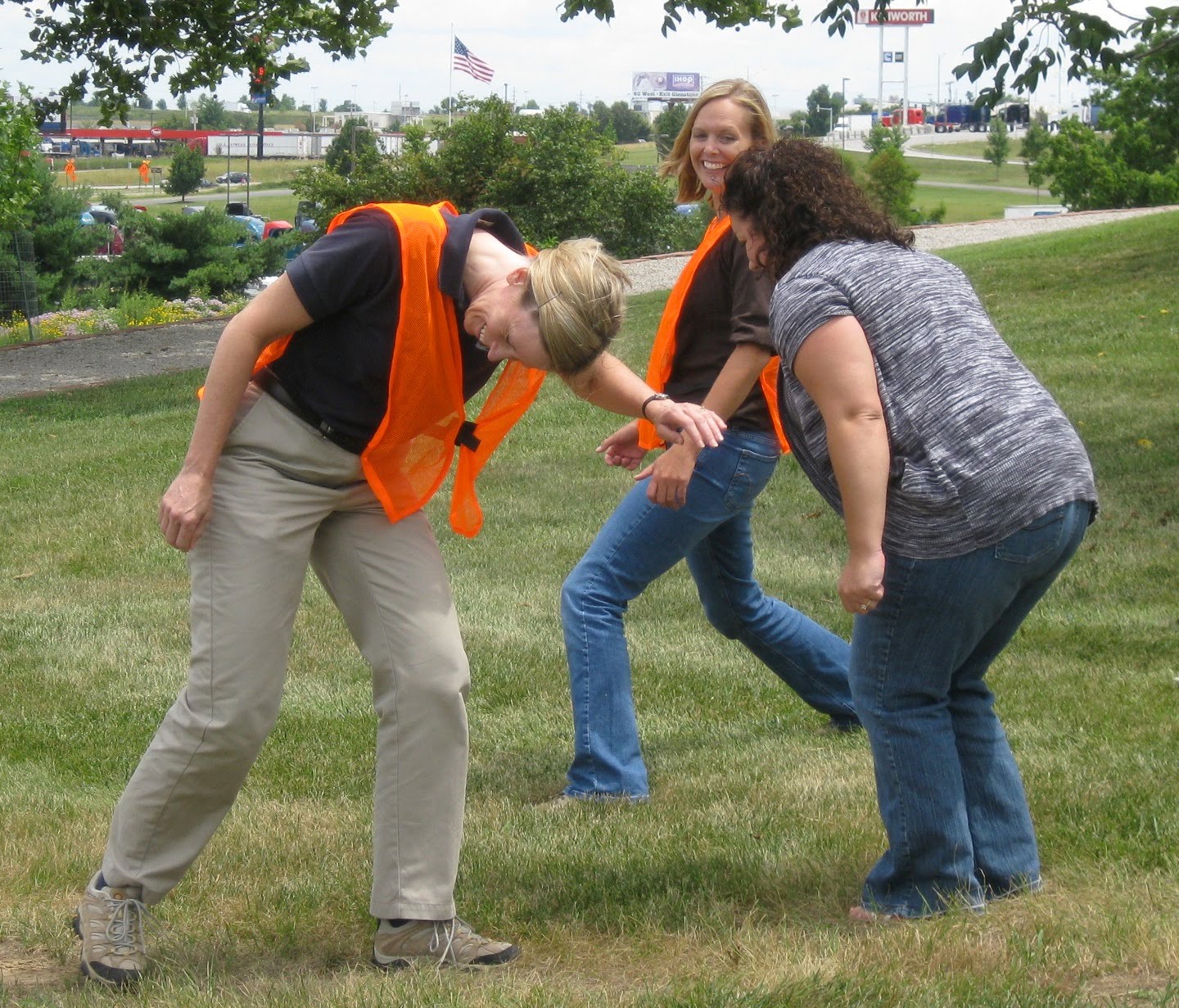
What were ten supposed adults doing running around the lawn of the MDC Regional Office?  Getting WILD- that is Project WILD.

Project WILD is one of the most widely used conservation and environmental education programs among educators of students in kindergarten through high school. It is based on the premise that young people and educators have a vital interest in learning about our natural world.  A national network of State Wildlife Agency Sponsors ensures that Project WILD is available nationwide --training educators in the many facets of the program.

 Our class of ten included teachers, MDC personnel from the Conservation Nature Center, city employees, college students and Master Naturalists.  It was taught by Jay Barber of MDC and Carl and Janet Haworth (facilitators from Master Naturalists).

We were introduced to the large number of teaching exercises by experiencing some of them as well as hands on teaching of each other.  It turns out that this group is not a lot different than 6th graders, just slower and a lot more wise cracks.

A morning exercise was to observe nature outside and write a poem in five minutes based on what we saw.  One format option was a cinquain, five lines of defined length and content.  There were lots of beautiful results.

Colorful river
Purple, green, over, under
Swaying and blowing, sleeping and running
Comfort, joy, strength and weakness below and above
Beautiful sight.
-Kim White

Flower
Tall yellow bright
Is gracefully moving
Searching, seeking, longing, hoping
For sun.
-Janet Haworth
Then there were those driven by the experience of the day, not so much beautiful as...well, you judge.
Mosquito
Little deadly
irritating, distracting, annoying, bloated
Blood sucking opportunist sucker diptera
Smacking squashing falling dying dead
Corpse.
-Liz Schroeder

Another exercise divided the class into Predator and Prey, 10 rabbits and 2 coyotes (in orange).  The coyotes are to tag the rabbits while they run from their safe homes between shelter (towels) to pick up food tokens and get back to their home base.  The goal is to introduce the experience of leaving shelter to get food and freezing when a predator is seen, much like a rabbit.  The rabbit has to get enough food to live while avoiding capture while the coyote will starve if it doesn't catch an occasional rabbit.  This leads to a discussion of strategies of predator and prey.