Sunday, May 29, 2011

Beetles that Bite Back

From LiveScience.com
In a "Man bites Dog" like story, scientists in Israel have reported on a beetle that attacks and eats amphibians of far greater size.  As reported in Livescience.com, the Epomis beetles frequently live peacefully in the same space with the toad or frog in the day.  At night, like a vampire, they strike.

Frogs and toads usually eat insects such as beetles.  In this case, the beetle bites the back of the amphibian which responds violently by trying to shake off the predator.  Once it has cut into the back, its prey is paralyzed and can be eaten at leisure.

The livescience.com site has a video of one attack.  These studies were done at Tel Aviv University in Israel and there are no observations of this behavior in the US - so far.

Friday, May 27, 2011

Shemales of the Wild

Leopard Lacewing butterfly
I came across these amazing pictures on LiveScience.com.  We all are familiar with hermaphrodites which are organisms that have reproductive organs normally associated with both male and female sexes.  These on the other hand are gynandromorphs, a whole horse (or in this case butterfly) of a different color.

You will notice that the wings are distinctly different.  According to Wikipedia, "A gynandromorph is an organism that contains both male and female characteristics."   The right half of the leopard lacewing butterfly pictured here is male while the left half is the typical paler color of the female.

According to the LiveScience posting, "This butterfly emerged from its chrysalis at Iowa State University's Reiman Gardens in 2008.  In almost nine years, Reiman Gardens has received about 163,116 pupae to populate its butterfly wing.  This leopard lacewing is the only gynandromorph butterfly to ever emerge."

Rose-breasted Grosbeak
Gynandromorphs occur when the organism is at the 8 to 64 cell stage.  If it occurs later, the animal is a mosaic with less distinctive changes mixed rather than divided in half  Gynandromorphs occur occasionally in crustaceans and birds as well, as seen in this confused looking Rose-breasted Grosbeak on the right.

There are 13 pictures including a cardinal and a carpenter bee which you can see on the LiveScience posting.

Wednesday, May 25, 2011

Barn Swallows


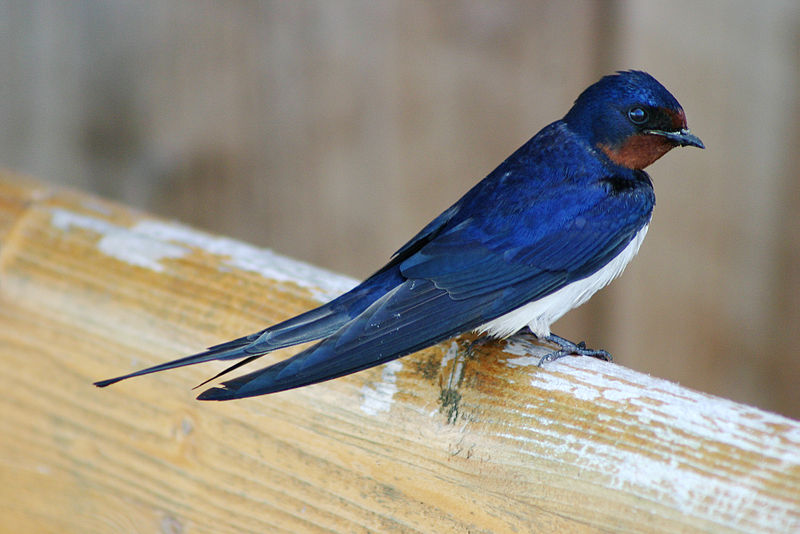
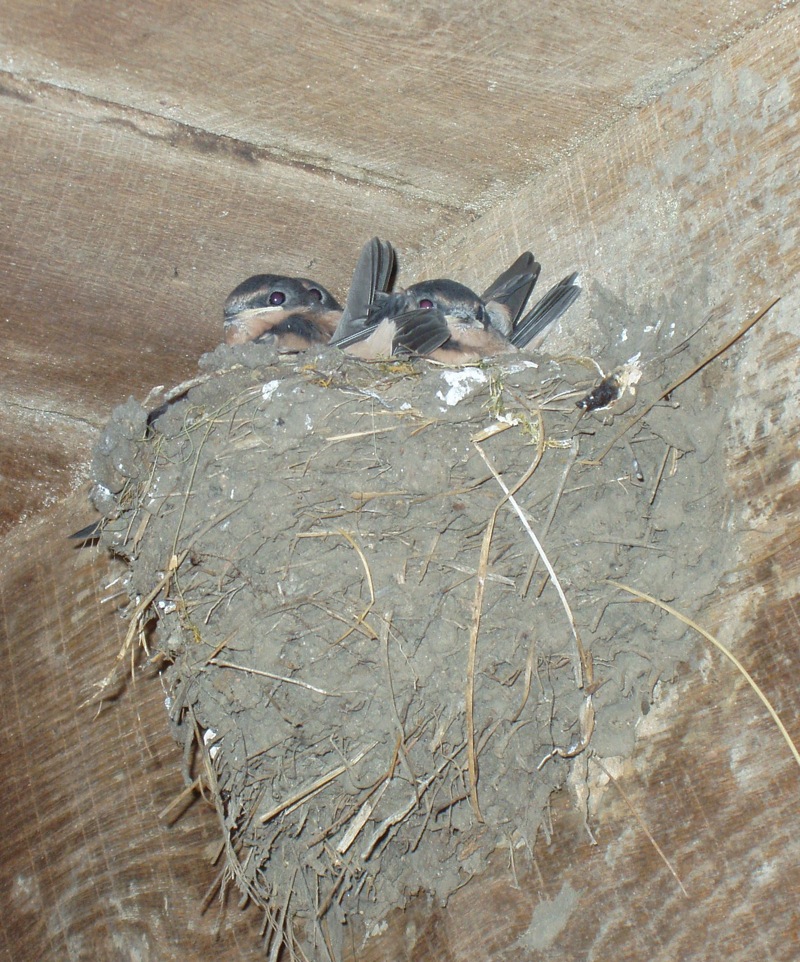
This is the time of year when our barn swallows go wild.  They return from their South American vacation and reclaim their mud nests that are glued to the rafters of our 100 year old barn.  They originally nested on cliffs but have expanded their numbers and range as humans built structures seemingly made just for them.

Click to enlarge

Barn Swallows (Hirundo rustica) are the most common of the swallow species, occurring in Europe, Asia and Africa as well as the Americas.  Like the swifts, they feed on the wing, flying up to 600 miles a day as they patrol up and down the creek at high speeds grabbing every tiny insect that we can't even see.  I become their new best friend when I run the tractor between the riparian plantings, stirring up a whole new crop of flying insects.  If I stop, they will patiently perch on the fence, waiting for me to flush their next flying crop.

They are less friendly when we enter the barn.  Their nests are filling with eggs and will soon have little peepers peering over the edge of them.  The parents get a little crazy, swooping in and out over my head with an ineffectual mix of "a twittery series of squeaky notes, often with dry rattle in the middle" as heard at allaboutbirds.org.

Swallow in flight
In the morning and evening, they patrol the garden, competing with the dragonflies for their flying meal.  Even at high speeds I can make out their deeply forked tail that is distinctive from the flat tail of the swallows.  This is apparently a big turn-on for lady swallows.  According to whatbird.com, "Females prefer to mate with males that have the longest and most symmetrical tails and a dark red chest color."  They apparently have read the studies which show that longer tailed males are stronger, more disease resistant and live longer.

A few other interesting facts:
  • A group of barn swallows are known collectively as a "kettle" of swallows.
  • The killing of Barn Swallows for their feathers was one of the problems that led to the founding of the Audubon Society and the passage of the Migratory Bird Treaty Act.
  • When building the mud nest, both male and female make up to 1000 trips collecting mud.
Wikipedia  has extensive information on these fascinating neighbors of ours.

Monday, May 23, 2011

Chimney Swifts

Shiann on point with Chimney Swifts
Once upon a time we were bothered by the chattering of Chimney Swifts in our family room fireplace.  We installed caps over the top that failed to keep them out.  Then suddenly we learned to love them.  Now their twitters in the fireplace in spring livens up our world and entertains our Schnauzer Shiann for hours.
"The very loudest sounds are made by the babies when they are being fed by the parents. Although it is quite loud, there will be only one active nest in any chimney at one time. Normally by the time the babies become loud enough to hear, they are less than a couple of weeks from being old enough to feed themselves. After that, most of the loud noise will be over." Chimneyswifts.org
Chimney Swifts (Chaetura pelagica) are frequently described as flying cigars.  They appear to streak through the sky with their wings beats alternately, something that took years and advanced photography to disprove to the prevailing opinion of ornithologists.

Click to enlarge- Wikimedia
Swifts live their lives on the wing, even drinking by skimming the water with their beaks open.  Like goatsuckers, they grab insects in flight with their jaws gaping open.  If you think this is easy, try grabbing your fast food order while passing the drive through window at 30 mph!  A breeding pair with youngsters to feed can consume 12,000 flying insect such as mosquitoes, flies and gnats a day.

They build nests in hollow trees and chimneys using twigs with their saliva as glue.  Even more impressive, they collect their twigs on the fly, grabbing them with their beak or claws.  If the twig doesn't break off, the bird tumbles in the air, then frequently makes a second pass.

Swifts are gregarious and migrate to South America in large flocks.  We now look forward to the first twitter of spring in the house.  Shiann still hasn't got it figured out.


Cornell has sound files of their chatter.
Chimneyswifts.org has information on how to live with chimney swifts and still use your fireplace.