Monday, April 14, 2014

Butterfly Season


As the temperatures gradually rise we are seeing the awakening of butterflies.  We have been seeing the goatweed leafwings and mourning cloaks occasionally throughout the winter and now they are everywhere.  The adults survive the winter by hiding under lose bark, emerging occasionally to collect tree sap.  Lately we are seeing a few tiger and zebra swallowtails that have emerged from their cozy winter chrysalis.

Zebra Swallowtail - Chris Barnhart
The zebra swallowtails, Protographium_marcellus, are flying low and rapidly, never appearing to land.  I don't know where they get all their energy this time of year as they are nectar feeders.  The flowers in bloom are tiny wildflowers and tree blossoms such as serviceberry that lack the landing space for the butterfly's feet.  In spite of this there are many flirting pairs and at least one has been successful.

Early pawpaw flowers
As we passed a pawpaw grove, I noticed the first signs of flower buds starting to open.  This is always a dicey time for the future fruit as a sudden frost will turn them all black and there will be few pawpaw to collect in the late summer.  I have noticed that the flower buds appear over a period of several weeks and some late ones may emerge after a freeze.

Checking a number of trees I found a few leaf buds opening and then felt the sudden thrill of discovery.  There, on a tiny unfolding leaf, sat a glistening pale green egg of a zebra swallowtail.
 
A female zebra swallowtail very carefully lays an individual egg on the underside of a leaf.  It seems to know that its offspring don't play well together so it lays only one egg per leaf.  When the zebra caterpillar emerges, it eats the egg case for energy, and then may eat neighboring eggs if they are available.  Since the only likely species on a pawpaw are zebras, it doesn't pay to invest the energy in eggs that will not survive.  It is interesting to contemplate how this trait evolved.

Additional thoughts on April 14th:
Tonight as the front has moved through the temperature is forecast to drop to 25 degrees, likely to kill both the pawpaw flowers and the egg we have been following to record its turn to orange in several days.  While being the first bud or egg may give the organism a head start, it comes with a price.  The zebras are like to continue laying eggs.  Whether the pawpaw produces more flower buds is the next question and I am guessing that we won't have pawpaw fruit again this year. 

Saturday, April 12, 2014

Serving Serviceberry


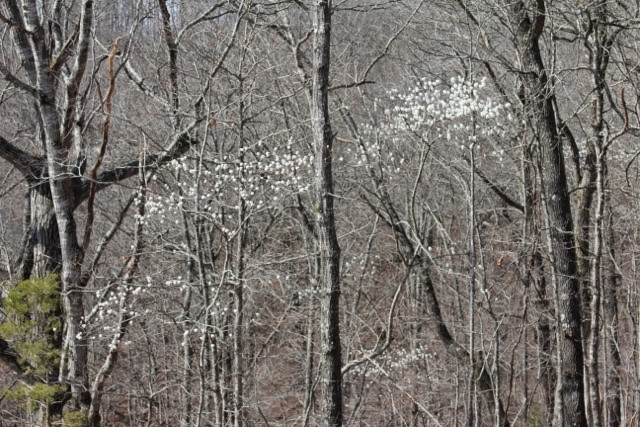
Serviceberries are blooming, the first of the cascade of flowering trees to be followed by dogwood and redbuds.  We consider them Mother Nature's answer to the plague of callery (aka Bradford) pear trees.  The flowers are small and delicate, a wisp of color among the oaks and hickories which are just awakening.  They whisper the promise of spring rather than shouting like a Bradford pear.

There are approximately 20 species in the Amelanchier genus, many of which confuse even the experts, as the trees tend to hybridize. Our local species is the downy serviceberry, Amelanchier arborea.  They have almost as many common names as there are species, including sarvis or sarviseberry, Juneberry and shad bush. According to Wildman Steve Brill:
"The shrub is called the juneberry because the fruit ripens in June. It's also called serviceberry because it blooms in mid-April, when long-delayed religious services were held throughout 19th century New England, as snow covered roads became accessible again. But not everyone was religious, and others would just as soon go fishing, especially when the first run of shad migrated upstream from the ocean, heralded by the blooming shadbush."

Mark Bower sent me these pictures with a note that you can eat the berries. 
The MDC page states that their berries can be sweet and great for baking and snacking.  Certainly wildlife enjoys them as 35 species of birds devour them at a time when few fruits are available and over a dozen mammals eat the fruit or the tender young leaves when little else has sprouted.

Wasp nectaring on serviceberry
Although the blossoms are small, they are an important nectar source for emerging bees, flies and other insects.  As the wasp that was nectaring on the daffodil bouquet on our dining table at the creek would tell you, there aren't a lot of natural nectar sources out there yet.  Unfortunately I didn't take a picture but then Mark sent me one taken fresh on his hill.

We saw this very distinctive bark on a November mycological survey at Mark Bower's land above Bull Creek.  Frances Main identified the photograph as serviceberry with its distinctive young smooth bark turning into darker gray with shallow grooves and long ridges.  I think I will be able to recognize it even when I can no longer remember the name of Allan What's-his-name.

Thursday, April 10, 2014

Spring at Last

Glade cress- Linda Ellis
I am finally pronouncing it spring.  Time to put up the firewood and start getting into the woods.  It was officially spring as indicated by the vernal equinox on March 20th, the day when the sun is at zenith over the Equator.  The date was first officially proclaimed as March 25 by Julius Caesar, but who is going to argue with an emperor?  Last week I thought that spring would never come, but now it has reached 70 degrees and April showers are passing through.

Glade Cress
I am ignoring Julius and going with Linda Ellis who proclaims the arrival of spring botanically.  She sent this picture of a glade cress, Leavenworthia uniflora, her first spring find while out hiking on her glade a few weeks ago.  It grows mostly in the Ozarks and has a very short growing season in March.  The single flower head is oversized compared to its dramatically long stalk as seen in this Missouriplants.com photograph.

Linda found a trout lily, Erythronium americanum, that same day.  It is another March bloomer, two green leaves usually with dull purple blotches support a single long stalked flower with lanceolate (lance-like) yellow petals.  Hers were on a glade which receives the sun's warmth far earlier than our deep valley where we still hadn't seen the leaves come up for another week.  Finally they have proclaimed spring in the valley.

Trout lily- Mark Bower
Traditionally, trout lily bulbs and leaves were eaten, either raw or cooked. The plant was also used in folk medicine to heal ulcers, as a mild emetic and antibiotic before those existed.  It was also used as a folk contraceptive.  After several unplanned children, this might have led the "folk" to the saying "hope is not a method."

Tuesday, April 8, 2014

First Reported Bluebird Twins


If you ever doubted the value of some mundane sounding citizen science projects, this story from Cornell Lab E-news is for you.   Gerald Clark, a retiree who spends time enjoying birds in his backyard, was monitoring the nests of Eastern Bluebirds in Pennsylvania.  A member of Project NestWatch he reported 3 normal eggs beside one large one in his bluebird box.  A few days later he had 5 chicks.  This is the first documented occurrence of bluebird twins!

With the frequent finding of double yolked eggs, I would not have thought it would be that rare, but apparently twins among wild birds are very rare.  It turns out that the odds in wild birds are one in a billion.  An article in CitizenSci describes the reasons for the rarity of twins in the wild.  The twins are crowded in and one has to be able to pip the shell to hatch.  In addition, both have to have access to the air cell where oxygen and carbon dioxide are exchanged through pores in the shell.

This citizen science finding was published in  PeerJ, a peer reviewed journal.  Details and pictures are at blog.allaboutbirds.org.  All citizen science begins by being aware of the opportunities and reporting findings.  Like the Christmas Bird Count and Project Monarch, getting involved is simple.  Check out the Cornell Lab of Ornithology's NestWatch at this link.

Thanks to Becky Erickson of MONPS (Missouri Native Plant Society) for the lead.

Sunday, April 6, 2014

True or not Rue?

Rue anemone just opening - Mark Bower
Rue anemone in full bloom- REK
Mark Bower sent Barb pictures of this beautiful little flower that is scattered in the wooded areas along Bull Creek. It far outnumbers other wildflowers at this time of year. It is a rue anemone.  The trick is to separate it from false rue anemone which is also common in this area.

"True" rue anemone has 5-10 sepals which look like petals and can be either pink or white and has a whorl of bracts which look like leaves below the flower head and the true basal leaves will appear after it starts flowering.   False rue is always white, has 5 sepals which look like petals and three-lobed compound leaves which come off the stem.

Rue - note bracts on base of flower head
Both species occur mainly at the base of wooded slopes and bottom land. Rue tends to grow solitary plants on drier sites and open woods while false rue often forms colonies and prefers moist areas.

Mark's plant has 6 sepals and the whorl of bracts off the flower head rather than the stem and therefore is the true rue.  According to Dennison in Missouri Wild Flowers, "they are possibly the longest flowering species of early spring."  Or as Barb says, "Aren't they sweet?"
White trout lily, Erythronium albidum - Mark Bower
Mark's trout lily or dogtooth violet reminds us that it is time to get out and get low.  Most of the spring ephemeral wildflowers are tiny and fighting to get above the leaf litter.  Getting pictures like these means getting down on the ground but it is worth it and the ticks seem to enjoy it as well.

Bloodroot, Sanguinaria canadensis, blooms for only one day - REK

Thursday, April 3, 2014

Golden Eagle

Golden eagle- REK

After a recent trapping of 11 feral hogs by hog trapping friends working with USDA and MDC, we had scattered gut piles in a narrow hayfield in the middle of the forest.  I put a game camera on it to see what would come in, hoping to get a picture of a coyote or bobcat.  What I got were eagles!

Turkey vulture warming up

Initially there were 12 turkey vultures that alternated shifts with 20 plus crows throughout the day.  In the early morning hours the vultures frequently had their wings spread out like they do on our barn to warm up.  I could not find any reference to mantling behavior to protect their finds and suspect that they were just cold.

Immature golden eagle

Then at 7:19 PM I "struck gold."  In spite of the setting sun and the 38 degree temperature, an immature golden eagle arrived and looked things over for several minutes.  The following morning it returned at 7:53 AM and hung around for 12 minutes, possibly discouraged by the 13 degree temperature.
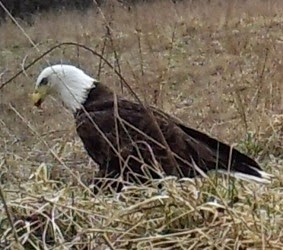

There was more excitement to come.  At 2:29 PM a bald eagle arrived, scattering many of the crows.  It only stayed around for 3 minutes, possibly turned off by the lack of anything but stinking guts.  This served to remind me that Benjamin Franklin opposed the selection of the bald eagle for the official seal as he considered it cowardly.  He favored the turkey.  The golden eagle might have been a better selection but bald eagles were more more commonly seen by the early settlers and were considered the American eagle.
"(The turkey) is besides, though a little vain and silly, a Bird of Courage, and would not hesitate to attack a Grenadier of the British Guards who should presume to invade his Farm Yard with a red Coat on.”  (I have personally attested to the valor of a turkey in the attack mode in Turkeys Gone Wild.)

The next afternoon a hawk arrived to join the vultures, but by then little was left but the intestinal contents and it quickly left.  It was interesting that its arrival didn't intimidate the crows.  I suspect that by this time even they had no interest in defending piles of intestinal content.

Hawk among the crows.

Now I am not a "birder" although I play one on the blog occasionally, so I first thought this was an immature bald eagle.  I referred this picture to Jeff Cantrell and a number of very patient GOAS* friends with expertise and they universally pounced on this as an immature golden eagle.

How big a deal is it to see a golden eagle along Bull Creek?  Their usual territory is west of Missouri, from Mexico through California up into Canada.  Furthermore, a small grassland in the middle of a forested region isn't their usual territory.  Allaboutbirds.com says "Golden Eagles live in open and semi-open country featuring native vegetation across most of the Northern Hemisphere. They avoid developed areas and uninterrupted stretches of forest."  As Jeff Cantrell wrote me, "That golden eagle is quite a find, for if it was Barton or Vernon County up it would be considered a great find and “uncommon,” and farther east and in more wooded hills it is really rare."

Based on my "years of golden eagle experience," if you want to see one, let me recommend hog guts.  Good for eagles and good for the land.  Organized hog hunting is discouraged, but if you see a feral hog, shoot it.  No permit is needed except for a valid permit when out hunting in deer and turkey season.  More importantly report any sightings immediately to the contacts listed below.  If you shoot a hog you may kill one but the rest scatter.  Trapping is much more effective than hunting and you might end up with some great pork.

Monday, March 31, 2014

April Phenology

Spring turkey - Conservationist, Noppadol Paothong
Phenology - the scientific study of periodic biological phenomena.

April is the time when the woods and fields come back alive.  After months of few new findings on a hike, all of a sudden everything is new as dormant life awakens and fertility cycles begin again.  Turkey are out everywhere, gobbling confidently in the knowledge that they are safe until youth season begins April 12th.

Belted kingfisher- Joe Motto
The belted kingfisher, a small bird with attitude and a bad haircut, began its loud chattering patrols up and down the creek last week, proclaiming its dominance to all within half a mile.  Birds of Missouri lists it as uncommon but we always have a pair taking possession on low slung branches above the shallow stretches of the creek.

Eastern tent caterpillar egg case
Eastern tent caterpillars will emerge from their egg cases which encircle the branches of our plum trees, ready to start building their web-like homes.  These will protect them by creating many layers of walls, insulating them against the cold.  Look for the cases and you will soon see tiny holes appearing before you will find the caterpillars.  Their host trees flowers will be the first to bloom along our drive.

Hummingbirds will start arriving any day now.  They will be hungry from their trip back from their wintering grounds in Central America and most will be moving on after fueling up.  Even though it was blustery today, we have loaded up the bird feeders, as there won't be many other nectar sources around for a while.  They can also feed on tree sap and flying insects but both are hard to come by.

Coldblooded reptiles begin to emerge when the average temperature suits them.  You will need to drive carefully on the country roads as turtles begin crossing them in their hazardous search for mates.  Also watch your step as copperheads will be emerging from their dens.  They are just minding their own business and you are too big for them to eat so consider letting them alone unless they are around your house.

Copperhead - Mark Bower  
Serviceberry blossom - Wikimedia
Dogwoods will soon be in bloom, preceded by the delicate white serviceberry blossoms.  Nearer to urban areas you will probably see the early blossoms of Bradford pear trees and their invasive callery pear offspring, a reminder to plant native species in their place.


One final annual April event; the black vultures are brooding in our old barn.  After four years of observing them, they look bored when I open the door to the stall.  Today I waited at the open door for several minutes before she stood up to show me the eggs.