Sunday, June 21, 2015

Attack of the Hummingbirds

Long-billed hermit - Dennis Skogsbergh
On our recent birding trip to Honduras, Janice Reynolds told the story of an acquaintance who had heard that hummingbirds could kill a human by stabbing their beaks into the center of the throat.  This led to an ongoing string of jokes about wearing a neck scarf for protection, reaching a peak at the final stop where we sat amidst large numbers of hummers including the Long-billed Hermit.  While we mammals are safe, there is a tiny grain of truth in a hummingbird "going for the throat."

Hummingbirds are aggressive by nature and most are not very communal.  Males will attempt to drive away competition, whether at a feeder or in fights over females.  Most of these are aerial battles with bluffs and "chest bumps" but occasionally a few feathers fly.  Usually there is no serious damage except to their chances to mate with a particularly hot female.

If you recall that the largest hummingbird weighs less than a nickle (5 grams), it obviously hasn't enough mass to penetrate your skin, no matter how fast it flew into you.  Watching hummingbirds fight, they hover at close range, banging against their adversary.  Their beak is just for sucking nectar..... right?

Hermit - Robert Gallardo
According to recent research, the long-billed hermit hummingbirds that we saw in Honduras will "go for the throat" during mating season, using specialized beaks that have evolved for mating disputes.  Research led by Alejandro Rico-Guevara from the University of Connecticut showed that their elongated decurved beaks (curving downward) are the "the first evidence of weapons in male bills."

They had observed that unlike our ruby-throats who battle with close encounters and chest bumps, the hermit male hummingbirds used their beaks in territorial fights with rival males during mating season. Rico-Guevara and co-author
"Marcelo Araya-Salas, a Ph.D. candidate at New Mexico State University, measured the size and puncture capability of beak tips in juvenile and adult hummingbirds.  The researchers found that during the birds’ transition to adulthood – puberty, if you will – males developed elongated beak tips that were sharper than those of females.

They also observed male birds using their bills to stab one another in the throat during fights, and found that, not surprisingly, males with longer, pointier bills were more likely to win these battles and therefore defend the best territories."
Rico-Guevara has observed the use of beaks as weapons in other hummingbirds and plans more studies.  He "hopes people realize that despite their tininess, hummingbirds are strong and aggressive animals."

At Rio Santiago in Honduras we were surrounded by hummers, a total of 12 species in all at over 100 feeders, most only a few feet apart.  The air was filled with buzzing and diving but no direct confrontations because the number of feeders reduced the need to compete for one.  You too can reduce most of the hummingbird combat by putting up multiple feeders separated by several feet.

An article in Audubon magazine discusses this and other interesting bird behaviors in the name of "love."  Go to Love in the Air: Even in the bird world, romance can get messy.

Friday, June 19, 2015

Walk in the Park

Growing in furrows in the bark of a large willow tree
With the forecast of heavy rain and the threat of being flooded in by Bull Creek, we escaped early from Bull Mills and returned to Springfield to hike around the Springfield Botanical Gardens.  We were accompanied by Cole (7) and Paisley(5) who view the landscape from a lower level.  In addition to the beautiful gardens, we were looking for different views of nature, including the mystery finding above.

Spicebush Swallowtail caterpillar - Not an eye but don't tell a bird that.
We started at the Butterfly House where there were several species flying.  There were remnants of giant swallowtail eggs, partially eaten by their recent inhabitants.  This is usually the first meal of the newly hatched larva.  The Spicebush Swallowtail caterpillar is always a hit with its cartoon "face" decorated like a character from Disney Studios.


In the deep wood mulch around the flower beds we found little fairy gardens of fungi, sending up their little umbrellas in an effort to reproduce by sending out their spores, the seeds of the next generation They are easy to overlook from above but interesting to view
from ground level. 


Paisley, Cole and "Cecilia"
There were Red-eared Slider turtles basking in the middle of the lake and families of geese strolling the grounds.  This turtle caught Paisley's attention as it headed north from the lake.  Earlier this year turtles were out crossing the roads looking for love.  This time of year is the end of the courtship cycle and we wondered if it wasn't a female looking for a site to bury its eggs.

The most dramatic finding was on the bark of a willow tree on along the walk south of Lake Drummond (see top of page).  There were bright red growths in the furrows of a large willow tree on the upland side of the walk.  I initially guessed that these might be some sort of fungi but Patrick Byers came up with an even more interesting explanation - adventitious roots!

Walter Reeves refers to this finding as "water roots" which form in times of rainfall and high humidity.  They are apparently normal and harmless, disappearing in a few weeks.

The term adventitious in botany refers to structures that develop in an unusual places.  Willows can grow from shoots placed in soil.  The stems have primordial nodes which develop these adventitial roots, establishing the root system for the willow to grow. This is the basis of using willow cuttings stuck in the ground for riparian planting.

Gabrielhemery.com CC
Why the pink to red coloration? Apparently nobody knows, although there are some interesting theories.  I couldn't even find much about them by an extensive Google search, but I did come across this beauty in England to confirm their presence.


Friday, June 12, 2015

Snake Weaving

Black but not Rat*
Coming off a busy week without time to sit down and create a blog, I received this gift from Gala Keller along with her description.  Not a lot of profound science but a great picture.
"I was going to the garden to pick lettuce and this black snake was hanging out on the fence. I gave him/her a tickle on the back thinking he would go on in the direction he was headed, but he just turned back toward me. I decided not to disturb its sunning any further, the lettuce could wait."
I can tell you that a search for "black rat snake" and "fence" gets nothing except a tradition that draping one over a fence will bring on rain.  Since we were flooded in for two days recently by Bull Creek, I hope that isn't true.

Initially I called this a Black Rat Snake but Kory Roberts of Herpes of Arkansas sent me a correction.  This is a subspecies of the North American Racer,  Coluber constrictor falviventris.  It has a smaller head than a rat snake as well as smooth rather than rat snake's keeled scales which have a ridge down the center that gives the rat snake a rougher texture.*  The racer behaves differently, including raising its head like a periscope at times to look around.  As the name implies, it escapes danger or predators by racing away, vividly described in Kory's Herpes webpage.

Black Rat Snakes, Pantherophis obsoletus are excellent climbers, slithering up a smooth barked tree, a fence post with a bluebird box or a flat wall with ease.  One site says they can only climb a few feet up a wall but we watched one go straight up a concrete block wall and through an imperceptible opening to enter the second story of our house on Bull Creek.  I would show you a picture but it was too fast for me.

Shed Black Rat Snake skin
We welcome them in our house as we have lots of wood rats a.k.a. pack rats that like to share the space of our A-frame.  The wood rats build nests in places such as our hide-a-bed, storing sunflower seeds, buckeyes, shiny objects and even ball point pens, a ridiculous addition since they can't write (that I know of.)  One nest had multiple pens and a high school graduation picture of a friend of the former occupant, as well as a cheap paring knife.  We probably were able to interrupt a murder plot when we trapped that rat.

I can't find the rats' entrances but they must have a bulletin board with directions to our house, as their numbers exceed our traps.  We find Black Rat Snake skins in the upstairs from time to time, and it is somewhat reassuring that these volunteers are watching out for us.

Rat Snake shed with eye skin intact
If you happen to see a shed, look carefully at the head end.  Although this is frequently gone, if you get lucky you can see the whole head shed.  You can see here that the skin includes the skin over the eye.  During the shedding process there is a time as the old skin separates when their vision is obscured, so shedding usually occurs in a protected area where they are less threatened by predators.

The price of housing a rat snake is small, although we have seen snake poop hanging between the separated boards in our living room ceiling.  The good news is their urine is extremely concentrated, forming a white powder on the floor which is easily picked up with a broom and dust pan.

Thanks to Gala for providing me a quick blog subject and to our 5' house guest for reducing our load of wood rats.  Unlike many guests, I wish they ate more often than once every 2-4 weeks.

Monday, June 1, 2015

One Cool Insect

Geina periscelidactylus
The creature above looks like an illustration from a science fiction magazine, but Kevin Firth assures me that it is quite real. It may look tattered or partially eaten, but it is actually a newly emerged healthy adult.  To save you from guessing what it is, I will tell you - it is Geina periscelidactylus.


I should have mentioned that he first found the larva above and raised it until it pupated. Its cocoon below is equally strange, looking like a broken plant stem. Time to mention that this is a moth! "Kind of excited about these little guys, though it sounds like it might be difficult to distinguish between Geina sheppardi and Geina periscelidactylus."  (Kevin and I are easily excited.)

Geina periscelidactylus pupa
Kevin was leaning toward calling it Geina periscelidactylus when he sent it off to BAMONA's Phil Koenig, who confirmed his diagnosis. This is more commonly known as the Grape Plume Moth, a common finding in the Eastern US. Its larvae feed on grape and Virginia creeper.

Plume moths are in the family Pterophoridae (not getting any easier is it?) characterized by their tattered appearing wings. On first glance they look like a chewed dead leaf or a bit of grass. Wikipedia describes them this way:
"The forewings of plume moths usually consist of two curved spars with more or less bedraggled bristles trailing behind. This resembles the closely related Alucitidae (many-plumed moths) at first glance, but the latter have a greater number of symmetrical plumes. The hindwings are similarly constructed, but have three spars."
This might be a minor annoyance if you raise grapes, but otherwise it is one cool insect!

Thursday, May 28, 2015

Bluebird Victims


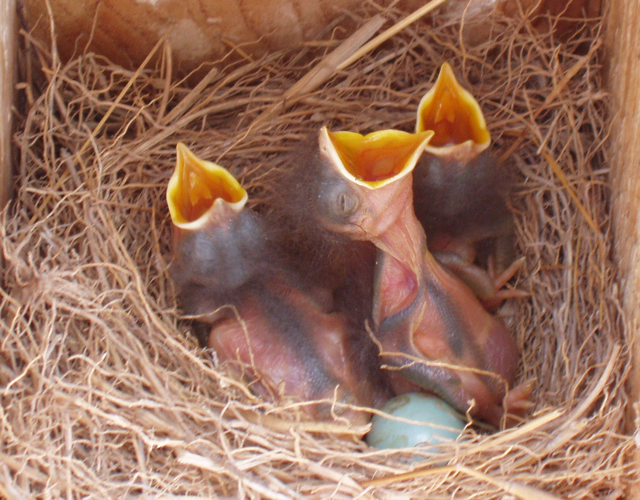
The scene above is one to warm the heart of anyone tending to bluebird nest boxes.  Watching them grow and fledge is the rewarding part of maintaining and cleaning the boxes over the year.  Unfortunately it doesn't always have a happy ending as reported by Mort Shurtz.
"I've been watching our bluebird house for several weeks. First eggs, then a check on the healthy chicks yesterday and everything looked good. This morning I discovered a House Sparrow on the bluebird box. When I inspected the box, all the chicks were gone and the sparrows had built a huge nest in the box. The babies were lying on the ground about 10 feet from the box with holes pecked in their heads"
Mort's Bluebird s- day one
After the attack
The House Sparrow (HOSP) is a native of Europe and Asia which has been transported to Africa, North and South America and Australia, making it the most common bird in the world.  Native species haven't learned to compete with them as they have only been exposed to this threat for a few hundred years.  HOSP thrives in close association with humans which, come to think of it, are also a rather invasive species.

HOSP are common nest predators of small cavity nesting species such as Eastern Bluebirds.  They will peck at the head and eyes, killing chicks and adults alike.  They will also destroy and remove eggs before building their own nest.  I asked Lisa Berger from GOAS* to comment.
"House Sparrows are fierce, nasty competition, negatively affecting many native cavity nesting species.  Bluebirds, Chickadees, Titmice, Tree Swallows, Carolina Wrens, House Wrens, Downy Woodpeckers and others did not evolve with the House Sparrow on the North American continent. The English Sparrow (House Sparrow) was introduced in the new world, soon after European contact: It is, in fact, an invasive species and should be treated as such. Our native NA species do not have strategies (nor have had time to adapt) to compete favorably with invasive species."
Like starlings, HOSP are not protected by the Migratory Bird Treaty Act, which makes it illegal to harm or harass any native species, including their nests and eggs.  For this reason, it is acceptable and even encouraged to remove the nests of HOSP if you are sure that it is the offending species.  Chickadees, wrens and others should be left alone, a nice byproduct of your nest box generosity.  Charley Burwick added this advice:
"On the GOAS Bluebird trails where we have had this problem, we just remove the boxes from the routes. Typically this happens when the Eastern Bluebirds build nests in a too urban area, and the House Sparrows are plentiful. Usually, when we have ran into this issue in more rural areas, it is where there are livestock pens, etc., too close to the boxes." 


*GOAS is Greater Ozarks Audubon Society

Nestwatch.org has some practical measures to discourage sparrows from nesting in birdhouses.

Sialis.org has lots of reports of nest predation by HOSP.  Graphic pictures of the results of a HOSP attacking a tree swallow nest, not for the faint-hearted, are at this Sialis.org link.
 

Tuesday, May 26, 2015

Firefly Larva


I found this creature on decaying wood, hidden among a crop of jelly ear mushrooms I was collecting.  Although it looks like a dinosaur or a flattened crocodile, the tee-shirt fabric it is crawling on gives away its size, only 3/8" long.

I initially thought it was a sow bug, one of the flattened cousins of the familiar pill bug, both members of the wood louse family.  When disturbed it curled into a defensive ball, a poor imitation of a "roly-poly bug" from my childhood.  After wasting time trying to identify it, I sent it to Bugguide and within minutes received this response, identifying it as a Photuris larva.  Photuris is a genus in the Lampyridae or firefly family.

The common perception of fireflies is romantic, the flickering lights in the dark summer night, as the blinking male looks for muted signals from lady fireflies perched on the grass below.  That evening is just the dramatic finale to a hard life as both predator and prey.

After emerging from an egg, all lamprid (firefly) larvae are predatory, primarily eating juicy slugs, snails and earthworms as well as small insects.  They have mandibles with small channels that inject chemicals that will paralyze and kill their prey, then liquify them for digestion.  What the final adult eats aside from tree sap is unknown and some adult species probably don't eat at all. Meanwhile spiders, ants, birds and even some bats are trying to eat them.

All lamprids have light organs in the egg, larval and pupal stage.  This is true of even the day-flying (diurinal) species discussed in the recent blog, which lose their bioluminescence in the adult stage when they would seem to need it most.  What purpose the light serves in the larvae is unknown, although some experts theorize that the light is an aposematic warning, telling predators "don't eat me, I taste bad and could make you sick."

This warning is not an empty threat.  Most firefly species have steroidal compounds that makes them distasteful or even toxic to predators, and the bioluminescence may be acting as a warning to potential predators.  These compounds are chemically related to the toxins on the skin of poisonous toads, called lucibufagins, a word that combines the Latin words for light and toad
Photuris eating another firefly
Photuris eating another firefly - Asknature.org- CC
Our larva above is in the genus Photuris, and one thing the adult females eat is known - other male fireflies.  These "femme fatale" fireflies have light flashing patterns designed to lure males of a different genus (Photinus), and it is not for sex.  These Photinus males have lucibufagins in their blood and when disturbed they can use "reflex bleeding" to release them as protection from jumping spiders and other predators.  Photuris females are aggressive predatory beetles and they are obtaining the blood of Photinus males, absorbing the toxic lucibufagins for their own defense.

It was early afternoon when I released my specimen on a dead log.  It crawled under the rotting bark looking for something to eat.  Thus ends my romantic story of fireflies.

Chris Barnhart had this to add:
"We should be seeing the adults soon. You can tell the Photuris males readily from their display - they have a greenish light and a faster pulse than the Photinus (remember Photuris as 'fast green'  and Photinus as 'slow yellow'."

Friday, May 22, 2015

Predator Guard from a Predator

Great crested flycatcher nest with snake skin -  the transient biologist
I have always been amazed how a tiny bird can build a complex nest on a small branch, balancing twigs, grass and even moss until it is firmly woven together.  Francis Skalicky's  article in the News-Leader added a material that was news to me - snake skins!
Tufted titmouse - Joe Motto
Both the Tufted Titmouse and the Blue Grosbeak commonly add bits of snake skin to their nest.  Other species including the Western Kingbird, Bewick's Wren and the House Wren may use snake skin, cellophane, or other flexible plastic as well.  These all would provide flexible, lightweight reinforcement to the twigs.

Research has shown that they may also serve as a predator deterrent as well, similar to a house sign warning that there is a burglar alarm inside. The Tufted Titmouse will incorporate bits of snake skin in its nest while a Great Crested Flycatcher may use a whole snake skin lining the nest with some hanging over the edges to show on the outside.  This flycatcher's eggs are frequently eaten by flying squirrels and rat snakes will take the eggs, the flycatcher and even the flying squirrel that is predating the nest.

So does the snake skin work as a deterrent?  A study described in Birds.com describes the proof.
"A test carried out by the researchers confirmed that to be so. Using 60 nest boxes in which quail eggs were placed, researchers added snake skins into 40 of the boxes, with 20 boxes having no snake skin in them. All of the 40 boxes with snake skins were left untouched, while up to 20 percent of the nests without snake skins were raided by flying squirrels – evidence that some birds use snake skins specifically to ward off predators, and it appears to work." 
If only a Black Rat Snake skin would deter the pack rats in our house!