Saturday, April 2, 2016

The Other Mockingbird

Barb called me outside yesterday morning to hear the mockingbird calling.  I went back for the camera and managed to get a picture of the bird when it dropped down to the ground.  When I saw it was a brown thrasher I was momentarily disappointed.  Then Barb did a quick search and found that it was the "mockingbird" we heard.

According to Allaboutbirds, the Brown Thrasher has one of the largest repertoires of any North American songbird, up to 1,100 song types.  Ours was playing its greatest hits but kept coming back to its version of the whip-poor-will, a nocturnal bird that has kept us awake during its breeding season. The other key to identifying the call was its repeating the song twice, then immediately starting the next tune while a mockingbird tends to repeat it three times.

The Brown Thrasher is rather distinctive with its long, slightly curved beak, long tail and a bright yellow eye that is prominent.  They migrate up this time of year, extending all the way to Canada.  There are reports of individual birds reaching Germany and England once each, probably on a foreign vacation.  Lisa Berger came up with more range data:  "
"They are listed as an uncommon Southern Missouri winter resident.  Locally, we see them on Christmas Bird Counts, similar to E. Phoebe.  These guys are more common in winter than my perception simply because they aren’t singing!"

They feed on the ground as well as gleaning fruit and berries in season.  Currently they are working our lawn, sweeping it with their long beaks looking for any available insects.  Then they fly up into the trees or wires to announce their presence, call for a mate, or just sing because it is a beautiful morning.  I went out to listen again this morning and was rewarded with a bird singing on the wire.  While our great sonic "discovery" didn't advance ornithological science, it made our day a little brighter.

Thursday, March 31, 2016

Honeylocust Eaters

Orange Wing on a zipper - REK
This little moth landed on my backpack just in time to make it to the blog.  You can see how tiny it is by comparing it to the backpack zipper it is perched on.  It's wingspan is less than an inch.  Googling "orange hind wing" brought up photographs without having to resort to Peterson's field guide.  This is commonly called Orange Wing - Mellilla xanthometata.


Mellilla xanthometata photographed by Jon Rapp at Bull Creek

This species has two generations a year, the first in early March.  They feed on honey locust trees, Gleditsia triacanthos, thus the genus name Mellillia, the diminutive from melinus ‎(of or pertaining to honey), from mel ‎(honey).  Looking for a more formal portrait the best one as usual comes from Jon Rapp.

Honey Locust with 9" thorns - REK
Honey Locust
The honey locust is the bane of many farmers as its bean pods are eaten by horses and cows which then spread them through the field.  The long compound thorns can grow to 12" on the trunk and grow all the way out onto the smallest branches.  They are capable of puncturing a tractor tire and relish my ATV's.  Even when small they can be a challenge to cut with a chain saw without feeling their wrath.  Some will be thornless like the tree in front of out house.

Not everyone hates the honey locust. It is the host plant for not only our moth above but also the Honey Locust Moth, Syssphinx bicolor, and the common Silver-spotted Skipper (Epargyreus clarus).  It also hosts the Honey Locust Plant Bug, Diaphnocoris chlorionis.

Silver Spotted Skipper - REK
Honey Locust Plant Bug


My favorite locust eater is the Honey Locust Bean Weevil.  You can read all about it here including watching it dance on a video.  Knowing that its kin are eating up the bean seeds makes me feel better about the thorn stabs..... a little.

July 12, 2017.  See Weevil, moth and downy woodpecker.
HHoneylocust


Tuesday, March 29, 2016

Northern Flicker

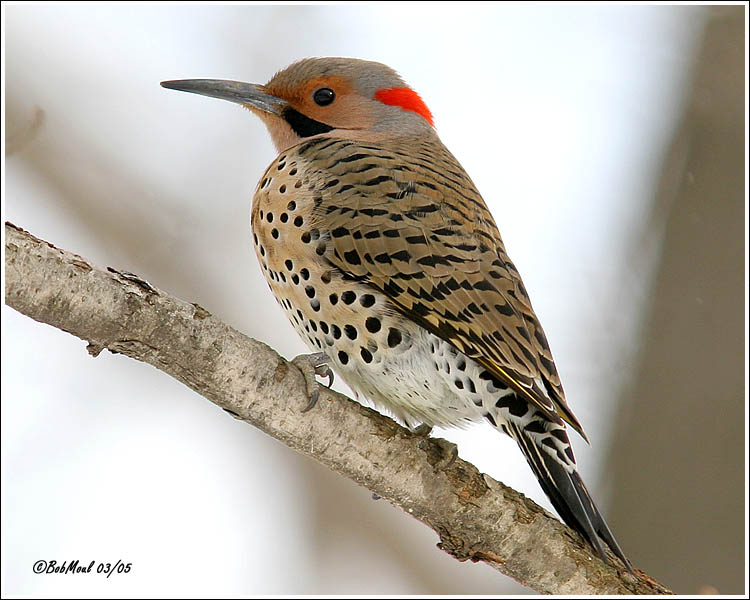
  Northern (Common) Flicker - Male- Bob Moul
Every year I discover at least one new species that was in front of me all along.  This spring it was the Northern Flicker.  We were visiting friends east of Oldfield and Barb spotted a pair feeding on their grassy yard, occasionally flying up to a tree just outside the second story window.  After she identified it, I naively emailed Charley Burwick to ask if they were common in the Ozarks.  His response confirmed my ignorance.
"During the fall, and again in the spring, like as we speak, they are quite common, and can be spotted in large groups. I led a field trip yesterday, and traveled through the Wah Kan Tah Prairie on the way to visit the Schell-Osage CA. There are large tracts that have been recently burned, and coming back in short green grass. There were somewhere between 80-100 of them feeding mostly on the ground, which is common for this species, and some small trees full of perched flickers as well. They are typically all yellow-shafted."
Northern (Common) Flicker-Female - Yellow Shafted
Then a few days later I was driving across our field along Bull Creek with friends from Minnesota as a dozen birds flush out of the grass one at a time several hundred feet in front of our UTV.  "Flickers," Matt said, pointing out the white patch on their rump that flashes as they flew straight away from us to land in distant trees.  Then I had an "Ahaa" moment.  We have noticed for years that when riding up on the fields on the ridge tops we would scare up 8-10 "woodpeckers" that we identified by their distinctive flight, flapping upward, then gliding down in a gentle vertical zigzag.  Northern Flickers all along!


Next we went to our favorite, Allaboutbirds.com from the Cornell Lab of Ornithology.  Their front page of the Northern Flicker has their call, a sound we have heard commonly and had ascribed to our common Red-bellied Woodpecker.  Embarrassing!

Yellow flight feathers and white rump - Andy Reago & Chrissy McClarren
Details we haven't gotten close enough to see include the yellow shafted flight feathers of the eastern species which are red in the western species.  They eat mainly ants and beetles on the ground unlike their tree-drilling kin.  They have a barbed tongue which can extend 2", handy when you are lapping up ants.

Unlike most woodpeckers, flickers migrate south for the winter.  This makes sense for a ground feeding bird whose supply of insect food would become scarce in freezing temperatures and snow.  This accounts for Charley's observation of large numbers in spring and fall.  Now if I can just recognize them in 6 months!

Sunday, March 27, 2016

Crabapple in the Wild

Crabapple in full bloom - REK

Grapevine Epimenis nectaring - REK
Last week our friend Debbie found a tree that was just opening a few pink flower buds.  In riding around the rim of the forest, this was the only splash of color.  It was buzzing with insects, the only source of nectar in sight this early in the season when serviceberry flower buds were just thinking about opening.  Solitary bees, honey bees, a tiger swallowtail and a very persistent Grapevine Epimenis moth flew around mostly out of camera range.  Barb identified it tentatively as a Prairie Crabapple.  We took a few pictures and returned a few days later to find it in full bloom.

We were now joined by our botanist friend Matt and Dave.  Now the leaf buds scales were off, revealing the small narrow leaves.  I thought they most resembled Narrow-leafed Crabapple, Malus augustifolia, but our Missouri trees books said that species only occurs in the Bootheel of Missouri and their leaves are said to be red when first emerging, contrary to our tree.

Smooth bark, horizontal lenticels

The bark of the tree was smooth with horizontal lenticels.  That and the flowers with five petals Matt explained were the identifying features of the Malus genus of the Rosaceae family.  These blossoms were pink and had from 10-20 stamens with yellow anthers just as the book says.

From there on we were left guessing about the species.  The Prairie Crabapple Malus ioensis is the most common native crabapple in our region but not a perfect fit.  The possibility remains that it could also be an exotic escapee.


The leaves didn't help us much, not fitting any one species.  Time for an expert opinion so I sent it off to Justin Thomas.  His response:
"Gorgeous tree! I was able to see that the outside of the sepals are hairy, in one of your photos. That puts it with Malus ioensis. There are scattered records of aberrant hybrids of Malus ioensis with domestic apples, but that is unlikely." 
Malus ioensis - the Prairie Crabapple has a huge list of faunal associations, including moth caterpillars, web worms, etc.  A wide variety of mammals consume the crab apple fruit, distributing its seeds widely.

As always (almost), Barb was right again on the species.  How about them apples!

Saturday, March 19, 2016

Springing Forward

Morels of spring 2013 - from "Mushroom Annee" Yarnton
This year "spring forward" applies to nature as well as our "beloved" daylight savings time.  Everything is a week or two ahead of schedule.  According to news just out in Time Magazine: "Global temperatures in February were the most above average since weather record keeping began nearly 150 years ago, bringing the world the closest it has ever been to what scientists consider dangerous levels of warming, a federal government agency confirmed Thursday."  To confirm this, the latest is news of morels found at several locations in southwest Missouri already.  Wonder where.....well DUH!  You expected GPS readings?

Our friend Jeff Cantrell, the MDC educator from the Joplin area sent us a nice description of a spring trip you might consider, along with some enticing photographs.  Here is a guest blog from Jeff with his photographs:

Buds are bursting open - Cantrell
One of the best things about having a “weekend” on a Wednesday/Thursday combo is you can savor several thousand acres of the Mark Twain National Forest to yourself. I spent 6 hours there this morning and I never saw one human being. Solitude can have many meanings; “pure soul refreshing” is one of them.

Piney Creek Wilderness (Barry County) can be one of your favorite starting points for chasing spring, it is mine. What happens here will be taking place in a matter of days in Newton, Lawrence, Christian, Dade counties and perhaps in over a week in Jasper, Cedar, Vernon and Barton... This “Wilderness” is latitude-even with southern McDonald County so there should be equal riches taking place in McDonald as well.


Their serviceberry are ahead of ours - Cantrell
The serviceberry are providing a mid-canopy, white petal-cloud layer against the pines and it is striking from a distance. Plus, you can hand pick your favorite scene by framing the blooms against the dark short-leafs, the blue sky, individually or in a floral swarm.

Spring Beauty - Claytonia virginica - Cantrell
Spiderwort - Tradescantia ernestiana. - Cantrell
Pine warblers and white-throated sparrows were in chorus, little midland brown snakes have emerged, and five species of butterflies were out. The ephemerals consisted of bloodroot, toothwort, harbinger of spring, Sweet William, pussy toes, violets, woodland spiderwort (cow slober), spring beauty and false rue anemone (wind flower). The holler/ wet areas harbored southern leopard frogs, peepers, western chorus, and American toads. My mind wandered as always to sleeping Ursids (black bears), wondering what they were dreaming of?

So if you are off this weekend, you might check out Big Sugar State Park, Piney Creek, or other southern Master Naturalist region targets. The life is opening up in our direction and changes daily.

Enjoy! It is a great time of year. - Jeff


Thursday, March 17, 2016

To Feed or not to Feed

Going where the food is - Blackbearinfo.com
After I posted this blog on feeding bears, I started thinking about what causes humans to want to feed wildlife. These acts blend the self-gratifying sense of feeding those in need, (even if they don't need it), with the desire to tame nature or at least bring it in close to us (but only on our own terms). We feed birds on our deck along Bull Creek. Squirrels are tolerated on corn cobs but discouraged on bird feeders. Raccoons express their gratitude by tearing down feeders and leaving seed-filled deposits on the deck.
A good day at the feeder  REK
Even among the bird visitors we impose our own social ranking. There is the normal neighbors, the chickadee, nuthatch, finch, and cardinal. We pause in conversation with friends to point out the arrival of a red-belly woodpecker. A downy woodpecker warrants a second look to be sure we haven't mistaken its cousin, the hairy woodpecker, higher ranked by its infrequent visits. In season there are even orange slices out for an oriole, the equivalent of a visit by royalty. We scare off crows which will devour a suet block in minutes and cowbirds that are a threat to songbirds.

Is feeding animals good or bad? The answer is "it depends." The good is obvious, the bad requires more thought. We know that bringing deer together in close proximity leads to increased risk of hemorrhagic disease and chronic wasting disease. Bird feeders can be a source of spread of avian pox, Aspergillosis and other disease and there are recommendations for preventing them. Feeding bears deliberately or accidentally with garbage or dog food lessens their fear and can produce a dangerous bear at risk of future euthanasia.

Americans spend over $3 billion each year on food for wild birds according to an essay Why do we Feed Wild Animals from the New York Times. It gives a thoughtful analysis of our varied motives as well as exploring the loneliness that leads some people to face fines for defying feeding bans.


Wednesday, March 16, 2016

Native Bee Houses

Leaf cutter bee, Megachile lagopoda-Wikimedia
When we think of pollinators, beautiful butterflies and the honey bees, which were imported from Europe by our ancestors immediately come to mind.  Fortunately, pollination was going on thousands of years before the honey bee arrive.  As Dr. Chris Barnhart reminded us at the Springfield Conservation Nature Center last week, many flowers and trees are pollinated by humble species such as solitary bees, bumble bees and even flies and beetles.

Solitary bees make up over 90% of bee species.  Unlike their better known communal cousins, every female is fertile creates its own family.  They are commonly divided up into carpenter bees, leafcutter bees and mason bees.  There are also sweat bees, polyester bees, squash bees, dwarf carpenter bees, alkali bees and digger bees.  Way too much for my aged brain to encompass.  Suffice it to say that lots of the little bee like things, visiting your flowers and plants are far more complicated than we can take on in a single story.

The message here is that they are an important part of our natural community.  Many of these species depend upon holes in wood (think dead trees) for a nesting site.  Guess what?  In our world, most dead trees get cut down before woodpeckers, beetles and other natural recyclers create the holes they need for their families.  This is where gardeners and other naturalist-minded people come in.

A quick and dirty bee house - REK
Many of the species need preformed holes to lay their eggs and raise their families.  One answer is building bee condominiums.  With a set of 1/8th to 3/8th inch drills you can turn blocks of wood or even dead trees into nest sites like these for solitary bees.  Another quick and crude method. is using hollow grass stems cut to length as above.*  Be sure that one end is blocked off and the open ends are at a slightly lower level to prevent rain from entering.

* If you are in the Springfield Missouri area, I can provide you with stems from the Springfield Botanical Gardens.