Tuesday, July 26, 2022

Handful of Wasps


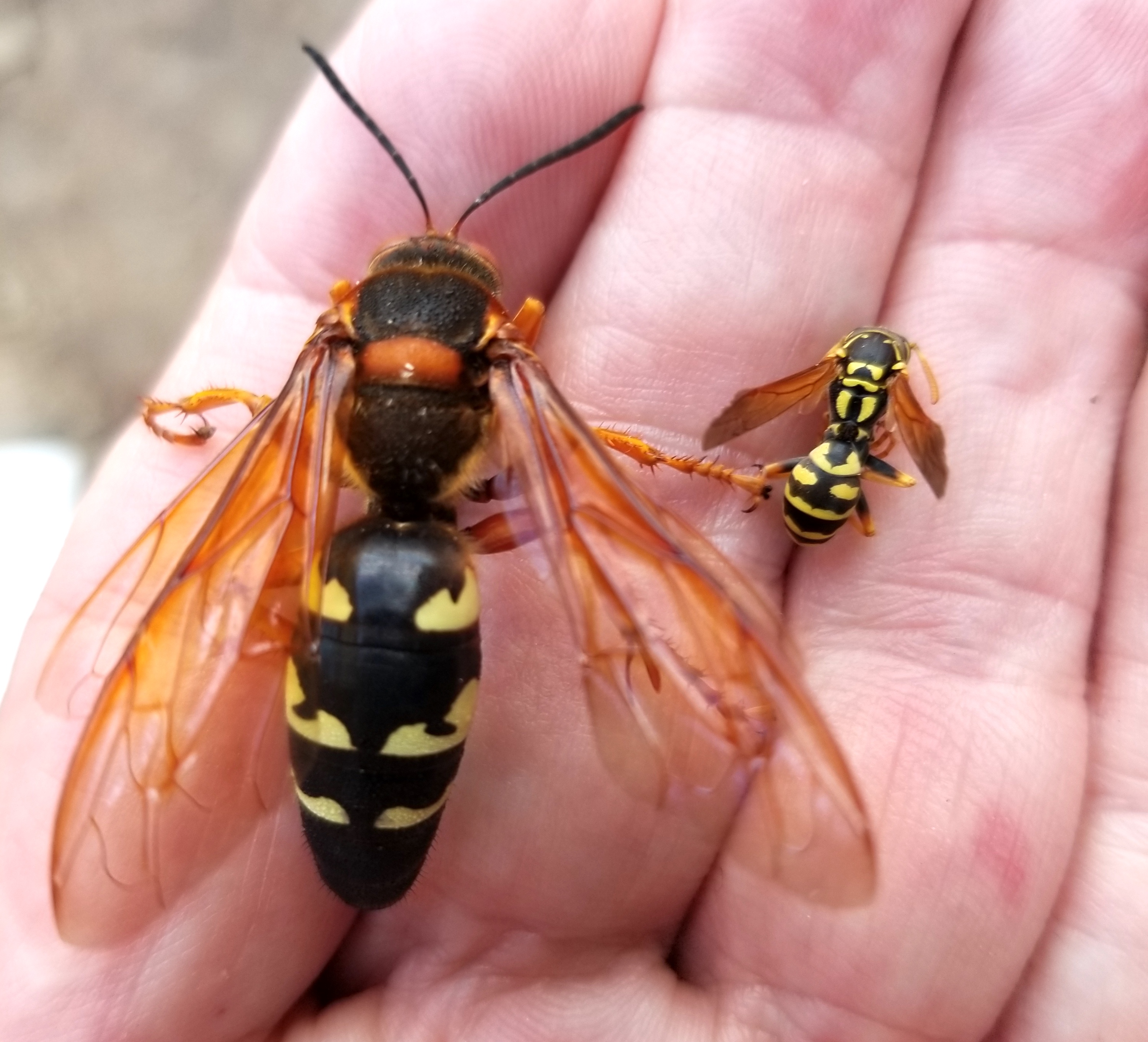
It was yellow wasp day in Springfield.  We started the day with the little one on the right.  Barb had seen them flying into a small construction hole in a rain barrel.  My first thought was yellow jackets but it looked a little small and they almost always nest underground.  I carefully caught one and chilled it in the refrigerator.  Once I could get better photographs I could compare it with yellow jacket specimens.
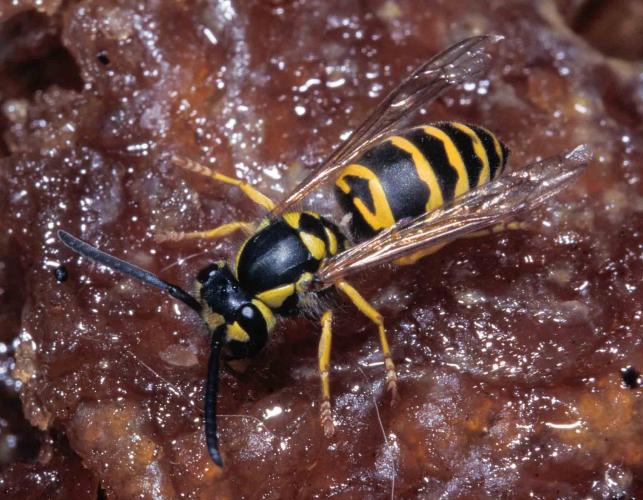


Yellow jacket - MDC
European paper wasp - Polistes dominula


When you get them side by side the distinction becomes easier.  The yellow jacket has black antennae vs. the orange ones on the European paper wasp.  The yellow jacket abdomen is thicker and shouldered at the front.  Paper wasps dangle their legs in flight which is easy to see.  On the other hand the yellow jacket has its legs up tight to the abdomen which tells you two things; it isn't a paper wasp and you are way too close! 

The Polistes dominula is a docile species and will only sting if you disturb their nests, unlike the yellow jackets we discussed in a previous blog.  They are an invasive species but not a big problem.  They have a lek based mating system where the females in the nest may mate with various males promiscuously so that 35% of the nest are unrelated.  (They are European you know!)

While I was identifying my specimen I heard a buzzing around some of Barb's native plants on the deck and saw a big yellow wasp slowly buzzing around the sunflower heads.  I wasn't able to photograph it on the wing and finally resorted to netting it and then very carefully transferring it in to a bug box for chilling.  
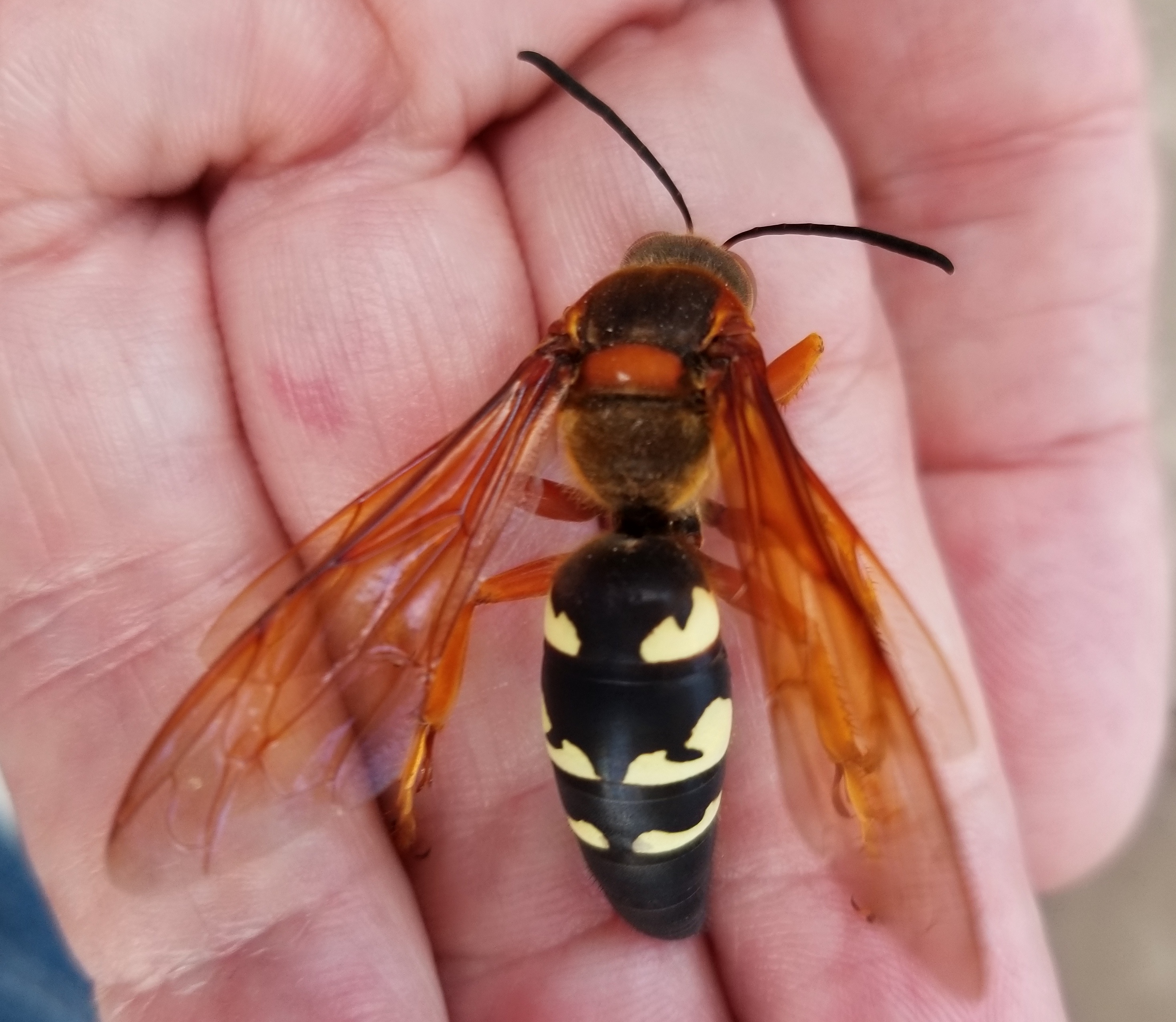

My first guess was right, this was the famous cicada killer, Spheseus speciosus.  You can watch this entertaining dramatic video on them on YouTube that I would recommend for fun.  MDC has a more scientific approach here.  They are scary in flight but relatively harmless, never aggressive unless you grab one or step barefooted on them at their nest opening on the ground.  The males bang into each other in competition for females but their pointed end is all a bluff.  Only the females can sting you.

MDC describes their lifecycle:

"Females emerge and dig nest tunnels; then they hunt, sting, and paralyze cicadas, transport them to the nest, drag them inside, and lay an egg on them. The larvae hatch in a few days and start eating the cicadas. Within a month, they finish growing, form a protective cocoon, and overwinter. In spring they pupate for about a month, then emerge as adults."

Not all wasps are harmful and even the paper wasps just want to be left alone to hunt spiders and other insects for their babies.  Avoid unnecessary insecticides unless they are where you can't avoid them.

Wasps on a quarter - OK, so these did die in the cause of education.

Thursday, July 21, 2022

Spragueia Moth


Ben Caruthers sent me this picture which he identified as a Common Spragueia Moth (Spragueia leo).  This is a friend of a farmer or gardener as its favorite food is invasive bindweed that tends to spread where we don't want it.  

Field Bindweed- Wikipedia

Field bindweed, Convolvulus arvensis, a native of Eurasia, was first documented in California in 1884 and rapidly became the "worst invader in California."  The roots can extend down 14 feet into the soil, making it drought tolerant.  Meanwhile, its roots can spread laterally for 10 feet in a growing season.  Its "bindweed" name comes from its twining growth clinging to other plants.  It thrives in disturbed soil such as agricultural fields and gardens.


S. leo caterpillar - Moth Photographers

Meanwhile back at the moth, there isn't a lot written about this beauty other than it's description.  It measures up to 1/4".  The map on Moth Photographers Group shows it's quite common but only in the southeast US.  It would be tempting to ship it to California where bindweed is a problem but it might then develop a taste for other desirable plants.  It doesn't pay to try outwitting Mother Nature.


There are a few pictures of the caterpillar which strike me as something out of a science fiction movie. Above is one of them.

Sunday, July 17, 2022

Thorn-headed Treehopper

I particularly enjoy little insects that generally escape our observation.  This little critter was photographed by Tonya Smith.  It was crawling along a stem although with those feet it looks more like paddling.  This was a totally new species to me, a Two-marked Treehopper,  Enchenopa binotata, aka Thornbug.   Before we get into details, you have got to see it in action on her Youtube video.

I often have a hard time identifying small insects down to species and in this treehopper I have a good excuse.  This is called a species complex rather than a species.  Reading the bottom line in the Wikipedia explanation, it basically means there are variations that can't be identified down to species and are identified by the plant they are feeding on.
 
These are "true bugs" or Hemiptera equipped with the standard sucking mouth parts.  They are sap feeders including their 5 generations of nymphs, but they don't cause much damage, measuring in at around 8mm (1/4th inch) when full grown.  They rarely hop but do fly between food sources, especially when the males are looking for love.  Females tend to stay on their birth plant.
 
This little package has a lot of talent vocal talent.  Males croon a love song to catch the ladies attention, the sounds traveling through the plant.  Her response is described as a grunting sound.  She will then lay her fertilized eggs in a slit she makes in the plant with her ovipositor.  Females frequently gather on a stem with egg masses covered with a protective foam called egg froth.
 
Treehopper eggs -  Tom Murray
 
There is a lot more fascinating things to learn about these little thorn heads.  I would suggest you start with the INaturalist page, then turn to  Buglady at UWM  for more photographs and details.

Monday, July 4, 2022

Milkweed Life

Red Milkweed Beetle - Tetraopes tetrophthalmus - Ben Caruthers

Everywhere you come across the word milkweed in the press it is tied to Monarchs.  The butterflies’ populations are down from loss of milkweed because of extensive roadside mowing, herbicide use and monoculture farming in rural areas.  This has led to a major effort to grow milkweed in parks, other public spaces and even our yards.  It turns out that this isn’t the first time that Americans have been encouraged to grow milkweed.


the-natural-web.org

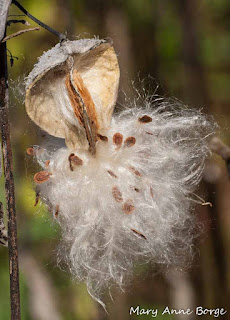
There was an earlier program during World War II to plant and harvest milkweed. The seed pods were collected and shipped to central collection stations. Milkweed floss is over 5 times as buoyant as cork and a lightweight life jacket was both effective and easy to store. It was also warmer than wool and 6 times lighter, perfect for aviators flying over the ocean.


Because milkweed is best known for being the obligatory host plant for Monarch caterpillars it is easy to forget about the value of milkweed in nature. There are several species native to Missouri. Common milkweed (Asclepias syriaca) grows in the easter 2/3rd of the United States. To the 450 species of insects that feed on it, it must look like Walmart. 


In our back yard a lot of other insects can be found on the plants. The Large Milkweed Bug, Oncopeltus fasciatus, has orange stripes. This bright aposematic color advertises its accumulation of toxic chemicals from the plants and say “don’t even think about eating me!” As true bugs (Hemiptera) they go through 5 juvenile life stages, all resembling smaller versions of the adult.


 Milkweed Tussock Moth caterpillars also collect toxins as they chew away on the leaves. You would think that predators would look at all those hairs and say “yuck!” The adult moth also makes ultrasonic clicks to warn bats and others to stay away.


The Southern Milkweed Leaf Beetles, Labidomera clivicollis, are again brightly colored and pick up toxin, but they believe in moderation. They will cut the vein of the leaf to drain out some of the sticky milky sap before chewing the leaf.

Milkweed Aphids, Aphis nerii, feed on the sap and get a little chemical protection.  They can push noxious secretions out their little tailpipes called cornicles.  Scientific studies have shown that when this secretion is applied to a spider's mouth parts, it will retreat and wipe its mouth (and presumably make a terrible face!)  This shows that the secretion is an effective deterrent.  It also suggests that some entomologists have way too much time on their hands.

Looking at the ant above you might think these aphids are toast but they actually have a more interesting relationship.  The aphids suck sugary phloem from the plant and excrete excess sugary secretions which may collect on the plant.  Ants get this nutritious drink from the aphids and it protects them. In return the ants tend the aphids almost like a farmer with dairy cattle.

Meanwhile back to the butterfly.  Monarchs spend the winter in Mexico, then fly north to the southwestern states where they mate, lay their eggs on milkweeds and die. Their caterpillars munch, grow, shed their skin 5 times then form a chrysalis and emerge to fly north. They do this through three generations, each time settling down where milkweeds are in season.   

Then a miracle occurs and the last migratory generation flies back to the Mexican forests which their great-grandparents migrated from last spring!  They will live there for up to 9 months before starting the cycle again.  How they find that wintering spot without a GPS, no one knows.

 ===============

More on common milkweed, Asclepias syriaca, is here.

Looking for more milkweed photos.  Check this album.

Friday, June 24, 2022

Leatherwing with Boots


I have been seeing these beetles in our wafer ash patch and then had this beautiful picture by Becky Swearingen jump out at me on Bi-State Bugs.  In the past I had seen similar colored Pennsylvania Leatherwings, Chauliognathus pensylvanicus, but the pattern wasn't right.  This is the margined leatherwing beetle, Chauliognathus marginatusIt appears in late spring and will be gone by mid-summer, about the time that the Pennsylvanians first appear to inhabit their favorite plant, goldenrods.

Mating Pair - REK

Without Becky's camera or talent I had to get the lens too close, causing them to scurry away.  I chased this mating pair, finally giving up and capturing them.  After refrigeration, they slowed down so I could photograph them separately.

Leatherwing female - REK
Leatherwing male - REK


  Pennsylvania leatherwing-Clay Nichols


The coloration is confusing as the most prominent feature, the broad black stripe down the elytra is variable, ranging from prominent and full length to a short spot on my two specimens and sometimes even completely absent.  The margined species have a yellow head with a black "V" while the Pennsylvanians have an all black head.  The black patch of the pronotum (back of the thorax) extends full length rather than being just in the center on Pennsylvanians.

Leatherwings get that title because of their soft flexible elytra wing covers which are hard in most beetles.  The family are also referred to as soldier beetles because of their bright colored "uniforms".  They nectar on flowers as well as feeding on small insects and their eggs. While the Pennsylvania Leatherwing is usually found in the fall, the Margined crawl are out in early summer.  Following mating, they lay their eggs in the soil and ground litter where their larvae will feed until their fall pupation.


Pollinia afoot -  Kareninnature

Pennsylvania leatherwings crawl around nectaring on the milkweed flowers and get yellow globs wedged on their feet.  These are paired sacs of pollen called pollinia.  These wedge tenaciously to the beetles' feet making walking awkward.  Because they are able strong fliers they can carry their load to nearby flowers where they leave them like a kid with muddy feet.  Rather than dusting individual pollen grains, the sacs of pollen are left in an opening on the next plant.

Beetle boots - Charley Eiseman

There is a risk in this strategy.  A variety of milkweed pollinators can get stuck by the leg if the pollinia is too firmly attached.  You can occasionally find a dead insect hanging by its leg, paying the ultimate price for nectar described in this video.

More on the trap at this site.

Tuesday, June 14, 2022

Slimy Feast

Mature, spore-releasing stage of Stemonitis - Becky Swearingen

This beauty is a Chocolate Tube Slime Mold, Stemonitis splendens, captured by Becky Swearingen on the wooden steps outside her patio.  Wikipedia says:

"Slime mold or slime mould is an informal name given to several kinds of unrelated eukaryotic organisms that can live freely as single cells, but can also aggregate together to form multicellular reproductive structures. Slime molds were formerly classified as fungi but are no longer considered part of that kingdom.[1] Although not forming a single monophyletic clade, they are grouped within the paraphyletic group, kingdom Protista."

Early Stemonitis before reaching maturity - Mark Bower

CTSM is found on rotting material, normally spreading on the forest floor but is frequently described around houses and even clogged air conditioners. 

"Slime molds form structures called plasmodia which are naked (i.e. without cell walls) masses of protoplasm which can move and engulf particles of food in an amoeboid manner.  Slime mold plasmodia creep about over the surfaces of materials, engulfing bacteria, spores of fungi and plants, protozoa and particles of nonliving organic matter.  At some point plasmodia convert into spore-bearing structures, in this case into a clustered mass of stalked sporangia."   Messiah.edu

Sporangia - Wikipedia

When stressful conditions such as our current heat and humidity occur, they form fruiting bodies, tubes to release spores into the air.  You can see Becky stroke the sporangia to release the spores in a video below.

The food chain continues as it always does in nature:

"Great fleas have little fleas upon their backs to bite 'em,  and little fleas have lesser fleas, and so ad infinitum.   And great fleas themselves, in turn have greater fleas to go on: While these again have greater still, and greater still, and so on."  Augustus DeMorgan


Look carefully at her photograph below to see CTSM's specialized predator.


Did you find the predator?

"When the fruit bodies consist of milky white sporangia, they are a favored food source for Philomycus slugs (mantleslugs), such as P. carolinianus  and P. flexuolaris.  The slugs emerge at night from under flaps of bark and migrate to more exposed areas at the top of wet logs, bypassing more mature, pigmented fruit bodies for the younger white ones.  The slugs eat the sporangia stalks from the top down.  The feeding preference of Philomcus slugs for immature white sporangia is not seen in other slug species."  Wilimili.com

You can watch a slug chewing away at the slime mold below the fruiting bodies which are not to their taste in Becky's video.   You can also watch Stemonitis grow on this video by Chris Barnhart.

Warning!:

Philomycus slugs use "love darts" in their mating.  This is a family friendly blog but you can read about them at this Wikipedia link.


Friday, June 10, 2022

Prairie Bioblitz


Margined calligrapher, Toxomerus marginatus, on a pasture rose, Rosa Carolina

We had a great time at this year's Missouri Prairie Foundation Bioblitz on the newly named Thoh-Dah Prairie in St. Clair County.  One of the many sessions was an insect program guided by Eric (aka Bugeric)* and Heidi Eaton.  With 14 sets of eyes we were constantly making new finds.  Unlike when we are out on our own, we had immediate identification down to genus and species.

There are 860 crambid snout moth species north of Mexico so we didn't dive into identifying them to species.  MDC has more details here.


Watching an experienced entomologist work was a joy.  I still struggle with how to hold insects like a grasshopper.  This orange-winged grasshopper, Pardalophora phoenicoptera, held in the right hands makes it easy to photograph for identification.  I would have a handful of parts if I tried to show its parts in detail.  Here is an expert demonstrating the vivid colors of the inside of its leg.

Likewise this looks like an "orange wing" to me but Eric can show it to be a totally different species, the Plains yellow-winged grasshopper, Arphia simplex.  This may look like a small detail when we are walking on the prairie but it is critically important to the male grasshopper.


There were lots of smaller insects to be found.  One of my favorites was this family of aphids, not identified to species.  The adult was agitated with the disturbance and flapped its wings in annoyance at the lack of privacy as seen here.


Finally we saw this deadly predator hop into its burrow to avoid our heavy feet.  Our herpetology expert, Jamie Leahy, identified it as an American toad, Anaxyrus americanus. It was licking its lips at the prospect of eating some of our finds as seen here.

The Missouri Prairie Foundation is a dynamic organization, not only preserving prairies but running Grow Native! and The Missouri Invasive Plant Council.  They have an excellent set of informative videos at this link.  A good place to start to sample these is this Betsy Betros session.  You may be familiar with her book,  A Photographic Field Guide to the Butterflies in the Kansas City Region which is our go-to resource.

------------------------------------

*Eric (Bugeric) Eaton has a blog listed in the sidebar of this page.  He and Heidi have just moved to the midwest and we hope to see more of him.  Meanwhile his book Wasps is full of details about their rich life and is highly recommended.  His Insectopedia has just been published and I am awaiting my copy in the mail any day.  His current blog has even more on the Thoh-Dah prairie bioblitz.