Sunday, June 29, 2014

Teenage Vultures

The black vultures are back.  For those of you who wondered how those small pale balls of fluff could ever become solid black, here they are as teenagers.  They are now on day 50, walking around and using their wings for balance but no longer as crutches.
Day 15
Day 1


Their nesting period lasts from 70 to 98 days after hatching.  The chicks of the past three years would make little effort to escape when I arrived at the door of the stall but this year's chicks have been hiding behind some old doors until the last few days.  Finally I have been able to catch them out in the clear on this video.

Once they have fledged they will make flights across the field and occasionally out of sight.  Soon they will be soaring with the family, but like some human post-teen children who come back home to live, they will depend on their parents to feed them for up to 8 months.

Vulture families remain tight knit, sharing communal roosts with several generations.  This serves as a gathering place when they go out foraging.  Once they have found a carrion treasure, they will generally exclude non-relatives from their communal meal.

More on this All About Birds link.

Tuesday, June 24, 2014

Yucca Bugs

Leaf footed bug - REK
June is the time that the yucca stalks are filled with beautiful white blossoms.  With them comes a special set of insects which make their living on them.  We previously discussed the tight relationship between yucca and the yucca moth, its prime pollinator.

REK
Another common insect found on the yucca blossoms is a leaf footed bug.  These were clinging to the petals and nearby stems, frequently found as mating pairs.  These bugs have widened leaf-like tibia on their hind legs, easily distinguishing them from other bugs.  When approached close up with a camera they frequently crawl around to the back side of their perch rather than flying away.

The leaf footed bugs are in the the family Coreidae which feed on plants.  They have a drill like mouth that is used to inject digestive enzymes into the plant before they suck out the externally digested meal. The enzymes digest cell walls, liquifying its content and can break down some plant toxins.  This allows the bug to feed on plants which other species cannot use.  Leaf footed bugs can give off a bad odor if disturbed.

The leaf shaped hind leg is especially prominent on the species I found.  Its distinctive color pattern led to an identification as a Leptoglossus species.  When they fly they make a faint buzzing sound and their legs hang down like a wasp, a fake warning to man and beast.  They are harmless to humans, commonly found feeding on yucca and other related plants.

L. clypealis mating - REK
There are four species of Leptoglossus, all seen together on this web page.  The western leaf footed bug - Leptoglossus clypealis was the best fit with its prominent zigzag band across the back.  Leptoglossus zonatus was a close second, with its jagged line but it has two light colored spots on the forward part of the pronotum that mine lacked.

Pointed clypeus extending forward like a unicorn - REK
Spiny clypeus - Joyce Gross
The key feature of Leptoglossus clypealis is a thorn-like clypeus extending from the front of its head like a six-legged unicorn.  My initial photographs didn't show this as I use only a pocket camera (Panasonic Lumix DMZ-ZS5), so I went back to the yucca and bagged a Leptoglossus for a trip to the freezer.   Sure enough, there was a sharp clypeus seen above in all its glory.

I have been following these L. clypealis on our yucca for a number of years and they never seem to do any significant harm.  On the other hand there are a lot of them around so freezing one probably hasn't upset the balance of nature.

Detailed photographs at this site.
Lots of detailed information is at this University of Florida link.

Wednesday, June 18, 2014

Bold Jumping Spider

Bold jumping spider, dorsal view - REK
Ventral view
I felt a little like Little Miss Muffet when I came out for my morning coffee and saw the spider descending from the ceiling beam toward our sink.  It nestled in to a ziplock bag for photographs.  I was too busy to start a long search and our copy of Spiders and their Kin reference was lost again.  It is always missing and we suspect it is taken under the furniture for bedtime reading by our resident wolf spider.

I sent a query to Bugguide.net and got back this response within a few hours, identifying it as a bold jumping spider, Phidippus audax.  This is a common spider in our area, and as you can better see from the photographs by Sam Martin, it is a beauty.

Bold jumping spider - Sam Martin

P. audax has distinctive white markings on the top and bottom of the abdomen as well as white stripes along the bottom of its legs.  These are more orange in younger spiders as you can see on ours.  P. audax belongs to the genera Phidippus which are larger than most other jumpers and have iridescent chelicerae, seen here as a bright metallic green.

Wikipedia has this to say about jumping spiders in general.
"The jumping spider family (Salticidae) contains more than 500 described genera and about 5,000 described species, making it the largest family of spiders with about 13% of all species. Jumping spiders have some of the best vision among arthropods and use it in courtship, hunting, and navigation. Although they normally move unobtrusively and fairly slowly, most species are capable of very agile jumps, notably when hunting, but sometimes in response to sudden threats."
Bold jumping spider - Sam Martin
P. audax is a daytime hunter, using its acute vision to track and stalk its victim.  It then pounces and neutralizes the creature with venom delivered by its jaws.   When it jumps it releases a silk safety thread behind it, a spider version of a bungee cord.  If it misses the target, this ensures that it can get back home.

Red admiral for lunch at the Butterfly House - Chris Barnhart
Their diet is carnivorous, encompassing a wide variety of species.  Many of these are pest species, such as plant bugs, weevils, and bolls that eat cotton.  Like most predators, they don't pay attention to human sensitivity when eating more charismatic species.  Above is a bold jumper munching on a red admiral, a sin in the Butterfly House that likely got it squashed.

On rare occasion, a bold jumping spider may bite a human if threatened by grabbing it or pressing on it.  These bites may create a pustule but don't cause any serious consequences.  That said, you might find this Youtube video outside your comfort range if you have a touch of arachnophobia.
When bold jumping spiders jump, they release a line of webbing for security. This ensures that if a leap fails, there is a safety line that will catch the spider before it falls

Animaldiversity.ummz.umich.edu has extensive information on P. Audax.

Saturday, June 14, 2014

Heavy Metal Drummer

Red-bellied woodpecker - Wikimedia
Every spring we watch the red-bellied woodpecker drum on the metal birdfeeder before chowing down.  The rhythm is different than the intermittent methodical pecking when they dig into a tree for insects or cavity building.  We hear drumming identical to the bursts we hear around the valley on hollow trees but the metal creates a much sharper sound.  Watch this video of the woodpecker pair, before reading on.

Why do woodpeckers drum on a metal box?  It is all about territory.  Their rhythm can be distinctive for their species, saying "I am male, big and strong so stay out of my territory."  It also serves to attract a female although the sexual attraction of a male beating its head against a metal surface is a turn-on that escapes me.
 
Female red-bellied-Wikimedia
We also get to see them transporting food to another bird.  The male will fly to a distant tree and deposit it on the branch next to the other bird, even occasionally making a beak to beak transfer.  I wondered if some of this might be so called courtship feeding, a.k.a. mate-feeding.  Also known as a nuptial gift, this is seen in animals as diverse as insects, spiders and mammals.  This is commonly seen in cardinals and bluebirds but Charlie Burwick gave me the answer.
"Really interesting thing about red-bellied woodpeckers. The female hatches the chick, and the male, as you are watching, is feeding the young chick after it has fledged. This is common behavior among woodpeckers."
Reviewing the video I can see that this is a rather drab chick with no red like an adult female.  By now the juvenile is flying and able to run up and down a tree like an adult.  It either can't get its own food or chooses to wait and be fed.  Any of you parents can relate to this behavior.


Feeding a juvenile - Bron Praslicka
To us sentimental humans the idea a "courtship feeding" is an "Aww, isn't that sweet," moment but before we get too mushy, look at the evidence.  A rather soberly titled study,  Mate-feeding has evolved as a compensatory energetic strategy that affects breeding success in birds, published in 2011 in Behavioral Ecology tends to shift the emphasis from romance to survival.  Their findings from studying 170 species of passerine birds:
  •  "Mate-feeding has evolved more often in species in which the female incubates and builds the nest alone and have noncarnivorous diets. This suggests that mate-feeding is a behavioral strategy that compensates for nutritional limitations of females during breeding, as both incubation and nest building are energetically costly processes, and noncarnivorous diets are deficient in proteins"
  • "Incubation feeding has evolved more often in species that place nests at elevated sites, suggesting that these species face low predation risk that allows males to feed females. In the particular case of incubation feeding, we found that species that have evolved this behavior produce larger clutch size and have higher hatching success."
So rather than a romantic come-on, mate-feeding is more like bringing in carryout dinner for her after a hard day with nest building or child care.  I too found this to be a good nesting strategy during our child rearing years.

In the video you can see the adult male getting seed from the feeders, then storing some in the bark of trees and delivering others to a rather drab appearing juvenile high in a distant dead tree branch.  Now that you know what is going on, feel free to watch the video again to catch the quick beak-to-beak feeding.

Wednesday, June 11, 2014

Little Dummy

Little Dummy caught again-  REK
On a Thursday morning at Bull Creek, I got a call from Jason Larson of MDC who I knew from timber surveys and hog trapping.  He was 20 minutes away where he had a bear in a barrel trap without enough light to see its ear tag.  I headed over with some flashlights and we spent some time trying to see the tag on the back of the ear.  We were looking for blue=male or yellow=female.  Unfortunately the tag was too faded to tell the difference.
Bear #58-57 at home in his trap - REK
Catching a bear requires a lot of patience and stamina.  After studying topographic maps, looking for intersecting ridge lines in heavily forested areas, MDC biologists contacted the landowners for permission to set up trapping sites.  This site was in national forest down a 1.5 mile logging trail crossing a small stream and over downed logs.  They have to come out regularly to bait the area and check the game camera, determining when to activate the trap.
Large male sizing up the trap - MDC
Little bear, free lunch
This trap had other visitors.  In addition to the ever present raccoons, a young bear crawled in to look around and munch some out of date pastries.  After that a big male dropped by, almost filling the tube with his bulk.  Finally the trap was activated and here came our bear.

Little Dummy.  Note white spot, his ear tag - MDC
Following our checking it out that morning, the bear team came out at 5PM after working up 3 other bears they had trapped.  They determined that it was a male, ear tag #58-57.  This season MDC is only putting radio collars on females and he had been measured recently so they released him.  A few days later I went to the MDC website to see where the radio collar had tracked him over the past years and discovered that we had met before!
Bear #58-57 four days before his initial capture and collaring - MDC
This bear is well known to the team, lovingly referred to as "Little Dummy" because of the frequency he is caught.  As you can see in the picture above, he was resting quietly, having gorged on all the donuts in the bait bag.  He had engorged ticks clinging to his face, an occupational hazard when you live full time in the woods.  At this moment, life was pretty good.
Eleven months of travel
Little Dummy was first caught in Christian County on June 11, 2011, munching on donuts while held by a foot snare.  He was sedated with a tranquilizer dart, and 14 different measurements were taken including extracting a first premolar for determining his age.  He was then moved to a safe location where they could protect him until the sedative wore off.  Over the next year his location was mapped as you can see on this MDC website.
September 1, 2011- note corn in background - REK
On September 1, 2011, three months later, we had a bear on a game camera, watching a pile of corn we'd spread for feral hogs.  We then put out a hog trap and on September 4, we had a picture of a collared bear in it.  The trap had no way of opening the door without reaching in as it wasn't built to remove a hog alive.  Fortunately the bear didn't bump the corn-filled bait cup at the far end and was able to walk out. Several days later we got our hog.
September 4, 2011- "No donuts here." - REK
The following year I went to the MDC bear map web site and discovered that bear #1117 had prowled around Christian County for months, even going past Ava.   On September 4, 2011 at 7PM it was located in our field, exactly where the trap was!

After our adventure watching bear #58-57 leaping out of his trap, we came back home to see his history.  To our surprise, we discovered that the #58-57 refers to the ear tag and he wore collar #1117.  That was our bear in the hog trap three years earlier!

Now back to the "Little Dummy" name.  He was recaptured with a foot snare on  May 25, 2012, noted to be in excellent condition, and the radio collar removed shortly before it was programed to fall off.  OK, any bear can be excused for falling for the old doughnut-foot trap trick a second time.  But when you catch him six times, you know you have a serious pastry addiction problem on your hands.

Having been caught repeatedly, they started to refer to him as Little Dummy.  Now I might argue that he should be called Little Smarty.  After all, he has trained a group of bright, educated wildlife biologists to drive all over in the middle of nowhere to bring in big bags of pastries.  Then "Smarty" wolfs (or is it bears?) them down and takes a nap until they come along to release him.  It just depends on your point of view.  When I took the picture at the top of the page, I swear I saw him wink at me.

Resources
  • Watch this 3 minute video to see Jeff Beringer demonstrate the steps of Phase 1 of the study.
  • For information on the different phases of the study including radio collaring an hair snare go to this site.
  • This Bear page lets you pull up information on the travels of individual bears.  Enter 1117 to follow Little Dummy by scrolling to the map and click on animation.  Be patient, it takes some time to load, but not as long as it takes to trap a bear. 
  • Learn about the Missouri Black Bear Foundation at http://moblackbears.org/ or like us on Facebook.

Sunday, June 8, 2014

Hackberry Emperor

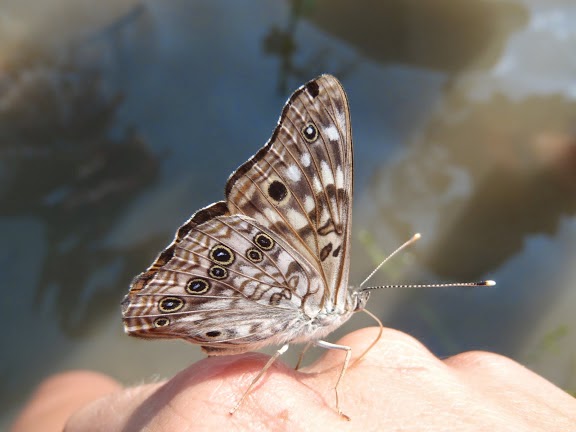
Hackberry emperor- Chris Barnhart
We recently have started seeing hackberry emperor butterflies, Asterocampa celtis.  Their identifying  eye spots, similar to many other butterfly species, can only be seen when they land.  These are a medium sized butterfly, brown and rather plain in flight, usually flying high in the trees but they often also fly rapidly around us as we walk through the trees. 

A special trait of this emperor is their attraction to humans.  They will frequently circle us while walking along the road or in the woods, looking for the perfect place to land.  If you watch carefully you can see them unfurl their rolled up proboscis and gently slurp up any sweat and salt off your skin.  This is harmless enough unless it lands on an insect-adverse individual in which case they occasionally get swatted.

Hackberry emperor larva - Chris Barnhart
As you might have guessed, their larvae feed on hackberry trees and are frequently seen on the underside of leaves during the night to escape predators.  They are ravenous eaters and can defoliate an isolated tree.  In the wild Ozarks, where they have so many hackberry trees to choose from, their larvae can be hard to find.  They have two generations a year and the fall variety wraps the leaf around its body and survives over winter as a larva (caterpillar), turning brown only to return to green the next spring to reach the final instar and pupate.*

Hackberry emperor - dpughphoto.com/
Wikipedia says "The adults do not visit flowers, but feed on rotting fruit, tree sap, dung, and animal carcasses."  I don't intend to speculate on the relationship of dead animal carcasses and dung to their attractions to my sweat but will allow you to reach your own private conclusions.

Since they are cold-blooded like all insects, they can't control their internal temperature.  They can use shelter, sun exposure and other tactics.  By aligning their bodies perpendicular to the sun, they can catch more warming rays like we might by getting out into the sun on a cold day. 

When cold, they slow down and hide.  We use this trait to move, transport and even photograph captured butterflies in a chilled state.  They survive for several days in the refrigerator, awaiting the relative safety of the enclosed butterfly house.  By transporting them in a cooler, we prevent them from dehydrating or damaging their wings by flapping to escape.  When released they need to warm up their flight muscles and like some other species they "shiver" before flying off.  You can watch this just before they flutter out of their ziplock bags, into the safety of the Butterfly House.

* University of Milwaukee Field Station

Friday, June 6, 2014

Baltimore Checkerspot

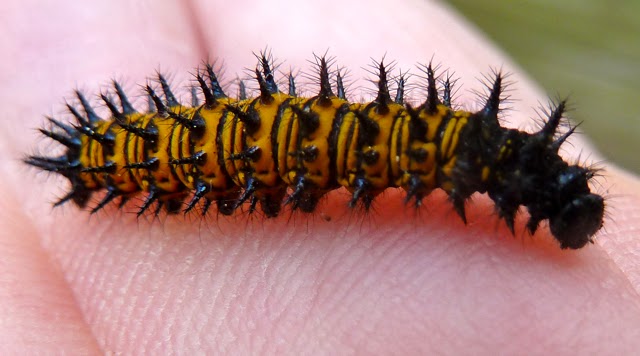
Hiking the glade with a 5 year old budding naturalist Eli Thomas, he suddenly presented me with this caterpillar. It looked familiar but I drew a blank and had too much going on to take time to search for it in Wagner. * The next best source was to send it to Kevin Firth, a caterpillar hunter.

Kevin thought I knew what it was and was testing him. He wrote back that he did not recognize it immediately having only seen adults. Fortunately he sent me a face saving clue. "According to Wagner, they prefer turtlehead (whatever that is), but will use plantain, foxglove, honeysuckle, lousewort, and viburnum."

Baltimore checkerspot
I suddenly recalled the "turtlehead host plant" and looked it up. It was the caterpillar of one of my favorite butterflies, the seldom seen Baltimore checkerspot.

Many years ago (12+ years) after we burned our first glade, Linda Ellis botanized with us and pointed out a single tiny emerging leaf of false foxglove, Dasistoma macrophylla, and told us that it was a host plant of the Baltimore Checkerspot. Another 20 feet along the trail and we found this caterpillar feeding on a tiny plant. That was the moment when I realized how little I knew compared to experts, be they amateur or professional.

We see Baltimore checkerspots along the edge of our road from time to time in mid-summer. They are smaller than the swallowtails, appearing dark in flight but not quite black, and tend to fly low along the ground, thus they are beautiful close up but subtle in the wild. Their caterpillars will spin a web on a plant and remain protected in it for several weeks before crawling under leaf litter of the forest floor. They will overwinter as a caterpillar, then pupate in the spring.

The butterfly is totally distinctive and once you see one you will never forget it. Linda Ellis gave a nice description on a previous blog.

*Caterpillars of Eastern North America,  Wagner