Saturday, January 30, 2016

The Price of Extinction

Lord Howe's Stick Insect - "World's Rarest Insect"- Australiangeographic.com
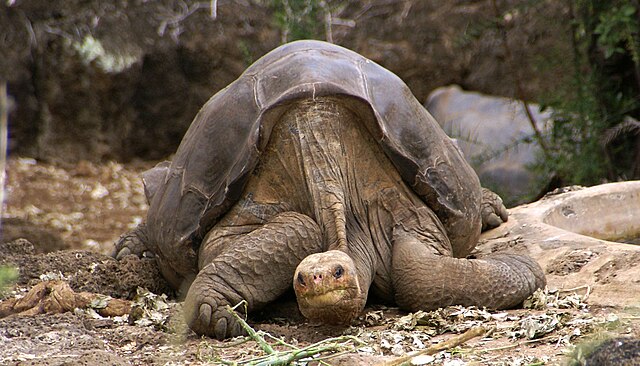
Lonesome George - Wikimedia
There is a price we pay for extinction as well as the cost of preventing it.  Condors, whooping cranes, even pandas can be considered charismatic species we struggle to preserve.  For Lonesome George in the Galapagos it was too late as he lived for years with no remaining female to mate with.


All this leads up to a fascinating update to a story by Robert Krulwich about the Lord Howe stick insect, Dryococelus australis, that was found barely hanging on, literally, to an isolated 1700 foot volcanic remnant named Ball's Pyramid.  This is in the South Pacific 13 miles from Lord Howe's Island, the insect's original home where it had gone extinct 80 years before.  The followup ends with a video of its amazing emergence from a tiny egg, much like clowns emerging from a circus VW.

In Missouri, a less charismatic American Burying Beetle comes to mind as an example of the public's efforts to restore an endangered species.  Although far from being cuddly, its habits are fascinating and the restoration efforts include the St. Louis Zoo and volunteers from around the state.

While I personally think that attempts to "restore" the Wooly Mammoth
is more a gee whiz exercise in DNA sequencing and genome editing rather than a pure species restoration, I think it is worthwhile to try preventing extinction of those species around us. I would hate to lose the Missouri Bladderpod or the American Burying Beetle on our watch.

In a somewhat related story, a recent study has demonstrated that early Australian settlers around 50,000 years ago caused or contributed to the extinction of the 500 pound, 7 foot tall flightless bird, Genyornis newtoni.

Monday, January 25, 2016

Shocking Bear Video

Grizzly bear facing a shocking carcass - Montana Grizzly Research
Bears are among the most intelligent mammals.  Some have suggested they are as intelligent as a 3 year old child.  It is at that point that we have to separate intelligence from trained performance.  Obviously a child can perform far more tasks as they grow and are trained.

Sophisticated studies have shown some limited numerical abilities of bears.  This was demonstrated by captive bears using touch screens with their noses.  They could be trained to make a selection based on the limited number of dots on the screen.  (If the bear used its paw the researchers would have gone through a lot of touch screens). 

Does this translate to bears in the wild?  Children don't start out life with counting and language skills.  Teaching a child requires their concentration and avoiding distractions.  Likewise the bear needs to focus.
"What's most interesting is that this level of intelligence and cognitive reasoning is not often observed among bears in the wild. A possible explanation for this is that a bear in the wild is so driven by the single-minded purpose of survival and finding enough food before the onset of winter that the full scope of what they're capable of must often take a backseat to wild instinct. Researchers like Else Poulsen and Doug Seus have shown that when a bear is kept in captivity, well-fed, cared for, and given a stress-free life, the other side of their nature becomes more apparent and takes precedence over instinct."  Where the Bear Walks
It is frequently hard to separate intelligent behavior from random chance as described in this blog.  Dave Shanholzer sent me this video of a grizzly bear faced with a carcass wired to shock it.  The bear's response looks to be the result of tenacity and an accidental solution.  It would be interesting to see what its response would be if tested with several more carcasses.  Would it "know" to disconnect the battery first?  Who knows?

Friday, January 22, 2016

Mystery Corpse

What is it? - Mark Bower
American Dagger Moth - Sankax CC
While reviewing his fungi photographs, Mark Bower came across this puzzling creature.  On first glance I thought it resembled a caterpillar of the American Dagger Moth with a haircut.  Then I realized that its thin stems are actually jointed like legs.  That narrowed it down to an arthropod ("jointed legs").   

Narrow veined wings


Mark first discovered the narrow wings extending out at right angles.  With only one pair and without a long extended abdomen it was not likely a dragonfly.  Chris Barnhart offered the most likely guess,* "Definitely arthropod, maybe dipteran. I think I can see folded, patterned wings - so it might be Ptychoptera."

Diptera is the order of true flies, equipped with a single set of wings, its second set having evolved into stick-like halteres which serve as stabilizing structures somewhat like a gyroscope.  Ptychoptera are the Phantom Crane Flies, equipped with extended legs like a daddy-longlegs with wings.
Ptychoptera - Judy Gallagher CC


I had already guessed* that it was transformed by a fungus but Chris added a more elegant description - an entomopathogenic fungus.  These fungi are parasitic on insects and some worm species.  They generally attach to the outside surface of the insect and in favorable conditions develop hyphae which spread into the body, injuring or killing the victim.

Entomopathogenic fungus on an earwig - aphotofungi.com

Bower the "fabulous fungi fotographer" (I love how that rolls off the tongue) got two-for-one fungi in his photograph.

*A guess by a scientist is sometimes called "a hypothesis based on careful observation but not supported by all the evidence."


Wednesday, January 20, 2016

Good Fat Bears


You calling me fat? - MDC
I was just reading an article in Connections on A Quest for the Missouri Black Bear by Jennifer Conner.  It mentioned "Body mass index (BMI) is measured using a contraption that measures electrical waves throughout the bear's body and can determine muscle/fat ratio which in turn determines the overall fitness of the individual bear."   I contacted Jeff Beringer of MDC to get more information.
"We are using an instrument that measures electrical resistance in bears. We fasten an alligator clip on the lip and a probe near the anus, then turn on the machine to measure resistance. The program considers body weight and other factors. It could be akin to BMI as used for humans. We are looking at this as another body condition index to see how it varies by sex, age, time or year, etc."
Denning bears do not eat or drink and don't take bathroom breaks to urinate or defecate.  Females that are inseminated carry their fertilized eggs for months before delayed implantation in the uterus starts the development of cubs.  Once she delivers, a mother bear will return to sleep, occasionally awaken to lick the cubs.  Otherwise the cubs nurse on their own - human mothers, eat your heart out!

Males lose 15-25% of their weight while pregnant females lose up to 40% as they lactate to feed newborn cubs over 3 months.  The stored weight and nutritional status correlate with reproductive success and offspring survival.  Bears burn their stored fat for energy and water, and their muscle and organs for protein just like you and I would in starvation.  Muscle atrophy is estimated at 10-20%.  Unlike humans, they will rapidly restore their muscle mass when they start eating in the spring.

Imagine the implications this would have on humans if we could unlock these secrets.  Kidney failure for months without harm, prolonged bedrest or starvation corrected rapidly, maybe even suspended animation during space flight.  Metabolic studies such as BMI and protein and body fat metabolism in bears will help unlock these secrets.

I couldn't find much on the measurement of BMI in black bears.  I suspect that once the technique (see "alligator clip on lip and a probe near the anus") gets out in the bear community, the enthusiasm of the bear volunteers diminishes dramatically. 

This and much more about bear hibernation is at this Nova site.

Sunday, January 17, 2016

Premature Delivery

Laney and the zebra swallowtail - Chris Barnhart
Similar to the annual first baby born news story on New Year's Day, the Butterfly House is happy to announce the first new arrival of 2016.  This zebra swallowtail emerged from its chrysalis last week.  Here it is being studied by Laney Barnhart.

Several volunteers bring home butterfly caterpillars during the summer, feeding them until they pupate, to provide a new brood when the Butterfly House opens in the spring. The plan is to bring the pupae out of storage in the spring in time for a new "graduating class" on opening day. The winter sleep is called “diapause’ and if the chrysalides are kept cool, and if the days are short, hatching will wait until spring.

However in this case, a caterpillar escaped and climbed to the underside of a cabinet to pupate.  It was not the first to have escaped and the first notice of this as the days lengthen is a butterfly fluttering around the house, wondering where all the flowers are.

The remarkable part of this story is.....January?  What was it possibly thinking?   Actually we don't know exactly what tells a butterfly when to eclose (emerge from its chrysalis).  In the wild, it is critical for the emergence to be timed to the presence of nectar sources and caterpillar food plants, in this case pawpaw leaves.  Clues could be the length of days, increasing mean temperature, or even some biological clock ticking away within the pupa.

The rest of its classmates formed their pupae and were stored out in the garage, where they see mainly normal light cycle and temperature. They are kept in a wine cooler, but it has a glass front, and it only chills them if there is a warm spell. The idea is to keep them on a normal schedule to emerge in the spring so  they are not in the dark, literally or figuratively. 

This zebra likely had no concept of the seasonal change by length of days. The house temperature was relatively stable and no sun reached its chrysalis under the cabinet.  Did it "think" it was March, the earliest time of normal emergence?  Either way this zebra swallowtail must have been very disappointed.

I recall a college roommate setting my alarm clock to wake me an hour early for an early morning class.  The position of the sun and the paucity of cars on campus didn't register until I found the building locked.  I can relate to this zebra's confusion.  The only "pawpaw" they could see was Chris.  That must have felt like the pull on the locked classroom door.

Wednesday, January 13, 2016

Bison Purity

North American Bison - Library.sandiegozoo.org
There is good news out of Utah where a genetically pure herd of bison has been discovered.  Following the near extinction of the species during the 1800s, conservation has maintained a few herds in Canada and Yellowstone National Park.  Due to intermixing with cattle, most herds have more than a little domestic cattle genes in their bloodstreams.  The DNA studies demonstrate that this herd in the Henry Mountains of southern Utah is unique.
"We’ve got a very, very special case in that the Henry Mountains bison is actually in fact the only population of bison in existence which is now both genetically pure and is free of the disease brucellosis and is free-ranging on public land co-mingling with cattle and is legally hunted.  So, we have this very unique population which is one of a kind. It’s a large credit to the Utah Division of Wildlife Resources, the Bureau of Land Management, and the local Henry Mountains Grazing Association. Over the years, they worked together to conserve this resource.” Dr. Johan du Toit, professor of ecology, Utah State University
The sad story of the near extinction of a species that once ranged across the United States in numbers estimated at 30 to 60 million beasts is summarized in this article from the National Humanities Center.  Much like the extinction of the megafauna 13,000 years ago, it is due to the confluence of many factors.  A period of drought in the early 1800s may have been a factor.  This was followed by increasing  hunting pressures by Native Americans using improved methods such as the development of the bow and arrow, introduction of Spanish horses and finally metal and guns.

The westward push of settlers and the extension of the railroads after the civil war increased market hunting for hides, meat and even delicacies such as bison tongue.  Any recognition of the diminishing numbers was numbed by governmental policy encouraging the total elimination of bison as a way to force settlement and agriculture upon the Native American tribes who posed unwanted competition for western lands.*

There are an estimated 500,000 bison in the US, the vast majority raised commercially in herds for meat consumption.  Less than 20,000 are considered wild, mostly in Yellowstone and Canada, and most of these have some degree of cattle genes.  The Henry Mountain bison represent a resource for reestablishing a pure strain of the original beasts that once roamed the country including our Ozarks.

* American University, Washington D.C.

Monday, January 11, 2016

Abnormal Antlers

 Injured leg leading to spike antler -Todd Reabe in QDMA.com
Antler size and abnormalities are a big topic among deer hunters, generally the bigger the better.  This is mainly a result of the effects of testosterone, not on deer antlers but on some male hunters' brains.  More on testosterone effects on deer later.

I have heard hunters talk of trying to harvest deer with abnormal antlers to "improve the genetics" of the herd.  This is usually applied to bucks with deformed or stunted antlers on one side.  An example of such a buck was sent to me by Dave Shanholzer in the article Leg Injuries can Effect Antler Growth.  As strange as it sounds, it is true.  It even has its own acronym, SOOS, (spike on one side.)

A recent study reported in QDMA.Com confirmed that injuries to a buck's leg is one cause of stunting of the antler on the opposite side of the head.  Why and how this occurs isn't known.  Gabe Karnes, studying this phenomenon for his PhD reports that "It is well documented that antler deformities due to skeletal injuries progressively disappear with each subsequent antler growth cycle, meaning you can expect most SOOS yearling bucks to develop normal antlers in another year or two."

In other cases it is due to damage to the "antlerogenic periosteum," the tissue on the skull that produces antlers.  Scar tissue due to injury, likely battle scars from males fighting over females (imagine that!) affects the blood vessels and the normal development of antlers.

22 point rack - KY3
The bottom line is that there is no reason to preferentially kill SOOS bucks to "improve the herd."   Besides, it may not even be a buck!  A recent story on KY3 showed a massive set of antlers on a 22 point buck, make that doe!  Curtis Russel of Billings had been hunting for it after seeing it on his game camera but wasn't prepared for a she.  According to Derek Farwell of MDC:
"Out of almost 250,000 deer harvested in the state each year about five are antlered does, but I have never seen one with that many points.  There's a couple different situations where this may occur; one, the doe may simply have a high level of male hormone such as testosterone.  The other situation is maybe a hermaphrodite where it has the reproductive organs of both the male and female deer."
Russel say that he watched it as it pushed a small buck around, thinking that was  more evidence it was a male.  I guess you could say it was "passing the buck."