Wednesday, April 6, 2016

Smooth Rockcress

Smooth Rockcress - Mark Bower
We celebrate the arrival of spring in many ways - the arrival of Harbinger of Spring, the first butterfly, the first show of redbuds.  Then small white flowers appear on the serviceberry, the preview of the main act, the flowering of our Missouri State Tree, the dogwood.

"Our" Smooth Rockcress - REK
Spring comes on in much smaller acts as well, discovered before most plants and shrubs cover them up with leaves.  We found rather inconspicuous dark green leaves of Smooth Rockcress, Boechera laevigata, on a moist rock seep along the base of a bluff, nurtured by a dense mat of moss.  The tiny gaping jaws of leaves on the right exposed flower buds, waiting to make their appearance in a month or so.  In the shade of the rocks I couldn't photograph the buds but the next day Mark Bower sent me a beautiful set of pictures of Smooth Rockcress that he had found.

B. laevigata is a biennial, meaning that it has a two year life cycle similar to thistle, teasel and garlic mustard.  The first year its energy goes into growing vegetative structure, its roots, leaves and very little stem, staying close to the ground.  The second year the stem "bolts," the stalk shooting up where it flowers and produces seeds.

Rockcress buds patiently waiting - Mark Bower
Growing on moss covered rock - Mark Bower
Even tiny plants have their faunal associations.  The tiny flowers are pollinated by equally tiny bees including Andrena arabis (Rock Cress Andrenid Bee).  The leaves are hosts to the beautiful Falcate Orangetip butterflies we have been seeing the last few weeks.  They will be laying their eggs and then dying off as their caterpillars develop over several weeks, then form a chrysalis in May that they will survive in until next spring.  Although this sounds like a risky lifestyle, it obviously works for them.

from Minnesota Wildflowers


We will be monitoring the little rockcress during the late spring when it will typically bloom.  The flowers last for 1-2 months but are hard to see, the white petals barely extend beyond the green sepals, all less than a third of an inch long.  We have flagged the area to be sure to find them.

* The life of the Orangetip Falcate is the subject of this 2015 blog.

Nibbled down- Mark Bower
Addendum:  Mark was following the plant to get a picture of its flowers, but a herbivore beat him to it overnight.  There isn't a lot to eat right now on the hillside so it is understandable.  Squirrels are reduced to crawling out on branch tips to nibble on tree buds while dangling precariously.  This plant lost its chance to procreate so I will have to guard ours carefully.
"This Buds for me  -  REK."  - 

Monday, April 4, 2016

Luna in March


I was out checking on our bluebird boxes and nearly stepped on something pale green in the mixture of dormant and new green grass.  It was a Luna Moth (Actias luna) desperately clinging onto a few grass blades 7" tall.  It was whipping around in the wind said to be 12mph with gusts to 20 although it must have felt like more.  In the picture below you can see it being lifted by a gust.

Hanging on but almost airborne in the gusting wind

 Male with large feathery antennae -  Bugunderglass.com
Female antennae - REK
Although everything else is appearing early this spring, I was still startled to see it.  This was a female as evidenced by the smaller antennae.  Males have large plumose (feathery) antennae, "My what large antennae you have.....The better to sense your pheromones, my dear."

The subject on antennae and pheromones alone is worth a book.  An insect may rely on a hundred different pheromones during their lifetime according to Thomas Eisner, the "Father of Chemical Ecology."  Those hair-like structures on the antennae are olfactory organs.  There may be up to 60,000 on a single individual in some species.  They are capable of sensing a single pheromone molecule from over a mile away.  And there might be only one molecule in a cubic yard of air.

In the case of Luna and other silk moths, time is of the essence.  Luna moths do not eat and don't even have an intestinal system.  With a life span of a week, quick mating and egg laying is crucial.  Mating occurs usually within 24 hours of emergence from the pupa which usually occurs in the morning.  The wings are initially shriveled and expand by hanging them down as body fluid is pumped into the vein-like vessels.  They then hang on while the wings dry over 2 hours to hold their shape.  In the picture below you can see that the long trailing "tails" of the wings were twisted by the heavy winds and have dried in a spiral..
Deformed tails of the wings, whipped by the wind.
I sent the photographs to Chris Barnhart who responded that evening.  "It's a girl! Get eggs if u can".  I was embarrassed that I hadn't thought of it earlier.  Guilt ridden, I went back out at 10PM  and searched the area with a flashlight and the truck headlights, but she was gone, likely having been blown of her grass stems.

Saturday, April 2, 2016

The Other Mockingbird

Barb called me outside yesterday morning to hear the mockingbird calling.  I went back for the camera and managed to get a picture of the bird when it dropped down to the ground.  When I saw it was a brown thrasher I was momentarily disappointed.  Then Barb did a quick search and found that it was the "mockingbird" we heard.

According to Allaboutbirds, the Brown Thrasher has one of the largest repertoires of any North American songbird, up to 1,100 song types.  Ours was playing its greatest hits but kept coming back to its version of the whip-poor-will, a nocturnal bird that has kept us awake during its breeding season. The other key to identifying the call was its repeating the song twice, then immediately starting the next tune while a mockingbird tends to repeat it three times.

The Brown Thrasher is rather distinctive with its long, slightly curved beak, long tail and a bright yellow eye that is prominent.  They migrate up this time of year, extending all the way to Canada.  There are reports of individual birds reaching Germany and England once each, probably on a foreign vacation.  Lisa Berger came up with more range data:  "
"They are listed as an uncommon Southern Missouri winter resident.  Locally, we see them on Christmas Bird Counts, similar to E. Phoebe.  These guys are more common in winter than my perception simply because they aren’t singing!"

They feed on the ground as well as gleaning fruit and berries in season.  Currently they are working our lawn, sweeping it with their long beaks looking for any available insects.  Then they fly up into the trees or wires to announce their presence, call for a mate, or just sing because it is a beautiful morning.  I went out to listen again this morning and was rewarded with a bird singing on the wire.  While our great sonic "discovery" didn't advance ornithological science, it made our day a little brighter.

Thursday, March 31, 2016

Honeylocust Eaters

Orange Wing on a zipper - REK
This little moth landed on my backpack just in time to make it to the blog.  You can see how tiny it is by comparing it to the backpack zipper it is perched on.  It's wingspan is less than an inch.  Googling "orange hind wing" brought up photographs without having to resort to Peterson's field guide.  This is commonly called Orange Wing - Mellilla xanthometata.


Mellilla xanthometata photographed by Jon Rapp at Bull Creek

This species has two generations a year, the first in early March.  They feed on honey locust trees, Gleditsia triacanthos, thus the genus name Mellillia, the diminutive from melinus ‎(of or pertaining to honey), from mel ‎(honey).  Looking for a more formal portrait the best one as usual comes from Jon Rapp.

Honey Locust with 9" thorns - REK
Honey Locust
The honey locust is the bane of many farmers as its bean pods are eaten by horses and cows which then spread them through the field.  The long compound thorns can grow to 12" on the trunk and grow all the way out onto the smallest branches.  They are capable of puncturing a tractor tire and relish my ATV's.  Even when small they can be a challenge to cut with a chain saw without feeling their wrath.  Some will be thornless like the tree in front of out house.

Not everyone hates the honey locust. It is the host plant for not only our moth above but also the Honey Locust Moth, Syssphinx bicolor, and the common Silver-spotted Skipper (Epargyreus clarus).  It also hosts the Honey Locust Plant Bug, Diaphnocoris chlorionis.

Silver Spotted Skipper - REK
Honey Locust Plant Bug


My favorite locust eater is the Honey Locust Bean Weevil.  You can read all about it here including watching it dance on a video.  Knowing that its kin are eating up the bean seeds makes me feel better about the thorn stabs..... a little.

July 12, 2017.  See Weevil, moth and downy woodpecker.
HHoneylocust


Tuesday, March 29, 2016

Northern Flicker

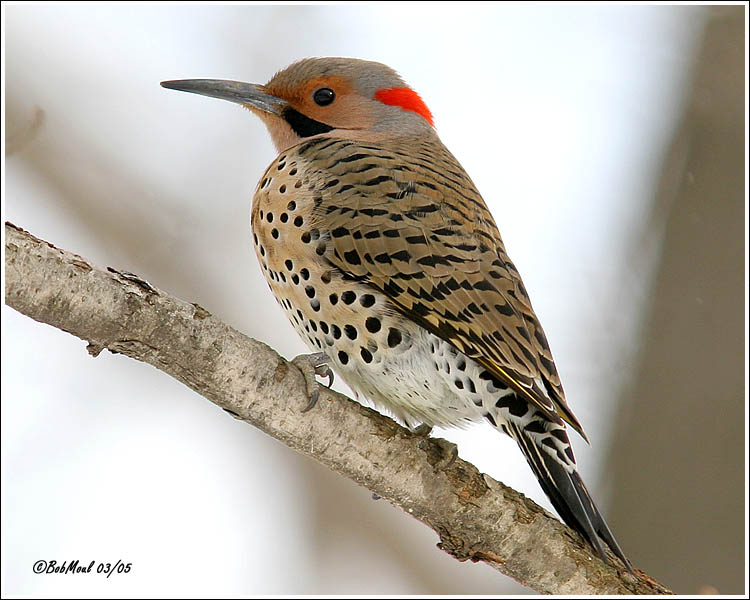
  Northern (Common) Flicker - Male- Bob Moul
Every year I discover at least one new species that was in front of me all along.  This spring it was the Northern Flicker.  We were visiting friends east of Oldfield and Barb spotted a pair feeding on their grassy yard, occasionally flying up to a tree just outside the second story window.  After she identified it, I naively emailed Charley Burwick to ask if they were common in the Ozarks.  His response confirmed my ignorance.
"During the fall, and again in the spring, like as we speak, they are quite common, and can be spotted in large groups. I led a field trip yesterday, and traveled through the Wah Kan Tah Prairie on the way to visit the Schell-Osage CA. There are large tracts that have been recently burned, and coming back in short green grass. There were somewhere between 80-100 of them feeding mostly on the ground, which is common for this species, and some small trees full of perched flickers as well. They are typically all yellow-shafted."
Northern (Common) Flicker-Female - Yellow Shafted
Then a few days later I was driving across our field along Bull Creek with friends from Minnesota as a dozen birds flush out of the grass one at a time several hundred feet in front of our UTV.  "Flickers," Matt said, pointing out the white patch on their rump that flashes as they flew straight away from us to land in distant trees.  Then I had an "Ahaa" moment.  We have noticed for years that when riding up on the fields on the ridge tops we would scare up 8-10 "woodpeckers" that we identified by their distinctive flight, flapping upward, then gliding down in a gentle vertical zigzag.  Northern Flickers all along!


Next we went to our favorite, Allaboutbirds.com from the Cornell Lab of Ornithology.  Their front page of the Northern Flicker has their call, a sound we have heard commonly and had ascribed to our common Red-bellied Woodpecker.  Embarrassing!

Yellow flight feathers and white rump - Andy Reago & Chrissy McClarren
Details we haven't gotten close enough to see include the yellow shafted flight feathers of the eastern species which are red in the western species.  They eat mainly ants and beetles on the ground unlike their tree-drilling kin.  They have a barbed tongue which can extend 2", handy when you are lapping up ants.

Unlike most woodpeckers, flickers migrate south for the winter.  This makes sense for a ground feeding bird whose supply of insect food would become scarce in freezing temperatures and snow.  This accounts for Charley's observation of large numbers in spring and fall.  Now if I can just recognize them in 6 months!

Sunday, March 27, 2016

Crabapple in the Wild

Crabapple in full bloom - REK

Grapevine Epimenis nectaring - REK
Last week our friend Debbie found a tree that was just opening a few pink flower buds.  In riding around the rim of the forest, this was the only splash of color.  It was buzzing with insects, the only source of nectar in sight this early in the season when serviceberry flower buds were just thinking about opening.  Solitary bees, honey bees, a tiger swallowtail and a very persistent Grapevine Epimenis moth flew around mostly out of camera range.  Barb identified it tentatively as a Prairie Crabapple.  We took a few pictures and returned a few days later to find it in full bloom.

We were now joined by our botanist friend Matt and Dave.  Now the leaf buds scales were off, revealing the small narrow leaves.  I thought they most resembled Narrow-leafed Crabapple, Malus augustifolia, but our Missouri trees books said that species only occurs in the Bootheel of Missouri and their leaves are said to be red when first emerging, contrary to our tree.

Smooth bark, horizontal lenticels

The bark of the tree was smooth with horizontal lenticels.  That and the flowers with five petals Matt explained were the identifying features of the Malus genus of the Rosaceae family.  These blossoms were pink and had from 10-20 stamens with yellow anthers just as the book says.

From there on we were left guessing about the species.  The Prairie Crabapple Malus ioensis is the most common native crabapple in our region but not a perfect fit.  The possibility remains that it could also be an exotic escapee.


The leaves didn't help us much, not fitting any one species.  Time for an expert opinion so I sent it off to Justin Thomas.  His response:
"Gorgeous tree! I was able to see that the outside of the sepals are hairy, in one of your photos. That puts it with Malus ioensis. There are scattered records of aberrant hybrids of Malus ioensis with domestic apples, but that is unlikely." 
Malus ioensis - the Prairie Crabapple has a huge list of faunal associations, including moth caterpillars, web worms, etc.  A wide variety of mammals consume the crab apple fruit, distributing its seeds widely.

As always (almost), Barb was right again on the species.  How about them apples!

Saturday, March 19, 2016

Springing Forward

Morels of spring 2013 - from "Mushroom Annee" Yarnton
This year "spring forward" applies to nature as well as our "beloved" daylight savings time.  Everything is a week or two ahead of schedule.  According to news just out in Time Magazine: "Global temperatures in February were the most above average since weather record keeping began nearly 150 years ago, bringing the world the closest it has ever been to what scientists consider dangerous levels of warming, a federal government agency confirmed Thursday."  To confirm this, the latest is news of morels found at several locations in southwest Missouri already.  Wonder where.....well DUH!  You expected GPS readings?

Our friend Jeff Cantrell, the MDC educator from the Joplin area sent us a nice description of a spring trip you might consider, along with some enticing photographs.  Here is a guest blog from Jeff with his photographs:

Buds are bursting open - Cantrell
One of the best things about having a “weekend” on a Wednesday/Thursday combo is you can savor several thousand acres of the Mark Twain National Forest to yourself. I spent 6 hours there this morning and I never saw one human being. Solitude can have many meanings; “pure soul refreshing” is one of them.

Piney Creek Wilderness (Barry County) can be one of your favorite starting points for chasing spring, it is mine. What happens here will be taking place in a matter of days in Newton, Lawrence, Christian, Dade counties and perhaps in over a week in Jasper, Cedar, Vernon and Barton... This “Wilderness” is latitude-even with southern McDonald County so there should be equal riches taking place in McDonald as well.


Their serviceberry are ahead of ours - Cantrell
The serviceberry are providing a mid-canopy, white petal-cloud layer against the pines and it is striking from a distance. Plus, you can hand pick your favorite scene by framing the blooms against the dark short-leafs, the blue sky, individually or in a floral swarm.

Spring Beauty - Claytonia virginica - Cantrell
Spiderwort - Tradescantia ernestiana. - Cantrell
Pine warblers and white-throated sparrows were in chorus, little midland brown snakes have emerged, and five species of butterflies were out. The ephemerals consisted of bloodroot, toothwort, harbinger of spring, Sweet William, pussy toes, violets, woodland spiderwort (cow slober), spring beauty and false rue anemone (wind flower). The holler/ wet areas harbored southern leopard frogs, peepers, western chorus, and American toads. My mind wandered as always to sleeping Ursids (black bears), wondering what they were dreaming of?

So if you are off this weekend, you might check out Big Sugar State Park, Piney Creek, or other southern Master Naturalist region targets. The life is opening up in our direction and changes daily.

Enjoy! It is a great time of year. - Jeff