Sunday, July 18, 2021

Water Strider

A pleasant way to spend a summer afternoon is sitting in the swimming hole watching water striders skim across the surface.  Gerridae are a family of insects in the order of "true bugs," Hemiptera.  They use their front and back legs to stay on the surface, rowing with the middle pair.  The short front legs have claws to grasp prey from above and below the surface while the hind legs can serve as rudders.

Their tiny feet resist sinking due to tiny hydrophobic microhairs, more than 1000 per millimeter.  Their ability to skate on water lies in the cohesiveness of water, the same reason that you can put 36 water drops on a penny before they run off as seen here on Youtube.  This creates surface tension, the same reason that it hurts to do a belly flop into a pool.  You can see it in action in this BBC Clip.

Danger comes from above and below.  When they sense movement below the surface from a predatory fish or backswimmer, they can jump up, putting even more pressure on the surface tension. 

Females have anatomical adaptations to resist an insistent male's advances but he may hang on anyway as in this video.  A male will mount and if she resists his advances will blackmail her by beginning to tap the water to attract predators until she yields. Discover Magazine

Water striders mating - Wikipedia

Now add on the weight of a mating male on her back and that puts the female even more at risk.  Surprisingly females can actually learn to jump with the new load.  Scientists have reported in Nature.com that they actually added weights onto water striders.  With time and practice females learned to jump with the load, using a slightly different technique.  Even more interesting, that is something that the weighted males in the study never learned.  My editor-wife doesn't find that surprising.

Thursday, July 15, 2021

Wren Family Album


Summer is the time when birds are raising a family.  The first clue may be a bird flying with twigs, leaves or even strings, the elements of nest construction.  By watching closely, you may be able to find their nests and watch the family develop.  Once you have found the nest, you should make your visits brief, just for a minute to avoid disturbing the family.  A quick photograph is a good way to follow their development.  Ben Caruthers sent me these photos of a Carolina Wren family.

Freshly hatched and naked

Initially they will be incubating the eggs and the parents will only be leaving the nest for a couple of minutes to avoid chilling their brood.  In some species, only the female broods the eggs while the male hangs around nearby.  Once the eggs have hatched, the pace picks up as the parents begin flying on the hunt for insects to feed their young.  The naked chicks initially sleep soundly but in a few days they may respond to your visit with open mouth, expecting a nice juicy caterpillar.

Partially dressed in downy feathers

Over the next couple of weeks they start to develop their feathers, a look that resembles a tousled look of a “bed head.”  During the third week they will lose some of their fluff and start to look more like a teenager.    

Day 14 - fully feathered and ready to fledge

Some species fledge during the third week.  It is important during this time to avoid disturbing them as a premature fledging puts them in danger, entering the cold cruel world before they are prepared.

Freshly fledged Phoebe  
If you are lucky enough to see a newly fledged bird like this Phoebe, you can still notice little remaining bits of fluff, the last remnants of their youth.

Safe nest watching pointers are available at Nestwatch.org Code of Conduct.


As I finished writing this yesterday, a tiny downy feather came floating down and landed on my keyboard.  I was sitting on the couch in our family room with no birds in sight.  Spooky! 

Thanks to Ben Caruthers for all the photos and his timeline.
 

Monday, July 5, 2021

Pearly-eye on the Web?

Pearly-eye in the morning - REK
On awakening, I saw a small butterfly clinging upside down on the bedroom window pane.  After considering how and why it was there, I got up and could see it was a Northern Pearly-eye, Lethe anthedon.  I photographed it with my cellphone and that got me thinking about technology and the pace of change in knowledge.

Bugguide via Creative Commons

L. anthedon was first named by A. H, Clarke in 1936 and a field guide describes the different names and spellings over time.  These would have been scattered in academic papers, known and argued over by a few experts in universities.  Finding this fact alone would have required searching through field guides 10 years ago.  Now I can find its history, lifecycle and foods on my iPad, computer, or even my cellphone if I have the patience to type on the small screen.

Black club bases - BG

At Explorer.natureserve.org I can see its frequency in individual states as well as if it is threatened and by what factors.  Instead of thumbing through a field guide a page at a time, I can identify a Pearly-eye in seconds by sending a picture to INaturalist.*  However this gives a somewhat ranked likely identification as discussed below.

If I am still unsure, sending it to Bugguide lets experts evaluate the photograph.  This however may take weeks or months, depending on which volunteer expert checks in.  Which Pearly-eye species is it?  "Similar to other pearly-eyes, but more northern in range, bases of antennal clubs black."

In this case INaturalist ranked Pearly-eye as the first choice.  I had sent my original picture in before cropping and color correcting it to the picture above.  Su Lynn Rogers saw the blog and suggested that it might be a Hackberry Emperor.  Looking at the photo closely I discovered she was right.  I submitted the improved photo and the Hackberry Emperor moved to Number one and Pearly-eye dropped to 4th choice.

What it eats  (grass and occasional sedge species) and  how it lives have been studied and documented by academics, grad students and obsessive naturalists.  These details were recorded in scattered papers but are now available instantly on BAMONA.

Duke, the dog -Canus familaris
Need a better photograph?  Searching Bugguide images instantly brings up lots, many tagged for Creative Commons where they can be shared without a copyright.

Most of these advances in technology have occurred in the lifespan of our dog Duke, not that he particularly cares.  But we do.

Wednesday, June 30, 2021

Funky Fungi Fingers

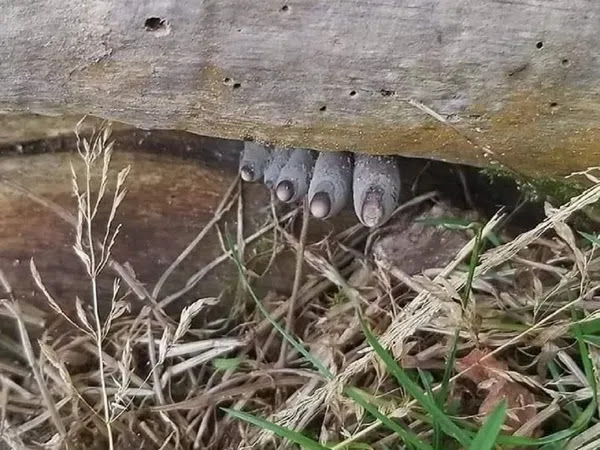
Gala Solari sent these photographs of what she identified as "Funky Fungus", a remarkable field of what I thought were Dead Man's Fingers. As usual, Mark Bower corrected me. "I think this is more consistent with Xylaria cornu-damae. The grayish dusting consists of the asexual spores. Dead Man’s Fingers (Xylaria polymorpha) are larger, fatter and grow in clusters. "

I felt better when I read the description of Xylaria sp in Mushroom Expert. The differences in the various species are described in terms that only a mycologist could love or even understand.  Being  absolutely certain usually requires microscopic examination of the spores.

Dead Man's Toes - Mark Bower
Typical Xylaria sp

In most photographs they only vaguely resemble fingers or toes as you can see to the right.  My favorite were the Dead Man's Toes that Mark Bower photographed on our land.  They were all the more incredible for growing on a huge moss covered rock with a large tree whose roots cling to it.


More "nails" on the Web
There are several photos on the web of "Dead Man's Toes".  This one above which is all over the web even has toenails, although when enlarged I suspected a little Photoshop manicure.  Lisa Berger however pointed out that lots of photos of X. polymorpha have the same nails.

Finally, Michael Kuo in Mushroom Expert writes "The genus Xylaria consists of funky, club-like decomposers of wood or plant debris that become black and hard by maturity, reminiscent of carbon or charcoal."  Note that even a world expert on fungi call them "funky".  I guess that means that Gala's ID was right in the first place.


Saturday, June 26, 2021

Woodchuck in a Tree

Hanging out by our deck
 
Visiting our deck
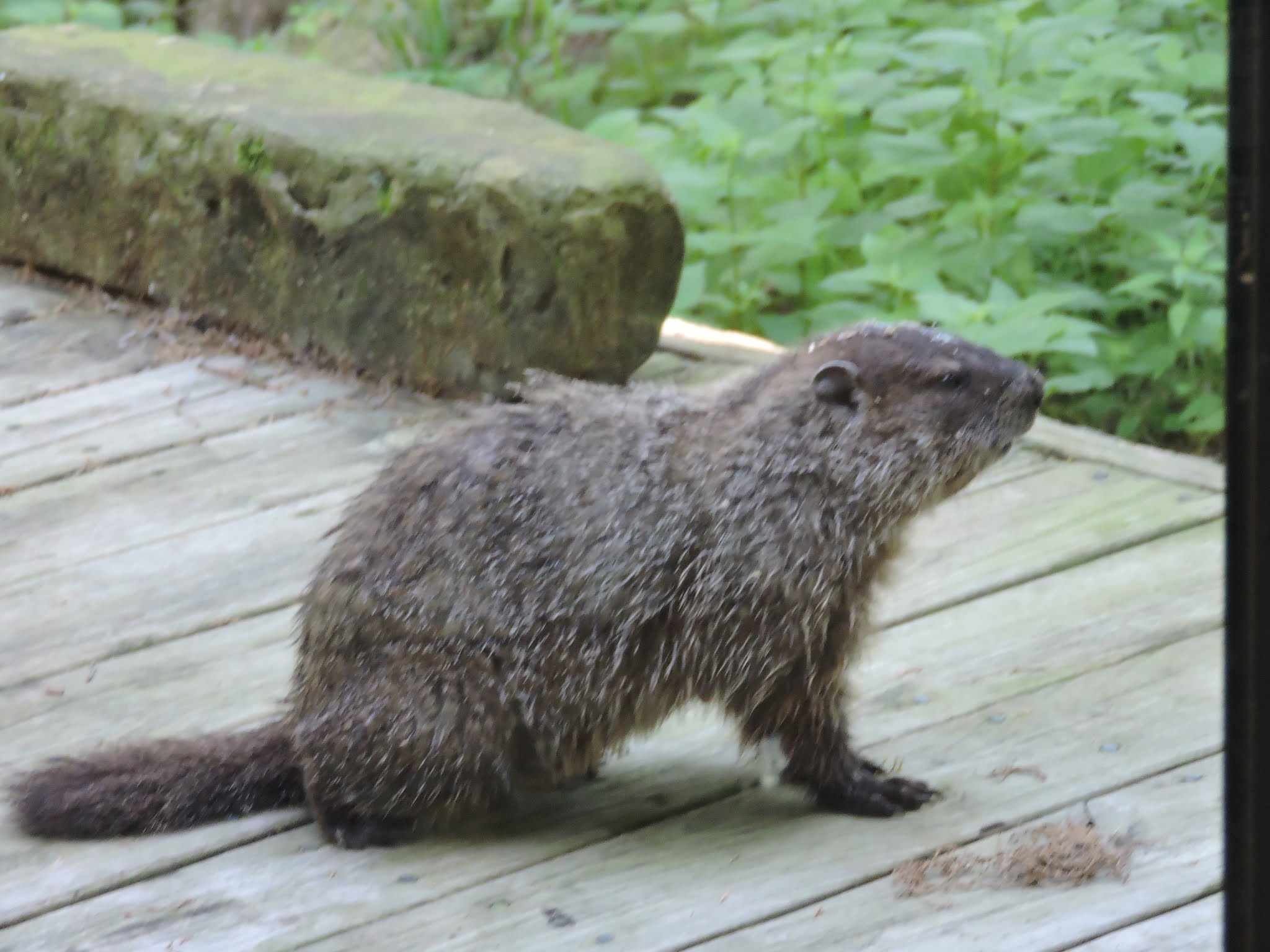
Over the last year I have seen our resident groundhog several times in a tree at eye level off our deck, 10 feet above the ground.  Mammal resources say that they may climb a tree to look for escape from predators but our whistle pig seems to do it just for fun and may spend up to an hour hanging out.

Woodchuck in a tree - Terry Lange
Posing for a game camera

The groundhog, Marmota monax, also known as a woodchuck, is our only Missouri member of the family Sciuridae, large ground squirrels known as marmots.  It is common to see one or more nearly motionless individuals standing erect on their hind feet watching for danger. 

When alarmed, they use a high-pitched whistle to warn the rest of the colony, hence another name "whistle-pig."  They are intelligent and form complex social networks.  They have kinship  groups with their young, understand and communicate threats, and are able to work cooperatively to solve tasks such as burrowing.  The groundhog prefers open country and the edges of woodland, and is rarely far from a burrow entrance. 

Mostly herbivorous, groundhogs eat primarily wild grasses and other vegetation, including berries and agricultural crops, when available.  Note that branches are not in their diet.  Apparently the answer to "How much wood would a wood chuck chuck, if a woodchuck could chuck wood" is very little.  Last week when Chuckey came down from the tree he spent the next 10 minutes munching on the grasses and forbs along our deck as seen in this video.

Visiting our truck
A risque fact is that groundhog social groups consist of one adult male and two adult females, each with an offspring from the previous breeding season (usually female), and the current litter of infants. Interactions within a female's group are generally friendly.They have a social greeting of nasal-oral contact much like an "Eskimo kiss" from my childhood.  OK, that was 75 years ago so put that down to ancient history.


Sunday, June 20, 2021

Camouflaged Looper

Wavy-lined Emerald- Wikipedia

While collecting beetles off a flower head I noticed movement in some dried plant debris in the bottom of a bug box.  Laid on the table, it began to twitch.  Only when it stretched out did I recognize it as a camouflaged looper caterpillar, the larva of the Wavy-lined Emerald moth, Synchlora aerata (SA) It is a member of  the Geometridae family.


 Geometrids ("earth measuring") have larvae that as a child I called "inch worms" for their habit of holding on with their hind legs as they move their head forward, carefully measuring their ground.  They lack several pair of prolegs in front and therefore can't crawl like other caterpillars.  My SA caterpillar was having problems getting traction on our smooth kitchen counter as seen here on Youtube.

While most geometrid caterpillars are smooth, the SA camouflaged loopers are prudish and would never consider going out in public naked.  They chew off flower parts and seeds, sticking them onto needle-like projections on their upper body surface with a little silk from the spinnerets beneath the caterpillar’s mouth.  Remove the particles and they will immediately start dressing again.  Each time it molts the camo falls off with the old skin and it starts again, a real "clothes horse" of the insect world.

Moths usually have rather specific host plants.  Our SA larvae however feed on a wide variety of plants, including the flower heads of composite flowers and other flowering plants, as well as shrubs and trees. Recorded food plants include Aster, Rudbeckia, Liatris, Solidago, Artemisia, Achillea and Rubus species. (Wikipedia)  They will even venture into non-native territory and conceal themselves on chrysanthemums, daisies, yarrow and Queen Anne’s lace

Because of its wide range of plant food, the SA caterpillar can dress up in many different colors and shapes.  Most sources say the caterpillar uses plant particles as camouflage to hide from predators.  I wonder if it doesn't make up for its drab adulthood by showing a juvenile sense of style.

Thursday, June 17, 2021

Meadow Plant Bug

Ben Caruthers shot this photograph at Wilson's Creek Battlefield.  It was a bug in a meadow sitting on a plant so he immediately called it a meadow plant bug (MPB) which is its common name.  A quick trip to INaturalist didn't hurt.  It also answers to Leptopterna dolabrata (Miris dolabratus), but we will stick with MPB.

It is a native of the grasslands in almost all of Europe and east across Asia Minor to the Caspian Sea region.  It was introduced to North America in the distant past where it has found a lot to love in our north central grasslands as well as southern Canada.  It is considered a pest in the grass seed industry where it feeds on developing grass seeds, causing seed heads to shrivel and prematurely whiten.  They also will cut into the base of the grass plant to insert their eggs.  When it comes to wheat:

"MPBs exude a sticky saliva as they feed, and according to one source, the residue of this saliva can break down wheat’s gluten midway through the bread-making process, turning a yeast dough into a runny mess."  UWM.EDU

MPB Nymph - Charlie Eiseman

As a "true bug" in the order Hemiptera, it goes through incomplete metamorphosis, the young resembling the adults although the wings only develop in the last of their five successive molts.   You can see the early wings budding in this nymph and its grass stem acrobatics at this link.

MPB left some of its natural predators at home in the Old World but has lots of grassland predators and parasitoids here.  It exudes a smelly defensive chemical from scent glands on their thorax when threatened.  Fortunately Ben didn't snort it!