Friday, September 30, 2022

Owl Pellets


I recently was gifted owl pellets by Ben Caruthers. The dried undigested regurgitated remnants of an owl meal is an exciting exploration for a 5th grade WOLF student. I stored them in paper egg cartons inside a ziplock bag in the dining room. I have a very tolerant wife.
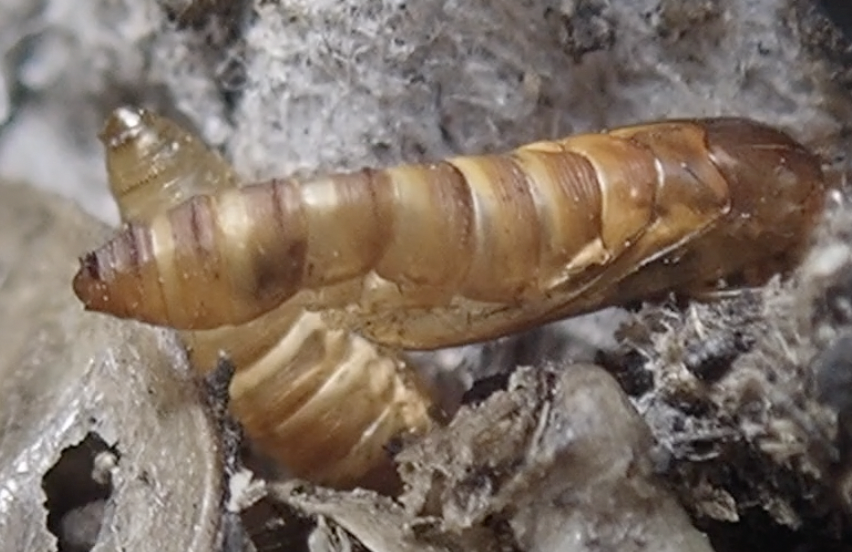
Exuviae of emerged moths - notice the wing features below

When I opened them a month later I could see exuviae, empty pupa cases with remnants where there had been wings developing. Among the collection of digested rodent bones, some of the debris was moving. After filming it, (a historic term for video), I extracted a wiggling piece of debris and captured a case-bearing larva attempting to escape as seen in this video.

 
The larva lives this stage of its life in a tunnel it glues together from debris.  The owl pellets in the egg carton had a least a hundred of these little guys.  Now the question was what were they?  
 
6 mm moth in owl pellets

A week later I had an answer.  I found several of these 6 mm long moths in the bag.  a quick Google search of "case-bearing moths" returned lots of links pointing to clothes/carpet moths in the Tineidae family.  The majority of these feed on fungi, lichens, and detritus, which fits with the material in these pellet remnants.

This is most likely the case bearing clothing moth, Tinea pellionella.  They are distributed world wide and are frequently associated with human populations.  There are a few other similar species in the family that can only be identified by examining their genitalia so we won't go into that.   

"T. pellionella larva eats mainly fibrous keratin, such as hairs and feathers. It can become a pest when it feeds on carpets, furs, upholstery, and woolen fabrics. It also consumes detritus, cobwebs, and bird nests."  -Wikipedia

The larva lives inside a snug case it constructs from debris such as fibers and hairs.  It extends its body to crawl around, hauling its home for protection.  Incredibly, it can turn around in the case to protrude its head and legs at either end and drag the case in either direction.  Finally they will form a pupa and eventually crawl out and expand their wings.

So back to the other question, what are owl pellets and why would a grown man collect them?  Owls often swallow mice, voles, small birds, and other prey whole.  After its gizzard has sorted out the indigestible parts such as fur, feathers, teeth and bones, the owl regurgitates them in a oval owl pellet.  This frequently occurs in a roost where they collect on the ground underneath.  Taking these to the 5th grade WOLF School, we students young and old, will examine them to try to determine what the owl had been eating. 


There are lots of resources available to students of all ages.  This brings out your inner 5th grader without having to get on a bus every morning.

Tuesday, September 27, 2022

Summer Egg Hunt #

Tonya Smith sent me on a non-Easter egg hunt with these picture of a string of barrel shaped eggs laid on a mulberry sapling leaf.  A search for insect egg photographs brought out a likely suspect, a leaf-footed bug, Leptoglossus oppositusA deeper dive found a picture of the critter in action below. 

The name leaf-footed bug comes from the shape of the tibia of many of the Coreidae family.  There are 88 species known in North America.   L. oppositus is extremely common across the eastern US and I find lots of them in the fields every year along Bull Creek.  

 L. oppositus is distinguished by the deeper scallops in the leaf-like feature of the hind tibia and the addition of three white spots across the hemelytra, the name of forewings in true bugs.

Proving the identification of the eggs down to species is hard but I would argue that the circumstantial evidence is strong.  Red mulberry is one of the host plants of the species as listed in BioOne.

Eggs closeup - Tonya Smith
Laying eggs - William Dedo


The eggs that Tonya photographed with their barrel shape and bulls-eye circle are fairly distinctive as seen at several sources.   Now enough of this hunt, it is time to go back to work.  No, not really - this isn't really work.

Friday, September 23, 2022

Rusty Spider Wasp


Building her nest - BC

Ben Caruthers comes through again with a great set of pictures.  He shot this red wasp and identified it as a rusty spider wasp (RSP), a lot easier to pronounce than its scientific name Tachypompilus ferrugineusThis is a large and impressive wasp that dives into its work head first.


Rusty spider wasp dragging a wolf spider across the ground
Click to enlarge - MDC

Spider wasps belong to the family Pompilidae.  These wasps visit flowers for nectar but their fame comes from killing spiders to feed the family.  The female stings her spider prey into paralysis and then drags the spider backwards to her nest, gripping the incapacitated spider with her mandibles.  The trip can be long and laborious as the spider is frequently much larger than the wasp.  Maybe that is why they call it going into labor?

Spider Wasp and Wolf Spider - Tachypompilus ferrugineus
With a wolf spider prey - Ted Kropiewnicki CC

Once the nest is prepared to her satisfaction, she grabs the spider and rolls it over so it is on top of her while she deposits a single egg before covering it with soil.  I frequently wonder how we know details like these but in this case it was observations by R.W. Strandtman described in this more detailed source.

The RSP specializes in collecting wolf spiders (Lycosidae).  Other species of spider wasps also tend to specialize in their spider prey, some with free living hunting species and others using web spiders.  The young wasp will get all its nutrition from this spider while all adults feed on nectar.

After this considerable effort to deliver and feed a single young, I wonder if she doesn't tell the next male that finds her, "Not tonight, I have a headache!"

Saturday, September 10, 2022

Giant Walkingstick


I found this stick insect in the bed of my truck after emptying a load of cut branches.  This is a giant walkingstick,  Megaphasma denticrus, quite distinctive in coloration.  This is the longest insect in North America, reaching up to seven inches long.

It had a rough day and was missing one leg but that didn't keep it from climbing onto my hand and start heading upward, the only direction most stick insects want to go.  During the day they cling to the tree, sometimes swaying a little like a small branch.  Their defense is to drop to the ground and they are light enough to survive the fall.  Then they immediately start to climb up for food and shelter.  M. dentricrus adult's favorite food is oak and grapevine leaves.

This specimen is a male, defined by a large, single spine on the underside of its mid and hind femora, the first leg segment like our femur.  Another distinctive male feature is the clasper at the end of its body.

Copulation - Marvin Smith CC

Males tend to be smaller and far fewer than females.  The copulation consists of the male using his clasper to hang on to the female's genitalia, fertilizing the eggs as they come out and immediately drop to down to the forest floor.  The male may hang on for several days, eating during this time. 

The female may produce 150 eggs with three eggs per hour.  Her ovipositor has a small flipper which propels them randomly, ensuring that they are scattered and less likely to compete for vegetation.  (See ADW)


Clasping copulation - Marvin Smith cc


The young offspring feed on grass and leaves, particularly oaks and grapevine.  They will go through four to five molts before achieving sexual maturity.  This species is known to regenerate a missing limb but in this case I wasn't able to raise it long enough to make it to the WOLF School alive.  I think it died of a lonely heart, never having reached its biological imperative.

Ben Caruthers sent this incredible macro of its eye.  Now check this Bugguide link for more photographs.


Thursday, August 11, 2022

The Ant that Ain't - Cow Killer

Our unpaid staff photographer Ben Caruthers sent me a set of photographs of a velvet ant that are too good to pass up. I updated this blog from 2013, guesssing that you won't remember it.

Female Velvet Ant
Some years ago I was out with some young naturalists.  All kids are naturalists if given a little freedom and encouragement.  They found this critter running rapidly through the cropped grass and weeds by our swimming hole.  The consensus among my young naturalists was "Wow, look at that ant!" and they were partially correct.  It is a velvet ant, an insect that "ain't really an ant."  I chased this swift creature for several minutes before catching in it a bug box.  Due to its formidable appearance,  I wasn't tempted to pick it up, a wise decision.

Male Velvet Ant - Ben Caruthers

This is a wasp called an Eastern velvet ant, Dasymutilla occidentalis. Although he looks wicked, he lacks a stinger as do all male wasps.  As a rule of thumb, I assume that all wasps are female until proven otherwise.  In this case however, the females lack wings and don't even look wasp like.

Male side view - BC

Velvet ants are characterized by their dense hair in vivid shades of red, orange or yellow.  The winged males have a different coloration than the wingless females.  Bright colors in insects are frequently warnings of toxicity or the ability to hurt predators like us.  Other harmless insects may also have these bright colors called aposematic that falsely warn of their toxicity.  In this case, the females are the real thing.

"I am not smiling!" - BC

Their other name is "cow-killer" which probably gives you a hint of their defense.  The name derives from the female's stinger.  She has a sting that is rated as a three on a one through four Schmidt sting pain index scale.  Justin Schmidt prompted insects to sting him and then graded the severity of the pain in terms generally reserved for a wine connoisseur.  These ranged from "light, ephemeral, almost fruity" to ""hot and smoky, almost irreverent. Imagine W. C. Fields extinguishing a cigar on your tongue."

Adults feed on nectar and water.  The male flies around looking for females on the ground.  They are parasitoids, rearing their young in nests of other species, eventually killing them.  When they emerge, the males fly off while the females crawl away as a warm and fuzzy "ant" - well maybe not so warm.

"Male mutillids fly in search of females; after mating, the female enters a host insects nest, typically a ground nesting bee or wasp burrow, and deposits one egg near each larva or pupa.  The mutillid larvae then develop as idiobiont ectoparasitoids, eventually killing their immobile larva/pupal hosts within a week or two."  Wikipedia

Surprisingly, the female's toxin isn't all that strong.  The severe pain is due to the extraordinarily long stinger!  Even without a stinger, the wasps have other defenses against predators.  In addition to its coloration and a thickened exoskeleton, when bothered they emit a stinky chemical secretion.  Also both males and females run fast which Ben mentioned makes them hard to photograph, let alone catch.  When threatened, they make warning sounds and clicks by rubbing their body parts together, a trait called stridulation.

Best to remember that their attitude is "just leave me alone!"

 "You wanna pick me up?"  Wayne Boo at  USGS

Monday, August 8, 2022

Frog-biting Midge


 Exciting News - Hang on for a long ride!

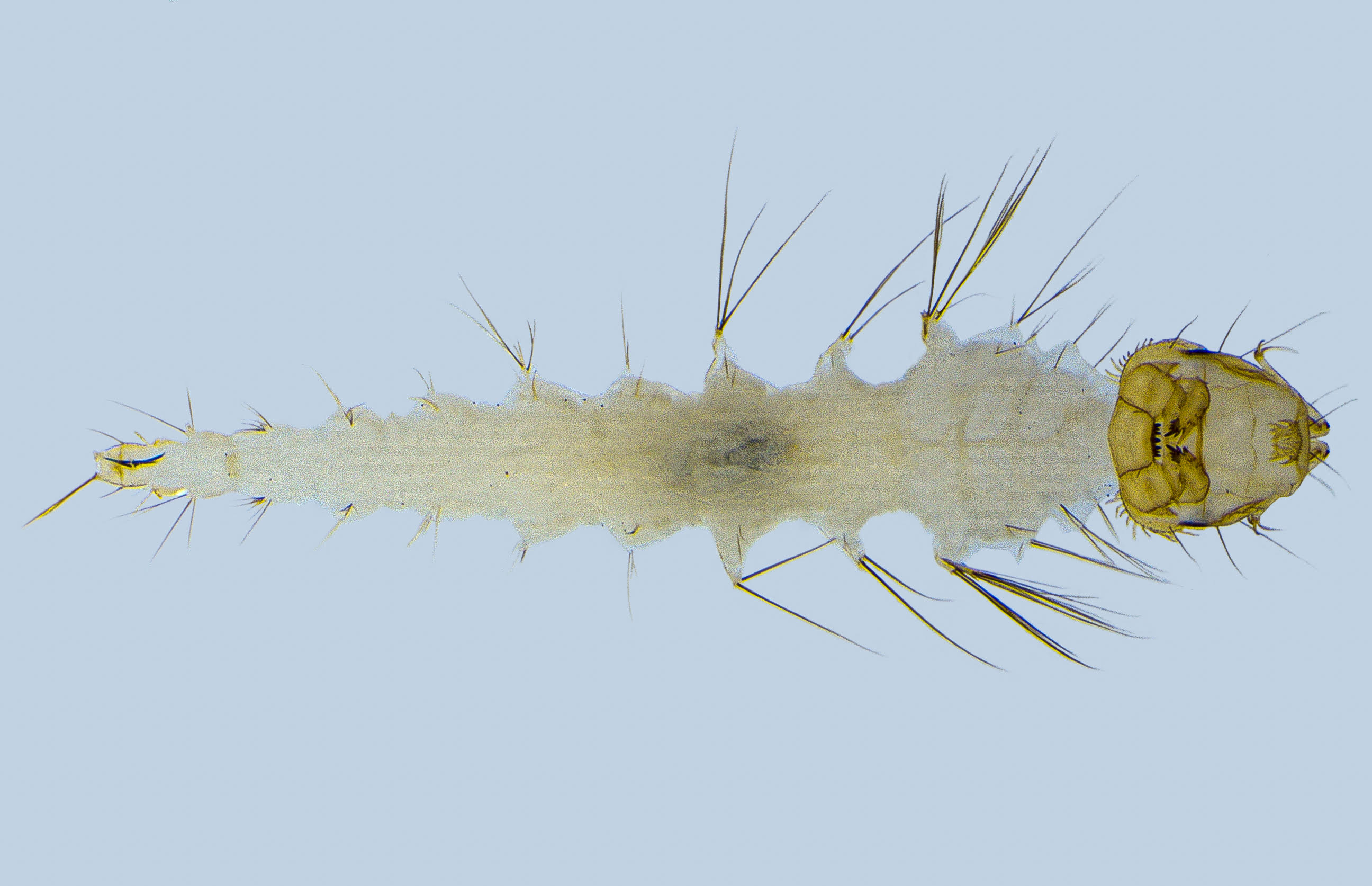
This little lady above was collected by our friend and stream researcher Nathan Dorff from Peckout Hollow just beyond our old barn.  After several years collaborating with experts in the field, it is now official.  This is a new species of frog-biting midge, now officially named Corethella kipferi.  These midge larvae spend their entire lives in the hyporheic zone, the water flowing out of sight under gravel bars.  There they happily spend their hours munching on mosquito larvae and other tiny delectables.  Then in a moment of passion they come flying when the female hears the call of a frog and draws out some blood, necessary to produce fertilized eggs for the next generation.

Adult female midges, < 2mm

The female adult specimens above are in my collection.  Preserved in alcohol, they measure just about 2 mm.  Nathan collected them in an insect trap as they were responding to the recorded call of a gray tree frog, Dryophytes versicolor, aka Hyla versicolor.  He had previously collected the larvae from pipe wells he had driven into the hyporheic zone bed of Peckout Hollow running below the dry surface gravel.  You may recall Hyla versicolor from this previous blog.

By now you are probably really confused.  I will try to explain a little more about our new species or you can just read Nathan's whole paper here.

If you are still with me, here we go.  Don't say I didn't warn you!  (Editors note:There will not be a test.)

The frog-biting midges are in the single genus Corethrella.  There were a total of 115 species and counting at last report with "52 of these being new" before Nathan's report.  All known species occur between the 50 North and 50 South parallels and are restricted to areas where frogs can live.

C. kipferi larva - Nathan Dorff
C. kipferi - Nathan Dorff

The larvae of FB midges are not distinctive and cannot be identified down to species level.  That said, I think that think you will agree that they are kinda cute!

FB midge eating mosquito larva - Sturgis McKeever at Bugwood

The larvae are predators on zooplankton in the water, such as mosquito larva above.  They remain anchored and stationary, grabbing dinner as it passes.  There is little known about their dietary specifics although one paper reported a common species that prefers munching on our Asian tiger mosquito larvae.

Of course their fame comes from the female's obligatory diet of frog blood.  They are thought to seek out the frog calls by their specialized Johnston's organ, a collection of sensory cells found on the second antenna segment.  Now that has to be tiny on a 2mm midge!  An article on Eavesdropping Vampires delves deep into how and possibly why they pick out hosts by their calls.

There is even some evidence of some having not only specific host frog species but even preferred biting sites on the frog by different midges such as face sucking or back biting!

Wikipedia CC


INaturalist  


Congratulations for hanging on for the whole ride.  This was a lot more than you asked for but I find it fascinating how much we can now learn about a tiny insect that measures 1/16"!

C. kipferi - Nathan Dorff

Finally, I was curious about this face shot and asked Nathan about it. 

"They are photomicrographs….but I’m afraid the techniques are beyond me. Essentially they take a stack of photographs through a microscope from different “depths” at high magnification and combine them to make those spectacular composites with so much detail. Love the compound eyes!!

We are grateful for Nathan's studies, his friendship and sharing his youngest addition to the family with us.

Tuesday, July 26, 2022

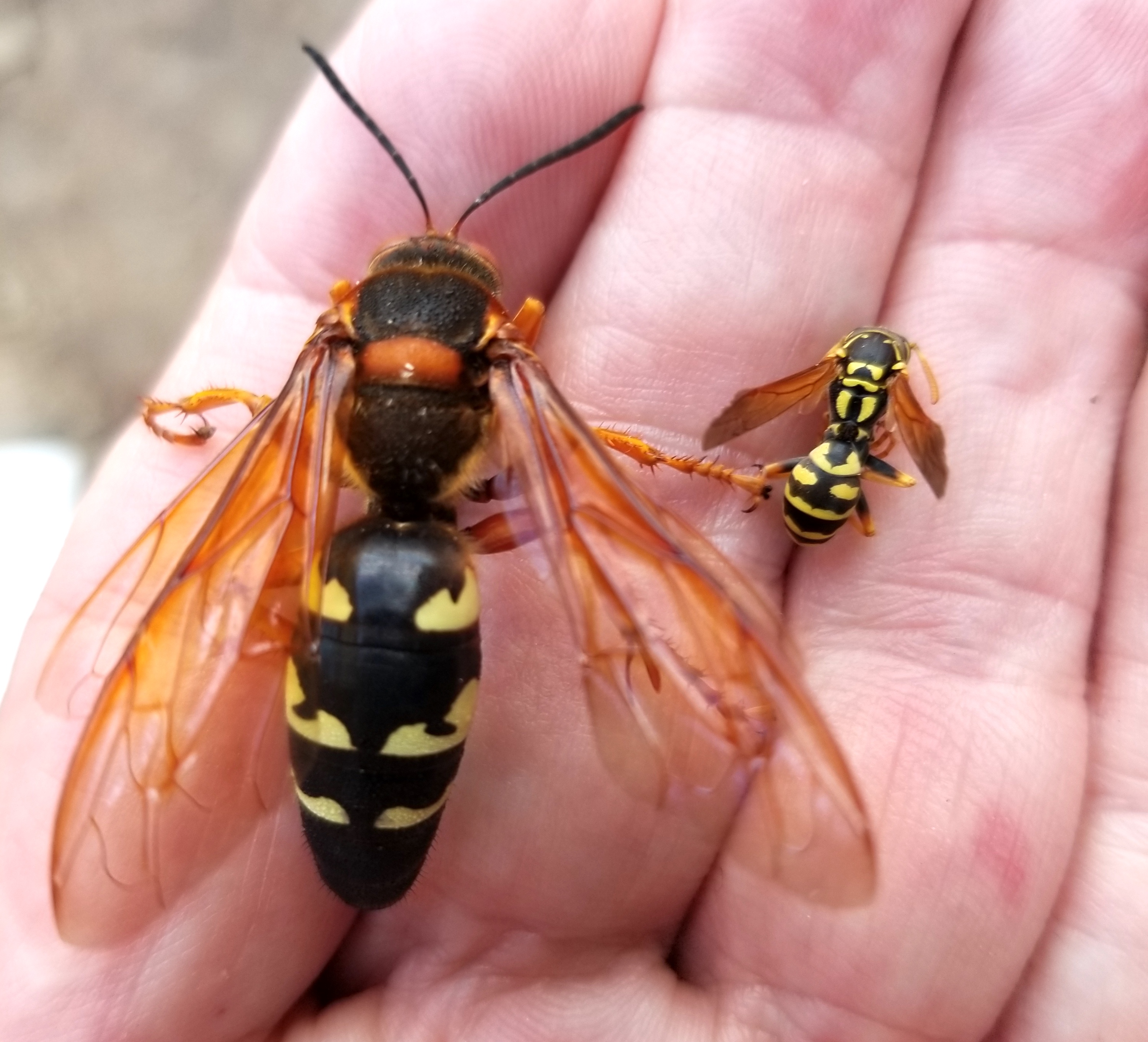
Handful of Wasps


It was yellow wasp day in Springfield.  We started the day with the little one on the right.  Barb had seen them flying into a small construction hole in a rain barrel.  My first thought was yellow jackets but it looked a little small and they almost always nest underground.  I carefully caught one and chilled it in the refrigerator.  Once I could get better photographs I could compare it with yellow jacket specimens.


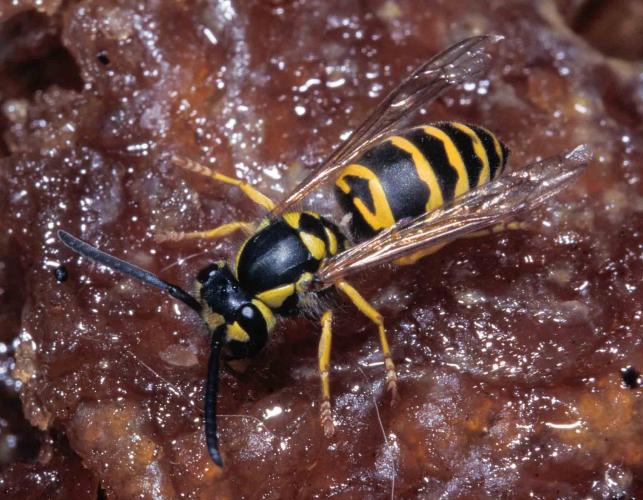
Yellow jacket - MDC
European paper wasp - Polistes dominula


When you get them side by side the distinction becomes easier.  The yellow jacket has black antennae vs. the orange ones on the European paper wasp.  The yellow jacket abdomen is thicker and shouldered at the front.  Paper wasps dangle their legs in flight which is easy to see.  On the other hand the yellow jacket has its legs up tight to the abdomen which tells you two things; it isn't a paper wasp and you are way too close! 

The Polistes dominula is a docile species and will only sting if you disturb their nests, unlike the yellow jackets we discussed in a previous blog.  They are an invasive species but not a big problem.  They have a lek based mating system where the females in the nest may mate with various males promiscuously so that 35% of the nest are unrelated.  (They are European you know!)

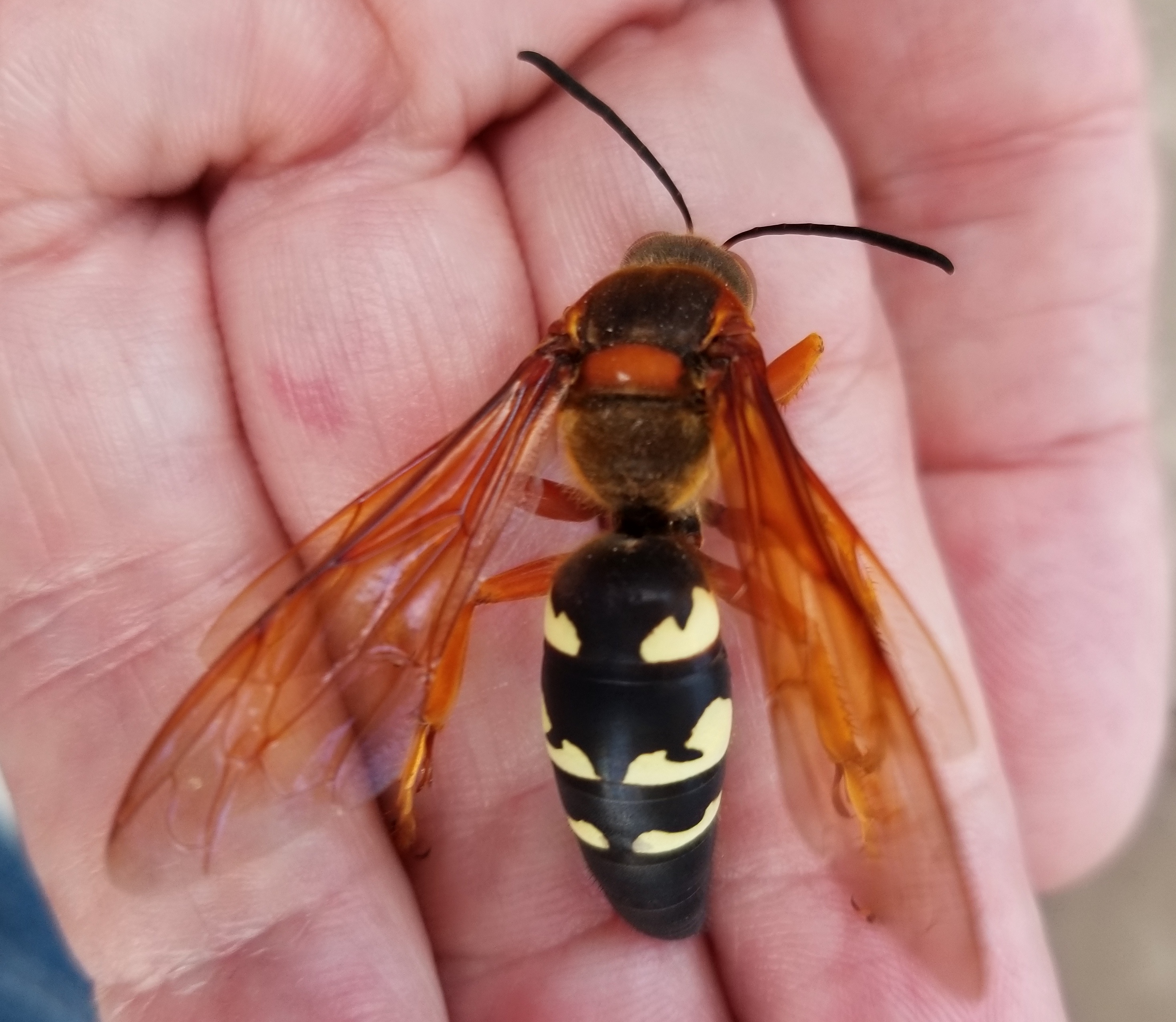
While I was identifying my specimen I heard a buzzing around some of Barb's native plants on the deck and saw a big yellow wasp slowly buzzing around the sunflower heads.  I wasn't able to photograph it on the wing and finally resorted to netting it and then very carefully transferring it in to a bug box for chilling.  


My first guess was right, this was the famous cicada killer, Spheseus speciosus.  You can watch this entertaining dramatic video on them on YouTube that I would recommend for fun.  MDC has a more scientific approach here.  They are scary in flight but relatively harmless, never aggressive unless you grab one or step barefooted on them at their nest opening on the ground.  The males bang into each other in competition for females but their pointed end is all a bluff.  Only the females can sting you.

MDC describes their lifecycle:

"Females emerge and dig nest tunnels; then they hunt, sting, and paralyze cicadas, transport them to the nest, drag them inside, and lay an egg on them. The larvae hatch in a few days and start eating the cicadas. Within a month, they finish growing, form a protective cocoon, and overwinter. In spring they pupate for about a month, then emerge as adults."

Not all wasps are harmful and even the paper wasps just want to be left alone to hunt spiders and other insects for their babies.  Avoid unnecessary insecticides unless they are where you can't avoid them.

Wasps on a quarter - OK, so these did die in the cause of education.