Showing posts sorted by relevance for query case. Sort by date Show all posts

Saturday, January 14, 2017

The Case of the Case-carrying Worm


Dero (Aulophorus) vaga - 1mm - Linda Bower
I was following correspondence from Linda Bower asking Chris Barnhart for identification help after filming an eccentric worm that appeared to be dragging around a decorated case. Chris recognized that the case was partly made of Bryozoan statoblasts (the oval brown objects with a pale perimeter). Chris Barkau, Graduate Research Assistant at Southern Illinois University Carbondale was able to identify it as Tubificida: Naididae: Naidinae: Dero (Aulophorus) vaga.  I asked Linda to describe her find.

Linda:
Case-carrying Worms dwell in ponds with Duckweed, but are often missed by traditional collecting methods. They are tiny – less than 1mm. It was difficult to find recent* detailed information on Dero vaga, also called Aulophorus vaga. We know that it forms protective tubes by means of a viscid secretion from their bodies. You can watch this video of the worm sliding in and out of its case as it searches for food. It is a fascinating dance you won't see elsewhere, and it is free!
Cut and whole Bryozoan colonies - Click to enlarge - MDC
The Case-carrying Worm is interesting enough, but combined with Bryozoan statoblasts? Wow! Bryozoans (aka Moss Animals) are really animals, but given their appearance, that is hard to believe. Bryozoans are a major animal group, having nearly 4,000 known species and only a few dozen of those live in freshwater habitats. They may grow on any submerged object, such as rocks, roots, and branches. They feed on protozoans, bacteria, and organic matter from the water. They are colonial, living in gelatinous blobs.

Most freshwater species produce resistant bodies called statoblasts that form in response to adverse environmental conditions and provide a means of overwintering. As they grow the statoblasts produce bi-valve shells made of chitin, the same stuff that makes the exoskeleton of arthropods (think insects and crayfish). More detailed information on Bryozoans is at this link.

I have filmed several Case-carrying Worms since this first find and here are three additional videos. Do not resist your temptation – follow these links:
Editor's note: You can bail out now or follow along for the details of the complicated life of D. vaga (or if you prefer A. vaga). These tiny (1mm) worms can be found floating within a mass of duckweed or clustered in the algae of the pond bottom, moving up or down based on the availability of food.  Like all other Oligochaeta (worms) D. vaga is a hermaphrodite. It is capable of sexual reproduction or fission. This was described in an 1899 paper, The Natural History and Morphology of Dera vaga.


The period of sexual reproduction occurs during the first two weeks of July, when the body cavity posterior to the clitellum is crowded with eggs.  Asexual reproduction by fission takes place throughout the year, but most rapidly during warm weather, when it may occur as often as three times a week. Three fission zones have been observed in one individual at the same time.
Click to enlarge

As the animal grows in length, the case which it inhabits is extended, and after fission the two daughter worms divide it by placing their heads together at its middle and forcibly breaking it, each worm then swimming away with one-half of the old case. The fission zone is formed near the middle of some segment, usually back of XVII and in front of XXII. The new head and tail are almost completely formed before separation takes place. The number of somites in the new head is constant, being five, while twelve to sixteen segments are visible in the tail before a second fission begins.
Worms divided by cutting regenerate the missing part, though only enough segments are regenerated at the anterior end to complete the cephalized portion, i.e., the first five. Thus if two are removed but two regenerate, while if seven are taken away only five new segments are formed. At least three or four segments in addition to the five in the cephalic region are necessary for the regeneration of the tail. 
There are detailed descriptions of this Oligochaete available when searching name variations.  

Saturday, April 22, 2017

Caddisfly Larvae

A field of 12 caddisfly cases.
Our stream team last week found lots of caddisfly larvae cases including 26 on one rock alone.   These cases are made of tiny pieces of gravel, twigs and sand which the larvae start to glue together with silk shortly after birth.  Cases I had previously found were tubular but these were round, giving them the name snail case building caddisflies.  Dr. David Bowles of MSU identified them for me as Helicopsyche borealis, which trout fishermen call a Speckled Peter.

David also explained the grouping behavior:
"The clumping you see in that photo, is a pupal aggregation behavior. They do that, apparently, so that when they emerge, the adults will be in closer proximity to one another. They secrete pheromones for attraction, so closeness is probably pretty important."
 H. borealis - University of Alberta
These little rock cases are made with silk excreted from their mouths.  As they grow, the larvae continue adding more rocks to the case which is open on both ends.  They draw water in through the posterior hole, across their gills and push it out the larger anterior opening.  They have a soft body but a harder sclerotized head which builds the case around the anterior end.  Their heads extend out to hold on to rocks not unlike a bagworm does on branches.
I was curious to see what these little guys/gals looked like but didn't want to break open a case which would harm them.  I took some of the 6 mm cases off the rock and carried them home in water.  Under the microscope the cases just sat there for several minutes and until I pushed them closer together.  Then the action started.

The larva on the right started reaching out until one leg touched the other case and it pulled it up tight.  The grip was strong as it must be to hold the case onto a rock in a current.  Each time I separated them, it would wait until I pushed them within 2-3 mm and then it would come out as seen in this video.  The other larva in the case on the left was facing upward and would occasionally move around the opening but couldn't apparently sense its neighbor.

The larvae feed primarily on diatoms, algae and detritus which they scrape off the rock surface.  They will continue to grow and build their cases until maturity.  The adults emerge, breed immediately, and fly low over or in the water to the delight of trout fishermen.

Helicopsyche borealis - Boldsystems.org

"Adult emergence throughout the season with a 5 to 6 month egg diapause. Both emergence and egg laying occur in the evening, the females will flop aimlessly on or near the water edge while extruding a mass of eggs (hangs off the tip of the abdomen), then later attaches the mass to a solid object.
H. borealis adults look different in flight from other Caddisflies. They fly with both wings in unison because the hindwing is attcahed to the forewing with a row of tiny hooks; normal Caddisflies beat their wings as two spread-out sets (LaFontaine, 1981)."   University of Alberta
Cheumatopsyche sp. out of its net - REK
We also found some caddisfly larvae without a case.  Free-living species don't build cases until they are ready to pupate.  Our specimens however were Cheumatopsyche sp. of the Hydropsychidae family.  These are net-spinning caddisflies, generally living in shelters they spin with silk that serve to sieve detritus and small invertebrates in the fast moving sections of a stream such as the riffle we were working.
Net-spinning Cheumatopsyche sp. - REK
Remains of the net - REK
Our specimen was likely crawling away after being displaced from its net on the right.  The net is still holding on to several pieces of gravel.  Displacement is a fact of life for the net spinners, forcing them to find another place in a riffle to set up housekeeping.  If the area is occupied, they can communicate their displeasure to the migrants by defensive stridulation.  To make this sound they run their femurs across ridges on the undersides of their heads.  Since they do this under water, I had a mental image of the entomologist in the stream with an ear on the rock.  They actually observe them while making audio-frequency recordings.
===
Thanks as always to Dr. David Bowles of Missouri State University for his patient guidance. 

Thursday, June 22, 2023

At Home in the Dung

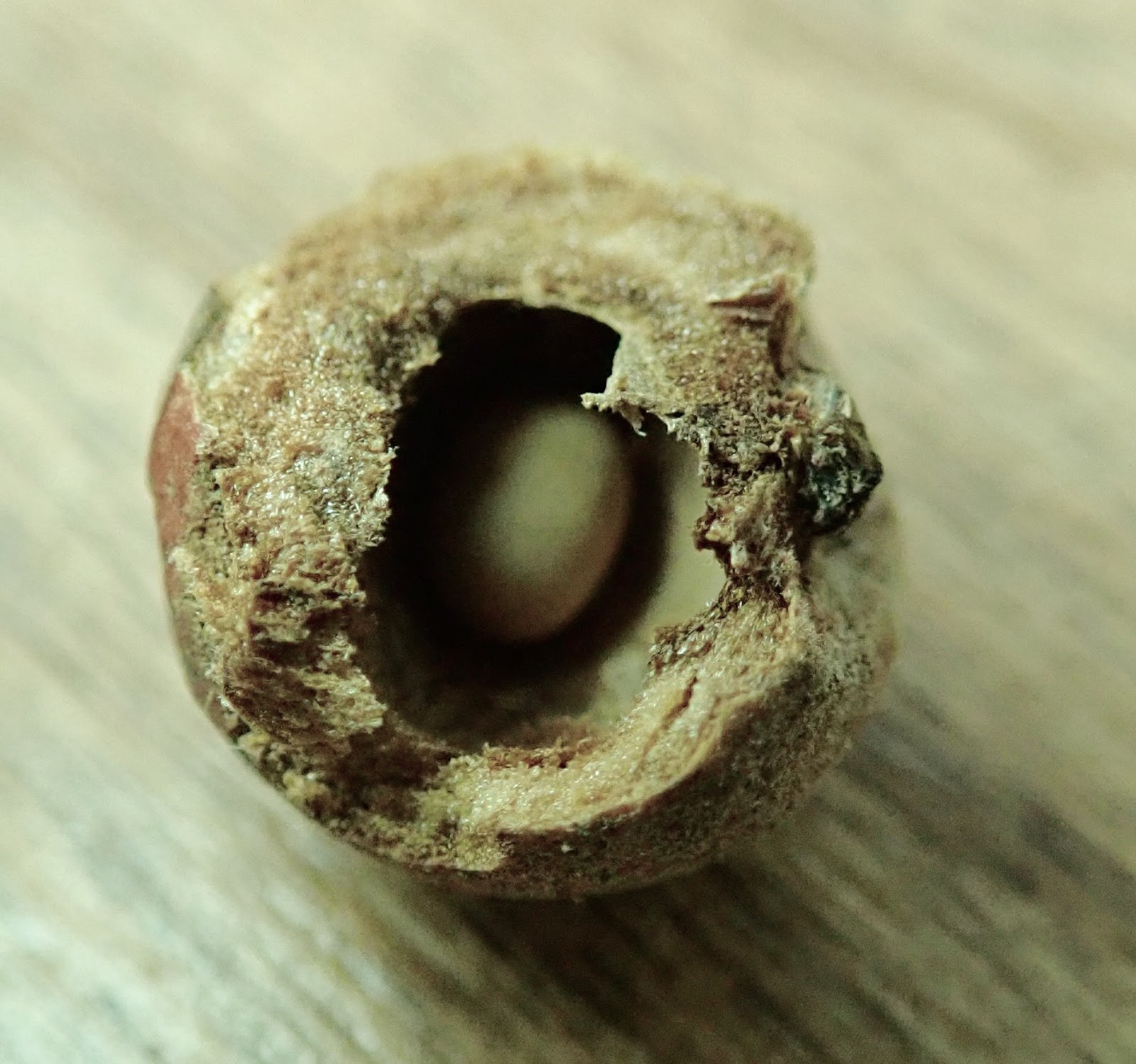
On the Missouri Prairie Foundation Bioblitz, "Bug Eric" Eaton was leading an insect identification session when I found this 6mm firm lump on a leaf.  Eric identified it as a beetle egg protected by material the female beetle deposited over it. 

I cornered Doug LeDoux of the Missouri Department of Agriculture who was leading the leaf beetle walk and he gave me more information.

"It is some sort of a Chlamisine beetle in the Chrysomelidae, possibly Neochlamisus. They refer to this group as the case-bearing case makers. The case is actually poop that is deposited around the developing larva to protect it from predation and to hide it while it feeds and develops. I see these fairly often when sampling."

This may sound like child abuse but remember it is a bug eat bug world they live in.  Looking like nothing edible has survival value.  Imagine how this delicious naked larva would look to any predator.....delicious!

Neochalmisus sp - Beatriz Moisset
Now the larva lives and eats inside the case, using its own excrement to enlarge the case as it grows.  Here is how Wikipedia describes it.

"The larvae remain on the natal host plant and add to and enlarge their fecal cases as they grow. Case enlargement in Neochlamisus is an elaborate process that larvae perform regularly until the case is sealed to the substrate prior to pupation. During this stage of the life cycle, beetles are immobile and are particularly vulnerable to predation."


Neochlamisus - Wikimedia

 This is just one example of a Neochlamisus.sp. in Wikipedia.  There is a whole tribe, if not subfamily, of casebearing leaf beetles. The warty beetles are pretty tiny compared to the larval case we found. It isn't just another pretty face, but before you make judgements about its appearance, take into account its rough childhood.

This is just one of the many fascinating finds from the annual Missouri Prairie Foundation bioblitz.  You can follow MPF and join up for the fun at https://moprairie.org/.


Sunday, August 19, 2012

Spider Nursery


Side view of egg case- Click to enlarge
"I get by with a little help from my friends" *
                  -   Lennon / McCartney

Barb found this spider trapped in a waste basket in our well house.  The timing was perfect as we took the arachnid to Insectorama that night and before returning it to our well house maternity ward.  I, like everyone else, identified it as a "wolf spider."  Wrong!

By looking carefully you can see the egg case that she is carrying.  A wolf spider spins a silken pad to deliver the eggs onto, then wraps them up in several layers of silk and attaches them to her spinnerets.  She will haul the case around with her until the young emerge.  This is a unique characteristic of female wolf spiders. 

Dr. Chris Barnhart pointed out my error, a role usually assumed by Barb.  He noted that she is carrying the egg case in her jaws and pedipalps, not her spinnerets.  On looking at the picture above, you can see that her spinnerets at the tip of her abdomen do not contact the egg case.  This is an identifying characteristic of a nursery web spider.

Egg case is off the floor
Her dedication to her young is incredible.  First, holding the egg sac with her jaws precludes eating.  Her only defense against predators is escape or dropping the egg case.  In moving her about and recapturing her during one escape attempt, she held tenaciously to her maternal burden.

Second, carrying the egg sac below is an awkward arrangement at best.  She essentially walks on tiptoes (if a spider can be said to have toes) as she lifts the sac higher so the egg case doesn't drag.   This must be even worse than shopping in Walmart the week of your due date.

Nursery web - Wikimedia
Another key difference in the species is the nursery phase.  A wolf spider's young crawl out of the egg sac and up on to her back where they ride around for a while as she hunts.  They depart at their own pace, apparently ignored by the mother.

Nursery web spiders get their name from the next phase of motherhood.  She weaves a rather haphazard web and attaches the egg sac to it.  The spiderlings emerge and stay within the confines of the web while the mother guards the web.  After their second molt, the young disperse.**

Don't mess with Mama- Note the eyes
While I was photographing her at close range she charged the camera lens several times, trying to get out the little aquarium door.  This gave me a chance for a good closeup picture.  Wolf spiders have four small eyes in a row on the bottom, two large secondary eyes in the middle and two smaller ones on top.  This picture shows two rows, each with four equal sized eyes.  If I had seen her hostile stare I probably would have dropped the camera and stepped back.

Male nursery web spiders take a risk when approaching with mating in mind, as the larger female will frequently look at him as the main course.  To counter this, the males frequently approach cautiously with a "gift" such as a dead fly or some other food offering.  They are even known to bring an insect leg or some other inedible fragment to keep her busy.  That seems like the equivalent of coming in late and bringing your a bouquet of dandelions, but apparently it works some times.

Looking for nighttime entertainment with a real reality show?  Try finding spiders including wolf and nursery web varieties in the dark by their eyeshine, a tiny bright silver spot in the beam of a flashlight.  This is light reflecting off their tapetum, the reflective surface at the back of their eyes.  This same structure is what gives the eyeshine you see from deer and raccoons along the highway at night.

As you can see in this short clip from the clip from Youtube below, the spider doesn't have to be facing you.  The eyeshine is more obvious in real life than in the video.  It is important to hold the flashlight close to your face so the light reflects straight back to your eyes.  An LED headlamp is a good tool for this.


Our spider will soon be back patrolling the well house where there is a ready supply of baby food as well as lots of house crickets to entertain her kids with.

 We discussed other wolf spider habits in the past on this blog.
* That would be Chris Barnhart
** abugblog.blogspot.com

Wednesday, February 19, 2020

A Different Tortoise


Clump of gravel - Mark Bower

Mark Bower showed his latest find from the bed of the little wet weather first order stream beside the cabin.  These were clusters of fine gravel, glued together like caddisfly cases but in tiny rounded ovals.  The stream flows for a day or two after a rain, trickles along in places before becoming a losing stream, disappearing several hundred yards from Bull Creek.
A village of caddisfly homes

Bottoms up - peeled off the rock
I didn't think this tiny stream could support caddisfly larvae.  Wrong!  Deb Finn immediately identified the photographs as cases of the caddisfly family Glossosomatidae, commonly known as the tortoise or saddle-case makers.  They are distributed around the globe and are "typically are found in fast flowing, cool mountain springs."  This description doesn't fit with the little trickle that depends on the last rain for a little flow but these larvae haven't read Wikipedia.
"Larvae of members of the family Glossosomatidae ... create dome-shaped enclosures of silk which enables them to graze on the periphyton, the biological film that grows on stones and other objects, while carrying their enclosure around like turtles." Wikiwand
Larva on the rocks
Like many other caddisflies, the tortoise larvae make a protective case, bits of gravel held together by silk.  The loose arrangement of the rocks allows water to flow through. Since they get oxygen through their "skin" (cuticle) rather than gills, cool water provides more concentrated oxygen.  Rapid flow and turbulence adds oxygen and they scrape up algae on the rocks for nutrition.

Tubular case of a Pycnopsyche caddisfly larva
Unlike many other caddisflies which make a tubular case that surrounds the larvae,  Glossosomatids make a turtle-shell shaped case of rocks which is open on the under surface and attached to the rock by silk around the edges.  Underneath it makes a sling of secretions which it rides "like a saddle".**

Glossosoma nigrior 4-5mm - RGH
Life may seem slow for the larva (a turtle's pace?) and not very exciting but there is a lot going on.  Each time it outgrows its case it has to build a new one out of bits of gravel.  The tortoises can live like this for months or years before they pupate.  Then they spin a brown, silken cocoon within their rock house.  This video shows one emerging from its abode.


Typical black caddisfly - John and Jane Balaban CC
After about a month they pupate, chew off the silk foundation of their rock house and float to the surface where they will emerge as an adult "fly." Their soft body now hardens (sclerotization) preparing the tortoise for flight.  Most adult species do not feed, flying mainly at night looking for mates.  The adult's common name is little black caddisfly, not a very catchy handle but apparently that doesn't turn off the males.  The female who is lucky in love will end up depositing a gelatinous mass of eggs in or around the water's edge.

Identification by species frequently requires detailed examination of the adult, beyond even the dedicate corps at Bugguide.  We will leave them in their anonymity with this photograph which best demonstrates their common name, tortoise case makers.

"I am a tortoise!  You have a problem with that?" - RGH
June 2020 update:
Some caddisfly species specialize in small streams like ours. This is from MSU's David Bowles whose dissertation included glossosomatids.
"The species in at your place are most likely are Agapetus illini, a species very common to our area. There are two other species of Agapetus known from our area (A. medicus from the Ouachitas, and A. artesus from Maramec Spring). The other glossosomatids in our area are Glossosoma intermedium, which is restricted to large springs, and several species of Protoptila. This latter genus is tiny and they generally prefer larger streams."
=======
*Thanks to Robert G. Hendricks for the photograph above.  His blog is Aquatic Insects of Central Virginia which is filled with detailed information and photographs.
** Troutnut.com

Friday, September 30, 2022

Owl Pellets


I recently was gifted owl pellets by Ben Caruthers. The dried undigested regurgitated remnants of an owl meal is an exciting exploration for a 5th grade WOLF student. I stored them in paper egg cartons inside a ziplock bag in the dining room. I have a very tolerant wife.

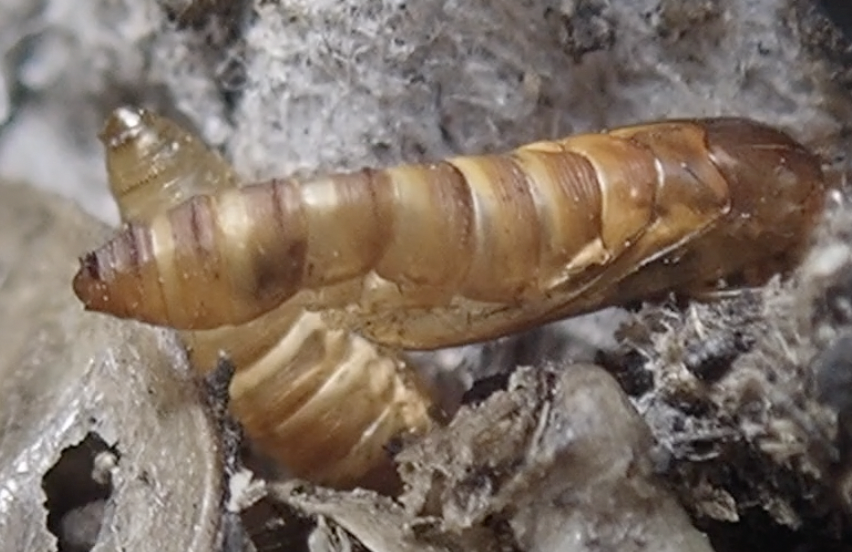
Exuviae of emerged moths - notice the wing features below

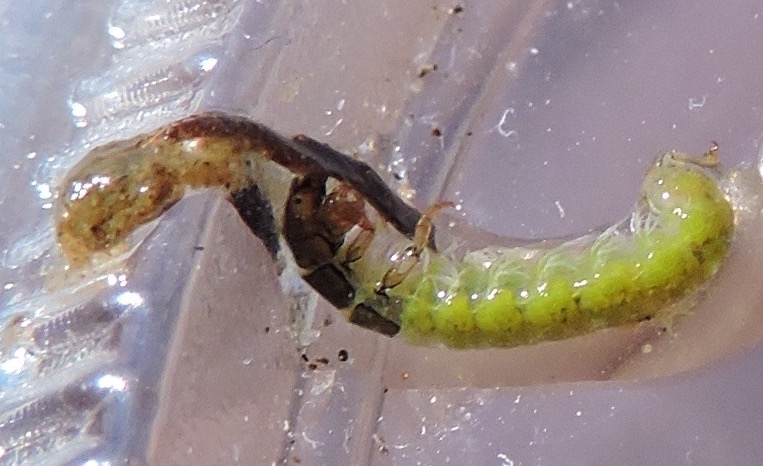
When I opened them a month later I could see exuviae, empty pupa cases with remnants where there had been wings developing. Among the collection of digested rodent bones, some of the debris was moving. After filming it, (a historic term for video), I extracted a wiggling piece of debris and captured a case-bearing larva attempting to escape as seen in this video.

 
The larva lives this stage of its life in a tunnel it glues together from debris.  The owl pellets in the egg carton had a least a hundred of these little guys.  Now the question was what were they?  
 
6 mm moth in owl pellets

A week later I had an answer.  I found several of these 6 mm long moths in the bag.  a quick Google search of "case-bearing moths" returned lots of links pointing to clothes/carpet moths in the Tineidae family.  The majority of these feed on fungi, lichens, and detritus, which fits with the material in these pellet remnants.

This is most likely the case bearing clothing moth, Tinea pellionella.  They are distributed world wide and are frequently associated with human populations.  There are a few other similar species in the family that can only be identified by examining their genitalia so we won't go into that.   

"T. pellionella larva eats mainly fibrous keratin, such as hairs and feathers. It can become a pest when it feeds on carpets, furs, upholstery, and woolen fabrics. It also consumes detritus, cobwebs, and bird nests."  -Wikipedia

The larva lives inside a snug case it constructs from debris such as fibers and hairs.  It extends its body to crawl around, hauling its home for protection.  Incredibly, it can turn around in the case to protrude its head and legs at either end and drag the case in either direction.  Finally they will form a pupa and eventually crawl out and expand their wings.

So back to the other question, what are owl pellets and why would a grown man collect them?  Owls often swallow mice, voles, small birds, and other prey whole.  After its gizzard has sorted out the indigestible parts such as fur, feathers, teeth and bones, the owl regurgitates them in a oval owl pellet.  This frequently occurs in a roost where they collect on the ground underneath.  Taking these to the 5th grade WOLF School, we students young and old, will examine them to try to determine what the owl had been eating. 


There are lots of resources available to students of all ages.  This brings out your inner 5th grader without having to get on a bus every morning.

Thursday, September 6, 2018

Snail-case Caddisfly


Snorkeling in the clear water of our swimming hole on Bull Creek I saw hundreds of tiny snails clinging on the small gravel downstream. One larger rock I found had a depression on the underside where there were tiny gravel clusters attached. They were 1/10" round and appeared spiraled. They were very firmly attached with one I couldn't even pry off with my fingernail.

I assumed they were caddisfly larvae until under magnification I saw they were the shape of snails with fine sand granules attached. and I wasn't able to extract a caddisfly larva. Could they be freshwater snails that have sand attached to their shells? A dumb question but since Deb Finn* and I had been talking about a snail research project I reached out to her.

The white glistening patches I saw with a magnifier looked like it could be a snail foot but with the macro views I could see they were chert chunks in the glued on sand. After a few minutes one started to crawl slowly on the rock surface as seen in this video. I still couldn't extract a caddisfly larvae as I have in the past. Then I got Deb's response, letting me down gently.
 "Your first thought (caddisflies) was correct. I found a lot of them yesterday too in the creek upstream. They are in a genus called Helicopsyche, which was actually originally described (embarrassingly enough) as a snail. The family Helicopsychidae all make spiral cases in the shape of a snail. And it is extremely difficult to pull the larvae out of their cases."
Adult Helicopsychidae - boldsystems.org CC
It helped salve my ego that they are called "snail-case maker caddisflies" and were originally described as snails!  "The case is diagnostic for Helicopsychidae as all Helicopsychidae construct spiral cases and no other caddisflies do."  Caddisflies are famous for their larvae while the Rodney Dangerfield adults get no respect. The image to the right is the only Helicopsyche sp. adult I could find on the Internet.

Helicopsyche sp. are flying under the radar of the web and need a new press agent.  I went through 5 pages of Google before I found anything significant about their life history.  Finally I found a page on Lifeinfreshwater.net where they are described a "scrapers," grinding off algae that is clinging to rocks.  Their head and legs usually protrude from a single opening in the case. Photographs online show a curved larva, the price it pays for living full time in a circular case of glued sand.

The fly - Troutfisherman.co.uk
We examined caddisfly larvae as a group in this blog last year where the cases from further up stream were larger.  They were encrusted with larger gravel flakes which didn't show the spiral pattern.   Dr. David Bowles of MSU identified them for me as Helicopsyche borealis, which trout fishermen call a Speckled PeterThe adult finally gets some respect from fly fishermen who tie a pattern called the Speckled Peter.
=====
* Dr. Debra Finn is a stream ecologist at Missouri State University and her team is studying Bull Creek.
MDC has a good brief overview of caddisflies in general.

Thursday, January 25, 2024

Ode to a Hat-throwing Fungus

Pilobolus crystallinus

A special guest blog from our favorite mycologist, Dr. Mark Bower. But first read his poem, a paen in the Poop  to a fungus among-us.
=====================

 Fun with Da Dung Fungus

Searching for mushrooms is such a strain
As I sat for a while
To relieve the pain
I spot a brown pile


Lumpy it was and also quite stinky
Into the mass I stuck my pinky
As it happens, I shouldn’t have done that 
For I quickly found out it was a pile of scat


Mycelia feeding
But it’s had its fill
Time to throw hats
With the spores, if you will

Pow, pow, pow!
The sporangia explode! 

 Up to ten feet   
 The hats will be throw'd
 
 Out towards the sun 
 Soaring like a bird
 Hoping to land
 On another deer turd
========

Back to Mark's story:

I am always on the lookout for fuzzy poop, and was lucky to come upon this example at Bull Creek in September. I didn’t have my good camera with me, so the photos are of poor quality. Nevertheless, here is the story:
Pilobolus crystallinus, the hat-throwing fungus or dung cannon (seen in action here) is a decomposer of the dung of various mammals, in this particular case, whitetail deer. Its mycelium feeds on fresh dung. When the nutrients are depleted, or if conditions otherwise dictate, the fungus forms its spore-containing fruiting bodies (sporangia).

These sporangia consist of a fluid-filled globular structure sitting on a stalk. At the apex of the sporangium sits a black “hat” which encases the spores.

Sporangium- click to enlarge
Somehow, the fungal spores must find fresh dung in which to germinate. It has devised an ingenious method of doing so. The sporangium builds up hydrostatic pressure until it finally explodes, and “throws” the black "hat" spore case as far as ten feet. After landing on a blade of grass or a fresh leaf, it may possibly be devoured by a passing deer. If so, the spores will pass through the digestive tract of the deer, then be deposited in a fresh pile of scat. Spore germination occurs, and the cycle is complete.

But why does the hat-thrower go to such lengths to eject its spores? The reason for this is the following: deer, cattle and most mammals don’t like to browse near poop. By ejecting the spores far away, the probability of ingestion is increased. For the same reason, the fungal sporangia are phototropic, that is, the stalks orient themselves towards the sun. They only shoot their spores in the morning and evening when the sun is at an angle, which maximizes the distance they can achieve.

As if that isn’t weird enough:
Lungworms are parasites of various animals, and are commonly found in the lungs of deer. The adults can be as long as 3 inches. When the lungworms are ready to reproduce, they lay eggs in the lungs. When they hatch, the larvae infect the trachea and bronchi of the deer, causing a form of bronchitis. The deer cough up gobs of larva-containing phlegm and inevitably swallow some of it. The larvae are deposited in fresh dung where they feed and thrive. If the larvae are fortunate, the sporangia of Pilobolus will also be present in the dung. The larvae crawl up the stalk of the sporangium and curl up on the black spore case, awaiting lift off. As the spore case is ejected, the larvae get a free ride away from the dung pile. They are then ingested by a deer and enter the blood stream and lymphatics through the wall of the intestines. They then travel through the blood to be deposited in the lungs, to mature into the adult worms. These lungworms rely on Pilobolus to complete their life cycle. The fungus does not benefit and is not harmed by the association.

If you are ready for some more fungal-culture I would highly recommend this poem by Tom Volk.

Thursday, June 21, 2018

Bagged Worms

Young bagworm - 1/3" including the case
An accidental find prompted me to update the 2016 blog below.  I got off my ATV at the house, took my backpack inside, and when I returned I saw a little dead vegetation on the seat.  Then I saw it move.  I had been swimming in the creek and thought it might might be a caddis fly larva but when I picked it up, it was hanging by a 6" silk thread.

Bag construction with petiole extending downward
Under magnification, the bag and "worm" combined measured 7mm (1/3").  The bag consisted of green and dried brown leaf fragments and what appeared to be strands of hyphae or even bits of lichen.  There was a straight rod of a dried leaf petiole that kept the case propped up when it traveled on a straight surface.

Crawling along the twig.
After filming it across a flat surface, I set up an obstacle course with a twig propped up 30 degrees on a rock and videoed its progress.  The bagworm consistently tried to move away from the camera which was the only big threat on the table.  You can see the video on Youtube here.

Bagworms, (aka bagworm moth), are the larval stage of one of the approximately 1350 species of the Psychidae family of moths.  They lead a sheltered existence with only the adult male emerging to fly off to find a female.  The wingless female remains "vegetating" in her case of plant parts, releasing her perfume to attract the male.  He will generally mate with her by inserting his abdomen into her case.  She will deposit her eggs in the bag and drop to the ground to die.  In some cases she will retain them in her body when she dies and they will hatch inside her.  Either way, she makes the ultimate sacrifice to perpetuate her species.
Male bagworm moth -  David E. Reed

A search for pictures of the male moths brought up some images of  beauties which are apparently only Australian species.  Our varieties are best described as drab.

Most of the online resources are focused on eliminating bagworms as a pest or worse on urban trees.  In our dense oak-hickory forest they are not a concern.  I enjoy finding them.  Who can't love a little "worm" that crawls around slowly in its little grass shack.


Friday, August 30, 2019

Rough Bulletgalls

Galls with a house fly, Musca domestica
I have been dissecting these rough bulletgalls which were clustered all over the branches of a small bur oak at Wonders of Wildlife.  Courtney Reece who teaches at the WOLF School had noticed wasps and flies swarming the tree and sent me the whole story.  She also researched it and came up with a diagnosis of rough bulletgalls.  These galls are produced by a rough bulletgall wasp, Disholcaspis quercusmamma.

She warned me that there was a large number of yellow jacket wasps on the tree.  The numbers were down by the time I arrived but the wasps were on their sugar high and paid no attention to me.  While they are notorious for attacking people threatening them by walking over the hole of their nests in the ground or running a mower over them, these didn't seem to be bothered by my camera a few inches away. 

So why all the insect traffic?  These galls exude a sugary juice that is an invitation to party to a number of sweet-loving insects.  According to Bugwood, "Rough bulletgall wasps produce a woody, generally rounded gall on bur oak, with a slight point. Very heavy infestations can occur that largely cover twigs, reducing growth rate of the tree. The galls also exude a honeydew-like sweet material that is attractive to bees and wasps and fosters growth of sooty molds."


Bulletgall wasp - Whitney Cranshaw - CSU
D. quercusmamma has an interesting life history. 

"Females emerge in late October and early November, after a hard frost. (A small circular hole in the gall indicates emergence.) Eggs apparently are laid in the terminal growth during the fall. winged and wingless forms are produced; males apparently are unknown.

Gall opened
In late spring, the developing insect stimulates a pocket of stem tissue to produce a large rounded gall, in which the young wasp develops. Galls are pale brown and soft in early stages, later darkening and hardening. Only a single wasp develops in each gall, although sometimes other insects (inquilines) also share the gall. The larva pupates within a small cell in the center of the gall, emerging in early fall. There is one generation per season." Bugwood Wiki

Three layers surround pupa case
Pupa, case and umbilical connection
The gall is firm and leathery, hard to cut open.  The outer layer is woody and tough, covering a thick middle layer the consistency of a dry apple that breaks off in chunks.  A thin third layer surrounds the pupa case leaving an open space around it.  The case its self connects to the inner layer of the gall with a knobby stem, somewhat like an umbilical cord which provided nutrition to the larva.

Syncophila sp. parasitoid wasp - Tom Murray
In attempting to raise the gall wasp, you can't just assume that what emerges is the cause of the gall.  Like Forest Gump's box of chocolates, the life and food web doesn't end there.  There are at least five Sycophila sp.  of parasitoid wasps that  live in D. quercusmamma larvae. Sometimes other insects (inquilines) also share the gall.
======
More on bulletgalls in general is at this Ohio State University site.
=============
Addendum:
A sharp eyed WOLF Student examining the galls noticed a tiny 1/2" patch of eggs on a leaf.  We kept the leaf in the box to see what would emerge.  There were tiny 1mm black dots in the box 3 days later.  The best macroscopic photograph I could manage showed enough in profile to call it a "ladybug" (beetle actually) larva.


H. axyridis
It is most likely a European lady beetle, Harmonia axyridis.  It is now commonly found in gardens and fields, especially where humans influence the landscape.  This isn't a bad or invasive species although it does tend to out compete with some of our native species.


H. axyridis larva
H. axyridis pupa