Showing posts sorted by date for query case. Sort by relevance Show all posts

Saturday, June 28, 2025

Life and Death at a Mountain Lake

Master Naturalist roving correspondent - Becky Swearingen)


Every visit I make to Rocky Mountain National Park includes several visits to Lily Lake. This high mountain lake (8931 feet)  has a trail around it that is slightly less than a mile long. Something interesting happens almost every time I visit it. I’ve seen moose, elk, long-tailed weasels, snakes and numerous species of ducks and birds. 


One interesting aspect of this lake is that there is a population of Western Tiger Salamanders (aka Barred Tiger Salamander (Ambystoma mavortium) that live there.  The interesting thing about these salamanders is that they stay in the paedomorphic stage for their entire lives. That means that they stay in the water and have external gills. 

As with many of the park's fauna, they are being impacted by climate change.  One study done in Yellowstone suggests that as we  get higher temperatures it will cause a rise in the temperature of these high-altitude lakes which will cause the paedomorphic salamander to mature into fully adult Tiger Salamanders and that we may begin to see these adults out of the water in the future years.


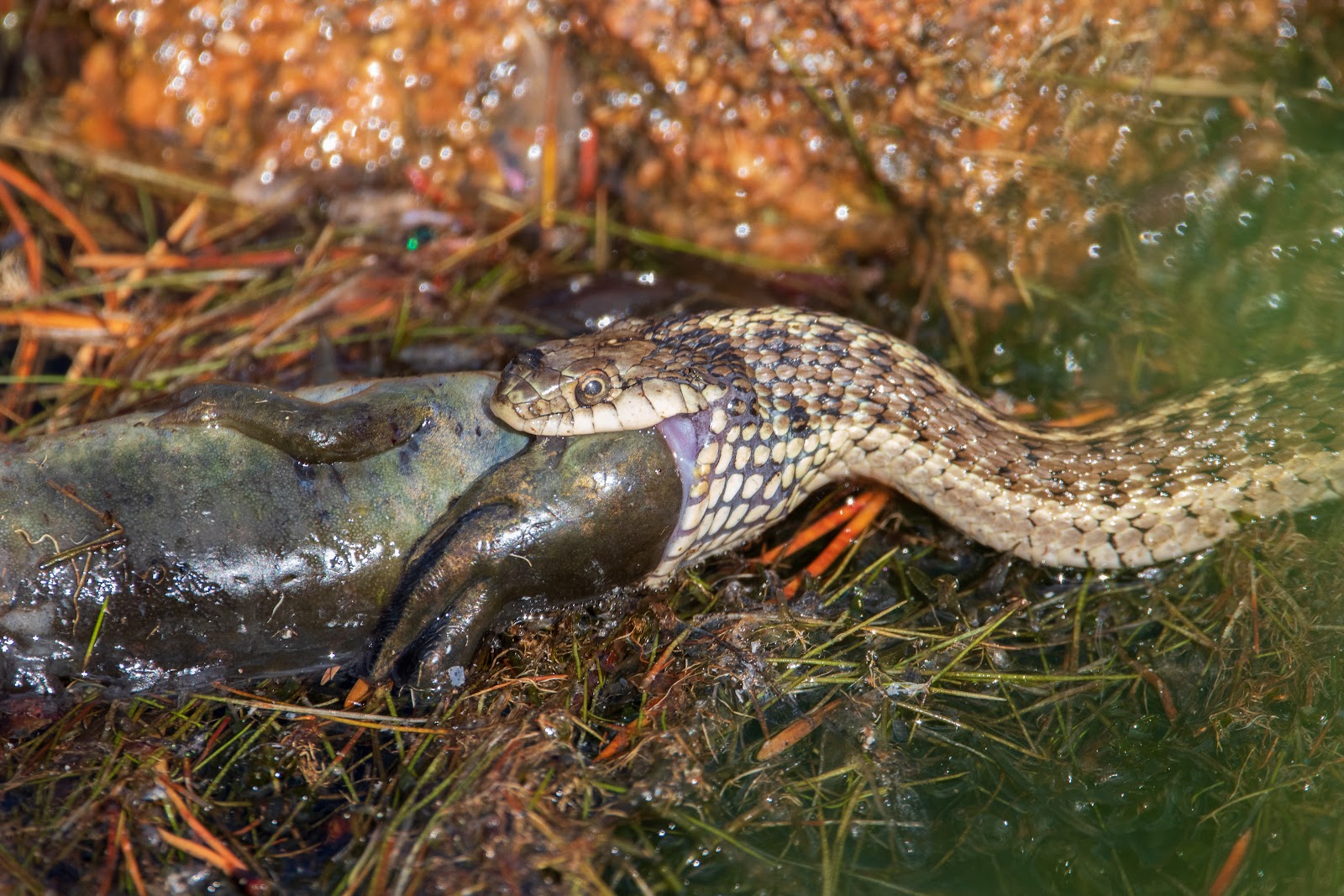
For now, though, I always look for these fairly large creatures (up to 14 inches) in the water. Last summer, I got more than I expected when walking the trails. At the water’s edge was a Common Garter Snake that was attempting to swallow a paedomorphic Tiger Salamander. I watched for about 10 minutes and from what I could see no progress was being made swallowing it.  You can see the video at this link.

Above is a picture of a Red Speckled Dun.  While the Tiger Salamander is known for being a voracious predator, it was interesting to see that it is not without its own predator.
"OK,, now what??
Meanwhile this Garter Snake is left deciding what to do next.  Give up or risk a bad case of constipation!

Sunday, September 8, 2024

Leatherwing Beetles


Mark Bower sent me this picture of beetles covering his goldenrods.  He tentatively   identified them as Goldenrod Soldier Beetles.

I immediately recognized them as Pennsylvania Leatherwings.  Looking them up I found that both names are commonly used to describe Chauliognathus pensylvanicus.  I will leave that pronunciation to you.

Of even greater interest, there is a fungus association, a beetle made for our mycologist friend!  To quote this Wikipedia entry:

"Adult C. pensylvanicus may be infected by the fungus Eryniopsis lampyridarum. After the fungus infects the host, it takes about two weeks for it to eventually kill its host. Before the host dies, the fungus orders the beetle to climb a plant and then attach itself to a flower by biting down with its mandibles into flower heads. About 15–22 hours later, the fungus causes the dead beetles to raise their elytra and expand their metathoracic wings in order to maximise infection of other beetles.  With their wings raised, the dead beetles may still attract mates as live males were observed mating with the deceased, infected females, this then transmits spores from one insect-host to another."


Journal of Invertebrate Pathology at this link

This is a sexually transmitted disease (STD) or in this case an infection or STI.  There is more recent information on this in this Science Alert story.  The Parasite of the Day blog has more on the fungus association.  As other soldier beetles are attracted to daisies, the plant acts as a pub which attracts other uninfected beetles.  Sound familiar?  Meanwhile other infected beetles fall to the ground where the fungi can survive until they hitch a ride on other beetles.

This is written in the name of science, even if it sounds a little X-rated.

Wednesday, July 10, 2024

Brave Little Bagworm

I found a  bag worm that had dropped out of a cedar tree onto a table on our deck. After watching it struggle on the table's edge, I moved it onto several leaves for security and food. At one point it suddenly lost its grip and was caught by a silk safety line until climbing back up to the leaf.  You can follow its journey in this Youtube video

The evergreen bagworm moth is Thyridopteryx ephemeraeformis--try saying that fast three times!  It is in the Psychidae family of bagworm moths.  The MDC Discover Nature Field Guide describes it here.

"Adult male evergreen bagworm moths are furry and look a lot like blackish bees with long, tapering abdomen tips. They have comblike antennae and usually have clear wings (which is very unmothlike), since they lose most of their wing scales as they squeeze out of their larval cases. Adult females lack wings and antennae; they look a lot like caterpillars or maggots and usually do not leave their bags."

Hanging by a thread
The larva will go through seven instars and the last one will be an inch long.  "Bagworm larvae eat the leaves and soft stems of many types of trees and shrubs, including evergreens. In Missouri, they are most commonly noticed on eastern red cedar and on the various junipers and arborvitaes used in landscaping."

MDC goes on to say, "The eggs, caterpillars, and adult females don’t leave their protective bags or even fully leave their pupal casing, which complicates matters slightly: The males must seek out the females. Receptive females emit pheromones (scents that attract the opposite sex), and a male, finding a female’s bagworm bag, must extend and poke his abdomen into the female’s case in order to mate with her. The female deposits her hundreds of eggs into her own bag and dies within a few days. If she doesn’t drop onto the ground when she dies, her dried-up body may remain with the eggs until they hatch in late spring the following year."

This give a whole new meaning to the term "bag lady."

More detailed information can be found at the University of Florida Entomology.

Monday, June 17, 2024

Rough Greensnake


This weekend, Noppadol Paothong brought his family to the creek and they spotted this Northern Rough Greensnake in a tree right by our house on Bull Creek.  Even knowing it was there it took me a minute to find it, and it was even harder to photograph.  You can see it in action in this video.  In addition to its coloration and the difficulty finding it even when it was pointed out to me, I was amazed with its climbing ability.  Once I saw it stretched out seven inches into space, reaching for another branch.

Information on almost any animal, insect or plant in Missouri is available through MDC.  Simply search the topic name followed by MDC.  In this case I entered "greensnake MDC" although even "green snake MDC" also works.  Here is the site that comes up.  They not only have pictures but frequently usually show similar species as well as lifecycle, food, and connections with nature and humans.  

It is hot and humid so I will leave you with this while I go out to see if I can f.ind it again.

Thursday, January 25, 2024

Ode to a Hat-throwing Fungus

Pilobolus crystallinus

A special guest blog from our favorite mycologist, Dr. Mark Bower. But first read his poem, a paen in the Poop  to a fungus among-us.
=====================

 Fun with Da Dung Fungus

Searching for mushrooms is such a strain
As I sat for a while
To relieve the pain
I spot a brown pile


Lumpy it was and also quite stinky
Into the mass I stuck my pinky
As it happens, I shouldn’t have done that 
For I quickly found out it was a pile of scat


Mycelia feeding
But it’s had its fill
Time to throw hats
With the spores, if you will

Pow, pow, pow!
The sporangia explode! 

 Up to ten feet   
 The hats will be throw'd
 
 Out towards the sun 
 Soaring like a bird
 Hoping to land
 On another deer turd
========

Back to Mark's story:

I am always on the lookout for fuzzy poop, and was lucky to come upon this example at Bull Creek in September. I didn’t have my good camera with me, so the photos are of poor quality. Nevertheless, here is the story:
Pilobolus crystallinus, the hat-throwing fungus or dung cannon (seen in action here) is a decomposer of the dung of various mammals, in this particular case, whitetail deer. Its mycelium feeds on fresh dung. When the nutrients are depleted, or if conditions otherwise dictate, the fungus forms its spore-containing fruiting bodies (sporangia).

These sporangia consist of a fluid-filled globular structure sitting on a stalk. At the apex of the sporangium sits a black “hat” which encases the spores.

Sporangium- click to enlarge
Somehow, the fungal spores must find fresh dung in which to germinate. It has devised an ingenious method of doing so. The sporangium builds up hydrostatic pressure until it finally explodes, and “throws” the black "hat" spore case as far as ten feet. After landing on a blade of grass or a fresh leaf, it may possibly be devoured by a passing deer. If so, the spores will pass through the digestive tract of the deer, then be deposited in a fresh pile of scat. Spore germination occurs, and the cycle is complete.

But why does the hat-thrower go to such lengths to eject its spores? The reason for this is the following: deer, cattle and most mammals don’t like to browse near poop. By ejecting the spores far away, the probability of ingestion is increased. For the same reason, the fungal sporangia are phototropic, that is, the stalks orient themselves towards the sun. They only shoot their spores in the morning and evening when the sun is at an angle, which maximizes the distance they can achieve.

As if that isn’t weird enough:
Lungworms are parasites of various animals, and are commonly found in the lungs of deer. The adults can be as long as 3 inches. When the lungworms are ready to reproduce, they lay eggs in the lungs. When they hatch, the larvae infect the trachea and bronchi of the deer, causing a form of bronchitis. The deer cough up gobs of larva-containing phlegm and inevitably swallow some of it. The larvae are deposited in fresh dung where they feed and thrive. If the larvae are fortunate, the sporangia of Pilobolus will also be present in the dung. The larvae crawl up the stalk of the sporangium and curl up on the black spore case, awaiting lift off. As the spore case is ejected, the larvae get a free ride away from the dung pile. They are then ingested by a deer and enter the blood stream and lymphatics through the wall of the intestines. They then travel through the blood to be deposited in the lungs, to mature into the adult worms. These lungworms rely on Pilobolus to complete their life cycle. The fungus does not benefit and is not harmed by the association.

If you are ready for some more fungal-culture I would highly recommend this poem by Tom Volk.

Tuesday, October 31, 2023

Losing a Neighbor

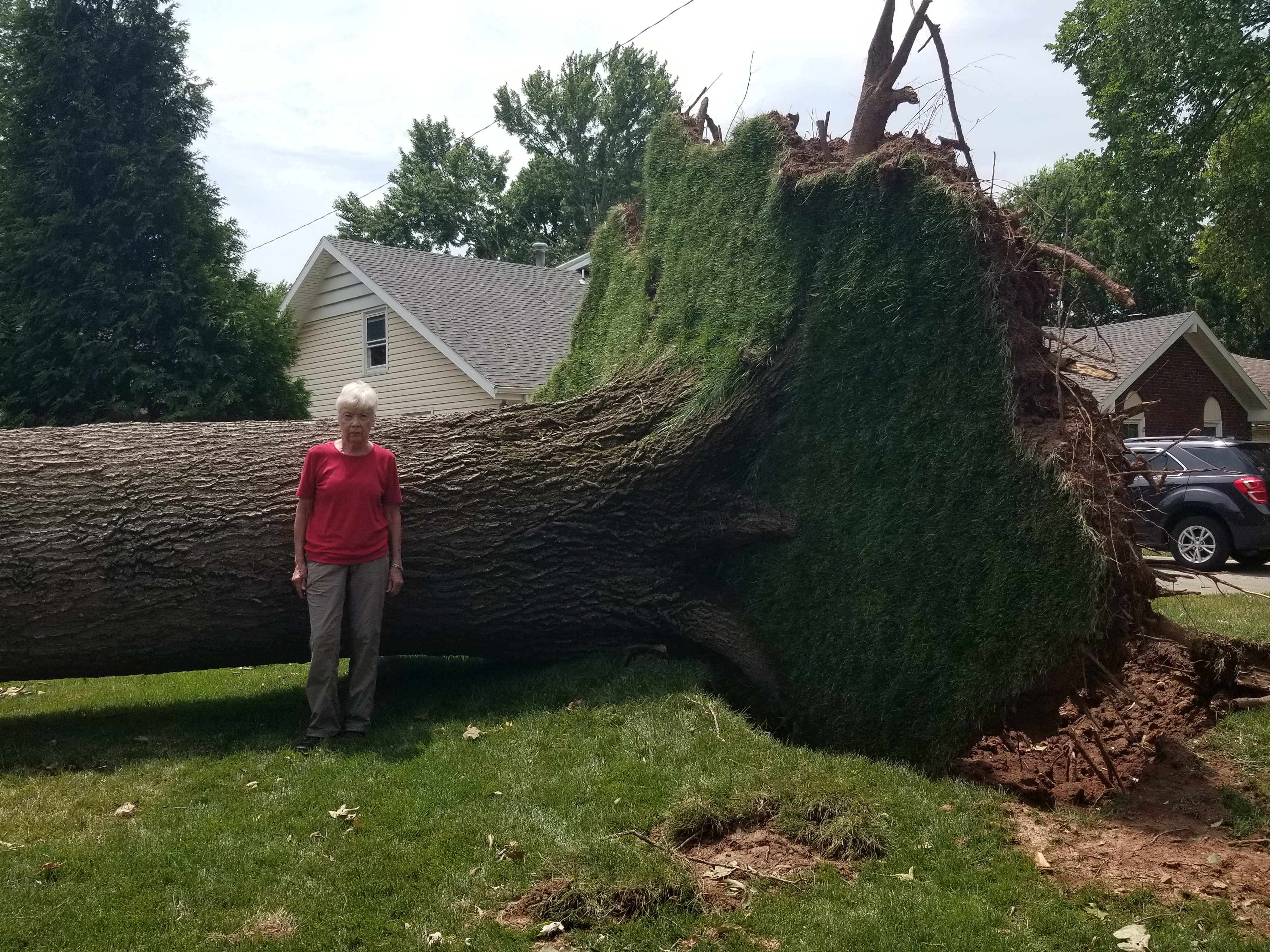
This year's big windstorm took down several large trees in our subdivision.  I was saddened to lose this neighbor as it has provided oak acorns with acorn weevils to show WOLF students.  They are a good example of another small lifecycle that goes on around us unnoticed.

These Curculio sp. live out of sight.  When our Master Naturalist Buck Keagy was collecting acorns to plant hundreds of oaks in the past, he would dump them in a bucket of water and plant only those that sank, knowing that the floaters had weevils or were otherwise damaged. I do the opposite, throwing out the sinkers to find acorns likely housing weevils. You can read about their life cycle and the weevil wasp Cerceris halone that depends on them in this blog.

Estimating the tree's age based on its diameter at breast height, most tree sites would have called it around 110 years old.*  In this case, by tree ring count it was 90 years old. The difference is that urban trees that are watered regularly and in open sun grow large faster.

This giant broke off at the roots about 16" underground. Oaks in nature spend more of their energy in the first few years creating deep roots before t.heir growth spurt to height and diameter later.  My forester professor Jim Gulden supported my theory that its shallow root system likely came from frequent urban lawn watering.  If gets all that free water, why bother with deeper roots?

The only good news is that the trunk will be making someone good furniture. 

* Estimating a standing trees age is explained at this web site.

Tuesday, July 18, 2023

Snake Month at Bull Mills

This has been snake month at our Bull Creek cabin.  We were having dinner there when we suddenly heard three loud "snaps" in 5 seconds.  Back in the closet with the water heater and well pump where pipes come up through the floor, we have frequent rodent visitors.  In this case though it was a 5 foot black rat snake that got caught in three rat traps.  Here it posed for pictures before moving to the barn where it will be hunting from now on.

Our next guests called us from across the creek reporting a snake with "Hershey Kisses" on the walk.   They had stepped  off the porch headed to the ATV but were stopped by the 24" copperhead curled up on the walk.  Ordinarily I would use my snake grabber to transplant it but in this case if I missed it would crawl back under the porch steps and our guests probably wouldn't come out the door from a week.  I was forced to execute it with a hoe.


After cleaning it

Not wanting it to die in vain, I cleaned it and prepared the skin for tanning.  The hoe had damaged the skin but the remaining hide will demonstrate the appearance for future visitors.  We tell the WOLF students about the "Hershey Kisses" you can see on their sides.  We also explain that "if you look down and see the "hour glass" you know that it is a copperhead and you are way too close!  We will see a lot more in the late summer when the cicadas emerge.  These look like an M&M to a copperhead as we discussed in this blog.


We get to see lots of other snakes each year.  Pygmy rattlesnakes are cute if you don't try to pet them.  This one was curled up on a rock crossing in the middle of the road and earned a free ride several hundred feet away in the woods.  We also have timber rattlesnakes like one that staked out the center of our driveway and defied me until I transplanted it a quarter mile away in the woods.  You can see it warning me here.


One of my favorites are the northern watersnakes.  We have had a lot of sightings this year including four gathered at one sitting on a downed sycamore.  They congregate in our swimming hole, frequently sunning themselves on the bank.  We have even found one on our deck 15 feet above the creek.  Our biggest one was over 5 feet long and was killed by a visitor who thought it was a cottonmouth, a species none of us have found on Bull Creek.  I saw the one below just starting to dine on a perch.  By the time I got back with a camera it was almost down the hatch.

Finally, it is important to know your snakes as one of our guests learned a few years ago.  After watching the watersnake swimming around with its head above water, he decided to catch it, not recognizing the whole body was on top of the water and it had little kisses on its side.  You can see the whole episode recorded by his friends who encouraged him to "go ahead, pick it up!" Watch it here in this 2 minute video.  It ended with $25,000 of antivenom and two days in the ICU.  The final lessons we tell the WOLF students:

  • Know your snakes
  • Don't let buddies get you to do dumb things.

Thursday, June 22, 2023

At Home in the Dung

On the Missouri Prairie Foundation Bioblitz, "Bug Eric" Eaton was leading an insect identification session when I found this 6mm firm lump on a leaf.  Eric identified it as a beetle egg protected by material the female beetle deposited over it. 

I cornered Doug LeDoux of the Missouri Department of Agriculture who was leading the leaf beetle walk and he gave me more information.

"It is some sort of a Chlamisine beetle in the Chrysomelidae, possibly Neochlamisus. They refer to this group as the case-bearing case makers. The case is actually poop that is deposited around the developing larva to protect it from predation and to hide it while it feeds and develops. I see these fairly often when sampling."

This may sound like child abuse but remember it is a bug eat bug world they live in.  Looking like nothing edible has survival value.  Imagine how this delicious naked larva would look to any predator.....delicious!

Neochalmisus sp - Beatriz Moisset
Now the larva lives and eats inside the case, using its own excrement to enlarge the case as it grows.  Here is how Wikipedia describes it.

"The larvae remain on the natal host plant and add to and enlarge their fecal cases as they grow. Case enlargement in Neochlamisus is an elaborate process that larvae perform regularly until the case is sealed to the substrate prior to pupation. During this stage of the life cycle, beetles are immobile and are particularly vulnerable to predation."


Neochlamisus - Wikimedia

 This is just one example of a Neochlamisus.sp. in Wikipedia.  There is a whole tribe, if not subfamily, of casebearing leaf beetles. The warty beetles are pretty tiny compared to the larval case we found. It isn't just another pretty face, but before you make judgements about its appearance, take into account its rough childhood.

This is just one of the many fascinating finds from the annual Missouri Prairie Foundation bioblitz.  You can follow MPF and join up for the fun at https://moprairie.org/.


Thursday, April 13, 2023

Callery Cedar


Note:   This is an update to a blog story started in 2018 with a chance find of a callery pear tree growing out of a eastern red cedar.
 
2018:  
Barb called me a few weeks ago to tell me that she had found a Callery pear tree (think Bradford) next door that was growing out of the trunk of an eastern red cedar.  I won't go on to say what I thought at the time as she edits this blog.  As I trust her fully I only said, "Oh?"
 
Pear above junction with the parent cedar.
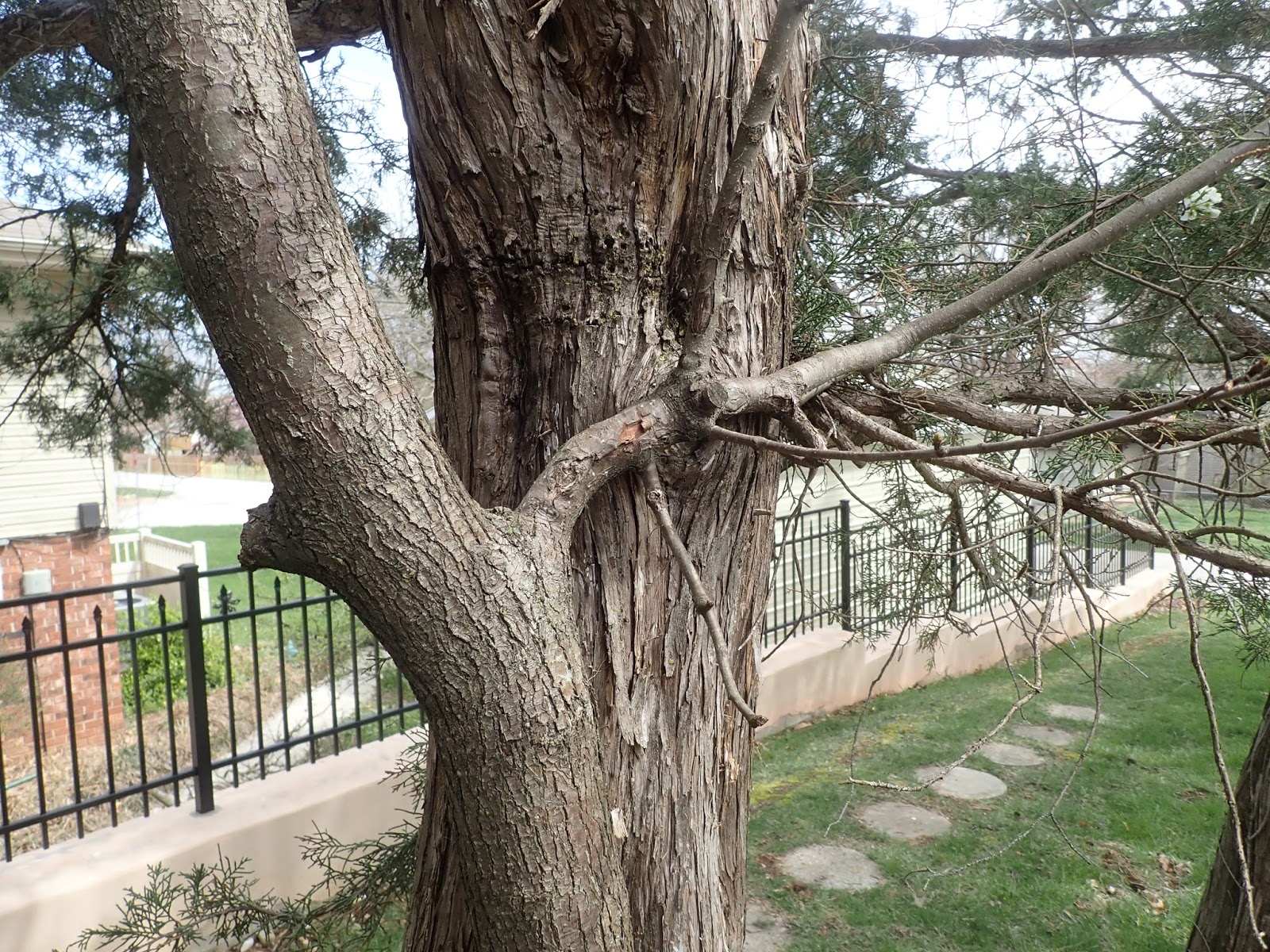
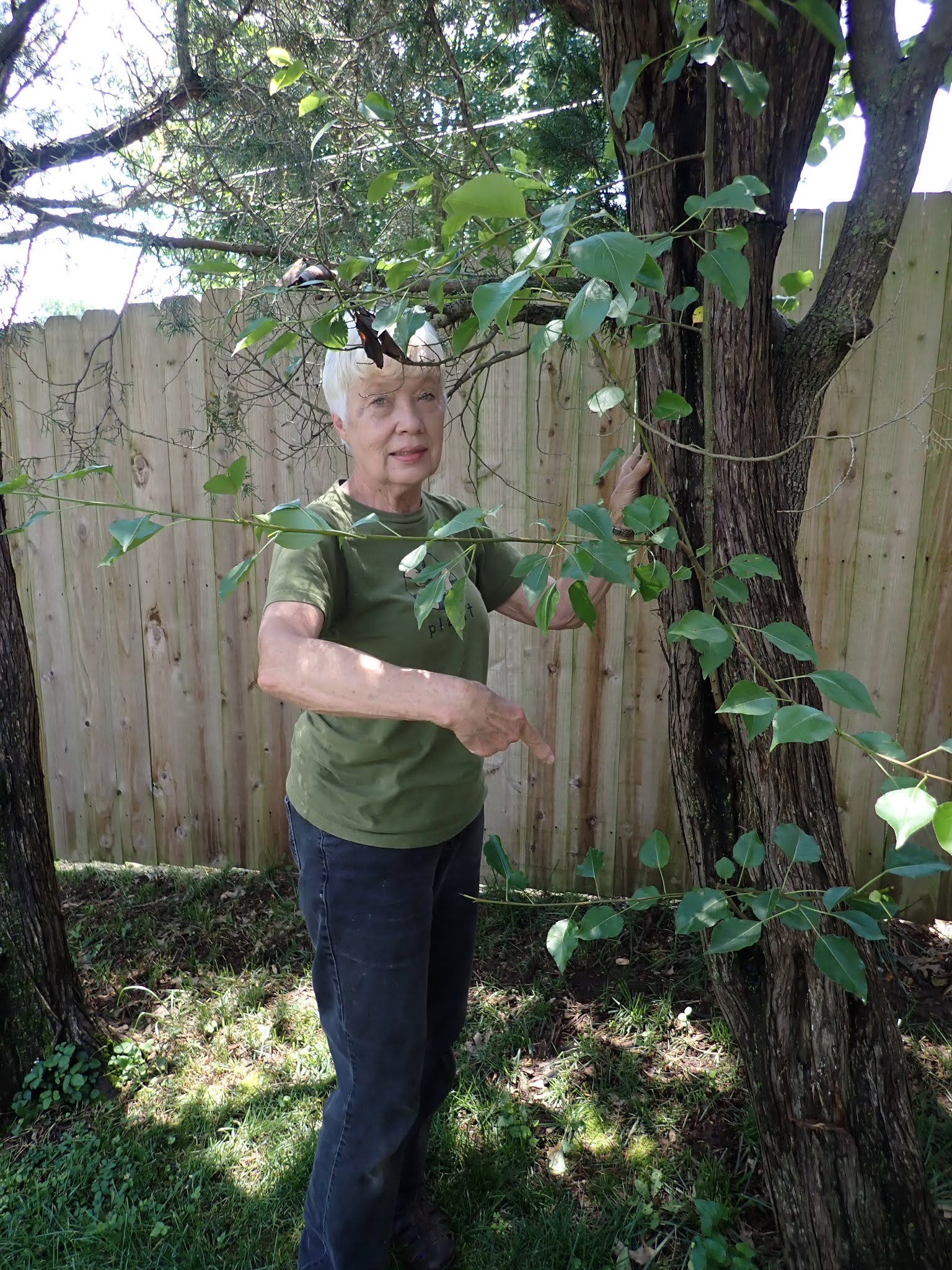
When I got home I went out to see it for myself.  Indeed, there is a Callery pear tree, Pyrus calleryana, 2.5" in diameter emerging from the cedar's trunk three feet above the ground!  It is healthy and happy, approximately 12' tall and in full bloom.  The cedar appears healthy and is the same height as its mates along the line.

Cedar limb scar with Callery pear exiting above - Click to enlarge
Base of pear - Click to enlarge

Close up you can see that a branch was sawed off years ago.  The Callery emerges from the top edge of the scar, which is 3" in diameter, on a 9" DBH (diameter at breast height) cedar.  There is no visible opening to suggest a cavity where a seed might have fallen in the past. 

The first thought might be that it was grafted.  Bradford pears like all other flowering broad-leaf trees are angiosperms and can't be grafted onto gymnosperms such as junipers and pines.  (Technically, our "eastern red cedars" are not cedars, they are junipers, Juniperus virginica.)

The current consensus** of several forestry people is that some time in the past fifteen or so years a bird passed a seed onto the branch and it landed in a crack in it.  Perhaps the bird's feces provided it a little nutrition and a break in the cedar bark allowed some water to collect.  A big question remains - does its roots extend to the ground or is it getting its nutrition from the cedar itself?  I hope to protect it until someone can study its vascular connection to either the cedar or roots extending into the ground.  Regardless of the details it certainly was a one in a million occurrence.

Callery pear trees were brought to the US in 1916 from China to combat fire blight in the common fruit pear (Pyrus communis).  Once they were found to be relatively resistant, 100 pounds of seeds were imported to develop a resistant genotype.  Over the years more seeds from across China, Japan and Korea were collected and made available to nurseries.

In 1952, the ornamental possibilities of one particular vigorous, thornless tree were recognized, and cuttings of it were grafted onto P. calleryana seedlings.  After 8 years of successful testing in nearby neighborhoods they were named "Bradford."  They are unable to self-pollinate, therefore the trees, by themselves, couldn't set fruit. Their vigor was described by USDA plant explorer Frank Meyer in 1918 who had first collected the seeds.

"Pyrus calleryana is simply a marvel. One finds it growing under all sorts of conditions; one time on dry, sterile mountain slopes; then again with its roots in standing water at the edge of a pond; sometimes in open pine forest, then again among scrub on blue-stone ledges in the burning sun; sometimes in low bamboo-jungle...and then again along the course of a fast flowing mountain stream or on the occasionally burned-over slope of a pebbly hill."
When a species is described as thriving in any condition, tolerating all enemies, and like Superman "able to leap over tall buildings in a single bound" you are describing an invasive species.  Soon there were several cultivars produced across the country and when they were planted together as my dad would have said, "up jumped the devil."

A cultivar with striking leaf color in Oregon became Autumn Blaze. Aristocrat, from seedlings growing at a nursery near Independence, Kentucky, had a strong central leader with horizontal branches and an early pyramidal form, more sturdy that the somewhat fragile Bradford.  Chanticleer, cloned from a street tree in Cleveland, Ohio, was named the 2005 Urban Tree of the Year by the Society of Municipal Arborists.

"Callery in a Cedar Tree" -  Click to enlarge
This was all well and good as they weren't self-pollinating but soon innocent insect species began moving pollen between different cultivars planted a few hundred feet apart. Their offspring began creating their own hybrids that could reproduce.  It was as though the individual varieties that had occurred natively in China had all moved into the same neighborhood and had a giant angiosperm orgy.

3 new branches 2020 - Click to enlarge


I would nominate Callery pears as our most invasive plant species, pending the discovery of garlic mustard growing on the back of a zebra mussel.  I am proposing naming this Callery/cedar tree shown above, Juniperus calleryana var. Barbarae, in honor of the discoverer.
==========


Update 2020


Now two years later there are three branches growing out the other side of the trunk as well.  The cedar is otherwise healthy looking.

New Callery growth 12" from the cedar base

Update September 2021  

New growth -Click to enlarge

Continued growth of all the original branches (red arrow) with two new small branches growing out  of the bottom two feet of trunk on the other side.  Also, a new growth with leaves coming out of the soil one foot from the base of the tree (lower right arrow).  While that could be a separate seedling there aren't any others in the surrounding area.  This would seem to settle the question of nutrition as the Callery now has roots in the ground through the cedar trunk!

There are now 26 cultivars of Callery pears. Twelve of these are currently being sold. The Missouri Invasive Plant Council will be making an effort to cease the sale.

========================  
Update-- April 10, 2023

This report is from a site visit by Dr. James Guldin.*

"That Callery pear growing from a knothole in the eastern red cedar is a fine demonstration of adaptive physiology on the part of the pear. It takes some imagination to describe how the pear can coexist with the red cedar.  It also takes some thought to account for how the pear tree gets enough nutrients and water to develop into a 3” diameter stem growing out of that knothole in the red cedar that is 4 ft above the ground.

The availability of nutrients is the easier question. When rain flows down the stem of a tree, the water in the stem flow is enriched by nitrogen, phosphorus, potassium, and the micro-nutrients that a tree needs to survive, no doubt by leaching those nutrients from the bark. That flow of nutrient-enriched rainwater down the stem of the red cedar finds its way into the holes, nooks, and crannies into the dark interior of the host tree. The roots of the pear got their start in those nooks and crannies, and by now have developed to utilize the macro- and micro-nutrients that the pear needs to grow.

But to me, the availability of water is the larger question. How do the twigs of a Callery pear stem look vigorous today, and flowering today, without any apparent contact with the ground to provide the water that the above ground stem needs to grow and thrive? There are two possible answers.

One, the roots of the Callery pear are also 3-4 feet above the ground, embedded in the decayed core of the red cedar, and the stem flow of water into the nooks and crannies into the punky decayed core of the red-cedar may provide all the water the pear stem requires. In the spring, I can buy into that hypothesis. But in the summer, even the decayed wood in the red cedar will become dry as dust, and I doubt the stem of the pear could drink up the water it needs on a daily basis from dry punky rotten wood. The stem would have died before we saw it today.

Two, more likely I think, is this—the roots of the Callery pear have wiggled, writhed, slithered, and otherwise grown downward through the decayed center of the decayed stem of the red cedar into the soil, below the root collar of the red cedar. If this is the case, the pear would be able to suck up the water it needs from the soil below and around its red cedar nurse tree. It might even continue to grow and thrive into, well, maybe a 3” diameter stem that’s flowering and showing twig elongation—as this stem is doing.

If this tree is ever cut for some residential purpose, a close look at the stem analysis would show whether the roots of the pear have made grown into the soil at the bottom of the stem of the red cedar." 

Dr. James Guldin is a recently retired forest scientist (University of Arkansas and US Forest service).  He serves on the board of the L-A-D Foundation.
=============

Callery pears and their 'Bradford' kin are now spreading wild and are considered possibly the greatest invasive plant species threat in Missouri.  In the words of Nathan Muenks* of MDC:

"It’s difficult to truly determine which invasive species is most impactful, but Callery pear sure ranks up there with bush honeysuckle, sericea lespedeza, spotted knapweed, feral hogs and a few others. The reason being that it I would consider it an “ecosystem changer.” Given its ability to invade many of Missouri’s habitat types (whether open or wooded) and the fact that it forms such dense thickets, it has the ability to drastically out-compete native flora and drive away native fauna by creating unusable space for them. It not only grows dense, it also grows quickly. In addition, it’s a tree, vs. bush honeysuckle and others, so it can tower into the upper mid-story – what hope do our native, slower growing trees have in competing for resources and regenerating our native forests and woodlands?

There is no doubt bush honeysuckle and other invasives are much more widely distributed and affecting more natural communities at this time, but there is a strong fear that Callery pear is on a very similar trajectory. While in St. Louis yesterday, I noticed that bush honeysuckle and Callery pear tended to do just fine growing together, with honeysuckle dominating the low under-story and the Callery pear towering above it – SCARY! Is this the future of Missouri’s landscape? It could very well be if we don’t halt the invasion and join in this fight together!"

*Nathan Muenks is the Habitat Management Coordinator with the Missouri Department of Conservation.  This includes coordinating the Department’s terrestrial invasive species management efforts.

Saturday, April 1, 2023

Backyard Heron

Our fellow Master Naturalist Jean Parker sent us this story of a blue heron in her backyard.

_____________________________________

I saw a blue heron in my backyard today. He was at my pond. Again! Last year he emptied my pond of 13 fish, including some 5-7 inch ones! He did it all in ONE afternoon when I was out. I did some research back then and found they LOVE backyard ponds. Makes their job so much easier...like shooting fish in a barrel...
 

I live in the middle of a suburb and find it curious that this huge bird flies our city skies.


Jean's pond


I restocked the pond and placed some old netting I had over the pond. No more fatalities! But he returns without fail, just in case. This time I shooshed him away and he flew to the top of my shed and stayed there for about half an hour. No matter what I did he ignored me. He knew my feeble earthbound limits.

Their feeding habits are described in abcbirds.org:

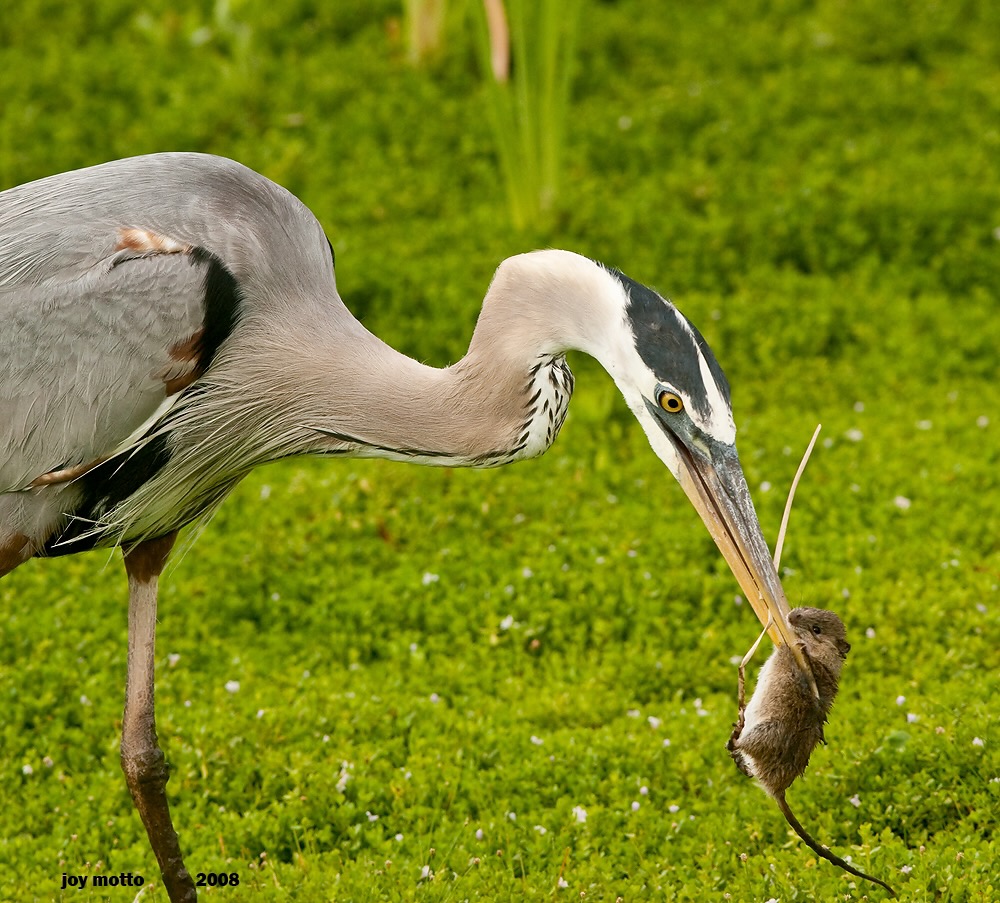
"The Great Blue Heron will eat whatever it can catch with its formidable bill: fish, crustaceans, reptiles, amphibians, small mammals, and birds — especially ducklings. It usually forages alone, locating food by sight. Once a Great Blue Heron spots a meal, it strikes quickly, straightening its long, powerful neck and grabbing its quarry with its spear-like bill, then swallowing it whole. Excellent night vision allows this versatile wading bird to hunt in darkness as well as in daylight."

Not a fish! - Joe Motto

According to North American Native tradition, the Blue Heron brings messages of self-determination and self-reliance. They represent an ability to progress and evolve. The long thin legs of the heron reflect that an individual doesn't need great massive pillars to remain stable, but must be able to stand on one's own.

Editor's note:
The description of GBH feeding is right on. Some years ago I pulled up to our Bull Creek crossing and saw a great blue heron at the end of our swimming hole. I rolled down the truck window, zoomed in with my telephoto, and snapped five quick shots.   I was surprised with my luck capturing this series.

Regarding their broad range of food choices, my bird photographer friend Joe Motto captured the one above choosing a red meat diet. Swallowed whole, that must have been one interesting poop!

Thursday, March 2, 2023

Cedar Pollen

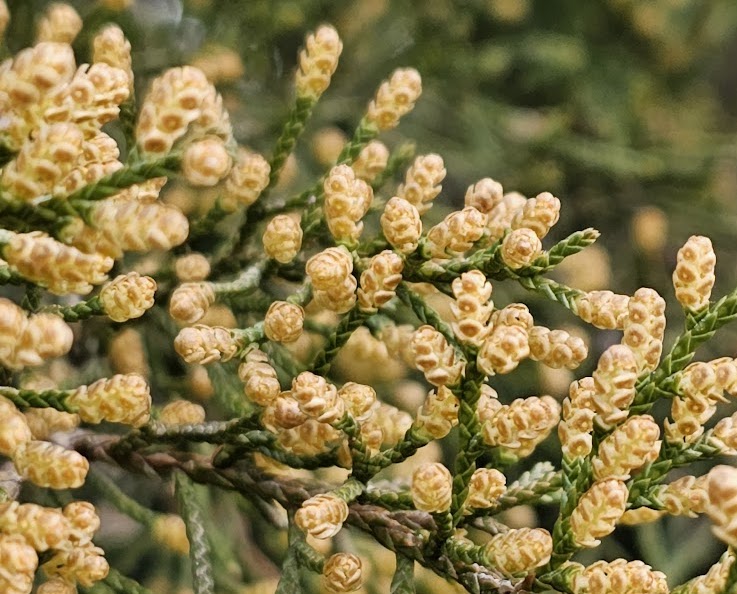
Male cedar cones - Drew Albert
 

"In the Spring, a young man's fancy, lightly turns to thoughts of Love SNEEZING!" (with apologies to Tennyson.)

This is the time of year when male eastern red cedars (Juniperus virginiana) release their clouds of love in the form of pollen which you can see in this video.  In Texas, this is referred to as "cedar fever" which is discussed in this Texas A&M link.  Their onset occurs earlier in Texas due to their warmer climate.  Our Master Naturalist Drew Albert suggests that "After a dry, warm February day yesterday with mid-70s and afternoon humidity dropping below 20% this isn't uncommon after colder weather." The video above was shot on March 12, 2020 which supports the weather theory.

Cedar pollen is distributed by the wind and doesn't seem to care if it lands on a receptive female cone or a human nostril.  When it hits our noses, the reaction is rapid and can produce symptoms over several days.  Not everyone is affected every time.  When I demonstrated in the video the pollen clouds drifting downwind of the WOLF students, I had no reaction in spite of my usual seasonal allergies.

They have been accused of worse.  "Among the many things old-time Ozarkers used to believe brought bad luck was the transplanting of cedar trees. Folklore collector Vance Randolph described several examples of people refusing to move cedar trees because they thought it would bring an early death to them or someone in their family. It was also considered "very bad luck" to bring cedar boughs into the home — except during Christmas, and then, they had to be removed completely before 12 a.m. on January 6 (Epiphany)."  MDC Discover Nature

Our red cedars are native but aggressive growers, early colonizers of bare ground. After the cedar cone on the female tree is pollinated it turns a waxy blue and contains one to three seeds.  The seed cones fall from the trees and are also dispersed by many birds.  Cedars are especially sensitive to fire and the end of burning the glades in the past has turned our historic "balds" into hirsute hilltops.  Some "wind breaks" along fence lines are actually cedars, planted by perching birds, that escaped the blades of a mower.  Abandoned fields and glades now are covered with cedars, creating the expense of clearing them to the landowner.  

Glade restoration - 2000

There is a market for cedar, but a large number of mature trees are needed to make the harvest worthwhile.  When we cut our first glade restoration around 2000, loggers were happy to cut and haul large cedar logs for free.  Our second glade restoration had smaller timber and we had to pay for extra help.  

There was a time around 1908 when the pencil industry developed an appetite for cedar as told in a News-Leader article.

"Ozarkers had other uses for their timber, though. In 1908 the American Pencil Company of New York built a pencil factory in Branson. The pencils were made from cedar logs. Cedar was another locally abundant tree. Thousands of cedar logs were cut into rectangular slats measuring 3" x 3" x 8". The slats were then shipped across the country to factories to be made into pencils. Eventually, the supply of cedar trees was exhausted and the American Pencil Company Factory was moved to California."    ProjectTaney.org

Juniper Hairstreak
So is the spread of cedars good or bad?  As we tell our 5th grade WOLF students, the answer to that question is usually "it depends" and even mosquitoes have a place in the food chain.  In this case, cedar cones (often called berries) are nutritious and feed robins, cedar waxwings, and a wide variety of other birds feasting on their dense carbohydrate and fat load.  Many insects also feed on them including caterpillars of our favorite Juniper Hairstreak.  Meanwhile the branches and evergreen leaves provide shelter for a variety of birds as well as nesting sites for Cooper's Hawks, Blue Jays, Northern Mockingbirds, as well as many other smaller species.

Red cedar spittlebug - REK
Cedars also host other species such as cedar apple rust galls, and cute tiny red cedar spittlebugs.  Perhaps the strangest example is an invasive Callery pear that we have growing out of the trunk of a neighbor's cedar shown in this prior blog.

Another strange thing I have photographed in a cedar tree is this one below, found inside a living but hollowed out cedar on our neighbor's land.  I have tentatively identified it as a new invasive species, Barbaria kipferiae.*

Newly reported "invasive species"
*Special thanks to our editor for her skills with words and as a model.

Saturday, January 28, 2023

Lightning Strikes an Oak

Our friend Judy Freeman told us about a lightning strike that destroyed a large red oak on the land she and her husband Steve own near Seymour.  I contacted our new friend Dr. James Guldin* (a forest ecologist) and we drove out to see it. It was even more impressive than Judy had described.  Before going further, review Jim's report on the site at this link.


It was roughly estimated to be 34 inches in diameter.  Any estimation would make it well over 120 years old as confirmed by a tree ring count.  Standing by the cemetery and the site of historic New Grove School, since then rebuilt, I can only imagine all the stories it could tell.


The tree literally exploded, spreading debris in all directions, covering approximately 8 acres.  The section of the base of the trunk above was blown 70 feet from the base.  You can see the charred area in the root junction.

Click to enlarge

The other most impressive debris was this piece impaled 16" into the ground, 345 feet from the tree site!  The angle gives some idea of its direction and altitude.  The dark area was underground.

Judy and Jim


This led me into a deep dive into lightning effects on a tree, and the results were truly shocking!  (Sorry)  First take a look at my video compilation of some strikes available on the web.

A lightning strike can carry 100 million volts and reach 5 miles long.  It can produce instantaneous temperatures in excess of 50,000 degrees Fahrenheit.  The science behind the various types of lightning and its effects is complex and beyond the limits of this blog (and its blogger).  This Wikipedia link summarizes a lot of the lightning science

The effect lightning has on a tree has a lot to do with the conditions. If the bark is wet from rain, the strike may travel over the bark, not producing visible damage. In the first example in the video above the current passed down through the xylem and phloem, the vascular system under the bark.  Since the sap is a poor conductor, it rapidly boils, producing the explosion of bark.  I suspect that in Judy's case, the tree had moisture in the trunk. This would allow the instantly boiling liquids to expand dramatically, exploding the tree.

My parents told me 70+ years ago to never stand under or around a tree in a thunderstorm but apparently this isn't common knowledge.  Lightning spreading through the soil around the tree base can pass through the a person's legs, up one and down the other causing collapse or worse.  If you are preparing to be struck by lightning, hold your legs together  Who knew!  This dramatic video demonstrates what happens if you violate these rules.

Finally, if you haven't seen enough, here is video of dramatic strikes captured by a lightning aficionado.   Lightning struck a tree on the ridge above Bull Creek last fall which you can see here.

________________________________________________________________
*Dr. James Guldin is retired as Research Forest Ecologist and Center Director with the Southern Research Station of the US Forest Service. He had a 38-year career in Arkansas, first in academia with the Monticello Forestry School at the University of Arkansas (10 years) and then with US Forest Service.  Jim now lives in Springfield, and is becoming active in the forestry and conservation communities in SW Missouri.

Thanks to Judy Freeman for sharing this amazing story with us.

Thursday, December 1, 2022

Owl Pellets

I received a gift of owl pellets from Ben Caruthers.  While this might not excite you, it got a rousing welcome from our friends in the 5th grade WOLF School.  I asked Ben for the backstory.


"The barn is on a cattle ranch where my father-in-law works as a cowboy. I asked the owner if I could place an owl nest box in the old barn. I had not seen any sign of an owl. This was just in the hopes that an owl would find the box and nest there. At the same time I placed a trail camera to monitor any bird activity. It took two years, but the barn owls finally showed up."

There has not been any sign that they have actually nested in the box, but they used it as a perch.  Several other birds have shown interest in the box including rock pigeons, European starlings, American kestrel, and squirrels. Turkey vultures have used the barn for nesting. Once when I went to check on the nest boxes there were two large, white turkey vulture nestlings. They spread their wings and hissed when I approached. I got out of there quickly so I didn’t disturb them further. I also didn’t want to experience their alert response. 

The most recent check I made of the owl box I got to see the barn owl above in person. It flew right over the top of my head!"

=========================================

Ben collected over one hundred owl pellets on the floor of the barn below the nest box and from two other cross beam perch areas.  He delivered them to me separated in paper egg cartons.  Note to self - don't eat any eggs shared by Ben.  The contents were dry for months and some had been cleaned by some clothing moth larvae described in this previous blog.

Barn owls are carnivores, specializing in mice, moles, voles and birds.  Since they swallow their prey whole, passage of bones through the intestine is impossible.  Even the thought of that hurts!  The food bolus goes first into a glandular stomach for digesting with enzymes, acids and mucus.  Next, on to the muscular stomach (gizzard) where it is mechanically mashed up and the digestible portion move down the tract.   Fur, bones, teeth and feathers are retained until they are hungry later when they will be compressed into a "pellet" pushed out.*

By now, I am sure you are anxious to see what is in a pellet. The photo above is a single pellet which also had some leg bones, ribs, etc.  With the charts below* you can begin to determine which rodents passed on (or in this case passed up) after encountering an owl.   Biologist can even survey rodent populations by studying the pellets in the area.

______________________________________________________________

* Hungry for more details?  Check out this World of Owl site.  More on studying owl pellets is at this site.  A key to identification is here.