Monday, April 13, 2015

Orangetips of Spring

Falcate orangetip on spring beauty
This picture summarizes early spring, a falcate orangetip butterfly clinging to a spring beauty*, each of which is a harbinger of the season.

If you go into the woods now, you will notice a tiny white butterfly flitting frenetically around, and occasionally you may even notice a flash of orange on its tiny wing.  It may stop occasionally for a nectar load but usually it just appears confused.  The orange tells us that it is a male falcate orangetip, Anthocharis midea, and he is on patrol, looking for what tickles his fancy, a lady falcate.


Although they both carry the orangetip name, only the males have the orange on the upper wing.  Both sexes have an intricate green marbling on the underwings, almost like lichen on a rock.  This is effective camouflage as long as they keep their wings folded shut at rest.
Note wing spot- Photo by Miles M. Buddy **
Once they have mated, the female will deposit a single egg on a mustard leaf, fortunately a common plant in nature.  This behavior is a necessary precaution as her caterpillars not only feed on mustard, usually the flower petals or seeds, but they will on occasion feed on their siblings, a charming little cannibalistic trait.  The female reduces this risk by leaving a pheromone on the leaf to discourage other butterflies from depositing more eggs.

Chrysalis - Kim Fleming

They fly for only a few weeks and then are through for the year.  Their young caterpillars will go through several instar stages, then pupate in May.  The chrysalis has a spike at the head, and attached to a branch it perfectly mimics a thorn.  They overwinter in the chrysalis, sometimes for two or more years.  It is no wonder that they are frantic when they take flight in the spring.

Female falcate orangetip lay an egg on a mustard
Two days later I had the opportunity to see a female falcate orangetip landing on some tiny mustard family plants in the field at Bull Creek.   She seemed to be very determined in her efforts, bending down the tip of her abdomen to touch the plant.


After getting a few suboptimal pictures, I pulled one of the mustards and found her tiny golden egg on the stalk.  It is a beautiful shiny golden-orange to the naked eye.  With magnification you can see it is fluted along its length.

After she had laid several more eggs, a male came by and tried to hit on her.  She must have given him a signal that she was already full as he immediately took off in pursuit of a more receptive female.

The falcates only have one generation a year, but that seems to be enough, considering how many are flying right now.  The message here is to look carefully when you see a butterfly on a leaf or stem and you may get to see the beginning of a new life.

* Spring Beauty, Claytonia virginica is interesting as well.  It is one of many plants whose seeds are spread by ants, a process called myrmecochory. The seeds have a fleshy organ called an elaiosome that attracts ants. The ants take the seeds to their nest, eat the elaiosomes, and put the seeds in their nest debris, where they are protected until they germinate. They also get the added bonus of growing in a medium made richer by the ant nest debris."

** Miles M. Buddy is a 14 y.o. naturalist from North Carolina whose bio is at this Bugguide link. 

For in interesting Orangetip view from Great Britain, see bobscotney.blogspot.co.uk

Friday, April 10, 2015

More Woodpeckers


Northern Flicker- Bob Moul
 We have always been interested in identifying a new bird but after a trip to Honduras with "real birders" and cataract surgery, it is a whole new game.  Spotting a bird flying into a tangle of branches and then finding it in the binoculars had previously been an exercise in frustration.

First, Brad Jacobs and Rick Thom taught me to stare at the bird's landing spot while bringing the binoculars up, never moving your eyes.  That was the most important lesson.  Next fix the cataract so you can actually see the bird's identifying markings.  (Learning bird calls is a whole other thing.)

This all came together last week up on the ridge when I heard three birds calling, announcing their territory.  The call was reminiscent of a red-bellied woodpecker that was in a hurry, the call higher pitched and compressed like a 33rpm record played at 45rpm.  That is a phonograph record for you kids.

I saw a bird fly to a distant snag tree and hang on the shady side like a woodpecker.  It was flying back and forth to another distant tree and I could hear it pecking at the wood.  I worked my way closer and could get brief glimpses of a white belly and a head that seemed more intensely red.  I got a couple of pictures at 45x before it flew away, confirming it was a red-headed woodpecker, a first for me.


Two days later I went on a mission to get a better photograph.  Starting out in the early afternoon when the light would be better, I sat at the base of a nearby tree with a good view of the snag.  After a brief nap in the afternoon sun, I heard the distant call repeated, just as I had heard on Allaboutbirds.com that morning.

This time the woodpecker flew in repeatedly, hanging on the shady side of the tree before flying off with its treasures.  The distant call of another red-head perked it up and it flew to the other side for a moment to look around and I got my shot.

Red-headed Woodpecker - finally!
On the way back home, I flushed a couple of birds in the field, tan colored but with the distinctive bobbing flight of a woodpecker.  One landed on a distant tree and Brad's lessons paid off again with a good view of a Northern flicker, seen above.

Flickers are woodpeckers with a little less wood.  They eat more beetles and ants, digging them out with their specialized bill, re-purposed with a slight curve for the dig.  I had seen woodpeckers frequently in the fields but had never had a good look before to see that these were woodpeckers of another color. 

Allaboutbirds.com mentions that you can find them by walking around the wooded edges of fields just like where we now see them.  They use their barbed tongue to pull out ants, a relatively messy meal compared to reaching into a pecked hole in wood. 

You can see more of the late Bob Moul's beautiful nature photography in these Pbase albums.

Thursday, April 9, 2015

Osprey Cam

Osprey on a fish search - Joe Motto
There is a new osprey nest cam operating around Stockton Lake, and the feel-good story behind it is available at this Springfield News-Leader link.

They migrate to Mexico in the winter, returning to raise their families, and any year there are between 10-20 nesting pairs in Missouri.  They build their nests in high structures with a view, and there-in lies the problem.  Around Stockton, power line transmission towers provide the prime real estate.  This creates a risk for fires, destroying nests and interrupting electrical transmission grids.

Empire District Electric Company faced this problem and contacted Greater Ozarks Audubon Society (GOAS) to work on a solution.  Working before the osprey returned this year, Empire built a nesting platform on a rugged ridge near Stockton reservoir and transplanted a nest from a nearby transmission tower, including a webcam to monitor the nest.

Empire's osprey cam
The move was just in time for the spring osprey housing market season and a lucky osprey family has moved in.  You can see the results on the live osprey cam here.
"Ospreys, sometimes referred to as fish eagles, are magnificent raptors that live near large bodies of water and eat primarily fish. They can be found on many of the lakes and rivers in the Ozarks during migration. They are slightly smaller than an eagle and not as bulky. On some of our beautiful Ozarks lakes, like Stockton, where ospreys nest, it is not uncommon to see several on any given day during the warm seasons. Osprey nests are rare in Missouri, however, with the Missouri Department of Conservation reporting only 10 to 20 statewide in 2014. In the winter, they head for the Gulf of Mexico, Central, or South America."  News-Leader
Empire is considering building more nesting towers.  At a time when conservation causes and big business don't always play well together, lets hear it for GOAS and Empire District Electric Company.

More on these magnificent birds including photographs and video is at Beautyofbirds.com.

Wednesday, April 8, 2015

Goose in a Tree

Canada goose in Washington Park, Denver - W. Gerecht
The Gerechts in Denver sent this picture with the following note.  "It is mating season here in Denver. The Canadian geese are in the trees, on the roofs and anyplace high, screaming to the world, that they would make the best mate (I assume it is the males)."  If this was any of my usual associates I might have thought alcohol and Photoshop was involved, but this was real.

Having watched geese land on earth, I would have never guessed they could hang on to a tree limb.  On the other hand, I doubt they could climb the trunk like a nuthatch or woodpecker.  As usual, that great repository of ornithological knowledge, Google, came to the rescue.

 Canada geese in Canada, nesting in a tree stump - DNCB
It turns out that others have seen this behavior.  A wild "goose in a tree" search brings up a bunch of pictures without any more details. Delta Nats Casual Birding in Canada even report finding a pair of Canada Geese that had started nesting in a tree trunk/stump about 30 feet high.

MPG Ranch manages 10,000 acres in western Montana.  They have this video showing a pair of Canada geese nesting in a sycamore tree.  It turns out this must be a Montana thing.  At the Lee Metcalf National Wildlife Refuge in the Bitterroot Mountains of Montana, an old Mutual of Omaha Wild Kingdom video documents Canada geese nesting in trees in a swamp, apparently to escape from ground based predators.  Watch the final two goslings make their big leap from the nest at 11:20, looking like Butch Cassidy and the Sundance Kid with feathers.

Burwick taught me that you never call them Canadian - it is Canada geese.  Eh?  Furthermore, it is unlikely they have ever seen Canada as they are likely to be resident geese this time of year.  He tells this story.
"A few years ago, a pair of Canada geese took over an eagle's nest located high up in a sycamore tree below Fellow's Lake dam. Literally took it over, they ran out the eagles that were already setting on eggs."
Having seen what geese do on the sidewalks of the Springfield Botanical Center, I am thankful that tree nesting hasn't occurred in our park.

Monday, April 6, 2015

Morel? True or False

A friend of ours sent me this picture, asking, "Found this puppy in the woods today. It’s a little more than 6 in. tall. Is it edible?" With morel hunting season around the corner, this is a great question.

First, everything is "edible" if your teeth can penetrate it, grind it up or you can swallow it whole. Do not eat this one. This is a false morel. Some people say they and their family have eaten them for years and love them. Of course I have never personally spoken with anyone who died from eating them but there are many reports.

The problem is that there are several species of false morels (genus Gyromitra) which require an expert mycologist to identify. Furthermore, there is uncertainty about which are toxic. Boiling them twice and draining off the water is said to remove most of the toxin but the fumes can make you sick and the boiled morel can still make you sick even if less likely to die. Finally it contains N-methyl-N-formylhydrazine which in addition to being a hemolytic toxin has been shown to be carcinogenic in mice.
"Although they are much sought after in Europe as an edible species (Gyromitra esculenta), 2 to 4 per cent of all mushroom fatalities are associated with them. It is not clear whether the same species occurs in North America, although we call one species here by that name. The active ingredient is called gyromitrin (N-methyl-N-formylhydrazine), which is metabolized to monomethylhydrazine (rocket fuel!) in the body." *
False morel - Linda Ellis
The false morel Gyromitra are easy to differentiate from true morels (genus Morchella). First of all they are reddish in color. Next slit the mushroom lengthwise. False morel's cap sits on top of the stipe (stem) while true morel's cap extends down the stipe. Even more fundamental, the stipe of a true morel is hollow while the false is solid with irregular chambers. Don't eat one with a solid stipe!
True morels cut open -  Great Morel
If you find a mess of morels with a hollow stipe but you are still wary of eating them, leave the bucket of them on our porch and I will take care of the problem.
* Tom Volk's Fungus page has a comprehensive discussion of false morels.

Friday, April 3, 2015

Tooting Our Horn

Bob Korpella (center) represented the Springfield Plateau Master Naturalist Chapter at the March 20 Conservation Federation of Missouri (CFM) Awards Banquet. The chapter received CFM's Conservation Organization of the Year award. Also pictured are David Smith of Bass Pro Shops and Brandon Butler, the Executive Director of the Conservation Federation of Missouri. (Conservation Federation of Missouri photo)
For those who follow our blog, this is my chance to brag about our chapter. The Conservation Federation of Missouri annually recognizes an organization with its Conservation Organization of the Year award. This year it was awarded to our Springfield Plateau Chapter of the Missouri Master Naturalists.  Their proclamation is below and we are excited to share it with you.

Space limited the listing of the many other achievements of our members.  A more complete listing of achievements are found in this nomination form.  Congratulations to all the individual members for their contributions that that made this award possible.  And a special thanks to the Conservation Federation of Missouri for all their contributions to the state's conservation achievements.

Award Proclaimation
The Springfield Plateau Master Naturalist Chapter is part of the Missouri Master Naturalist Program, a community-based natural resource education and volunteer program of MDC and the University of Missouri Extension. The program’s purpose is to develop a corps of well-informed volunteers to provide services pertaining to natural resource management.
The volunteer efforts of the Springfield Plateau Chapter were numerous and diverse. A few of the chapter’s long list of activities in 2014 included:
-       Surveyed quail on several Missouri Department of Conservation prairies
-       Surveyed mushrooms at Springfield’s Valley Water Mill Park and noted several species that had not previously been recorded in Missouri
-       Monitored seven urban springs in Springfield for water quality
-       Conducted invasive species plant control at La Petite Gemme Prairie in Polk County, one of Missouri’s designated Natural Areas.
-       Restored riparian corridors along two of Springfield’s urban creeks – Fassnight and South creeks
-       Conducted education program for University of Missouri Extension’s early childhood day.
-       Developed a Bear Education Guide that were used at several educational events in southwest Missouri in association with the MDC’s Bear Education trunks
-       Developed a neighborhood Conservation Day event in Springfield's Center City area.
“The Springfield Plateau Chapter of Master Naturalists has demonstrated commitment to the natural resources of southwest Missouri in a number of ways,” said MDC Conservation Education Consultant Jay Barber. “Last year (2014) alone, they volunteered over 6,500 hours and cumulatively, since the chapter’s inception (2006), they have volunteered 38,200 hours.”

April Phenology 2015

Harbinger of spring
Phenology - the scientific study of periodic biological phenomena.
The harbinger of spring were hiding in the leaf litter a few days ago, announcing the arrival of the spring ephemeral wildflower season.  Within several days they are followed in rapid order by trout lily, trillium, and a variety of other tiny beauties.  To see them you have to bend over and of course, get outside!

 Noppadol Paothong
April is the time when the woods and fields come back alive.  After months of few new findings on a hike, all of a sudden everything is new as dormant life awakens and fertility cycles begin again.  Turkey are out everywhere, gobbling confidently in the knowledge that they are safe until youth season begins April 11th.

Belted kingfisher - Joe Motto
The belted kingfisher, a small bird with attitude and a bad haircut, began its loud chattering patrols up and down the creek last week, proclaiming its dominance to all within half a mile.  Birds of Missouri lists it as uncommon but we always have a pair taking possession on low slung branches above the shallow stretches of the creek.


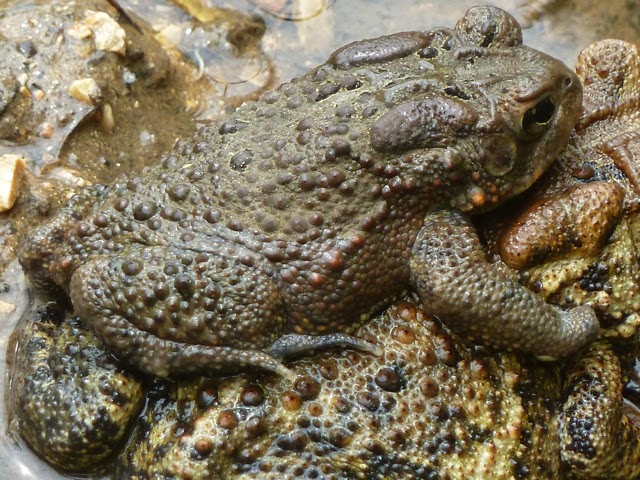
The eastern american toad usually starts calling in mid-April, but we heard a preview last week as one tried to overcome the chorus of spring peepers.  Their high pitched trilling call seems to hang on forever, up to 30 seconds, as you wait for it to stop for a breath. They will soon be mating and you can look for their distinctive long, double strands of eggs in ephemeral collections of water.

Eastern tent caterpillar egg case
Eastern tent caterpillars will emerge from their egg cases which encircle the branches of our plum trees, ready to start building their web-like homes.  These will protect them by creating many layers of walls, insulating them against the cold.  Look for the cases and you will soon see tiny holes appearing before you will find the caterpillars.  Their host trees flowers will be the first to bloom along our drive.


Hummingbirds will start arriving any day now.  They will be hungry from their trip back from their wintering grounds in Central America and most will be moving on after fueling up.  Even though it was blustery today, we have loaded up the bird feeders, as there won't be many other nectar sources around for a while until columbine starts blooming  They can also feed on tree sap and flying insects but both are hard to come by at this time of year.

Snakes begin to emerge from their hibernaculum (dens) when average temperature of the soil warms sufficiently.  Watch for copperheads - they are just minding their own business and you are too big for them to eat so they don't want to waste venom on you.  Leave them alone unless they are around your house.

Copperhead - (he was photographing the mushroom) - Mark Bower

Serviceberry blossom - Wikimedia
Dogwoods and redbuds will soon be in bloom, preceded by the delicate white serviceberry blossoms.  Nearer to urban areas you will see the early blossoms of Bradford pear trees and their invasive callery pear offspring, a reminder to plant native species in their place.
Three-toes box turtle laying her eggs
Why did the turtle cross the road?  In a few weeks it will be due to their raging hormones driving them to look for love.  This is a dangerous occupation as they commonly cross roads in their quest.  If you are lucky you might get to see a female digging a hole to deposit her eggs. 

Black vulture parent - 2015
Our annual big April event has occurred; the black vultures are brooding again in our old barn.  After five years of observing them, they look bored when I open the door to the stall.  Today he/she (they both brood the eggs) glared at me for a minutes before getting up to show me the eggs.  I think it knew the paparazzi would not leave until he had the photograph.  This weekend their seasonal neighbors the barn swallows arrived and are adding their nests in the eaves above them.