Showing posts sorted by relevance for query polistes fuscatus. Sort by date Show all posts

Friday, September 11, 2020

Wasp Mating Ball


We normally see the northern paper wasps, Polistes fuscatus, come and go through a crack in our eaves but the sight above was very impressive.  A tight scrum of wasps four deep were crawling all over each other, mostly males.  None were flying around and there were more hanging around the edges as if thinking about joining in. You can watch the action on this Youtube video.

I suspected that it was a wasp orgy and sent it to an expert (on wasps, not orgy's), Chris Barnhart.  He confirmed that it was a mating scrum and sent this link which described this behavior in Polistes gallicus.  They write:

"At the end of summer, males of Polistes gallicus fly in swarms around vertical landmarks and land in clusters on their favorite perches, where they drag their legs and abdomen. Here males occasionally crowd around a perched female; they make no effort to defend an exclusive mating territory but instead attempt to copulate by displacing rivals from the female."

 Another source from NC State adds more details.  

"Paper wasps show types of swarming behavior during the cool and cold times of the year when there are no nests and no young larvae to protect. During the fall, this behavior is connected with mating and is the wasp version of "boy meets girl." 

Male wasps look for the best place to "hang out" and attract females. On these warm days during the fall, the future queens become active and fly about.  They go on to say that the females tend to seek high spots like towers or the highest house in a neighborhood (like ours on a bluff).  Males seek out good spots and emit hormones (pheromones) to attract females.  That is likely what all the bumping and grinding of abdomens is about in the video.

Ordinarily I spray for them when they are tending the nest as they become defensive and sting occasionally when we walk around.  They will patrol the deck but don't usually sting seated guests unless someone instinctively swats at them.  The books say that at this stage they aren't aggressive but I am not sure how many wasps read books.

Since these were six feet from our front door and within reach of anyone passing by, I sprayed them, then counted 42 bodies with more dropping through the gaps in the deck.  While they are a part of nature and considered "beneficial," I don't think I upset the balance of nature too far and I am confident that they will be nesting here next year.

There is more on Polistes fuscatus in Wikipedia.

Thursday, February 16, 2017

Another Wasp in the House

Yellow banding on abdomen helps identify P. fuscatus - REK
P. metricus
We have new boarders in our creek house as well as up at Bower's cabin.  This is Polistes fuscatus, the Northern Paper Wasp. After years of harboring dark red-brown Polistes metricus that occasionally come from nowhere to assert dominance with their stinger, we are hoping for a better relationship with P. fuscatus.  There are prettier pictures of it live but this one from Jan Bower is the way I like to handle them - dead. 


These are social wasps in a matriarchy with a solitary queen although her "court" sometimes has other female queens that serve her.  Occasionally they will share their paper nest with P. metricus.  When they first emerge there may be fighting between the females until one establishes dominance.  This is a battle of reproductive strength where the dominant queen usually has the largest and most developed ovaries.

There is evidence that the wasps can recognize individual nest mates by their appearance.  When an individual was painted with black and yellow paint to change its features, it was greeted with aggression which let up with time, unlike a wasp from another nest, suggesting that chemical clues are more important in nest mate recognition.


There is extensive information on every stage of P. metricus life here.  This was the species that was studied in understanding frass-flinging caterpillars.   Caterpillars of silver-spotted skippers (Epargyreus clarus) were paired with P. metricus to determine the benefits of "flinging" frass (caterpillar poop) shooting it away from their leaf shelters.  We have a video of the frass flying out here, a fun sight before delving into the scientific experiments.  I will try to keep in mind the wasps' contributions to entomological research the next time I find them inside our bedroom window.

Wednesday, December 10, 2014

Frass Flinging Caterpillars

Silver-spotted skipper caterpillar with brown head - Chris Barnhart
As I am a retired gastroenterologist, Chris Barnhart knew he could hook me with this video of his showing a caterpillar shooting out its frass. Many animals have special ways of eliminating their fecal matter, called frass when produced by insects, to reduce disease or avoid predators.  Epargyreus caterpillars simply go ballistic.

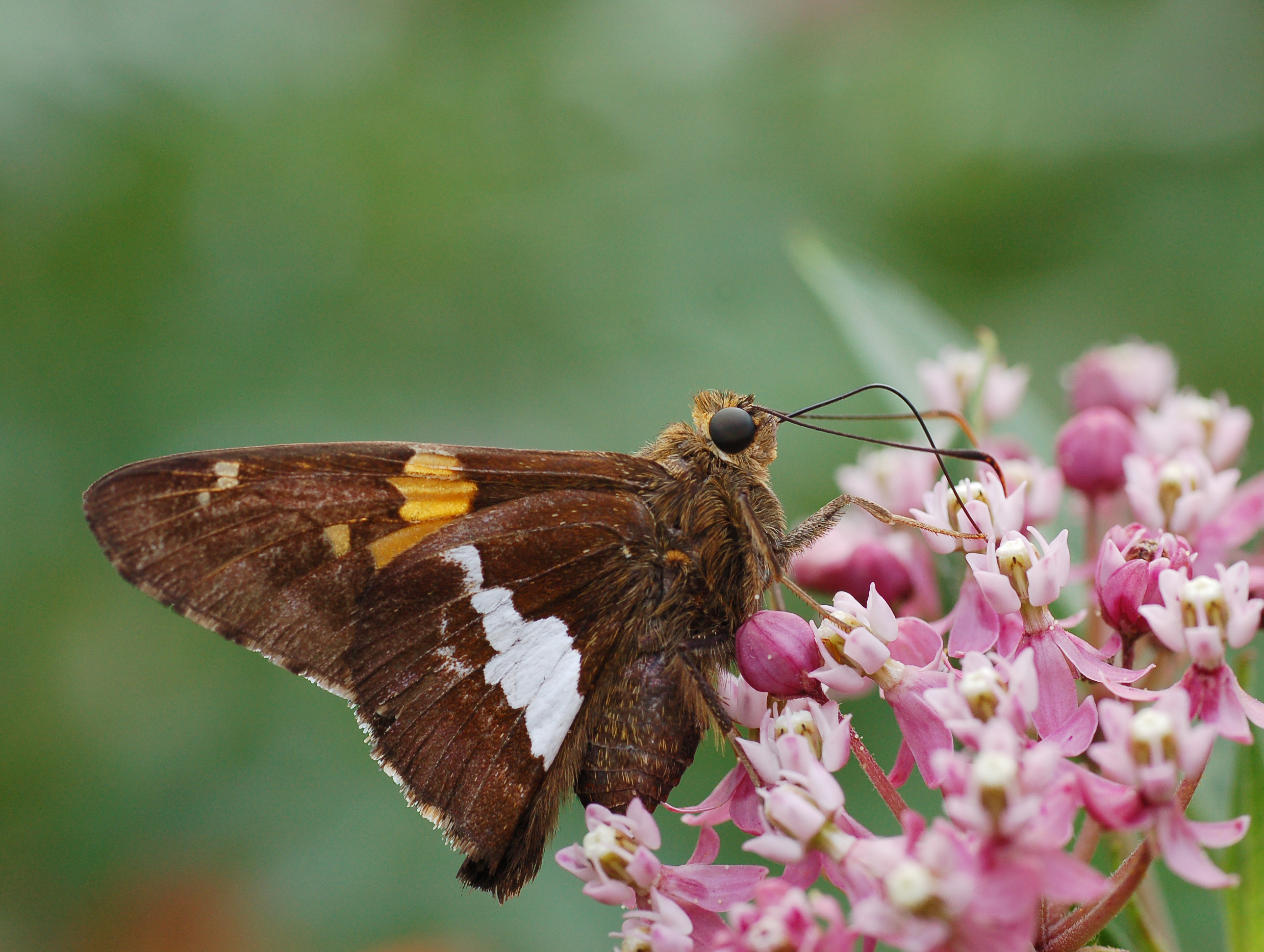
http://upload.wikimedia.org/wikipedia/commons/9/99/Silver-spotted_Skipper_Epargyreus_clarus_Milkweed.jpg
Silver-spotted skipper - Wikimedia
The common Epargyreus species we see in Missouri is the silver-spotted skipper, Epargyreus clarus. They are regularly found throughout the warm months nectaring on a wide variety of flowers. Its caterpillars feed on a wide variety of plants in the pea family, ranging from the beggar's ticks (tick trefoil) that cling to your clothes to the black locust tree that can exceed 100 feet tall.

Cocked and ready to fire
Our silver-spotted skipper can use its anal comb to shoot its frass "faster than a scat out of hell," to quote Chris. It can fly up to an astounding 38 body lengths away. (Yes, some one actually has measured its record launch - and you thought filming it was odd). It is not alone in long-range bombing. There are videos on line of frass-flinging Asian caterpillars like these of Mycalesis mineus, Ypthima pandocus and.....oh well, you get the picture. 

Frass flinging is commonly found among caterpillars that live in leaf nests. Why do they bother? This is felt to be a defensive mechanism to eliminate the smell in the nest which would be a clue to predators, specifically the northern paper wasp, Polistes fuscatus as described in this study.

More stories of scat disposal and frass chain building caterpillars in future blogs.