Showing posts sorted by date for query pennsylvania. Sort by relevance Show all posts

Sunday, August 10, 2025

Oak Leaf Itch Mite


Several days ago I noticed some itching red bumps below my waistline. The itching was mild and only a couple of them developed a white head in the center. Then the next day, this story came out in the NewsLeader.

These are the bites of an Oak Leaf Itch Mite, aka. Pyemotes herfsi.  It has a complex story and we are not their intended prey. They are thought to have originated in Europe, has been recorded from Australia, India, Egypt, Chile and most recently, the United States. According to the Penn State Extension story:

"The first recognition of this mite in the U. S. occurred in Kansas in the autumn of 2004 where it was estimated to have affected around 19,000 people. Since then it has been reported from Illinois, Nebraska, Ohio, Oklahoma, Missouri, Tennessee, Texas and in 2007, Pennsylvania (Lancaster County)."

These mites feed on many different insects but when running short, they come after us. One of their common victims they feed on are periodical cicada egg nests and this is cicada season as we can hear out in our back yard. The mites proliferate when the cicadas emerge.

Pest and Diseases Image Library, Bugwood.org
Pyemotes herfsi - Pest and Diseases Image Library, Bugwood.org

Then News-Leader has this gallery of cicada photos.  The mite seen above is virtually invisible to us, measuring 0.2 mm long. More from the News-Leader:

"The species commonly feeds on the larvae of midges or flies that form galls, or growths that develop on plants as a reaction to insects and mites feeding on them, on the edges of pin oak leaves. Once their development is complete, they drop from the tree and can land on (and bite) humans and animals. "

If you start feeling the itch and seeing the bumps, "don't do anything rash."(Sorry about that. ) Aside from the possibility of a secondary infection from scratching, the rash will diminish with time and the cicada season will be over soon.

Sunday, September 8, 2024

Leatherwing Beetles


Mark Bower sent me this picture of beetles covering his goldenrods.  He tentatively   identified them as Goldenrod Soldier Beetles.

I immediately recognized them as Pennsylvania Leatherwings.  Looking them up I found that both names are commonly used to describe Chauliognathus pensylvanicus.  I will leave that pronunciation to you.

Of even greater interest, there is a fungus association, a beetle made for our mycologist friend!  To quote this Wikipedia entry:

"Adult C. pensylvanicus may be infected by the fungus Eryniopsis lampyridarum. After the fungus infects the host, it takes about two weeks for it to eventually kill its host. Before the host dies, the fungus orders the beetle to climb a plant and then attach itself to a flower by biting down with its mandibles into flower heads. About 15–22 hours later, the fungus causes the dead beetles to raise their elytra and expand their metathoracic wings in order to maximise infection of other beetles.  With their wings raised, the dead beetles may still attract mates as live males were observed mating with the deceased, infected females, this then transmits spores from one insect-host to another."


Journal of Invertebrate Pathology at this link

This is a sexually transmitted disease (STD) or in this case an infection or STI.  There is more recent information on this in this Science Alert story.  The Parasite of the Day blog has more on the fungus association.  As other soldier beetles are attracted to daisies, the plant acts as a pub which attracts other uninfected beetles.  Sound familiar?  Meanwhile other infected beetles fall to the ground where the fungi can survive until they hitch a ride on other beetles.

This is written in the name of science, even if it sounds a little X-rated.

Tuesday, September 12, 2023

Leatherwings in Love


Mating leatherwings - Click to enlarge  

In the fall, a young beetle's fancy turn to thoughts of....... making more beetles.

PL - click to enlarge
We are seeing these soldier beetles on flowers in Barb's backyard.  These are Pennsylvania Leatherwings (Chauliognathus pennsylvanicus), aka Goldenrod Soldier Beetles we will call PL.  They are members of the Cantharidae family of soldier beetles.  The "soldier" label comes from the coloration of this family which reminds some of uniform decorations.  The "leatherwing" refers to their front pair of wings (elytra) which are hard in most beetles but flexible and leathery in PL.

Many of them are linked as mating pairs, the female intent on eating and the male on.....well you know what I mean.  They seem to mate non-stop and at times, finding a single is unusual.  "Size matters" as males in a breeding pair are usually larger than single males nearby.

They resemble fireflies without the electronic gear, and some sources suggest that this coloration protects them from predators familiar with the toxic secretions that fireflies produce.  They also manufacture their own brand of defensive chemical which they can release from their abdomen.

They are found in large numbers on flowers that bloom from August through October.  They seem to mate non-stop and at times, finding a single PL is an exception.  While feeding on pollen and nectar, they are also opportunistic omnivores, snacking on small insects  and caterpillars for variety.  They do not damage plants and eat some less desirable insects like aphids.  

Michael Raupp

"Adult females lay their eggs in clusters in the soil. The dark-colored, long, slender, worm-like larvae are covered with tiny dense bristles, giving a velvety appearance. They spend their time in the soil, where they are are predators of other insects, eating grasshopper eggs, small caterpillars and other soft-bodied insects."  Wisconsin Horticulture

Bug of the Week has this interesting story of a zombie fungus attacking our leatherwings. 

"A fungal pathogen called Entomophthora lampyridarum lurks in the landscape waiting to infect soldier beetles when conditions are right. After penetrating the surface of the hapless beetle, the fungus takes control of its host and zombie-fies it. 

The fungus causes beetles to march to the upper leaves of the plant, clamp onto leaves with their jaws, and spread their wings in the final act of death. This allows fruiting bodies to erupt from the upper surface of the beetle and spew their spores into the environment where they disperse and infect other victims. While we lament the loss of beneficial soldier beetles to their disease, in the greater scheme of things Entomophthora fungi are highly beneficial causing epizootics that can decimate nasty pests like gypsy moths, house flies, and locusts. Some entomologists believe that fungi are the primary regulatory agents of insect outbreaks worldwide. Glad they infect bugs and not us. "

Bug of the Week also has this video of mating leatherwings while the female is hard at work, supporting the male, something that my wife can relate to.

 More on soldier beetles in general at this University of Kentucky site.

Friday, June 24, 2022

Leatherwing with Boots


I have been seeing these beetles in our wafer ash patch and then had this beautiful picture by Becky Swearingen jump out at me on Bi-State Bugs.  In the past I had seen similar colored Pennsylvania Leatherwings, Chauliognathus pensylvanicus, but the pattern wasn't right.  This is the margined leatherwing beetle, Chauliognathus marginatusIt appears in late spring and will be gone by mid-summer, about the time that the Pennsylvanians first appear to inhabit their favorite plant, goldenrods.

Mating Pair - REK

Without Becky's camera or talent I had to get the lens too close, causing them to scurry away.  I chased this mating pair, finally giving up and capturing them.  After refrigeration, they slowed down so I could photograph them separately.

Leatherwing female - REK
Leatherwing male - REK


  Pennsylvania leatherwing-Clay Nichols


The coloration is confusing as the most prominent feature, the broad black stripe down the elytra is variable, ranging from prominent and full length to a short spot on my two specimens and sometimes even completely absent.  The margined species have a yellow head with a black "V" while the Pennsylvanians have an all black head.  The black patch of the pronotum (back of the thorax) extends full length rather than being just in the center on Pennsylvanians.

Leatherwings get that title because of their soft flexible elytra wing covers which are hard in most beetles.  The family are also referred to as soldier beetles because of their bright colored "uniforms".  They nectar on flowers as well as feeding on small insects and their eggs. While the Pennsylvania Leatherwing is usually found in the fall, the Margined crawl are out in early summer.  Following mating, they lay their eggs in the soil and ground litter where their larvae will feed until their fall pupation.


Pollinia afoot -  Kareninnature

Pennsylvania leatherwings crawl around nectaring on the milkweed flowers and get yellow globs wedged on their feet.  These are paired sacs of pollen called pollinia.  These wedge tenaciously to the beetles' feet making walking awkward.  Because they are able strong fliers they can carry their load to nearby flowers where they leave them like a kid with muddy feet.  Rather than dusting individual pollen grains, the sacs of pollen are left in an opening on the next plant.

Beetle boots - Charley Eiseman

There is a risk in this strategy.  A variety of milkweed pollinators can get stuck by the leg if the pollinia is too firmly attached.  You can occasionally find a dead insect hanging by its leg, paying the ultimate price for nectar described in this video.

More on the trap at this site.

Sunday, March 6, 2022

Winter Tick

Tic on a tweezers tip

"In the spring, a young tick's fancy, turns to thoughts of blood." - with apologies to Tennyson


A 70 degree day on March 3rd prompted me to lay down and stare up into the barren winter trees in our upland forest. It was 16 days until Spring officially starts and the only signs were a slight plumping up of buckeye buds and an occasional small swarm of midges.


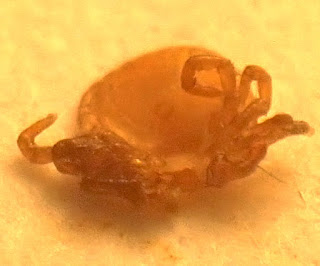
A small itching bump on my hip the next day introduced me to the first tick of 2022.  It took a magnifier to convince us there was even something there.  We previously reported a Christmas tick on December 26th, 2020.

Lone Star ticks - Entomology- University of Florida

1.3 mm larva
Ticks' life stages are egg, larva, nymph and adult.  Ticks are arachnids, like the spider family, and have 8 legs.  The larval stage  shown above in the two top specimens above has only 6 legs.  They typically are less than 1.5mm and mine was 1.3 mm.


6 legs = larva

It is commonly thought that ticks die off in the winter after the first hard frost.  Unfortunately, they do not.  The tick lifecycle on average is about two years.  This means that ticks in cold winter climates have to survive spells of below-zero temperatures.  They spend the winter in a low energy state but can revive on warm days and wake up mighty thirsty.  

Ticks' winter survival is complex.  Some can survive up to -7 degrees.  One key depends on their micro-climate.  Dry arid landscapes put them at greater risk while moist and humid soil with leaf litter provides a degree of insulation.  Prolonged cold spells increase mortality while mild temperatures and global warming increase their survival.

Frontal view-Click to enlarge

While blood-fed ticks can emerge and quest for food and mating, unfed larva need warmer temperatures to emerge and feed to enter the next life stage.  Two days of 70 degrees with 30 degree nights was all this little sucker needed to quest.  Add a warm body on the ground and the larva's survival is ensured.....unless a pair of tweezers attack!

University of Florida entomology site is my go-to resource for a wide variety of insects. The Tick Research Lab of Pennsylvania has more studies on tick survival in winter.

--------------------------------------

Addendum March 9, 2022

Male Lone Star Tick
We walked up and down our gravel drive yesterday, never sitting or even going into the grass.  Because of the 40 degree day with wind we didn't go anywhere else.  This morning I had a new tick burrowed into my armpit.  It is a male Lone Star (only the females have the spot on the back).  It is quite healthy, currently running laps in my bug box.

I now face a moral dilemma.  As an ethical ecologist, am I obliged to release it along the road where it found me or can I drop it off in the National Forest?

Friday, March 19, 2021

Mating Black Rat Snakes


Mort Shurtz sent me these pictures of mating black snakes in a tree. "About twenty feet from our deck my son Jay noticed two blacksnakes in some form of endearment in a maple tree."  Like any dedicated Master Naturalist, he ran for a camera and soon had "five voyeurs gawking at these two mating snakes."

The Western Rat Snake, Pantherophis obsoletus, known locally as the Black Rat Snake goes by many different common names across the country.  Its official common name (if there can be such) was recently changed to Texas Rat Snake although they are predominately north and east of Texas (see my recent diatribe).

Black Rat Snakes are one of the largest native snakes in North America, growing up to 8 feet long.  They are talented climbers of trees, rocks and seemingly any structure.  We watched a five foot specimen scale the exterior wall of our Bull Mills house and crawl into a fissure that we couldn't even see from below.  We had evicted it twice before because of its unsanitary habits, such as leaving shed skins in the closet and dropping white powdery excreta on the living room floor.

Although young snakes are vulnerable to a number of predators such as foxes, skunks and raccoons, the adults are most threatened by humans, victims of either tires or fear.  They respond to danger by shaking their tail and spreading a foul musk, and they will give you a non-toxic bite if you try to pick one up.

They are constrictors, progressively tightening coils around their prey with each exhalation until the victim is smothered.  Their prime prey are rodents although they will eat other small mammals, birds and their eggs.  Mort's snakes probably met on a dinner date, headed to the bird house seen in the video below.


Males wait for females in a territory which they defend from other males.  They find females by benefit of pheromones, mating for minutes to hours with the male sometimes holding on to the female with his mouth so she won't get away.  The female later produces 6-24 eggs from which the young will emerge.  One of the significant threats to their eggs is the burying beetle, (Nirtophorous pustulatus).  "The adult beetles lay their eggs in the snake eggs and the beetle larvae feed on the developing snake embryos."*

*  From Pennsylvania State University,  which has a detailed account of their reproduction.

More Black Rat Snake pictures and video are at this site
Various rat snake species information is at Animal Diversity Web  

Saturday, September 29, 2018

Mosquito and Other Bites


Did you ever wonder what a mosquito bite looks like close up?  So did I, so here it is.  I felt it land on my arm, probably the movement of the hairs.  I had been photographing other little insects gnawing on me this weekend so it only took about 30 seconds to get my camera out and change the settings.  She wasn't bothered in the least with having a big camera two inches away.

While I was working one handed with the camera, she (only female mosquitoes bite) was searching under my epidermis for a blood vessel.  Once found, she injected saliva with anticoagulant to insure that the blood would keep flowing into her proboscis.  So far, this can be painless but my body's immune system had been alerted and it released histamine at the site.  This caused the sting and the subsequent  swelling.  When you slap, you probably have her saliva on board so just hope she hasn't been promiscuous with a disease carrier!

"I can't believe I drank that much"  (After 2 minutes)
National Geographic has more detailed information on how the proboscis works.  Frequently compared to a hypodermic needle, it is much more complex than that.  For one thing it is very flexible, bending and twisting in the tissue under the epidermis.  Rather than a hollow tube, it is a sheath that introduces 6 mouth parts under the skin.  A pair of mandibles and another pair of maxillae (same name as your jaw) grip the skin so it can push deeper in the search for blood.  Their video even shows the blood vessel compressing as the red cells are drawn in.

Last week we were in Bob Ranney's back yard when I grabbed at a slow flying insect.  We argued about what it was as it was bigger than the mosquitoes we see at Bull Creek, but as usual he was right.  This turned out to be an Asian Tiger Mosquito, Aedes albopictusIt arrived in Texas in 1985 and spread rapidly, now extending from Oklahoma and Missouri to Pennsylvania. (CDC)  They can range from 3-10mm depending on food size, so Bob's was well fed.
"This mosquito has become a significant pest in many communities because it closely associates with humans (rather than living in wetlands), and typically flies and feeds in the daytime in addition to at dusk and dawn. The insect is called a tiger mosquito for its striped appearance, which resembles that of the tiger."  Wikipedia.
Lacewing larva
Most of the species I photograph giving me little bites are never identified.  I am excluding wasps, predaceous diving beetles and hellgrammites. These are bites that require an immediate response, coupled with an announcement such as "*&^%$, you **&#@."  My favorite minor bite was from the lacewing larva on the right which let go just before the picture.  It seemed to have nothing to gain from subduing me and I suspect it was just curious.  Aside from the tick below that was slurping up my juices the others are unidentified.  Any suggestions are welcomed.

Unknown digging in.
Unknown biting hand that fed it

Tick at lunch

Friday, May 18, 2018

Stink Bug Eggs


One of our WOLF School students gave me this leaf from the playground.  On the underside there was a tiny tightly packed cluster of eggs.  She recognized that they might be eggs, but of what?  Under magnification, the eggs were a cloudy white with a faint pink line.  The cluster was typical of stink bugs eggs.  I did what any other sophisticated biologist with my training would do.  I put the leaf in a ziplock bag and waited for nature to take its course.


Five days later was the great "coming out."  The tiny 2mm creatures were clustered around the empty egg mass, but by the time I got out my camera they were on the move.  The eggs were still in place but the tops were ajar where the larvae had chewed their way to freedom.  They seemed larger than the egg they had emerged from, a phenomena that any human mother can appreciate.

  David R Lance, USDA
Under better light as seen above, these can be identified as brown marmorated stink bugs (MBSB), Halyomorpha halys.  I bagged the larvae in with assorted fresh leaves from Barb's flower garden (all native species of course) and the next morning they were all tightly clustered on the underside of a squaw weed leaf, Packera obovata.  When disturbed they began to move, as seen in this somewhat shaky videoI challenge you to try making a video of 2mm crawling nymphs after your second cup of coffee.

BMSB is a species accidentally introduced from Asia and first collected in 1998.  It has rapidly moved across the country and is now found in Europe and South America.  It is found in wooded urban areas as well as orchards where it has become a major pest.  Like most other stink bugs it feeds by sticking its proboscis into the plant and injecting juices that digest the plant.  This leaves fruits dimpled with rotting inside, making them unsaleable.  For most of us, it seems likely that we will become more intimately acquainted with BMSB in our personal lives.
"Late in the season, adults will enter homes and other buildings when seeking sheltered sites to overwinter or diapause. During the several weeks of peak flight, many insects can enter homes through any small opening, mostly around windows. In Japan, the BMSB is a well-known nuisance pest for this reason, and the same situation is now common in Allentown, Pennsylvania in late September and early October.  As the insect spreads to new areas, this aggregation behavior will probably again attract attention and ironically assist in monitoring its distribution." Entnemdept.ufl.edu
5th instar - Hectonichus CC
Adult BMSB - Alpsdake CC


They progress through 6 instars before reaching adulthood with the brown marmorated color, meaning having a marbled or streaked appearance.  The 5th instar is my personal favorite but sadly they won't be reaching this stage in our house.  (Mama don't allow no stinking invasive species around here.)
============
The University of Florida Entomology Department has more detailed information.

There are some "good" stinkbugs that are predatory, feasting of insects that you don't want in your garden.  This website has photographs to help you tell the difference between them but the easiest feature is the sharply pointed shoulder spines seen below.

Wednesday, May 9, 2018

Owls of Winter

  
Becky Swearingen had a big owl winter and shared this story with us.

I was walking Pennsylvania Prairie one evening in late winter. It was about an hour before dusk and I was just standing in the middle of the prairie soaking in the peace and quiet when I looked up and saw a Short-Eared Owl making a beeline for my head. Not wanting to spook it I didn’t even get my camera up to take a picture. Instead I froze in spot thinking “Do I duck?” Fortunately about 10 feet in front of me it veered to my right.

I turned and took what I thought was a parting shot, but the owl turned returned to get a better look at me, flying about 10 feet from me.

I had just read that owls that summer in the far north are often not familiar with people and show less fear than birds that breed in more populated areas. This owl seemed curious about what I was more than concerned. It happened in just a matter of moments and then the owl passed me and continued hunting for its dinner. It was a once-in-a-lifetime experience, though.


This owl is in a fairly open barn in Southwest Missouri. Two of us were given the opportunity to approach the barn. As we approached, it flushed and flew into a decrepit house also on the site. I slowly approached the house and once again the bird flushed, but this time landed on a branch right above me to check me out.

A month or so later I was out with the Greater Ozarks Audubon Society looking for shorebirds. They were aware of a Barn Owl in the area and decided that for a treat they would show us the location. When Barn Owls are found, their location is kept a closely guarded secret. They are easily disturbed in their nesting locations. They are also the victims of predation, particularly from Great Horned Owls. I had known of one other Barn Owl family that over the course of a couple of months was completely decimated. We found the remains of Barn Owls in the area and can only assume they were victims of Great Horned Owl predation.

I shot as many pictures as I could until it flew back to its barn roost. We heard that there was possibly a second Barn Owl close by, so we have hopes of a new family of Barn Owls taking up residence. Barn Owls breed year-round and can have owlets of different ages in their roost at the same time.


This time of year, it also a good idea to look at all the old hawk’s nest around. That is one area that Great Horned Owls will nest in. This nest is from this spring in Dade County.

Great Horned Owl and owlet snuggling together at Lake Springfield
--> Finally, as winter is winding down and spring is making its slow progress, it is time for the owls who winter here, like the Short-Eared Owls, to move back to their breeding grounds. As dusk approaches, though, keep your eyes peeled for those owls. It is a treat when you get a close encounter of the owl kind.

Saturday, December 10, 2016

Corn is for Popping

Squirrel at a feeder - hors d'oeuvres before hitting the bird feeder - REK
Winter is the time for popcorn and hot cornbread with butter and syrup. Some might even like a sip of a good distilled corn mash. Maybe even a bowl of corn flakes. But most important, corn isn't for wildlife, although a racoon in your fresh corn field might disagree.
Let's start with deer.  In Feeding corn to deer could be death sentence, a deer biologist and a veterinarian explain the problem.  For one thing, a deer's digestive tract is not designed to handle high carbohydrate loads.  In winter especially its bacteria and enzymes are tuned to a diet of woody vegetation and a load of corn in the gut acidifies it, killing off its normal bacteria and can lead to acidosis and death.

Winter time feeding isn't even necessary.  Jerry Feaser, a deer biologist, explains:
“By late fall, deer instinctively reduce their food intake and continue to do so through most of the winter,” Feaser says. “During that time deer rely heavily on fat reserves and their ability to conserve energy.  In fact, a 1984 Pennsylvania study found that deer could survive a least a month with no food at all. During winter, deer lose 20 percent or more of their body weight by burning fat reserves. They are well adapted to survive the many stresses that winter presents."

Feeding deer is never a good idea and in New York it is actually illegal.  It is actually banned in 29 Missouri counties.  Unlike putting out food plots where the deer are spread out browsing, a feeder concentrates individuals in close proximity which can increase the spread of disease like CWD and blue tongue as described by Jim Low of MDC.  You may also do Bambi a disservice in our area when hunters gather outside your gate, waiting to take their pick as deer movement becomes predictable.

What about squirrels?  We have fed squirrels corn in the past to keep them away from our bird feeders.  Yeah, like that is going to happen!  It turns out that field corn is not only not a good food for them but it can have a toxic mold.  Unless they are eating the siding of your house and your feeding them corn has ulterior motive, best not to do it.
Bears at the feeder - Texas.gov

Finally, deer feeders are rarely marked plainly enough to keep near-sighted bears away.  Most corn feeders are around your house so you can see visiting wildlife.  Encouraging a bear to come in for a free meal may be thrilling the first time but once they get addicted, the thrill is gone.  "A fed bear is a dead bear," is still true and you don't want the blood on your hands.

It is time to stop feeding wildlife which has managed to get along without us for hundred of thousands of years.  Birds, OK, when it doesn't attract bears in the wild.  I like seeing wildlife up close as much as you do.  But it just isn't worth the price. 

* Hunters will want to read this from Field and Stream.
Good News- Suburban living may reduce the risks of cancer and lung disease

Friday, August 19, 2016

Dog Bane

Silvery Checkerspot on early dogbane blossoms - REK
There are scattered patches of dogbane in our grassland, a species that most true farmers would consider a weed and try to kill but we save it for fiber.  Its scientific name is Apocynum cannabinum, the Apocynum meaning "poisonous to dogs," hence the bane of dogs.  It can also be toxic to cattle so we hay around the patches.

Milky latex
Its reddish stems ooze a white milky latex which can cause skin blisters. It is described as bitter tasting (there is always someone to try tasting) and contains cardiotoxic glycosides, the same family of chemicals as digitalis.  The roots had been used therapeutically in the past to treat heart failure.  With its bad taste, only a desperate horse or cow would continue eating it, but 15-30 grams of dried leaves reportedly will kill one.

Dogbane grows freely in fields and open areas, prefers moisture but is thriving on our upper hayfield.  The "cannabinum" might stir excitement in a lawman's heart but it comes from Cannabis as a fiber plant like hemp, and fiber is one reason why we protect it, but more on that later.


Spittlebug home - REK
There are a lot of insect associations with dogbane which add diversity to our otherwise boring fescue and Johnsongrass fields.  In spite of its toxicity, spittle bugs seem to love dogbane.

During the early summer most of the dark red stems have a little bit of drool concealing a tiny green bug, butt up in the air, blowing froth of dilute digested xylem out its rectum.  If you set aside the yuck factor and wipe away the bubbles, the little guys are actually cute!  These are the nymphs of froghoppers, little athletes capable of hopping 2 feet in the air.  They are well worth the blog focused on them alone.


Spittlebug exposed - REK


The broad head of flowers attracts a wide variety of pollinators including bees, flower flies, wasps, butterflies and moths.  The USDA/ NRCS ranks its value to pollinators as "very high."  Pennsylvania leatherwings (Chauliognathus pensylvanicus) are attracted to their pollen and their larvae attack many other insects.  Tachinid flies visit the flowers and lay their eggs on stinkbugs, Japanese beetles and other pests where their larvae grow up eating inside them until they die or at least don't reproduce.  Birds even use the fibrous fluff of the seeds for nesting material.

Milkweed is in the dogbane family (Apocynaceae), and a variety of "milkweed" insects visit ogbane as well.  Small milkweed bugs (Lygaeus kalmii) are attracted to them.  Dogbane is a host plant for several caterpillars including our beloved snowberry clearwing moths that mimic hummingbirds, nectaring without touching down.  Monarchs nectar on the flowers but their caterpillars can't survive by feeding on the plant.
Dogbane Beetle
I have left out one of the best for last, the dogbane beetle.  This gem literally changes color depending on the angle of the light, its metallic green sheen blending into gold and all shades in between.  According to Illinois State Museum:
"Chrysochus auratus iridescence "changes color because of stacks of tiny slanting plates, under which is a pigment.  Some light rays reflect from the surface of the plates, and other light rays reflect from the pigment underneath. At different angles, the light reflects at different speeds, causing interference and resulting in our seeing different colors that shine."
The eggs are laid in the soil or on the plant and the larvae tunnel in the soil to feed on dogbane or milkweed roots.  The adults are able to defend themselves by giving off a foul odor like many other beetles.  The best approach to them is to photograph them and enjoy them at a distance.

Colors we can't reproduce -  Nature Web
Dogbane cordage - REK
Ah yes, the fiber!  Hemp dogbane has been used for cordage by Native Americans for at least several thousand years.  The individual fibers that are found under the dry bark in the fall are stronger than cotton of the same size and found multiple uses from bowstrings to sandal soles.  Primitive skills instructors demonstrate the process at the Nature Center each year and you can learn to make your own cordage at this site.  We will be harvesting the dogbane this fall for the Wonders of Wildlife classes.