Showing posts sorted by relevance for query snapping. Sort by date Show all posts

Wednesday, April 10, 2013

Snapping Turtle

While looking for amphibian eggs, I circled a small pond by our cemetery and nearly stepped on a rounded grey rock laying in the boggy leaf-covered mud.  I had to look twice to confirm that this rock was capable of movement.  It looked like it had a coating of dried algae and only a faint turn of its head betrayed the presence of a big snapping turtle.

We watched each other for several minutes.  When I got out my camera, it raised its chin some, following me only with its eyes.  Only when it was convinced that I was there to stay did it slowly turn and amble off as seen in this video I posted on Youtube.


By the time I got back to the house and described it to Barb it had grown to 16" long, but measuring it with a stick a few days later, it came in at a little under a foot.  Snapping turtles are said to rarely bask in the sun.  This however was the first warm day after a long cold snap and there was no sign of egg laying so I suspect it was just enjoying some down time.

Salamander eggs stranded on bank
Since then I visit the pond daily and can usually see a little of its carapace buried in the leaf litter in the foot deep middle of the clear pond.  I have counted 25 spotted salamander egg masses around the edge, green with the internal algae providing oxygen to the eggs.  As the pond drained down some they were stranded in the moist mud.  I was torn between leaving them on the edge vulnerable to skunks and raccoons or tossing them back a few inches into the water even though my new friend might still feed on some of them.

I have a confession to make.  In 1996, having just bought our place on Bull Creek, I found a snapping turtle laboriously crawling across the field headed, I thought, for the creek.  I had always heard that they could wipe out all the fish in a pool and responded by taking its life.  I now know that they represent no significant danger to the fish population in the creek and still feel a little guilt over this barbarous act.

I went ahead and put the salamander eggs back into the pond several inches from shore, planning on moving them often if needed.  If the turtle gets a few, I figure I owe it one.  Snapping turtles can live for 40 years in the wild and the one I killed 17 years ago may have been its loved one. 

Aside from taking naps and enjoying the water, the snapping turtle and I share another trait - we are both totally omnivorous.  According to the MDC online field guide they eat "insects, crayfish, fish, snails, earthworms, amphibians, snakes, small mammals and birds. However, up to a third of the diet may consist of aquatic vegetation. Carrion may also be consumed."  They kill other turtles by decapitation, either as a protection of territory or an inefficient form of feeding.


Now I routinely stop to check on my new friend.  It is always buried in the leaves of the pond, minding its own business.  I can only hope it can forgive my past ignorant brutality to its family.

More detail is available at tortoisetrust.org.

Monday, August 23, 2010

Alligator Snapping Turtles

Ritter Spring's alligator snapping turtle
Melvin Johnson sent me this interesting story from observations he made at Ritter Springs Park, confirming their suspicions that there was an alligator snapping turtle living in the pond.
"Both Kara Warren and I were sure of what we were seeing.  Finally, after some six years of  my trying to get photo verification documentation, MDC has verified from the below photo that there are alligator snapping turtles at Springfield – Greene County Park Board’s Ritter Springs Park."

This makes Ritter Springs Park unique in its natural habitat as it already contains federal endangered gray bats and Missouri bladderpod.

Alligator snappers are rare in Missouri.  They are up for review for the “Concern List” in Missouri as well as being up for review and nomination to the Federal Endangered Species List.  They are a protected species in Missouri.

Alligator snapping turtles (Macroclemys temmincki) are described in Wikipedia as being one of the largest freshwater turtles in the world.  They are carnivores, eating anything that they can catch, including both live and dead meat.  Much like me, they can eat a vegetarian diet when meat is not available, but prefer meat.  The average adult size is around 175 pounds with a 26 inch shell length, although several are known to weigh in at over 235 pounds. 

If you get to Ritter Springs you might be lucky enough to see this big boy.  For a more urban experience look in the tank at the Bass Pro Shop.


Friday, July 3, 2020

Snapping Turtles


Bob Ranney sent this photograph of a snapping turtle that was 18" long, wondering
about its age. We sent this question to Dr. Day Ligon at Missouri State University.

"That is indeed a large snapper—especially for Missouri! Unfortunately, it’s not possible to infer age from size of adult turtles because, despite what you might hear, they don’t really exhibit continuous growth. These guys are omnivorous, and in many populations plants make up the majority of individuals’ diet. This species also typically reaches sexual maturity at 5-7 years, which is young for such a large
species. They lay just one clutch annually, but clutches can be huge, ranging from
30 to over 100 eggs. The eggs are spherical."

Omnivores indeed. according to MDC
Discover Nature
"Insects, crayfish, fish,
snails, earthworms, amphibians, snakes,
small mammals, and birds. However, up
to a third of the diet may consist of
aquatic vegetation. Carrion may also be
consumed." A few weeks ago there were
lots of frog eggs in two 15' water filled tire
tracks along the creek where I also found
a 10" snapping turtle. When I prodded it
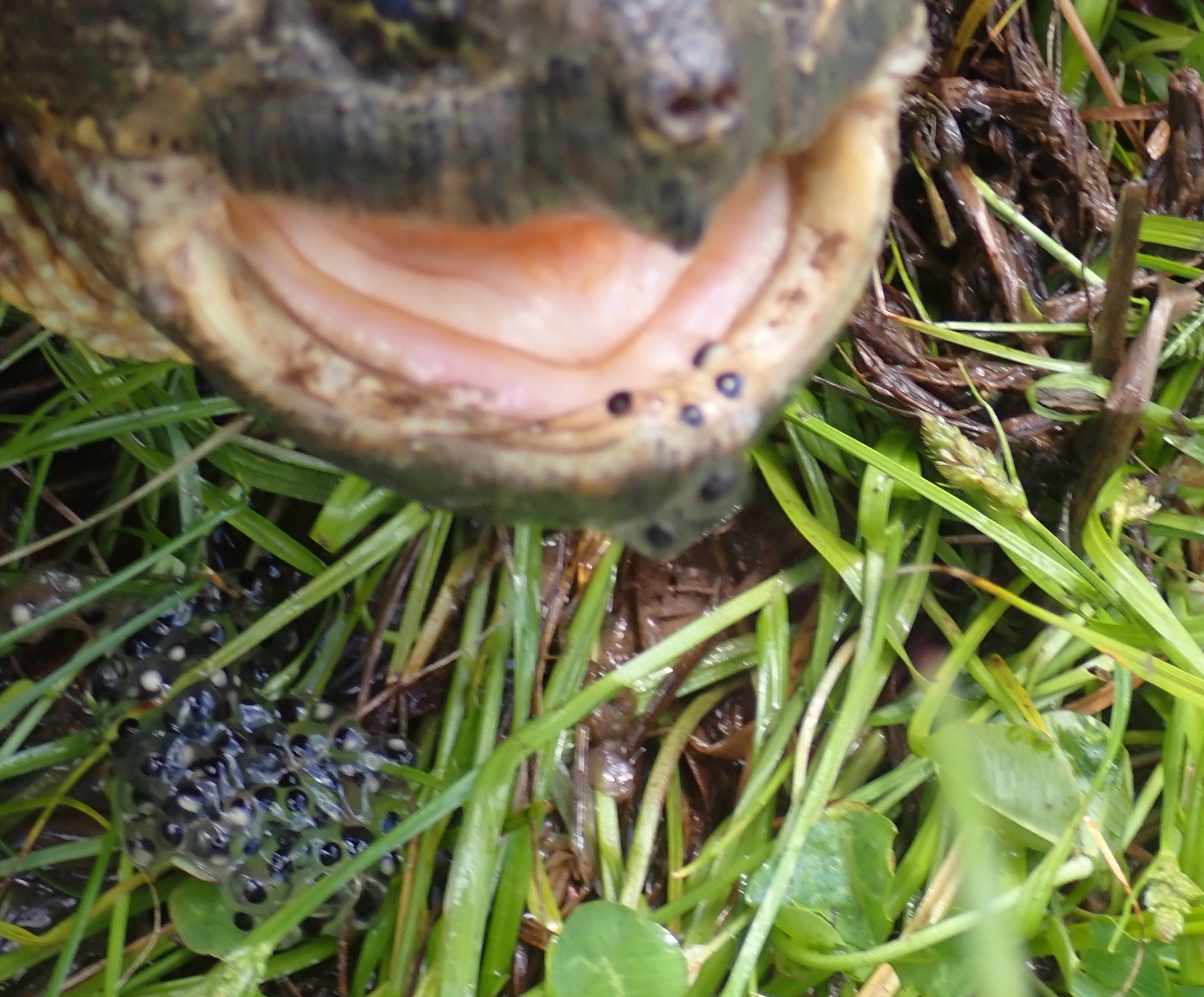
out with a hiking stick it opened its jaws
to attack and out rolled hundreds of frog
eggs!

It has been a big year for snappers.  Besides the 10" snapper mentioned above, our stream ecology team found two others crossing the field.  At the other end of the size scale, our neighbor girls June and Kate found this little baby snapping turtle far away from the water.


MDC Discover Nature describes the young turtles as, "the upper shell has 3 rows of
low keels, but these are less apparent in older individuals." You can see this in the
one we found on the path at the Springfield Botanical Garden. It was motionless
and thinking it was dead I put it in my shirt pocket to take to the 5th grade WOLF
School. We left it on the kitchen counter over night (I married the right woman, a
saint) and the next morning we found it on the family room carpet 15 feet away,
crawling to freedom. We named him Lazarus and after its classroom duties it
returned to pond life.

There is a high infant mortality for eggs and young turtles as lot of nature has a taste
for them. Skunks, crows, foxes and raccoons are common predators of eggs and
young as are great blue herons, bullfrogs, hawks and snakes. The adults make up
for that high attrition by longevity. The snapper's life span in nature is uncertain but
one mark/recapture study documented a 100 year old specimen.

I was surprised at how far away from water we found them but this isn't uncommon.
They can travel a long way from water and females can hold sperm for several years
as necessary! Combining this with their ability to hibernate under ice for 6 months in
northern climes and we have one tough mama!

My first encounter with a snapper was in 1997, long
before I had any nature education. We found this one
crossing the field headed toward the creek. I had
been told that they could "wipe out a fish population"
and foolishly we shot it. We then turned the carapace
into a wall light sconce and are continuously reminded
of how important getting the right information about
wildlife can be for humans and other animals.

Another important lesson is picking up a snapper by
the tail can cause serious internal damage to the
turtle. Picking it up by the shell may provide a painful
lesson on how far it can extend its neck. Knowing
what I know now, I now would limit my contacts to a
camera like this one back in 2013.

More details at Wikipedia.

Wednesday, May 3, 2017

Baby Snapping Turtle


We were walking around Lake Drummond at the Botanical Center after the big rains.  There was occasional small debris on the sidewalk, including this indistinct brown patch which a sharp eyed friend noticed was a baby turtle.  I picked it up and since it didn't move we pronounced it dead.  I put it in my shirt pocket to take to the WOLF class.


Back at home Barb put the body on a counter top so our dog wouldn't get it. The next morning she found it on the living room carpet 25 feet away and saw some motion in its tail.  We revised its prognosis and moved it to a makeshift aquarium that previously contained margarine.

This is a common snapping turtle (Chelydra serpentina), likely a hatchling from last fall although on rare occasions they won't exit their ping pong ball size shell until spring.  A newborn averages one inch long and ours is 1.3 inches.  The carapace (top shell) has rough ridges in a young turtle that will become smooth over several years. 


The head is relatively large and triangular with a pointed nose.  From the side you can appreciate the curved parrot beak.  It has no teeth but doesn't need them as the wide jaws and bony beak have lots of clamping power.  The ventral view of the carapace below shows its rough surface that will become smooth with age as it drags if over the ground.

Ventral view of plastron and triangular head
Snapping turtles are omnivores, eating mostly animal matter in the winter and switching to aquatic vegetation when the waters warm up.  We are trying this one on leaf spinach until we get some meal worms tomorrow.  Meanwhile, under a desk lamp for warmth, it is now stretching out and relaxing.

We only picked the turtle up in the park because it was "dead." After its visit to the WOLF school it will be back in the wild this weekend, hopefully basking in the sun.

Past adult snapping turtle blog

Tuesday, October 3, 2017

WOLF Grasshoppers


The WOLF class field trip to Bull Creek last week had us talking about riparian tree identification and why trees are important.  As fascinating as I am sure the 5th graders found our insights, they couldn't compete with grasshoppers.  One hop and they were off and chasing them like a dog on a rabbit.

This drab gray grasshopper that fell prey to the quick WOLF hands is the Carolina grasshopper, Dissosteira carolina.  This is one of our largest grasshoppers and is commonly seen on bare ground like the gravel road we were walking.  Their slow and lazy flight may be mistaken for a butterfly.  They are easy to see in flight but are camouflaged on landing when its outline can disappear.


The brown grasshopper above especially caught my eye.  This is the autumn yellow-winged grasshopper, Arphia xanthoptera.  It may look drab but wait until it takes off.  It produces a crackling-snapping sound in flight called crepitation. The yellow-orange underwings flash brightly until it lands, then the grasshopper disappears in the ground colors.  Males may do this to attract females.

The flash of color is a trick similar to the goatweed leafwing butterfly when it lands and suddenly becomes a dead leaf.  Strangely enough, this bright color is an effective trick to fool predators.  The white tail of a cottontail rabbit or a deer works the same way.  Focus on the tail and when it suddenly freezes with its tail down, our eyes are still searching for the white flag.  Dirk Seemann's research on this trick is described here.

Postscript
This post prompted my buddy George Deatz to sent the picture above of a really cool grasshopper his daughter Leslie photographed in Nixa.  This is a  Pine Tree Spur-throat Grasshopper, considered rare by those hunting grasshopper but occasionally found by us amateurs wandering around with cameras.  Good shot, Leslie!  

==========
Thanks to Bugguide and Brandon Woo, an undergrad at Cornell and fellow bug nerd, I was able to get a quick identification of these species.  Bugguide volunteers monitor the photographs coming in for identification and make life much easier for me.

Saturday, February 12, 2011

Noisy Caterpillars

Image via Live Science video
When the Huffington Post writes about caterpillars, you know the story "has legs".  It turns out that caterpillars can be noisy - we just hadn't been listening closely.

Initially reported online in the Journal of Experimental Biology by Jayne Yack and Veronica Bura,  Live Science describes research on Walnut Sphinx caterpillar's ability to whistle.  Unlike a wolf whistle which is used to attract mates, these creatures use their whistle to ward off predators.

The Walnut Sphinx Moth is "highly common across Missouri with limited appearances in certain portions of other states east of the Rocky Mountains.  Like some other moths, the adults do not feed, living only long enough to breed.
Walnut Sphinx Moth- Wikimedia

How does a caterpillar whistle when it doesn't have lungs?  They use their spiracles, small holes in their sides where they get their air.  By applying latex to each pair of spiracles, researchers found that the eighth pair are the noisy ones.

Some silk-moth caterpillars make a clicking sound by snapping their mandibles together, warning off predators.  Suspecting a similar motive in the whistles, Yack and Bura put walnut sphinx caterpillars in cages with birds which eat them.  When the birds approached, the caterpillars whistled and the birds backed off.  No caterpillars were harmed in these experiments (besides scaring the whistle out of them.)

Other caterpillars defend their territory by scraping their rear ends (called "anal oars") against leaves, making a sound to announce their territory.  (I am not going there.)

The recording in this LiveScience video probably won't make the Grammys, but it does prove that the walnut sphinx caterpillars aren't just whistling Dixie.

Sunday, January 31, 2010

Witch Hazel

Out for a ATV cruise in six inches of snow, my face masked against the twenty degree wind, the last thing on my mind was looking for blooming flowers.  Barb had me stop at the creek crossing, and sure enough, there were tiny yellow petals with a red base, clustered on bare shrub branches.  It was Ozark witch hazel announcing the beginning of a new year.
Witch hazel come in two varieties in the Ozarks, shrubs which rarely grow into small trees and tend to be found growing in gravel and rocky stream beds and along streams.  These are Ozark witch hazel (Hamamelis vernalis) that Barb planted several years ago along the graveled riparian edge of Bull Creek.  The scientific name is unusually descriptive.  Hamasmelis means "together with fruit," describing the unusual appearance of next year's leaf buds appearing at the same time as the flowers and fruit.  It is also called Winterbloom in honor of the flowers which can appear on the bare stems in the dead of winter.  The species vernalis or 'spring' refers to its being the first woody species to bloom in the year.
It's cousin, Eastern witch hazel (H. virginiana) is the last woody species to bloom in the year, late fall or early winter.  Its flowers are yellow and the petals are longer.  The fruit of both species form a hard woody capsule which splits open in the fall, about eight months after flowering, ejecting one or two hard black seeds "forcibly discharged to a distance of up to 30 feet."*   Another name for the shrub is "Snapping Hazel".
You may have come across "witch hazel" on the pharmacy shelves.  An astringent compound extracted from the leaves and bark is used in aftershave lotions and to shrink hemorrhoids, (although thankfully in totally separate compounds.)

A good gallery of pictures can be found at the bottom of this Wikipedia page.
*Kurz, Don, Shrubs and Woody Vines of Missouri, 1997

Thursday, February 12, 2015

Witch Hazel 2015

Ozark Witch Hazel- Hamamelis vernalis
Cruising around the valley yesterday, we stopped to appreciate the flowering Ozark witch hazel in full bloom.  The upper blossoms were just past prime while the lower branches held freshly emerged petals.  The grove is densely clustered and its fragrance filled the air.

I read Peter Longley's entry in the Springfield Botanical Garden News, and decided to share it in its complete form with his permission.
"The genus name, Hamamelis, literally means “together with fruit” referring to the simultaneous occurrence of the flowers with the maturing fruit from the previous year, in very early spring or latter winter. The seed capsule splits explosively at maturity, ejecting the seeds with great force to a distance of up to 35 feet. This is why, sometimes, witch hazels are called ‘snapping hazels.’ Although we think of the witch hazel as a winter plant, it is found all down the eastern half of North America, from Canada to Florida, so it is not winter’s cold that governs its cheerful winter blooms, but a seasonal phenomenon.

The witch is not related to the flying broomstick, and nor is the hazel related to the popular nut. Witch comes from the Middle English wiche, in turn from the old English wice, meaning pliant or bendable. Hazelnut twigs are also pliant and were commonly used in England as divining rods to find sources of water. There was a certain mystique and magic to a divining rod that some associate with those who possess magical powers, and it is more likely that the witch on the broomstick, got her name from the water diviner and those mysterious pliable hazel twigs. American colonists on finding that the Hamamelis twigs had the same pliable use for water divining along the Eastern seaboard of the Americas, called the Hamamelis twigs ‘Witch Hazel.’ It was also learned that the Hamamelis was used by Native Americans for many medicinal purposes, which is why to this day we associate Witch Hazel distilled from the leaves and bark of the Hamamelis virginiana, which actually blooms in the fall, as an astringent and healing balm."
Witch hazel is still used as a herbal medicine, mainly externally on rashes, sores, bruises, and swelling. For the rest of us, the blossoms are a sign that spring will soon heal the natural bruises of winter.

* From the Springfield Botanical Garden News. If you would like to be added to the list for direct distribution of this blog to your e-mail inbox send a note to Peter Longley, plongley@springfieldmo.gov. 

Wednesday, July 6, 2011

Ha Ha Tonka Foray

Dennis Snapping a Russula- Jon Rapp
This last Saturday, like any other individuals of sound mind, we elected to "Foray" with the Missouri Mycological Society (MOMS for short) at Ha Ha Tonka.  A hundred degree heat index won't stop this intrepid bunch, especially as mushrooms tend to grow best in the shade.

So what is a foray?  The Free Dictionary.com says:
1. A sudden raid or military advance.
2. A venture or an initial attempt, especially outside one's usual area
3. v.tr. Archaic  To pillage in search of spoils.
These definitions are right on as (a) Barb and I were definitely outside of our usual area, and (b) mushrooms frequently grow on the spoils of nature, i.e. decaying wood.

The MOMS members were a good-natured bunch, friendly, generous to a fault, full of information and suffering fools gladly (that would be us).  Our mentors, Jay Justice and Chris Crabtree shared their knowledge without flaunting it and all the members guided us gently through the mysteries of mushroom I.D.
A few of the pearls of wisdom:
Bunch of Basket Cases
  • Russela mushroom stalks snap like chalk with a sound to match.
  • Sniff every mushroom-  don't taste.
  • Walk through the woods like a beagle, eyes to the ground.  They found four times as many as I did.
  • Carry a basket to carefully store your collection.  Yeah, it feels funny at first, but it works.
After 3 hours of scouring the woods, we met back in camp to spread out our treasures.  Next came the identification process, a restrained, intellectual, academic discussion of the fine points to pinpoint the exact species (i.e. friendly arguing).  Actually, while this was going on, most of us were sitting in a nearby stream cooling off.

Camping Stan, the man with the fan
We missed much of the camaraderie and food as we wimped out in a motel rather than roughing it.  Roughing it may be a little strong, as Stan had a tent larger than our Comfort Inn room.  Staying in a motel and eating pizza was our loss as MOMS come to eat with great dishes to share brought from home.  This may be the real reason for the foray. 

There is a lot to learn to even catch up with the newest members, but they never gave up on us.  I doubt that I will ever become expert at identifying and naming most of the mushrooms- I struggle with remembering Barb's name some days-  ("Just call me Sweety").   But if you enjoy a walk in the woods with like souls, MOMS may be for you.


Check out the MOMS designated photographer, Jon Rapp's, pictures at flickr.com and find more information on MOMS at http://momyco.org. 

A Springfield chapter has been formed.  Read about it at momsspringfield.wordpress.com.  There may be fungi in your future with fun guys and gals.