Saturday, December 13, 2014

Admirals of Winter

Red admiral - Wikimedia
A recent article in the News-Leader described the adventurous life of the red admiral (Vanessa atalanta).  It serves as a reminder of many ways butterflies, these seemingly delicate creatures, survive the winter.  Many of our common butterfly species overwinter as eggs, larvae (caterpillars) or pupae (chrysalis).

The red admiral will migrate north in the spring but not all migrate back south.  Some will hang around, taking their chances on surviving a mild winter.  Like the mourning cloaks and other species living over winter as adults, they don't depend on nectar for their food source.  Instead they primarily consume tree sap, rotting fruit, carrion and animal dung.  They commonly land on humans, presumably attracted to sweat - if one lands on you try not to think about what it ate last.

Dorsal view - Wikimedia
A few other species* such as goat weed leaf wings and mourning cloaks always tough it out as adults, hiding under the bark of trees or other shelters, emerging on rare warm days to stretch their wings and grab a bite before hiding again.  They tend to have drab ventral wing surfaces which blend with the tree bark while resting.  While the red admiral dorsal wing surface is vividly colored, when the wings are folded up, the under wings provide good camouflage.

Camouflaged red admiral Vanessa atalanta roosting on larch trunk © Adrian Hoskins
Some butterfly species migrate as cold weather comes on and their food sources dwindle.  The monarch butterflies famously have several broods as they move north, the last hatch returning all the way to Mexico.  Other migrating butterfly species travel shorter distances, heading north a few hundred miles in the warm months, then returning to the mild weather of the southern states in late fall.  In England, in addition to migrating, there is evidence that the red admiral can occasionally lay eggs in the autumn with adults emerging in the spring.

Yes, England!  They are found in temperate Europe, Asia, and North Africa.  The British love their butterflies and are particularly fond of red admirals.  Some of their population migrates from Southern Europe while recent studies have shown that some survive the winter as adults in southern England.  Southern European residents will migrate to Scandinavia while some North African butterflies will cross to Southern Europe.

Green eggs laid on spiky nettle leaf rather than ham.  Wikimedia
Leaf-wrapped chrysalis -Wikimedia
Eggs are generally laid on nettle leaves in the spring, with a second batch in late summer.  The caterpillars roll leaves around their body as protection until they eat their shelter and move on and wrap up in another leaf.  The hairs of stinging nettles probably provide protection from some predators.  Unlike most leaf rolling larvae which tend to pupate on the ground, the red admiral pupates within the rolled up leaf.

* Missouri species that overwinter as adults include the American lady, anglewings (commas and question marks), goat weed leaf wing and mourning cloaks.

Wednesday, December 10, 2014

Frass Flinging Caterpillars

Silver-spotted skipper caterpillar with brown head - Chris Barnhart
As I am a retired gastroenterologist, Chris Barnhart knew he could hook me with this video of his showing a caterpillar shooting out its frass. Many animals have special ways of eliminating their fecal matter, called frass when produced by insects, to reduce disease or avoid predators.  Epargyreus caterpillars simply go ballistic.

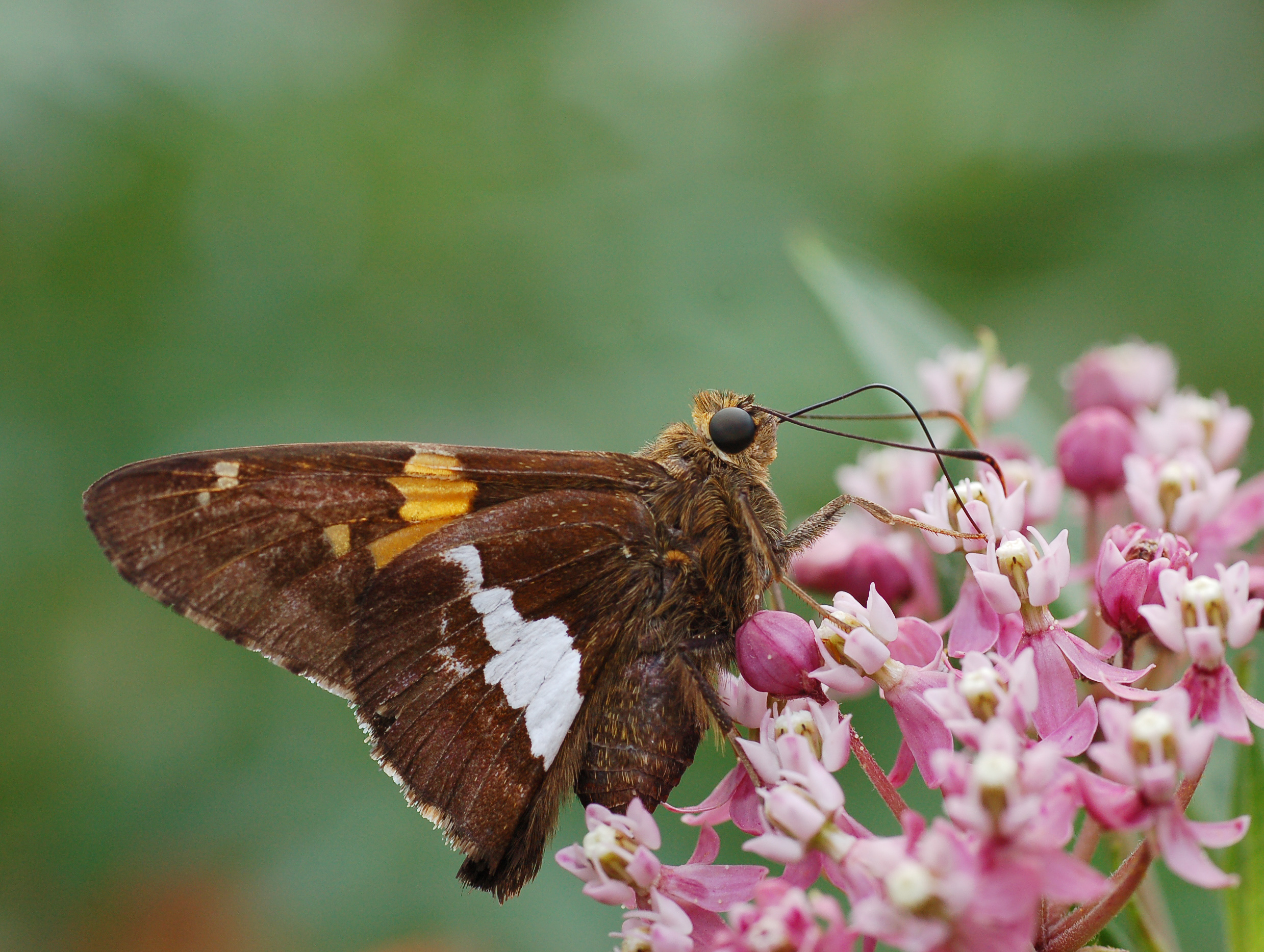
http://upload.wikimedia.org/wikipedia/commons/9/99/Silver-spotted_Skipper_Epargyreus_clarus_Milkweed.jpg
Silver-spotted skipper - Wikimedia
The common Epargyreus species we see in Missouri is the silver-spotted skipper, Epargyreus clarus. They are regularly found throughout the warm months nectaring on a wide variety of flowers. Its caterpillars feed on a wide variety of plants in the pea family, ranging from the beggar's ticks (tick trefoil) that cling to your clothes to the black locust tree that can exceed 100 feet tall.

Cocked and ready to fire
Our silver-spotted skipper can use its anal comb to shoot its frass "faster than a scat out of hell," to quote Chris. It can fly up to an astounding 38 body lengths away. (Yes, some one actually has measured its record launch - and you thought filming it was odd). It is not alone in long-range bombing. There are videos on line of frass-flinging Asian caterpillars like these of Mycalesis mineus, Ypthima pandocus and.....oh well, you get the picture. 

Frass flinging is commonly found among caterpillars that live in leaf nests. Why do they bother? This is felt to be a defensive mechanism to eliminate the smell in the nest which would be a clue to predators, specifically the northern paper wasp, Polistes fuscatus as described in this study.

More stories of scat disposal and frass chain building caterpillars in future blogs.

Monday, December 1, 2014

Mobiles from Nature

Everyone is a nature artist
Fall is a good time to create nature mobiles.  We first tried this activity on our favorite guinea pigs, the WOLF School.  This turned out to be a great 5th grade activity which combines nature and the study of mechanics.

We began by having the students comb the fields and yards, looking for colorful nature finds such as nuts, seeds, berries and leaves for elements to hang on their mobiles.  It can also include fishing lures (no hooks!), shotgun shells, rocks with fossils or holes, etc.  The nature hunt is half the fun.


The classroom session begins with a brief lesson in the mechanics of levers, including fulcrum, load and effort.  We use a broom with a sliding rope fulcrum to demonstrate the principles of balance.  The goal is for each one of them to create a balanced mobile and learn how to adjust it and add on more elements at home.

Finished! Click to enlarge
The beam of the mobile to the right is made from a box elder branch but almost any stick will do.  Some students used sticks covered with thick  lichen, an indicator of the clean air of the area they found it.  A thread tied to the middle of the beam with a slip knot allows adjustment of the 'fulcrum' - a word they are asked to repeat.  They make their own elements which can be tied with a thread or attached with a hot glue gun.  This student included elements like acorns and their caps, a sweet gum seed ball, pieces of turkey tail fungus, buck brush berries and a turkey feather.


As they build their mobiles, we ask them about food chain relationships such as  "What eats the acorns?"  Answer: deer, turkey, weevils, etc.  We had lots of honey locust seed pods with holes in them where the honeylocust bean weevil larvae had crawled out.  "What eats the larvae?"  Answer: spiders, beetles, birds etc.  " Is that good or bad?"  Answer: it depends on whether you are a tree, a bird or the larva.

The choice of elements is limited only by  imagination.  Hook-less fishing lures, empty shotgun shells, snail shells and fossil rocks, everything is fair game.  Next year we are going to add colorful card elements where they can write the answers above to include on their mobiles, or even a picture or photograph.

Tuesday, November 25, 2014

Calliope Hummingbird

Late visitor at the feeder - Greg Swick
Greg Swick sent a story of an uncommon visitor to warm your heart on a cold day.  This played out on his Facebook page during the cold snap around November 16th.  The main character in this drama is a calliope hummingbird (Selasphorus calliope), the first report of this species in Christian County.  The first photographs are by Greg who apparently developed the trust of his subject who we will name Cal.

Cal posing head on - Greg Swick

Little Cal rests by leaf buds - Lisa Owens 
So what is a hummingbird doing, hanging around in the cold?  Aren't they supposed to be south by now?  Greg posted a good discussion on this which I will steal word for word.
"First of all, birds don't migrate because of cold weather. They migrate in search of food, open water, or appropriate habitat for breeding. In the case of southward migration this time of year, they are in search for adequate food and water. 
Calliope hummingbirds are a very hardy, temperate species that nest as far north as the British Columbia Rockies at altitudes from 4 to 11,000 feet. They are commonly exposed to the elements, so the cold temperatures do not bother them. They have evolved and adapted in cold/cool climates and torpor is frequently used to survive overnight or even during the day in extended cold, precipitous weather events. 
We have long suspected that many NW hummingbird species migrate through Missouri regularly. In Christian County alone, we have had Anna's, rufous, and now calliope in the late fall/winter months.
It is important to note that calliopes are increasingly wintering along the Gulf coast, so it is highly likely that this bird is simply on course and, actually, not even aberrant in timing. We just don't know much about it.  It might even be following a migration route that many others of its species have followed from the Rockies to the Gulf of Mexico. That's why it's so important to document these species, and contribute the data to the global avian database."
Wikipedia has more in depth information about calliopes.  Although we tend to think of hummingbirds as nectar feeders, they also consume insects and tree sap when available as well as Greg's sugar water.  Seeing an uncommon migrant is a real treat and it was fortunate to have visited Greg where it would be recognized as uncommon.

Final approach - Greg Swick
Calliope was the daughter of Zeus like many of the characters in Greek mythology.  At last count he had 43 divine offspring as well as many semi-devine and human progeny.  He was so busy fathering that he barely had time to run things, which may be the reason there was so much conflict and wars.  Among his offspring were the nine muses of the arts, including Calliope, the Greek muse of poetry.  Her name is pronounced Kal-yo-pee, although our hummingbird is pronounced like the familiar circus musical instrument. 

Doug Hommert takes a shot - Greg Swick
I suspect that Calliope was also the muse of photography.  Greg invited birders to come by his house to see the bird, even when he was gone.  Soon they were coming from all over the state.

This bird's rarity quotient brought in birders far from our region.  Now the guest register is over 100, and most recent guests were from Austin, Texas, Indianapolis, and a visitor from NYC.  Calliope must be the most photographed single hummingbird in Christian County history.

Unlike hunting rabbits and deer, with birders there seems to be an inverse relationship between the bird size and lens length.  Whether it is a camera or a magnifier or microscope, the smaller the "game," the bigger the lens or microscope.

Photo by Peter Kondrashov 
Many naturalists enjoy the thrill of the hunt and bagging an image.  Whether we are birders, bug people, or those who are foraying for mushrooms, we have a need to capture our own picture even though the "hunter" next to us probably has a better photograph.  In this case we can blame Cal, the Missouri muse of the camera.

Thanks to Greg and the other birders, from KC (Lisa) and St Louis (Doug) and Kirksville (Peter)  for the photographs.
Note:  Article amended to add new information of the wide range of birders coming to view Cal,
Greater Ozarks Audubon Society supports GLADE.

Monday, November 24, 2014

Mapping Carbon Dioxide

A recent posting on Ecowatch.com began with, "While most of us—and virtually all climate scientists—won’t deny that the carbon emissions driving climate change are real, they’re still abstract." Atmospheric carbon isn't something you can see or hold and as a non-point pollutant it is impossible to trace where it goes. Or is it? 
Ecowatch.com has posted this this 3 minute video of a supercomputer model of data which gives a vivid demonstration of both CO2 and carbon monoxide pathways in the atmosphere.  As you might expect by thinking about where major population centers and industry are located, much of the CO2 is swirling above the northern hemispheres.  I found the seasonal variation especially interesting, showing the effect of carbon absorption by plants in the growing season.

Don't waste any further time reading this, just click on the video.  The billowing CO2 is both beautiful and disturbing.

Thursday, November 20, 2014

December Phenology 2014

Phenology - the scientific study of periodic biological phenomena

By now the male black bears will be denning up, usually a few weeks after the females.  Black bear cubs are born this month but you will never know it.  They are curled up in dens and the mothers will be sleeping through much of their nursing.  Human mothers, eat your hearts out!  The cubs won't make their debut for another few months.


Red squirrel drey
When winter weather is cold and wet with icy winds, squirrels will gather in their leafy dreys nestled high in tree forks; this is to conserve energy. Yet late December brings mating season when males can be seen chasing females, as well as chasing off other suitors. This ritual of chasing, occurs through the trees at top speed, performing some of the most breathtaking acrobatics imaginable.
 

Christmas fern is the largest of the evergreen ferns in our region.  Snow may flatten its fronds to the ground, but once the snow melts, the Christmas fern will reappear in all its green glory.


Barred Owl
- Wikimedia
Barred owls call "Who - Who cooks for you - who cooks for you all?"  Courtship begins in early December and although owls are more elusive to see at this time, their courtship “hoots” can be heard.  Two to four eggs will be laid in hollow trees or hawk nests in February or March.

Great Horned Owl - Greg Hume

Great horned owls' courtship "hoots" can also be heard beginning in early December.  Less common than the barred owls, you may want to refresh your memory of their calls.  Listen to this "Hoo  Hoo-hoo    Hoo-hoo." After mating they will adopt an unused hawk or eagle nest and lay one to six eggs in January or February.


Shelf or bracket fungi that grows on trees, stumps and fallen logs are very much part of the winter scene as they are very obvious and attractive when the foliage is off deciduous plants.  Look for the various colors of tan, brown, pink and rust found on the top surfaces.
White crowned sparrow- Wikipedia
Dark-eyed junco - MDC

Don't forget to stock up on bird food.  Winter is when the insects and fruits get scarce and nutrition is important for overwintering species.  All the usual suspects will show up at the feeder but be on the lookout for some winter species.  Dark-eyed juncos return, not dramatic in color but they make it up in "cuteness." You might also spot a white throated sparrow, visiting for a Christmas vacation.  They breed in Canada and come to "snowbird" in Missouri.

Bats Jamming for Food

Mexican free-tailed bat - Wikimedia
In a previous blog we discussed how tiger moths elude bats by jamming their sonar. Bats have poor eyesight and hunt by echo location, sending out high pitched sounds that bounce off objects.  They can judge the size and speed of prey with this.  Tiger moths can produce a series of high speed clicks that confuse the bats.  "Since the attack sequence of a bat lasts less than a second, the moths have to react fast.  Fortunately, the moths can produce up to 450 clicks in one-tenth of a second."*

While studying this phenomenon, this same team of scientists discovered that bats can jam the signals of other bats competing for their prey.  A story from  Livescience.com reports that William Conner, a biologist at Wake Forest University, discovered a strange sound that Mexican free-tailed bats made only when another bat was homing in on a moth they were competing for.
"Competition for food can be fierce, and Mexican free-tailed bats emit a special call that can interfere with the sonar of other bats that are pursuing a meal. "They get into amazing aerial dogfights," said study leader William Conner, a biologist at Wake Forest University in Winston-Salem, North Carolina. "One will jam the other, and the other will jam back."
The bats would produce a "terminal buzz" just as they were about to capture their prey.  When the researchers played the interference sound, the bat was 86% more like to miss the prey.  Do other animal species use similar tricks?  Stay tuned for further research.


Other news from the bat world highlights the danger of wind turbines to bats.  They are apparently drawn to them by confusing them with very tall trees.  Birds face their greatest danger when the blades are turning at high speeds.  Although they look slow as we drive by them, the tips of the blades reach between 138 to 220 mph.  Bats are attracted when they are moving slowly, apparently avoiding the high speeds which create greater air turbulence.  Details at this link.

* More on moth jamming bats at Discovermagazine.com.