Monday, September 14, 2015

Twice-stabbed Bug

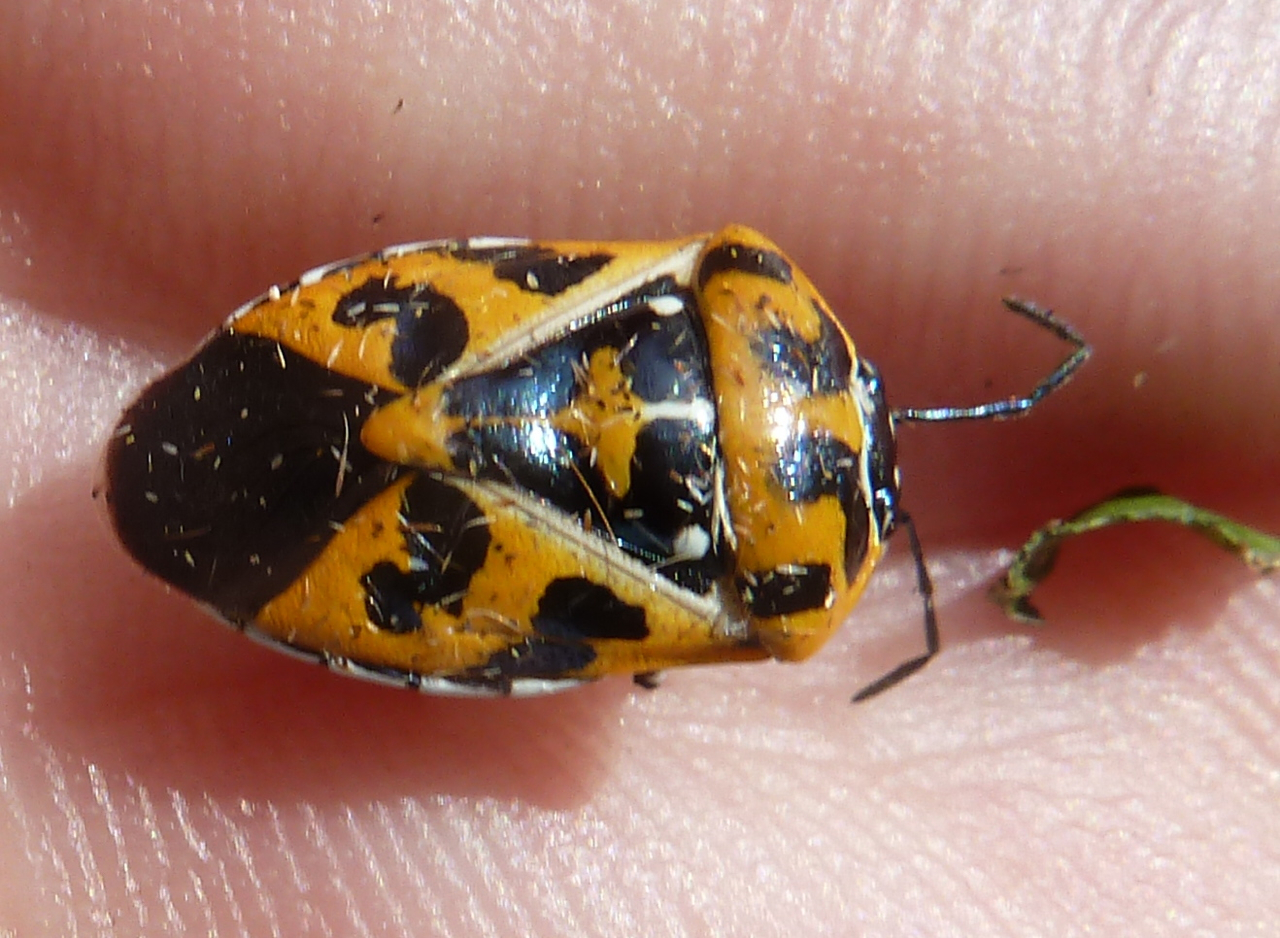
Twice-stabbed stink bug on my fingertip - REK
I recently visited with Kelly McGowan, the Horticultural Educator for the MU Extension.  She gave me several tiny black bugs from the Botanical Gardens to confirm her initial identification.  By photographing them close up we could confirm that they were the twice-stabbed stink bug, Cosmopepla lintneriana.

M. histrionica - REK
C.  lintneriana is sometimes referred to as the wee harlequin bug.  This is a nod to its coloration and shape, somewhat reminiscent of its larger cousin, the easily recognized harlequin bug (Murgantia histrionica).  It is a member of the
Pentatomidae or stink bug family, and if threatened or handled it puts out a noxious odor.  You need to sniff your fingers to get the full effect.

Twice-stabbed orgy, note yellow eggs below - MJ Hatfield
Both species guard their egg clusters after placing them on host plants.  As you might guess, a bug named "wee" has tiny eggs.  MJ Hatfield has some exceptional photographs of them in Bugguide.
 
Emerging from egg - MJ Hatfield
MJ Hatfield


Eggs are laid in clusters on a variety of host plants including mint, echinacea, asparagus and goldenrod, and the adults hang around to guard them.  The adult bugs overwinter beneath the leaf litter.

Mating end to end - REK
They are dietary generalists, their sucking mouth parts working on a wide variety of plants and fruits, including grapes, columbine and raspberry.  They are specifically fond of the Verbascum family which includes the exotic mullein, Verbascum thapsus, so they get a 4-star rating from my wife, the Invader Crusader. 

They may produce surface discoloration on some fruit but don't usually cause significant damage to plants and are not considered an economic pest.  


MJ Hatfield generously shares his photographs by Creative Commons.  If you put photographs from nature on the web, consider sharing them with others with a Creative Commons License.

Thursday, September 10, 2015

House Centipede

House centipede
I received this photograph from friends who wondered if they should be alarmed about its presence in their house.  This is the common House Centipede, (Scutigera coleoptrata), and although it won't harm them, the news is mixed.
My what big fangs you have! S. coleoptrata - Stan Gilliam from Bugguide
Most important to know, although all centipedes come equipped with poison glands connected to their fangs to subdue their prey, you are not on their menu.  In the unlikely event that you wanted to pick one up you might briefly have some mild pain from a bite.  They normally feed on silverfish, beetle larvae, spiders, cockroaches and other arthropods.  They like dark moist places with food and if you see multiple centipedes you probably have lots of their prey in your house.
  Elizabeth Dauch
They are thought to originate in the Mediterranean, were first found in Pennsylvania in 1849 and are now found throughout the world.  They tend to remain motionless for long periods of time, only to suddenly dart ahead at startling speed, enough to "bug" the average homeowner.  I found this 1902 description from USDA entomologist, C.L. Marlatt.
“It may often be seen darting across floors with very great speed, occasionally stopping suddenly and remaining absolutely motionless, presently to resume its rapid movements, often darting directly at inmates of the house, particularly women, evidently with a desire to conceal itself beneath their dresses, and thus creating much consternation.”
Sexist references aside, the adult measures 3-4 inches in length from legs to antennae tips and is a formidable addition to your bathroom, enough to "cause consternation" for most homeowners.  Newly hatched larvae have only 4 pairs of legs and will accumulate another one or two body segments, each with another pair of legs through five larval molts.  It will have another 4 molts with 15 pairs of legs before reaching adulthood.  And humans think they have trouble keeping their kids in shoes!

If having these around the house bugs you, read the suggestions for control in the PSU Extension factsheet.
To study one up close go to this Wikimedia link and continue to enlarge the photograph.

Tuesday, September 8, 2015

Texas Wildflower in the Ozarks


Texas Native Wildflower Takes Root in the Ozarks
By Jennifer Ailor, MN

Several years ago I spotted a new wildflower along my heavily shaded driveway. It was spindly, growing right at the base of an oak. But it was loaded with heavy, bright yellow, trumpet-shaped flowers that bowed it almost to the ground.

I couldn't find anything close to it in various books on Missouri wildflowers. Then, in 2012, a friend near Stockton sent me a photo of the exact same flower growing in a fringe area of a pasture that her husband couldn't brush hog. It was the same flower except hers was bigger and clearly loving the sun. Each bloom lasts only about a day.

With the help of Greene County Extension's Patrick Byers, who had never seen the flower before, we determined it was Esperanza Tecoma Stans, more commonly known as Gold Star or Yellow Bells. It's a native of central and western Texas, does very well in dry and drought conditions, is deer resistant, can grow to 15 or 20 feet and in the right conditions blooms May to frost. The sources I checked said Zone 8a is about the northern reach of its territory, but I'm in 6a, and my friend is even further north.

Right now (early September) my plants are blooming, after a hiatus of several years. I'm going to collect some seed and plant them in a sunnier location where, more true to type, they should bloom all summer. Or I may just order a plant from a nursery, such as davesgarden.com. Either way, I'm adding Esperanza Tecoma Stans to my flower garden.

The natives of Texas and Mexico have used T. Stans for making bows, bee fodder, and even made a type of beer from its roots.  It was also used as a medicinal herb in treating diabetes, stomach cramps, and for intestinal worms.  Native to Texas, there are now several cultivars developed for the commercial market so it is unknown if they have migrated northward with the warming climate or were planted here and escaped.  Texas A&M Extension.

Monday, September 7, 2015

Emerald Ash Borer Update

Emerald ash borer - Leah Bauer USDA Bugwood
Emerald ash borer (EAB) has been cropping up in new locations across Missouri as seen in the map below. You may recall from a previous blog or other publications, this is a serious threat to our ash trees, capable of nearly wiping out the species similar to the attack of Dutch elm disease in past decades. It is spread by moving wood such as firewood into unaffected areas.
First found in the US in 2002, the EAB, Agrilus planipennis, is naturally found extending from eastern Russia to China and Japan. It likely arrived in shipping materials and first was found in Michigan. With time it has spread through the eastern US.
Emeraldashborer.info
The tiny beetle itself is rather beautiful although seldom seen. After emerging, it nibbles a few ash leaves for a week, mates and then lays 40-200 eggs in ash bark crevices and cracks. When the larvae emerge they chew their way under the bark, tunneling into the tree's underlying circulatory system. The larva will go through 4 stages (instars) over weeks before pupating. When the adult beetle emerges, usually in the spring, it chews a characteristic D-shaped hole and then flies up into the tree to start the cycle again.

Larval Tunnels - USDA
The larval tunnels in the cambium under the bark gradually disrupt the vascular system, blocking the flow of phloem (delivering photosynthesis-derived nutrition from the leaves to the rest of the tree) and xylem (carrying water and minerals upward from the roots). The tree slowly dies from the top down.

Prevention is the best answer by not transporting infected ash wood, usually as firewood carried by unsuspecting campers. There are treatments for individual urban trees but none for our forests in general. MDC has published a new four-page guide called the Emerald Ash Borer Management Guide for Missouri Homeowners. The guide can be found at this link.

Comprehensive current information is on this Wikipedia site.

Friday, September 4, 2015

An Aphid, an Ash and a Mushroom


Mark Bower found this unusual mushroom in the woods above Bull Creek.  It is unusual in that its stem isn't centered in the cap but more off to the side.  He identified it as Boletinellus merulioides, a bolete fungus that is found around ash trees this time of year.  Most mushrooms associated with particular trees are mycorrhizal, living in symbiosis with tree roots.  They absorb minerals from the soil and exchange them with the tree for nutrition the tree produces by photosynthesis.  Not so with B. meruliodes, which makes its living off of aphids!

   Wikimedia
Meliarhizophagus fraxinifolii, the "leafcurl ash aphid" creates a curl in emerging ash leaves and lives there while parasitizing energy from the tree.  Like many other aphids, the ash aphid produces honeydew but it also secretes a protective wax that keeps it from accumulating on its body.  The B. meruliodes fungus mycelium forms hollow sclerotium that surround the aphids in a protective layer.  In exchange it absorbs the aphid's honeydew as its sole source of nutrition.

Leafcurl Ash Aphid - Whitney Cranshaw, Colorado State University
Whitney Cranshaw, Colorado State University, Bugwood.org - See more at: http://www.insectimages.org/browse/detail.cfm?imgnum=5445321#sthash.D3NGQM9A.dpuf
Whitney Cranshaw, Colorado State University
Honeydew is produced by aphids, some scale insects and even the caterpillars of Lycaenidae butterflies.  Some species of ants farm aphids, protecting them from harm in exchange for their honeydew.  An article in Wikipedia explains, "When their (aphids') mouthpart penetrates the phloem, the sugary, high-pressure liquid is forced out of the gut's terminal opening," an icky fact that doesn't seem to bother the fungus.  That gives new meaning to the saying "no guts, no glory."

Tuesday, September 1, 2015

Dove Impression

Final impression of a dove  -  Photograph by Nancy Kaproth
Our friend Nancy in Ithaca, NY arrived home one fall day to find this imprint on her south facing window.  She described it as "...like the Shroud of Turin - distinct features of a mourning dove who had perhaps taken a recent dust bath.  Wingtip to wingtip measurement of 18" confirmed the identification (wingspan 17-19")."

Scene of the collision  -  Nancy Kaproth
I forwarded it on to Lisa Berger who sent back this comment:
"Interesting images. All of our Mourning Dove window hit impressions have been made as the dove has taken off the ground, hitting the window almost parallel to the pane. This produces an almost full ventral mark of flight and tail feathers, so ID is easy. Some of this may be dust, but the birds have a lot of dander from feather wear and mites: Think of the stuff in our bed pillows.

This impact appears perpendicular, or head-on, so you don't get a good view of the body proportions. The bird had been airborne for a distance; could not have just taken off from the ground under the feeder. 
Did they find the body? If it was being pursued by a raptor, it may have been picked up after bouncing off the window. This is an increasingly common practice used by Cooper's Hawks. Not in the sense of intentionally driving prey into a window, so much as just not abandoning it after it hits. Flopping on the ground is probably hard to resist, too."
This is not an uncommon phenomenon.  There is actually a Flickr collection of 292 Bird Imprints on Glass.  Some dramatic images are seen here.  The cause of the image hasn't been studied but some speculate that it is powder protecting the newer feathers.  According to one source:
"The imprints are caused by the bird’s powder down, a special type of down which helps feathers to grow. In some species, the tips of the barbules on powder down feathers disintegrate, forming fine particles of keratin, which appear as a powder, or ‘feather dust’. When a bird strikes a glass pane, the powder is shaken lose and adheres to the glass."
A further description from Wikipedia:
"Some birds have a supply of powder down feathers which grow continuously, with small particles regularly breaking off from the ends of the barbules. These particles produce a powder that sifts through the feathers on the bird's body and acts as a waterproofing agent and a feather conditioner. Powder down has evolved independently in several taxa and can be found in down as well as in pennaceous feathers. They may be scattered in plumage as in the pigeons and parrots."
Bird window collisions are a common cause of bird mortality, estimated by the U.S. Fish and Wildlife Service to cause up to up to one billion bird deaths a year.  Some are merely annoying as when a cardinal or robin repeatedly attacks a window to drive an intruder (its own reflection) away from a nesting area.  Much more serious is when a bird sees a reflection of the landscape and flies directly into the glass at full speed.  The highest bird mortality occurs windows in tall building windows where light distracts the bird as described in Allaboutbirds.com.

Bonus Points
Now go back to the top picture and look for the image of a different bird, an apparent owl above the "dove's" head.  Several of us have been wrestling with this for weeks with no answer.  All of Nancy's pictures taken at different angles are at this link for you to study.  I will discuss our theories and answer some naturally occurring questions in a blog a week from now.

On the other hand you may want to skip this as it may drive you crazy also!

Natural Remedy

I can remember when Nature's Remedy was a popular laxative.  Now there is an advertisement for Nature as a cure that I can truly recommend to virtually anyone.  It is effective for SAD (Seasonal Affective Disorder), lowering blood pressure, and might even raise your Vitamin D levels along the way.

Check out their promotion in this video.