Friday, June 30, 2023

Tiny Bison?

Two-marked treehopper - Wikimedia

While looking for leaf galls I noticed a small 5mm white speck on the under surface of a tree leaf, apparently dried up and dead.  Under magnification it resembled a tiny white bison, frozen in time.  With a plunge into INaturalist and Google I came up with an answer.  This is the final nymph of a twomarked treehopper, Enchenopa binotata (EB).  EB is a species complex made up of multiple species, often identified by their host plants.  The adult is only 7-9 mm long.  As usual, a deep dive into the tiny critter's life reveals interesting quirks.

Like many tiny insects that we overlook, EB is mainly discussed as a minor pest.  Most websites focus on the minor cosmetic damage they cause to a tree in our yard.  

"Twomarked treehoppers cause damage to hop tree or wafer ash, Ptelea trifoliata, black walnut, butternut, black locust, viburnum, redbud and bittersweet."  A more broadminded nature site says "This insect rarely causes enough damage to warrant control, even though the insect itself is abundant."

The nymphs sucking up the sap go through 5 instars before reaching the "white bison" stage if found.  The feeding results in honeydew which allows the fungus sooty mold (mycelium is black) to grow and turn the plant blackish. This in turn draws ants and other insects that lap up the sweet honeydew, all part of the food web.  Egg laying may cause minor slits in the bark.

 
The University of Illinois Urbana describes its life cycle.
Nymph stages

"The twomarked treehopper will overwinter as an egg under bark. Newly hatched nymphs move to the tips of the new shoots where they extract plant sap in mass. The nymphs are brown to dark gray. After a little more than a month, the twomarked treehopper becomes an adult. 

As adults, they often line up in a row on the new shoot. Females lay eggs until August. However once egg laying starts, it will continue till the adult is frost killed. The female treehopper has a saw like ovipositor. She uses this to make a small cut in the twig. The eggs are forced through the narrow cut so that they are left under the bark. Once the egg laying for the individual cut is completed, the adult female seals the cut."

Males hookup with females by seismic communication, "substrate-borne vibrations on the stems, petioles, and leaves of their host plants that travel throughout the plant."  It is hard to imagine this tiny creature shaking a stem to make a sound but you can here it in this Wikipedia link. 

Before and after - Linda Williams MN

For more on our Missouri treehoppers, check out this MDC link.

Thursday, June 22, 2023

At Home in the Dung

On the Missouri Prairie Foundation Bioblitz, "Bug Eric" Eaton was leading an insect identification session when I found this 6mm firm lump on a leaf.  Eric identified it as a beetle egg protected by material the female beetle deposited over it. 

I cornered Doug LeDoux of the Missouri Department of Agriculture who was leading the leaf beetle walk and he gave me more information.

"It is some sort of a Chlamisine beetle in the Chrysomelidae, possibly Neochlamisus. They refer to this group as the case-bearing case makers. The case is actually poop that is deposited around the developing larva to protect it from predation and to hide it while it feeds and develops. I see these fairly often when sampling."

This may sound like child abuse but remember it is a bug eat bug world they live in.  Looking like nothing edible has survival value.  Imagine how this delicious naked larva would look to any predator.....delicious!

Neochalmisus sp - Beatriz Moisset
Now the larva lives and eats inside the case, using its own excrement to enlarge the case as it grows.  Here is how Wikipedia describes it.

"The larvae remain on the natal host plant and add to and enlarge their fecal cases as they grow. Case enlargement in Neochlamisus is an elaborate process that larvae perform regularly until the case is sealed to the substrate prior to pupation. During this stage of the life cycle, beetles are immobile and are particularly vulnerable to predation."


Neochlamisus - Wikimedia

 This is just one example of a Neochlamisus.sp. in Wikipedia.  There is a whole tribe, if not subfamily, of casebearing leaf beetles. The warty beetles are pretty tiny compared to the larval case we found. It isn't just another pretty face, but before you make judgements about its appearance, take into account its rough childhood.

This is just one of the many fascinating finds from the annual Missouri Prairie Foundation bioblitz.  You can follow MPF and join up for the fun at https://moprairie.org/.


Friday, June 9, 2023

Cute Little Fungus


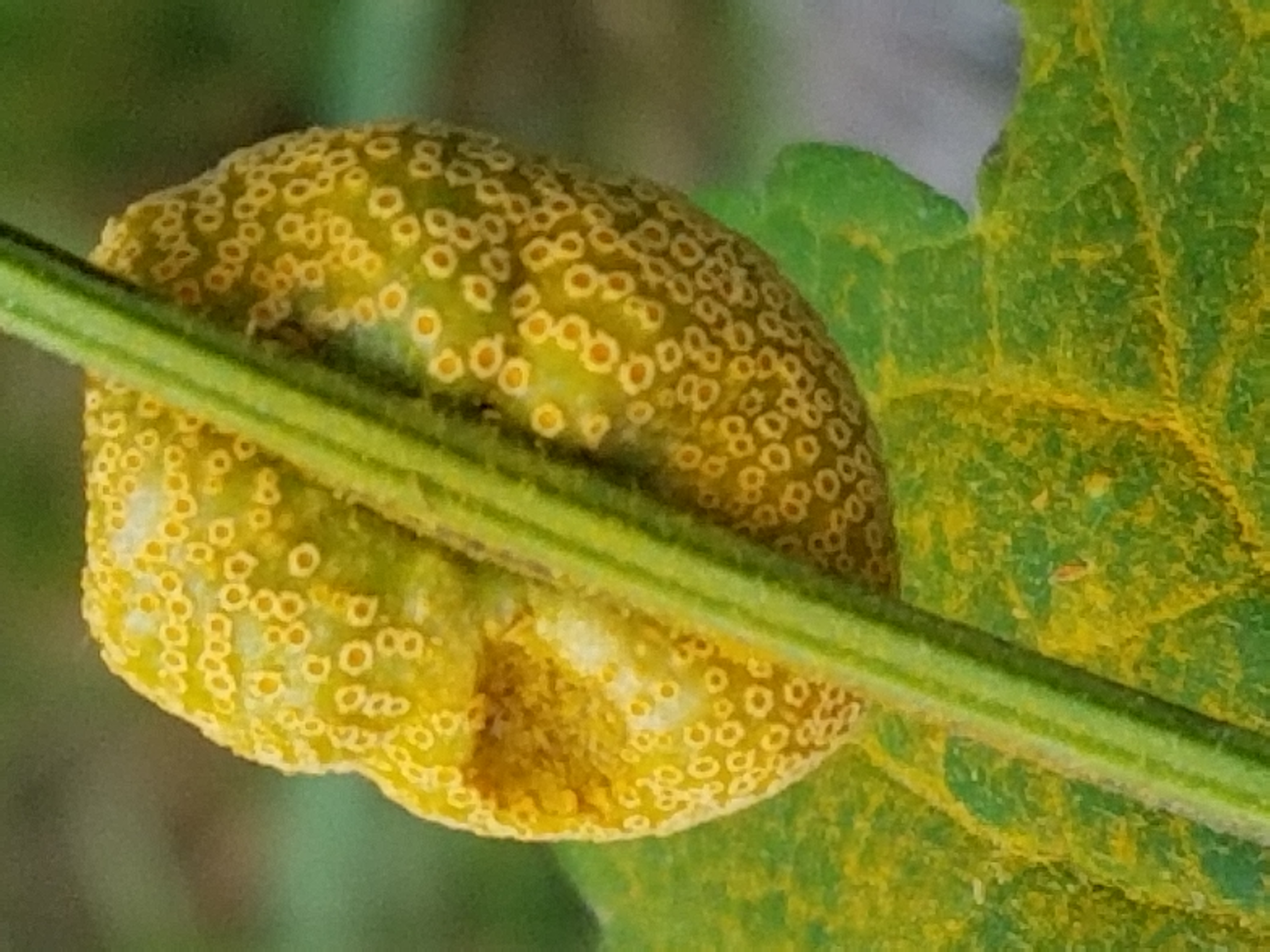
While searching the woods for plant galls I came across these beauties on the leaves and petioles of Clematis virginiana.  On the petioles they curled into various shapes and it was obvious they weren't galls.  Measuring less than half an inch long, it required magnification to appreciate the tiny orange cups that covers the surface.  Tiny round ones were on the underside of the leaves and the vines didn't seem damaged otherwise.


The knobs under the leaves were just miniature versions of the petiole growths and with magnification they too were covered with the little cups.  Some sources refer to them as pustules but that seems to be a harsh judgement to me.  Another term is a rust fungus, not much kinder name.

I think this is Puccinia recondita also refered to a wheat leaf rust, a fungal disease that is a major problem for farmers.  

Gardeners consider it a disease on clematis but to me it is just another interesting small feature of nature, a mushroom on a leaf.  In the words of Bill Bryson, "Life just wants to be, but it doesn't want to be much."

Thursday, June 1, 2023

Flying Lint

Woolly aphid - Mark Bower
The last few days we have been seeing tiny white fluff drifting through the air.  Watching closely you can see it gradually change altitude or direction.  These are woolly aphids, members of the Eriosomatinae subfamily.  In flight they have been likened to "flying mice" and are given nicknames like "angel flies," "fluff bugs,""fairy flies,"and "ash bugs."  My favorite is "flying lint."

Woolly aphids on a log - Mark Bower
Ready for take-off - Mark Bower
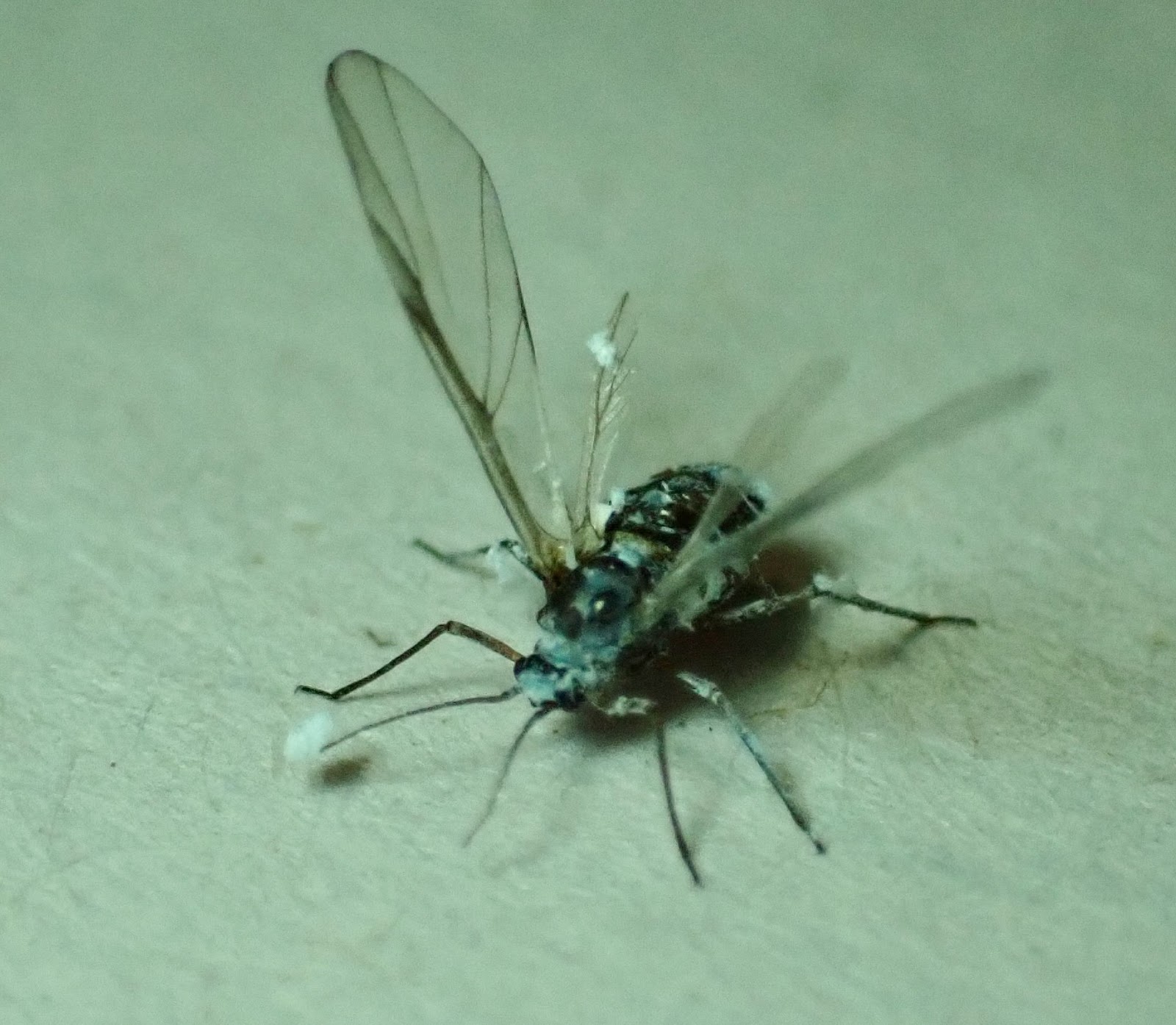
Mark Bower introduced me to them years ago when he found a log with clusters of tiny 2 mm light blue winged insects.  Looking closely they even appeared to be covered in powder.  He nailed the diagnosis of woolly aphids before I could even get back to my computer.

Woolly aphids (WA) are members of
Eriosomatinae subfamily, a branch of the aphid family, Aphididae.  According to Wikipedia:
"Woolly aphids are sucking insects that live on plant sap and produce a filamentous waxy white covering which resembles cotton or wool. The adults are winged and move to new locations where they lay egg masses. The nymphs often form large cottony masses on twigs, for protection from predators."
Naked WA - REK
I caught this one by hand and by the time I transferred it to a bug box, its wax had rubbed off and it couldn't take off, making it willing to pose.  This one was also 2mm long although it looked larger when it had all its wax.  You can see a video here of another one under the microscope as I wiped off some of its wax.

Some WA specialize on one variety of plants while others may lay eggs for their larvae on a different species than the ones adults feed upon.
Insect trash talk - Mark Bower
The woolly apple aphid is a major economic pest in orchards.  Like the cedar apple rust galls that depend on cedar and apple trees in close proximity to support their two year life cycle, the apple aphid requires elm trees for the egg and larval feeding phase while the adults attack apple trees.  Woolly aphids have a needle-like stylet mouth which they use to penetrate buds, bark, leaves and roots to suck up sap.  Many produce a sticky honeydew which then can support the growth of a sooty mold on the fruit.

Many woolly aphid species are accidentally introduced invasive species.  An example is the hackberry wooly aphid, Shivaphis celti, which was found in the south in the 1990's and is now also a problem in California.  Although it doesn't damage the tree significantly, it is a pest because its copious honeydew excretions create a sticky mess which in turn feeds a blackish sooty mold on leaves and anything under infested trees.. 
Woolly aphids- Courtney Reece

The reproductive cycle of these woolly aphids which use two host plant species is complex, as explained by this Bugtracks article.  Most species emerge as all females in the spring and reproduce by parthenogenesis (without mating between the male and female).  They give live birth (no eggs) several times in the spring and summer on the primary host plant.  Winged forms then fly to the secondary host plant, reproduce again and eventually give birth to winged males and females which fly off to a primary host plant and mate, starting the whole process.  If you think this confuses you, imagine being the aphid figuring out your family history.

Not all woolly aphids are warm fuzzy creatures.  The larvae of the woolly beach blight aphids gather together when disturbed and poke their posteriors in the air, an aphid version of "mooning."  It looks like dancing as seen in this video.  This is no hollow threat as they are shown under the microscope to stab predators with their stylet mouth parts that are usually reserved for penetrating wood to sip sap.  I guess if you usually drill into beach trees with your mouth, penetrating a predatory moth larva is a piece of cake.

The very complete source of information on aphids is aphidsonworldsplants.

Monday, May 29, 2023

Finger Gall Inquiliines

We found some of these elm leaf finger galls on a tree beside our deck measuring up to 15 mm long.  With a magnifier I could see that  each had an exit hole. so I cut into a few to see their internal structure.  Under magnification I was surprised to find tiny creatures visible only under magnification, living in the hollowed galls.  These are either inquilines or new inhabitants using the structures that have been deserted by the original occupants.  


This little 1mm critter was inside a gall and I couldn't tell if it was an eriophyid mite that caused the gall or another visitor.  It wiggled its butt but didn't crawl around.

This 3mm beetle had found a home in another finger gall.  You can compare it to the dark stained exit hole on the bottom of the gall.  I always wonder what they might find to eat.

You can see these two 3mm flies were crawling around, not particularly disturbed by having their home cut open.  They never did fly away and were still near the gall an hour later moving around at this Youtube link that I filmed with a Celestron MicroCapture Pro digital microscope.  

There are two takeaway lessons in this:

  1. Looking closely you can find lots of life in small spaces.  To quote Dee Morgan, "Big fleas have little fleas upon their backs to bite them, and little fleas have lesser fleas, and so ad infinitum."
  2. I have way too much time on my hands. 
There is more on elm leaf finger galls at this link.

Sunday, May 14, 2023

Exploring a Little Gem


The 5th grade WOLF class explored La Petite Gemme Prairie last week with their usual vigor. We found lots of the usual suspects and some great new finds.  One of my favorites was the beauty above that was on the prairie roses in great numbers. These occurred in small 1-3 foot clumps scattered across the prairie.  This is Carolina rose, Rosa carolina.  This prairie rose is found across the US, ranging from glades, open woods, prairies, to wet soils along streams and swamps and low areas.  We commonly find these colorful leaf galls decorating them on the prairie.

These spiky balls were galls created by the spiny rose wasp gall - Diplolepis bicolor.  I split one open during the WOLF field trip in 2021 and it revealed a lively larva that was constantly jumping and impossible to photograph.  I had to settle for a frame grab from my shaky video seen here.  This year I was more organized and brought some home to open under the microscope.  This one laid dormant until I used a single hair from our dog, Duke, to touch it lightly as seen here, setting it off on a twitching spasm which lasted 5 minutes!

Much of what is written about rose galls focuses on how to get rid of these "pests."  Apparently a rose-growing purist doesn't see the same beauty as my 5th grade colleagues did on the prairie.  There are roughly 50 Diplolepis sp. which are in the Cynipid wasp family.  Their larvae induce galls on wild roses, and rarely on domestic roses.

Diplolepis sp - Charley Eiseman

The insect overwinters as a larva in the gall.  In early spring the adult wasp matures and chews out through the gall, just as the first cells of leaf tissue appear. After mating it looks for fresh expanding leaf tissue to lay eggs on. The eggs attach to 1-2 plant cells and this induces gall formation. Once hatched, the larva feeding stimulates gall growth even more. This provides food and shelter until the next spring.  There is only one generation per year.

Diving deeper, Diplolepis sp. have their own special problems.  While safely hiding in the gall, there are interlopers that can move in with them.  Most Diplolepis galls are known to host inquilines - species that invade and occupy a gall but do not feed on the larva. They may however harm the larva by competing for their resources like a hungry roommate.

As if life wasn't tough enough,  Diplolepis species and their inquilines can be attacked by a wide variety of parasitoid wasp species.  With this complex intra-gall food chain, I no longer feel bad about opening mine up.  

Prairie Crayfish

This year we had several other personal firsts.   In the classroom we had talked about the prairie crayfish which burrow tunnels down to water level sometimes as far as 6 feet below the surface.  Three different student teams found dead crayfish on the ground around their deserted burrows.

Oblonged-winged Katydid - MDC
 

My personal highlight was a pink katydid.  I have read about them for years but it took sharp-eyed WOLF students (who are incidentally built lower to the ground) to actually capture one.  We commonly find the green form and the pink-yellow-orange variants are common in prairies but are thought to be eaten by predators because of their lack of camouflage as explained by MDC here.  We couldn't get good pictures through a plastic bug box and all living finds are returned to the prairie unharmed.

Finally, a popular if not rare find was this ornate box turtle seen in this video plowing through the dense vegetation which must feel like a forest to it.  It is either looking for insects and an occasional berry for dinner or possibly looking for love.

Barb and I are privileged to go on a field trip with young eyes.  They see more and are more inquisitive, leading us to see a fresh view of a prairie.  More on the WOLF School is at this link.  La Petite Gemme Prairie is owned and protected by the Missouri Prairie Foundation, one of 32 protected prairie remnants.  More past prairie adventures in these blogs.

Tuesday, May 9, 2023

Micromoths of May

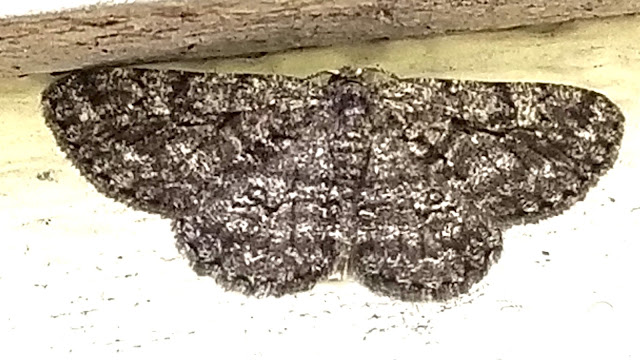
Umber moth- Hypomecis umbrosaria

May is the start of moth season on Bull Creek.  Leaving the porch light on Sunday night called in a haul of micromoths.  My definition is a moth less that an inch long.  The umber moth above is a good example, common, underappreciated and with little information the lifecycle.  It is in the Geometridae family whose name come from the inchworm larvae that seem to measure the earth as they crawl along.  There is another similar moth more common to the north which requires dissection to differentiate, so this is good enough for me.

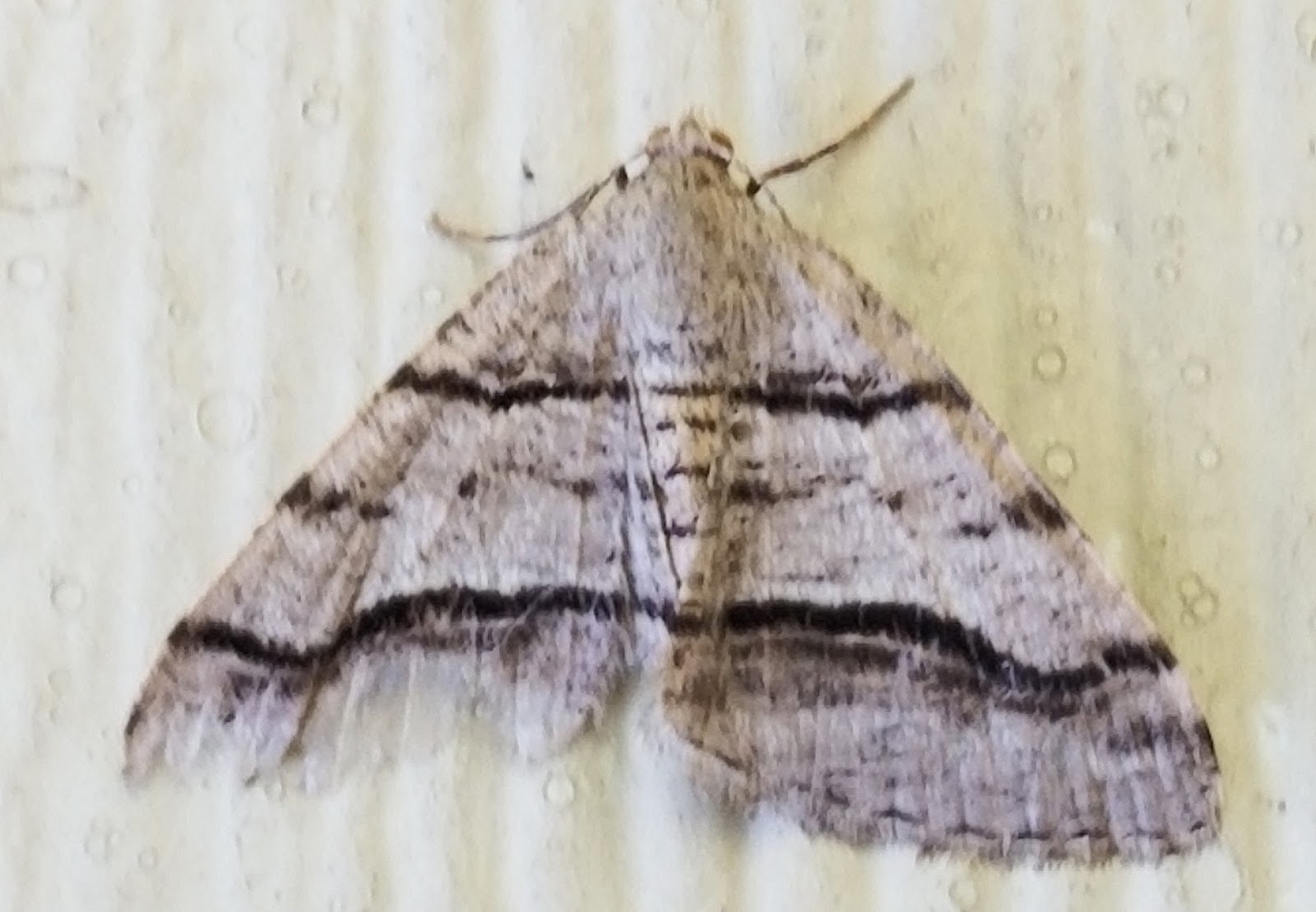
Curved-lined angle moth

The curved-lined angle moth, Digrammia continuata, is another geometrid moth. This one has larvae feasting on our eastern red cedars.  This is another common find on the wall of our deck.  Its larva grows to 29mm, virtually an "inch-worm" before pupating in the soil over winter.  Soon they will be laying eggs on cedar trees, preparing for another year.


Small Necklace Moth
The small necklace moth, Hypsoropha hormos, is distinctive but like many of these micromoths, there isn't much on them easily available.  For me, the thrill is in the chase through INaturalist and other resources.  With a deep dive I found that their host plant is sassafras.


Below is it's cousin, the large necklace moth, Hypsoropha monilis.

Large Necklace Moth

Banded tiger moth
This banded tiger moth, Apantesis vittata, is a common find this time of year.  It is a beauty and we will be seeing them over several months.  They feed on a variety of herbs including dandelion.  Their bright aposematic colors help them ward off predators by signaling that they might have a bitter taste, (although no entomologist has reported tasting them).

Spcekled Lactura
Finally we have the speckled lactura, Enaemia subfervens. They feed on bumelia and are very common visitors on our porch.

There were several other species higher up that I couldn't get good photographs of.  You might try leaving your porch light on to see what comes in.  We also find occasional wing fragments on the ground suggesting that we are feeding other wildlife.