Monday, May 1, 2023

Derecho

Bull Mills derecho - May 8, 2009

Our own Master Naturalist and retired Springfield meteorologist, Drew Albert, offers a series of monthly columns in the Springfield Daily Citizen on weather trends in the Ozarks.  This month's column gives a great description of derechos and how they develop at this link.  The National Weather Service defines them here.

"A derecho (pronounced similar to "deh-REY-cho") is a widespread, long-lived wind storm that is associated with a band of rapidly moving showers or thunderstorms. Although a derecho can produce destruction similar to the strength of tornadoes, the damage typically is directed in one direction along a relatively straight swath. As a result, the term "straight-line wind damage" sometimes is used to describe derecho damage. By definition, if the wind damage swath extends more than 240 miles (about 400 kilometers) and includes wind gusts of at least 58 mph (93 km/h) or greater along most of its length, then the event may be classified as a derecho."

Some of you may recall the major derecho that swept through the Ozarks on May 8, 2009 which is written up on here on Wikipedia. Here is his description of the storm when it moved east into the Springfield area.  The pictures here are from our forest above Bull Creek at that time. 

Root wad 6' tall
"Storms shifted east into the Springfield area by around 8 a.m. with continued fury. In addition to the wind gusts up to 90 mph along the leading edge of the storms, a small-scale circulation known as a mesoscale convective vortex (MCV) developed, which aided in producing additional intense storm activity including strong winds, large hail, and tornadoes. This feature prolonged the period of damaging winds by an hour in some cases. Like the Joplin area, damage to homes was common, and widespread power outages occurred."


We had major damage, especially to large trees on the ridges.  A striking feature is whether trees were broken trunks or uprooted, they all fell in exactly the same direction.  There were over 60 trees downed that were 12" or greater in diameter.  Younger trees with diameters less that 10" tended to survive the straight line winds, protected by their taller neighbors.  It was difficult to walk through the forest and my chainsaw and tractor worked there for several years simply clearing the trails.  

"When life gives you lemons, make lemonade."

Five years later in 2014, I contacted Frances Main, our MDC forester, looking for some way of using the downed wood.  Most of it was a half mile up a rather steep trail, a challenge to most vehicles.  She got me in touch with Ed Hultgren and a crew of volunteer wood cutters which does charity wood harvests.

They would donate their time to cut, split and deliver firewood to families that heat with wood but have neither the source or the financial resources to obtain fuel at the present.  They had been collecting our downed wood now for several years.  This year he and Steve Prine planned a big charity harvest and coincidentally there was a sudden shortage of propane for heating throughout the area.

Young work horse
Saturday was the big day, with around 14 wood cutters arriving from Cabool, Carthage, Arkansas, Mississippi, and four "Okies from Muskogee," many of whom were professional timbermen.  I use the term Okies with the greatest respect as they were great guys, big, strong and especially because all of them were holding chainsaws.  They brought four powerful wood splitters, a UTV with a power dump back, and an unbelievable collection of chain saws.  Four of them brought their kids who worked hard hauling wood to the splitters and moving the split wood onto the six big trailers Ed had borrowed.

When Steve said he would bring a "collection of saws," Barb said he just meant backup saws as "no one would collect chainsaws."  Knowing "men and boys and the price of their toys" in a world where Harbor Freight acts as an adult Toys-R-Us, I respectfully disagreed.  It turns out that for once I was right.  Steve alone has over 90, most of which are operational. Almost everyone there collected chainsaws to some degree and all had several brands on hand, both modern and historic, switching between them just for fun.

A real man's chainsaw
We had a lot of logs previously hauled out of the woods by tractor, enough to keep them busy I thought.  This backlog lasted until about 11 AM and from then on we were dragging logs out as crews plunged into the woods with abandon. Several dead trees were felled, always leaving lots standing as future housing for wildlife.

They harvested 7 huge trailers full of split firewood as well as other large piles which would be loaded onto the trailers once they are emptied.  By late afternoon several loads had been delivered to families which heat with wood but don't have the resources to obtain wood or buy it.  With a sudden shortage of propane, the timing couldn't be better.  For that reason, to my surprise, KY3 showed up to film the event, arranged for by the organizers of the cut, Steve Prine and Ed Hultgren.

Ordinarily I enjoy running a chainsaw and cutting up logs but that Saturday my role was as the greeter, photographer, and chief log-dragger using my tractor to back into the woods and drag out logs to the cutters and splitters.  Besides, I was a little embarrassed displaying my "little" Stihl 260 saws which looked like they were made by Mattel compared to their monsters.

Homemade splitter

The boys were cute and hard working, hauling cut logs that I would find intimidating. Each had his dad's work ethic with a little mischief thrown in.  There were undoubtedly a lot of snoring kids headed toward Muskogee and Cabool that night.

By Tuesday morning, 8 loads had been delivered to families in need, and the wood pictured below is some of the next loads which are being scheduled.  Ed's crews have delivered 693 pickup truck loads in the last 5 years as the program has grown and I can't guess at how many they packaged that Saturday.

You can see more on the 2014 firewood harvest in this KY3 video news report.  There is one error in the video- no firewood was sold, only delivered by volunteers to those in need.

 
Here is Drew Albert's personal story on the 2009 storm. 
"I was home on a day off on Friday morning.  I had worked an overnight shift the morning before.  Because my sleep schedule was off, I got up at 5AM and watched this storm roll in.  When I saw the wind reports at Joplin I filled the tub and large containers with water and moved the car to an open spot away from trees.
We were lucky because our house sits in some lower terrain, we had no roof damage. All our neighbors had at least some. No power until sometime the next day. The bad news was three large trees fell and blocked our way out to the road. Chain saws came out, but it took until afternoon before we and our two neighbors could get out."

If you didn't read Drew's Springfield Daily Citizen column on derechos and how they form at the start of this blog, here is the link again.  SDC link.

-----------------------------

More on the subject at these links from Drew.

Good video from an eye witness: Derecho Tales - Logger Larry May survives tornado - YouTube
And an excellent article here: (foresthistory.org)

Thursday, April 13, 2023

Callery Cedar


Note:   This is an update to a blog story started in 2018 with a chance find of a callery pear tree growing out of a eastern red cedar.
 
2018:  
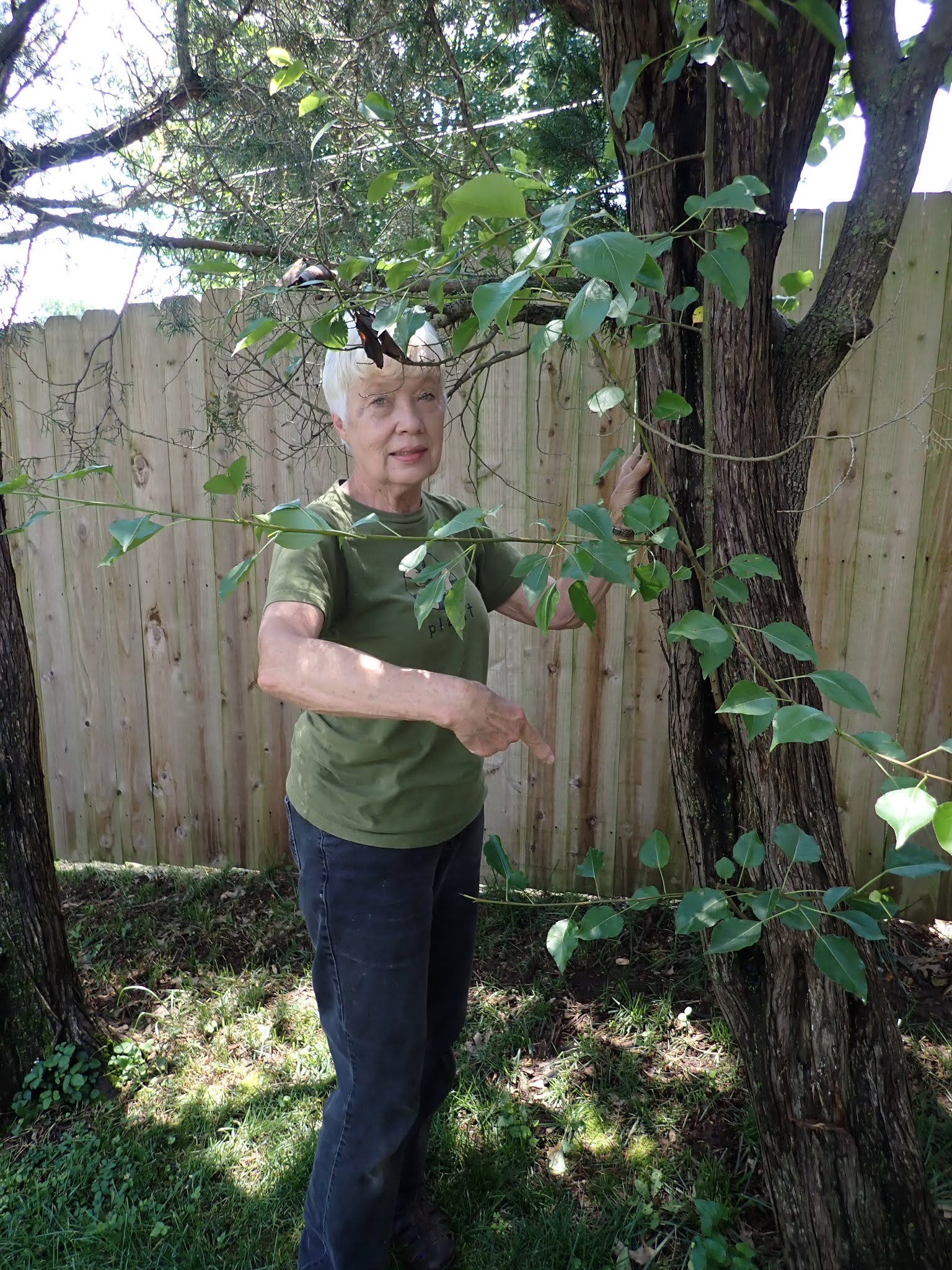
Barb called me a few weeks ago to tell me that she had found a Callery pear tree (think Bradford) next door that was growing out of the trunk of an eastern red cedar.  I won't go on to say what I thought at the time as she edits this blog.  As I trust her fully I only said, "Oh?"
 
Pear above junction with the parent cedar.
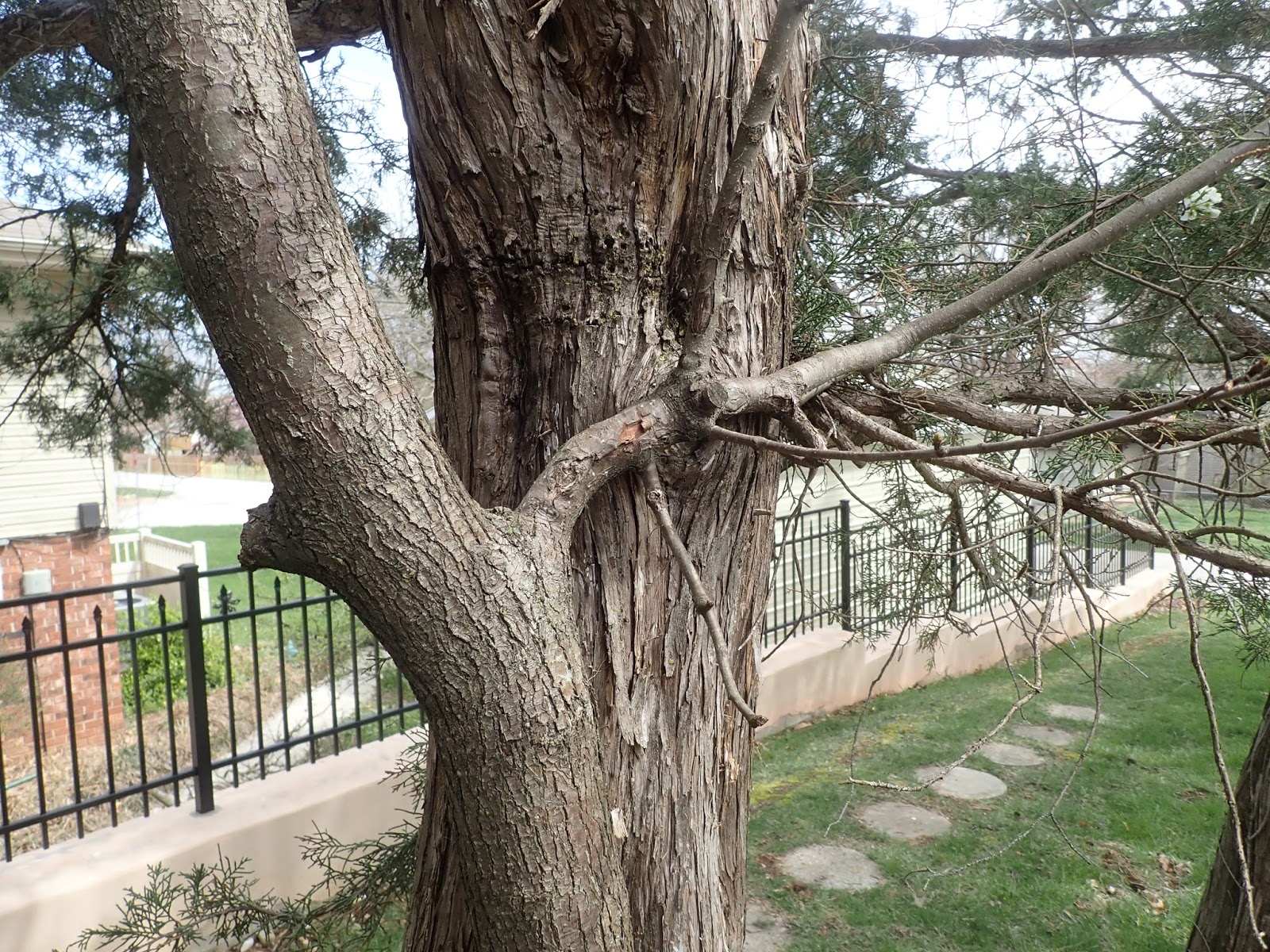
When I got home I went out to see it for myself.  Indeed, there is a Callery pear tree, Pyrus calleryana, 2.5" in diameter emerging from the cedar's trunk three feet above the ground!  It is healthy and happy, approximately 12' tall and in full bloom.  The cedar appears healthy and is the same height as its mates along the line.

Cedar limb scar with Callery pear exiting above - Click to enlarge
Base of pear - Click to enlarge

Close up you can see that a branch was sawed off years ago.  The Callery emerges from the top edge of the scar, which is 3" in diameter, on a 9" DBH (diameter at breast height) cedar.  There is no visible opening to suggest a cavity where a seed might have fallen in the past. 

The first thought might be that it was grafted.  Bradford pears like all other flowering broad-leaf trees are angiosperms and can't be grafted onto gymnosperms such as junipers and pines.  (Technically, our "eastern red cedars" are not cedars, they are junipers, Juniperus virginica.)

The current consensus** of several forestry people is that some time in the past fifteen or so years a bird passed a seed onto the branch and it landed in a crack in it.  Perhaps the bird's feces provided it a little nutrition and a break in the cedar bark allowed some water to collect.  A big question remains - does its roots extend to the ground or is it getting its nutrition from the cedar itself?  I hope to protect it until someone can study its vascular connection to either the cedar or roots extending into the ground.  Regardless of the details it certainly was a one in a million occurrence.

Callery pear trees were brought to the US in 1916 from China to combat fire blight in the common fruit pear (Pyrus communis).  Once they were found to be relatively resistant, 100 pounds of seeds were imported to develop a resistant genotype.  Over the years more seeds from across China, Japan and Korea were collected and made available to nurseries.

In 1952, the ornamental possibilities of one particular vigorous, thornless tree were recognized, and cuttings of it were grafted onto P. calleryana seedlings.  After 8 years of successful testing in nearby neighborhoods they were named "Bradford."  They are unable to self-pollinate, therefore the trees, by themselves, couldn't set fruit. Their vigor was described by USDA plant explorer Frank Meyer in 1918 who had first collected the seeds.

"Pyrus calleryana is simply a marvel. One finds it growing under all sorts of conditions; one time on dry, sterile mountain slopes; then again with its roots in standing water at the edge of a pond; sometimes in open pine forest, then again among scrub on blue-stone ledges in the burning sun; sometimes in low bamboo-jungle...and then again along the course of a fast flowing mountain stream or on the occasionally burned-over slope of a pebbly hill."
When a species is described as thriving in any condition, tolerating all enemies, and like Superman "able to leap over tall buildings in a single bound" you are describing an invasive species.  Soon there were several cultivars produced across the country and when they were planted together as my dad would have said, "up jumped the devil."

A cultivar with striking leaf color in Oregon became Autumn Blaze. Aristocrat, from seedlings growing at a nursery near Independence, Kentucky, had a strong central leader with horizontal branches and an early pyramidal form, more sturdy that the somewhat fragile Bradford.  Chanticleer, cloned from a street tree in Cleveland, Ohio, was named the 2005 Urban Tree of the Year by the Society of Municipal Arborists.

"Callery in a Cedar Tree" -  Click to enlarge
This was all well and good as they weren't self-pollinating but soon innocent insect species began moving pollen between different cultivars planted a few hundred feet apart. Their offspring began creating their own hybrids that could reproduce.  It was as though the individual varieties that had occurred natively in China had all moved into the same neighborhood and had a giant angiosperm orgy.

3 new branches 2020 - Click to enlarge


I would nominate Callery pears as our most invasive plant species, pending the discovery of garlic mustard growing on the back of a zebra mussel.  I am proposing naming this Callery/cedar tree shown above, Juniperus calleryana var. Barbarae, in honor of the discoverer.
==========


Update 2020


Now two years later there are three branches growing out the other side of the trunk as well.  The cedar is otherwise healthy looking.

New Callery growth 12" from the cedar base

Update September 2021  

New growth -Click to enlarge

Continued growth of all the original branches (red arrow) with two new small branches growing out  of the bottom two feet of trunk on the other side.  Also, a new growth with leaves coming out of the soil one foot from the base of the tree (lower right arrow).  While that could be a separate seedling there aren't any others in the surrounding area.  This would seem to settle the question of nutrition as the Callery now has roots in the ground through the cedar trunk!

There are now 26 cultivars of Callery pears. Twelve of these are currently being sold. The Missouri Invasive Plant Council will be making an effort to cease the sale.

========================  
Update-- April 10, 2023

This report is from a site visit by Dr. James Guldin.*

"That Callery pear growing from a knothole in the eastern red cedar is a fine demonstration of adaptive physiology on the part of the pear. It takes some imagination to describe how the pear can coexist with the red cedar.  It also takes some thought to account for how the pear tree gets enough nutrients and water to develop into a 3” diameter stem growing out of that knothole in the red cedar that is 4 ft above the ground.

The availability of nutrients is the easier question. When rain flows down the stem of a tree, the water in the stem flow is enriched by nitrogen, phosphorus, potassium, and the micro-nutrients that a tree needs to survive, no doubt by leaching those nutrients from the bark. That flow of nutrient-enriched rainwater down the stem of the red cedar finds its way into the holes, nooks, and crannies into the dark interior of the host tree. The roots of the pear got their start in those nooks and crannies, and by now have developed to utilize the macro- and micro-nutrients that the pear needs to grow.

But to me, the availability of water is the larger question. How do the twigs of a Callery pear stem look vigorous today, and flowering today, without any apparent contact with the ground to provide the water that the above ground stem needs to grow and thrive? There are two possible answers.

One, the roots of the Callery pear are also 3-4 feet above the ground, embedded in the decayed core of the red cedar, and the stem flow of water into the nooks and crannies into the punky decayed core of the red-cedar may provide all the water the pear stem requires. In the spring, I can buy into that hypothesis. But in the summer, even the decayed wood in the red cedar will become dry as dust, and I doubt the stem of the pear could drink up the water it needs on a daily basis from dry punky rotten wood. The stem would have died before we saw it today.

Two, more likely I think, is this—the roots of the Callery pear have wiggled, writhed, slithered, and otherwise grown downward through the decayed center of the decayed stem of the red cedar into the soil, below the root collar of the red cedar. If this is the case, the pear would be able to suck up the water it needs from the soil below and around its red cedar nurse tree. It might even continue to grow and thrive into, well, maybe a 3” diameter stem that’s flowering and showing twig elongation—as this stem is doing.

If this tree is ever cut for some residential purpose, a close look at the stem analysis would show whether the roots of the pear have made grown into the soil at the bottom of the stem of the red cedar." 

Dr. James Guldin is a recently retired forest scientist (University of Arkansas and US Forest service).  He serves on the board of the L-A-D Foundation.
=============

Callery pears and their 'Bradford' kin are now spreading wild and are considered possibly the greatest invasive plant species threat in Missouri.  In the words of Nathan Muenks* of MDC:

"It’s difficult to truly determine which invasive species is most impactful, but Callery pear sure ranks up there with bush honeysuckle, sericea lespedeza, spotted knapweed, feral hogs and a few others. The reason being that it I would consider it an “ecosystem changer.” Given its ability to invade many of Missouri’s habitat types (whether open or wooded) and the fact that it forms such dense thickets, it has the ability to drastically out-compete native flora and drive away native fauna by creating unusable space for them. It not only grows dense, it also grows quickly. In addition, it’s a tree, vs. bush honeysuckle and others, so it can tower into the upper mid-story – what hope do our native, slower growing trees have in competing for resources and regenerating our native forests and woodlands?

There is no doubt bush honeysuckle and other invasives are much more widely distributed and affecting more natural communities at this time, but there is a strong fear that Callery pear is on a very similar trajectory. While in St. Louis yesterday, I noticed that bush honeysuckle and Callery pear tended to do just fine growing together, with honeysuckle dominating the low under-story and the Callery pear towering above it – SCARY! Is this the future of Missouri’s landscape? It could very well be if we don’t halt the invasion and join in this fight together!"

*Nathan Muenks is the Habitat Management Coordinator with the Missouri Department of Conservation.  This includes coordinating the Department’s terrestrial invasive species management efforts.

Tuesday, April 4, 2023

Dragonhunter


Gala Keller sent us this photograph of a huge dragonhunter larva she found on their stream.  It was left "high and dry" on their creek path when the flood water receded.  This MDC Field Guide has lots of information on dragonfly larvae but lets look at a few of the highlights.

Adult dragonhunter - Donald Lake on Wikimedia

The dragonhunter, Hagenius brevistylus, is the largest of the clubtail dragonflies in the US and the only member of that genus.  Adults feed on large insects including other dragonflies and darners.  They are known to feed on monarch butterflies, eating the thorax and abdomen first to avoid the greatest concentration of the toxins acquired from feeding on milkweeds. 

Typical dragonfly nymph - MDC

Now about dragonfly larvae aka nymphs in general, and a few "fun facts." Note to self- spending too much time talking with 5th grade WOLF Students!

  • The larvae are all aquatic and live in the stream bed until they molt into flying adults.
  • They are ambush predators of small aquatic animals, using their lower scoop like jaw which covers most of the bottom part of their heads.
  • They have a chunky body with large eyes.
  • "Gills are located inside the rectum (unlike those of damselflies, which extend from the hind end like 3 leaf like tails). They breathe by drawing water in and out of their hind end. talk about bad breath!  By forcefully expelling this water, the animal can also move quickly in a form of jet propulsion."  You can see it "exhale" at the last of this video by our own Linda Bower.     Now wasn't that fun?
  •  The nymphs undergo several molts which can occur over several years. They finally crawl out of the water to a safe place, shed their skin, and emerge as a young adult. In the next days or week, they complete their maturation.

For more on Dragonfly and damselfly action check out our Linda Bower's Nature in Motion videos.

Saturday, April 1, 2023

Backyard Heron

Our fellow Master Naturalist Jean Parker sent us this story of a blue heron in her backyard.

_____________________________________

I saw a blue heron in my backyard today. He was at my pond. Again! Last year he emptied my pond of 13 fish, including some 5-7 inch ones! He did it all in ONE afternoon when I was out. I did some research back then and found they LOVE backyard ponds. Makes their job so much easier...like shooting fish in a barrel...
 

I live in the middle of a suburb and find it curious that this huge bird flies our city skies.


Jean's pond


I restocked the pond and placed some old netting I had over the pond. No more fatalities! But he returns without fail, just in case. This time I shooshed him away and he flew to the top of my shed and stayed there for about half an hour. No matter what I did he ignored me. He knew my feeble earthbound limits.

Their feeding habits are described in abcbirds.org:

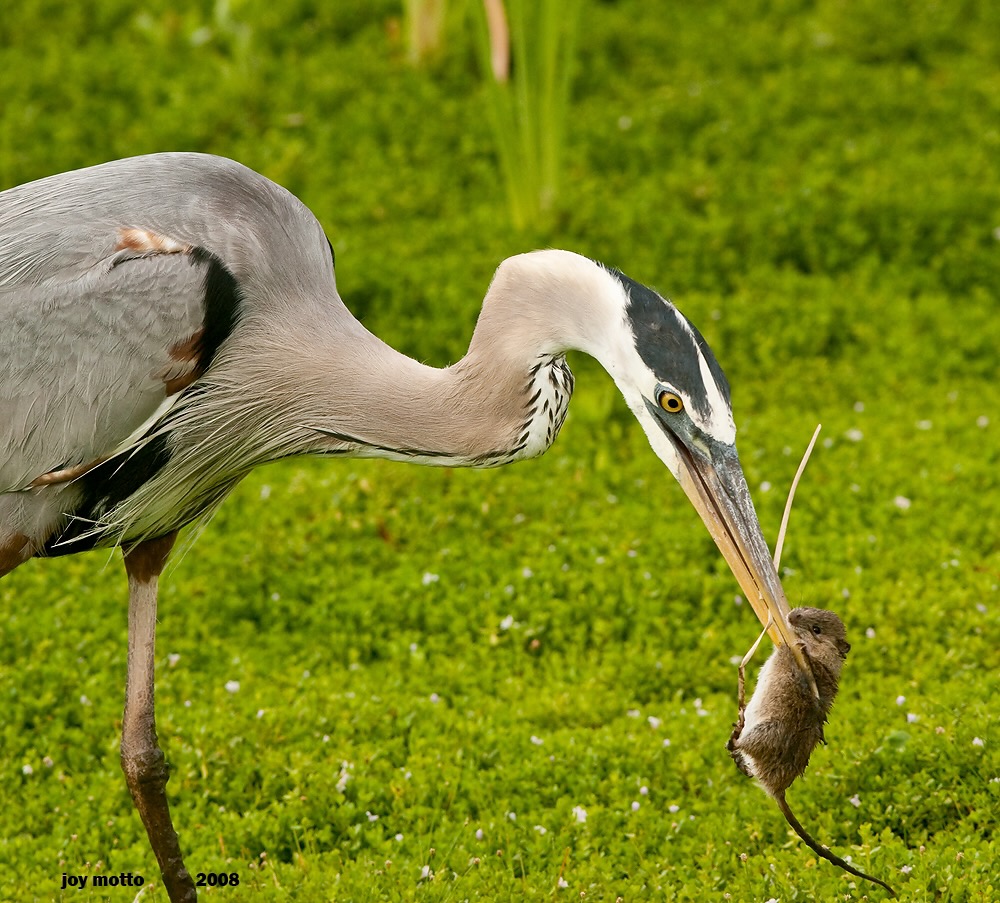
"The Great Blue Heron will eat whatever it can catch with its formidable bill: fish, crustaceans, reptiles, amphibians, small mammals, and birds — especially ducklings. It usually forages alone, locating food by sight. Once a Great Blue Heron spots a meal, it strikes quickly, straightening its long, powerful neck and grabbing its quarry with its spear-like bill, then swallowing it whole. Excellent night vision allows this versatile wading bird to hunt in darkness as well as in daylight."

Not a fish! - Joe Motto

According to North American Native tradition, the Blue Heron brings messages of self-determination and self-reliance. They represent an ability to progress and evolve. The long thin legs of the heron reflect that an individual doesn't need great massive pillars to remain stable, but must be able to stand on one's own.

Editor's note:
The description of GBH feeding is right on. Some years ago I pulled up to our Bull Creek crossing and saw a great blue heron at the end of our swimming hole. I rolled down the truck window, zoomed in with my telephoto, and snapped five quick shots.   I was surprised with my luck capturing this series.

Regarding their broad range of food choices, my bird photographer friend Joe Motto captured the one above choosing a red meat diet. Swallowed whole, that must have been one interesting poop!

Tuesday, March 28, 2023

Searching for Snow Trillium

Snow Trillium - Linda Williams

Wake Robin
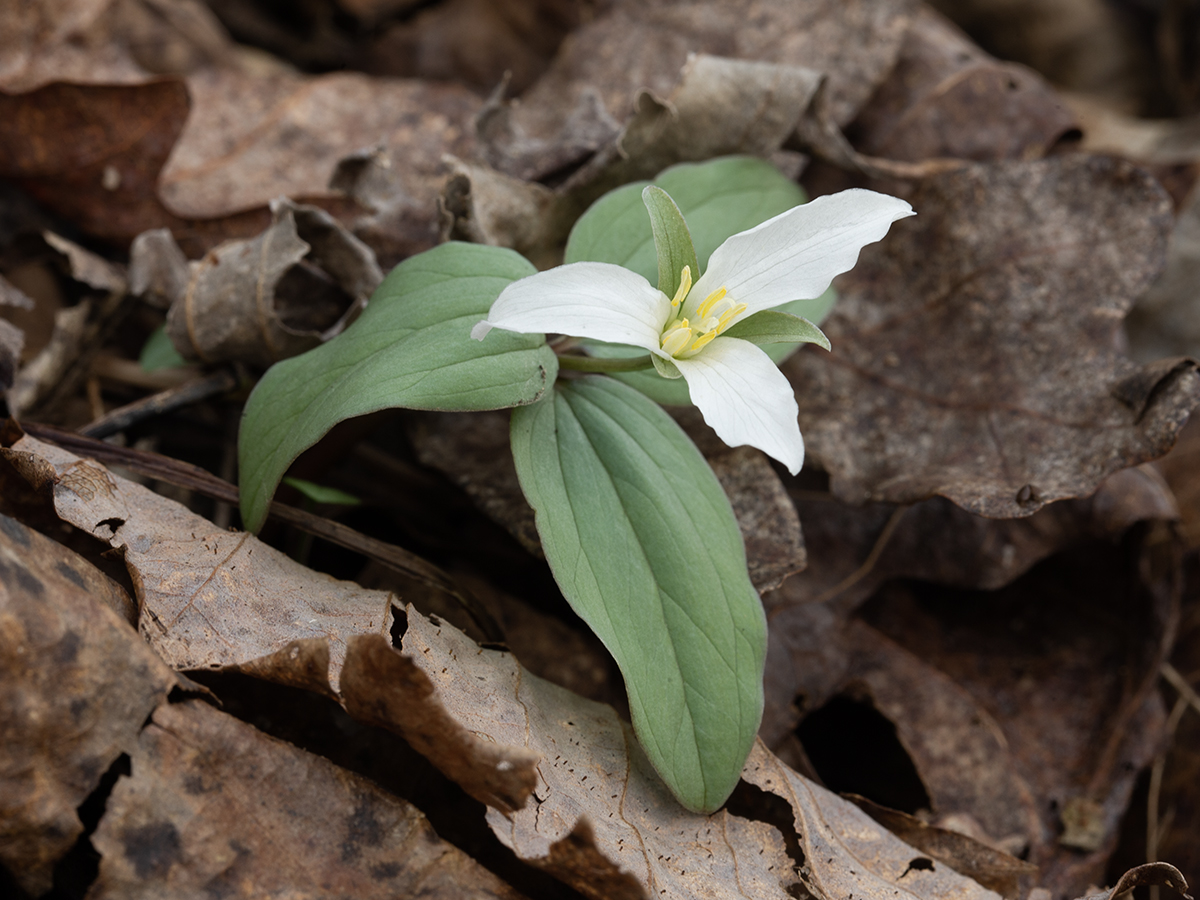
As we emerge from the winter doldrums, I asked Linda Williams who transferred to our chapter from Osage Trails Chapter last fall to write on her experience in documenting an uncommon snow trillium, aka. white wake robin,
Trillium nivale. Even I can tell the difference from our common wake robin, Trillium sessile, seen on the right.

______________________________

Snow Trillium - by Linda Williams

The end of March and the welcomed appearance of beloved spring ephemerals brings up some recent memories for me of helping to survey the rare-for-Missouri snow trillium, Trillium nivale.

On March 27, 2021 my good friend Susan Farrington, the MDC Natural History Biologist for the Ozark Region, asked me to accompany her to survey these special trilliums on some private property on the Jacks Fork River in Texas County. What a magnificent north-facing hillside on a bend in the river! The land partially borders the Ozark National Scenic Riverways. The owner is conservation-minded and proud of the rarity.


The location for the snow trillium here was in the MO Natural Heritage Program Database but the entry had not been updated since 1954 when several hundred plants were counted. When we arrived at the gravel bar on the opposite side, I used my spotting scope and could tell we were going to find plenty of plants. I was able to start counting them with my scope and photographing them with my 500mm lens while Susan launched her kayak to go to the other side and get a closer look. She didn’t go very far above the water since the hillside was so steep and it would have been a cold swim! We could tell the population included at least as many numbers as almost seven decades ago.

                                                     Hepatica nobilis blooms in early spring - Linda Williams

Trillium nivale is generally thought of as a northern plant species. In MO it’s a glacial relict which means it’s a species adapted to colder climates, and it remained in select areas after the glaciers receded and the ice age ended. The glaciers 10,000 years ago did not extend as far south as the Lower Ozarks but the proximity of them still cooled areas in southern Missouri. Large cool, moist, north-facing bluffs are excellent places to find these types of plants. Snow trillium’s rank* in MO is listed as S3 and globally G4.

Snow trillium on a steep north-facing bluff

On March 24, 2022 I was invited again to help survey a newly discovered area with snow trillium on a north-facing bluff in Shannon County above the Current River on Pioneer Forest land. About a dozen folks from MDC, The Nature Conservancy, National Park Service, and L-A-D Foundation took part in combing the steep hillside for plants. We spent several hours counting blooming (425) and non-blooming plants (626) and could have gone a few more hours! During recent years more groups have found more sites in similar habitats racking up similar numbers.

______________________________________________________

Editors note

 * "Snow trillium’s rank* in MO is listed as S3 and globally G4."

This refers to the Missouri Species and Communities of Conservation Concern Checklist found at this link.

  • S3 is Vulnerable in the state due to a restricted range, relatively few populations or occurrences, recent and widespread declines, or other factors making it vulnerable to extirpation.
  • G4 is Apparently Secure: Uncommon but not rare; some cause for long-term concern due to declines or other factors.

Wednesday, March 8, 2023

Peeper Season

Find the peeper - click to enlarge - answer below   

Driving by our pond we stopped to hear the first spring peepers.  Barb could hear them faintly but I couldn't.  Later way out in the field we found the source in a water filled tire rut.  As I approached it they were almost deafening as heard here.  As I bent down to find one they all stopped singing.

The species is one of the first anurans to begin breeding after winter hibernation. The breeding period lasts from March - June, when 800 - 1000 eggs per female are laid in shallow ponds. The eggs hatch within 6 to 12 days, and tadpoles transform to adults during July (range 45 - 90 days)
"The species is one of the first anurans to begin breeding after winter hibernation. The breeding period lasts from March - June, when 800 - 1000 eggs per female are laid in shallow ponds. The eggs hatch within 6 to 12 days, and tadpoles transform to adults during July (range 45 - 90 days)." Animal Diversity Web
The species is one of the first anurans to begin breeding after winter hibernation. The breeding period lasts from March - June, when 800 - 1000 eggs per female are laid in shallow ponds. The eggs hatch within 6 to 12 days, and tadpoles transform to adults during July (range 45 - 90 days).
Most of these eggs won't survive to produce adult peepers or we would likely be deafened by the songs.  Frog eggs and tadpoles are at the bottom of the aquatic food chain, eaten by any denizen of the shallows that can get its mouth around them.  Our Master Naturalist Linda Bower* captured one of those attempts in this video of a dragonfly nymph attacking a peeper egg just before it could hatch.

Dragonfly nymph attacking peeper egg with tadpole inside - LB

This time of year is when male spring peepers (Pseudacris crucifer) audition for their ladies.  They have emerged from hibernation and the three year olds are now ready for mating.  (Over 21? See the x-rated details here.)

 "The spring peeper produces glucose, or sugar, and "freezes" itself for the winter. In winter, peepers' bodies freeze--but their cells don't rupture because of the concentrated sugars in them. These sugars act as a kind of natural anti-freeze.
Like many of the chorus frogs, the spring peeper is often heard, but not seen. It gets its name from its call, which consists of a single clear note or peep, occurring once a second. Only the males sing, calling from shrubs and trees standing in or overhanging water.
The faster and louder a male sings, the more likely he is to attract a mate. A male peeper may also give a lower-pitched trilled whistle, usually when another male has moved too close to its calling site. During the daytime, peepers often call during light rains or in cloudy weather."  Maryland DNR

X marks the frog - REK

Peepers are hard see, let alone to photograph, as they are watching for anything moving above them.  At less than 1.5" almost everything is higher.  They have great camouflage, with a faint "X" on the back as their distinguishing mark, the reason for the name P. crucifer (crucifer = “cross-bearer”).  Because of the cacophonous chorus, it is hard to localize an individual frog.


A few years ago I chose a pond with a six foot high dam so I could approach the water from below unseen.  The chorus was in full voice by 4:45pm while the low lying sun was still reaching the pond surface.  I crawled up the side on my belly like my Uncle Sam taught me, discovering in the process that my belly wasn't the same one I had used in 1967.

I reached the top and peered over and saw....nothing!  There was the water, dead leaves and floating sticks with even a few mushrooms, but no frogs.  The cacophony continued unabated, scattered voices from all around the pond edges.  Finally I made out a tiny bump that seemed to vibrate on a log to my left. 

Crawling six feet to the left and then peeking over the edge I was face to face with a singing peeper.  He watched me closely as I ever so slowly brought out my pocket camera.  I waited several minutes with my arms outstretched until he again joined the chorus.  The next 10 minutes I continued to film it, pausing when it became suspicious and stopped singing.  Mission accomplished with this video!

A final confession.  I broke the rule of "Take nothing but pictures leave nothing but footprints, kill nothing but time."  When I got home I discovered I had taken a number of ticks from the pond dam. You can guess the killing part.

Tadpole emerges left upper, intact egg with tadpole to the right - Linda Bower

Our Linda Bower produced this incredible video of spring peeper tadpoles emerging from their eggs, the end product of a mighty spring peeper choir.  You can find this and more on her Nature in Motion Youtube Channel.

==========================

Did you find the Peeper?   Here it is.

Click to enlarge

Thursday, March 2, 2023

Cedar Pollen

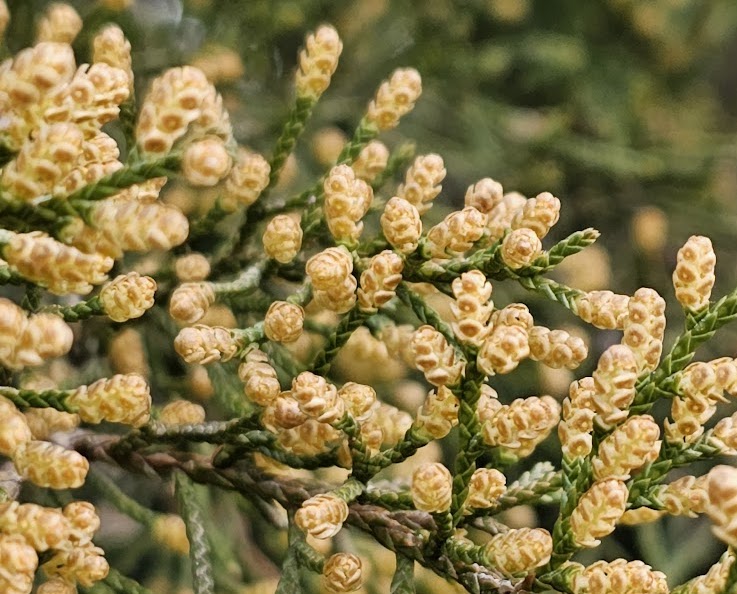
Male cedar cones - Drew Albert
 

"In the Spring, a young man's fancy, lightly turns to thoughts of Love SNEEZING!" (with apologies to Tennyson.)

This is the time of year when male eastern red cedars (Juniperus virginiana) release their clouds of love in the form of pollen which you can see in this video.  In Texas, this is referred to as "cedar fever" which is discussed in this Texas A&M link.  Their onset occurs earlier in Texas due to their warmer climate.  Our Master Naturalist Drew Albert suggests that "After a dry, warm February day yesterday with mid-70s and afternoon humidity dropping below 20% this isn't uncommon after colder weather." The video above was shot on March 12, 2020 which supports the weather theory.

Cedar pollen is distributed by the wind and doesn't seem to care if it lands on a receptive female cone or a human nostril.  When it hits our noses, the reaction is rapid and can produce symptoms over several days.  Not everyone is affected every time.  When I demonstrated in the video the pollen clouds drifting downwind of the WOLF students, I had no reaction in spite of my usual seasonal allergies.

They have been accused of worse.  "Among the many things old-time Ozarkers used to believe brought bad luck was the transplanting of cedar trees. Folklore collector Vance Randolph described several examples of people refusing to move cedar trees because they thought it would bring an early death to them or someone in their family. It was also considered "very bad luck" to bring cedar boughs into the home — except during Christmas, and then, they had to be removed completely before 12 a.m. on January 6 (Epiphany)."  MDC Discover Nature

Our red cedars are native but aggressive growers, early colonizers of bare ground. After the cedar cone on the female tree is pollinated it turns a waxy blue and contains one to three seeds.  The seed cones fall from the trees and are also dispersed by many birds.  Cedars are especially sensitive to fire and the end of burning the glades in the past has turned our historic "balds" into hirsute hilltops.  Some "wind breaks" along fence lines are actually cedars, planted by perching birds, that escaped the blades of a mower.  Abandoned fields and glades now are covered with cedars, creating the expense of clearing them to the landowner.  

Glade restoration - 2000

There is a market for cedar, but a large number of mature trees are needed to make the harvest worthwhile.  When we cut our first glade restoration around 2000, loggers were happy to cut and haul large cedar logs for free.  Our second glade restoration had smaller timber and we had to pay for extra help.  

There was a time around 1908 when the pencil industry developed an appetite for cedar as told in a News-Leader article.

"Ozarkers had other uses for their timber, though. In 1908 the American Pencil Company of New York built a pencil factory in Branson. The pencils were made from cedar logs. Cedar was another locally abundant tree. Thousands of cedar logs were cut into rectangular slats measuring 3" x 3" x 8". The slats were then shipped across the country to factories to be made into pencils. Eventually, the supply of cedar trees was exhausted and the American Pencil Company Factory was moved to California."    ProjectTaney.org

Juniper Hairstreak
So is the spread of cedars good or bad?  As we tell our 5th grade WOLF students, the answer to that question is usually "it depends" and even mosquitoes have a place in the food chain.  In this case, cedar cones (often called berries) are nutritious and feed robins, cedar waxwings, and a wide variety of other birds feasting on their dense carbohydrate and fat load.  Many insects also feed on them including caterpillars of our favorite Juniper Hairstreak.  Meanwhile the branches and evergreen leaves provide shelter for a variety of birds as well as nesting sites for Cooper's Hawks, Blue Jays, Northern Mockingbirds, as well as many other smaller species.

Red cedar spittlebug - REK
Cedars also host other species such as cedar apple rust galls, and cute tiny red cedar spittlebugs.  Perhaps the strangest example is an invasive Callery pear that we have growing out of the trunk of a neighbor's cedar shown in this prior blog.

Another strange thing I have photographed in a cedar tree is this one below, found inside a living but hollowed out cedar on our neighbor's land.  I have tentatively identified it as a new invasive species, Barbaria kipferiae.*

Newly reported "invasive species"
*Special thanks to our editor for her skills with words and as a model.