Showing posts sorted by relevance for query bluebird. Sort by date Show all posts

Thursday, July 19, 2018

Bluebirds of Happiness

Kathleen's bluebird - Chris Meyer
We spend most of our time on Bull Creek where we have a trail of 15 bluebird houses scattered along the field edges.  We see bluebirds throughout the nesting season while maintaining the boxes.  Barb was talking with Kathleen Graves Birdsong recently about her experiences of living with bluebirds in an urban neighborhood and passionately caring for them..  We asked her to share her story in the blog.
"I have enjoyed watching birds since I took a bird watching course in college. When we moved onto 10 acres of open woodland in southwest Springfield I saw the usual birds - robins, cardinals, blue jays, chickadees, titmice. But I would see a flash of blue as early as February - a bluebird.

We had tons of birds and hawks, even though we were surrounded by subdivisions. I put bird seed on the north side of the house, which was rapidly devoured, but no bluebirds.  I put an eastern bluebird house on the south side of the house close to my front door, but again no bluebirds.  I knew the bird house needed to have an opening for bluebirds so other birds did not get in and damage their eggs or chicks - starlings are the worst in my opinion. I also found it was best to place a bird house near a softer spot so if they fall out, they are not injured.

Then I spoke with someone at Wild Birds Unlimited and began my education. Bluebirds do not eat seed. They LOVE mealworms which must be kept in the fridge in a dormant state. Also, my bird house needed to be farther from my house and the feeder I put mealworms in every morning had to be a short distance away.  They suggested that I train my bluebirds every day by feeding at the same time and I needed to let them know I was coming. I began to whistle "Shoo Fly" at feeding time. They also need water to drink so I put in a birdbath.  Being busy I feed at about 7 AM, starting in February or March, whistling on the way. The thing is, they are waiting for me along with robins and cardinals. They battle for the worms and on occasion a blue jay joins in the fight.  I was amazed at how aggressive the pretty little bluebirds could be, diving into other birds.

Last year I had two nestings of eggs which is common for bluebirds, spring and late summer.  When it is rainy, stormy, or in the winter, I did not see them as often. (When they are not nesting, these birds roam the countryside in small flocks. *)  Usually in February I will see them first.  Sadly, I just moved from the 10 acres to down size since my children are grown.  I live in a neighborhood but still have trees and lots of open space so soon I will start again. Wild Birds suggested I walk from my 10 acres to new home, which is not too far away, whistling "Shoo Fly," but my new neighbors would think I was crazy. I did try to educate the new owners of the 10 acres about my bluebirds and I hope they care enough to take care of them. It only took me 10 years to figure all this out!"
Bluebirds went through a bad spell in our country.  They were one of the cavity nesting species common across eastern North America before "us" invaded and became US.  Back in the day dead trees stayed up, filled with cavities created by tree decay or woodpeckers, providing secondary cavity nesters like bluebirds (means they cannot create their own cavities) with mass housing.  The European invasion first brought axes and saws clearing land for crops, felling dead trees and creating a housing shortage.

House Sparrow - Wikipedia
Then in the early 1850s "we" settlers imported  house sparrows (HOSP), aka English sparrows as a novelty.  At first they didn't naturalize or thrive but as they were propagated as a fad over 20 years they spread across the country.  In the 1870s the novelty began to wear off, leading to the "sparrow war" of words among ornithologists reaching a peak in 1878.  By then HOSP were spreading across the country like feathered feral hogs.  See Sialis.org HOSP site.

Invasive starlings and HOSP are aggressive birds known to destroy the nests, eggs, and nestlings of other birds, especially bluebirds.  See Mort Shurtz' story.  Ongoing deforestation and other habitat destruction also contributed to the decline of bluebird populations in the early 20th century.  Populations are now increasing due to education and the spread of bluebird boxes.  Invasive HOSP and starlings are fair game for nest destruction as they are not covered by the Migratory Bird Treaty Act of 1918 that protects all native birds except designated game bird species.

Chickadee nest in box
Our bluebird experiences are somewhat different than in urban areas.  Bluebird houses need frequent inspection to clean out abandoned nests and remove wasp nests.  Frequently we find a welcome nest of a chickadee.  They are identified by the moss they use and by the white speckled eggs.  We enjoy their progress and it is illegal to interfere with their nests.


The first sign of bluebird nesting is the accumulation of grass that is then hollowed out quickly.  After several more days we start to see beautiful blue eggs appear a day or two apart until there are five or rarely six.


Then the brooding by the female begins.  When we inspect the box she will usually flush like a quail with a flapping that startles me every time.  On other occasions she will tenaciously sit on the eggs even when we open the box to inspect.  Those times she will never look at us or acknowledge our presence.


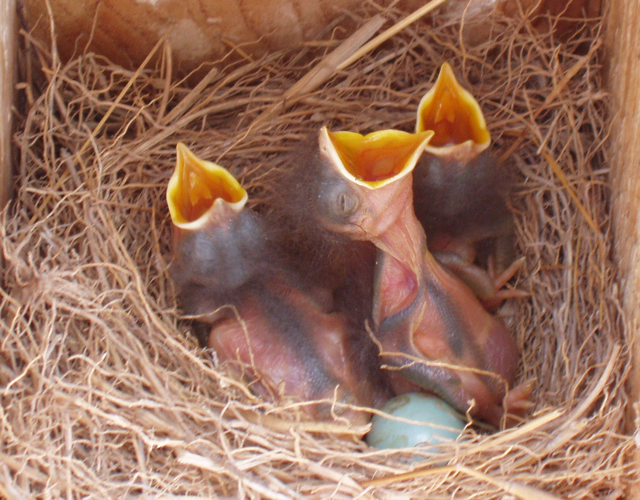
The fun really begins when the chicks first hatch.  Naked and bald except for some fluff on top of their heads that doesn't resemble feathers, they initially aren't disturbed by our presence.  Their eyes are closed tightly and there is no movement at all.  By the next day they are responding to any disturbance with gaping mouths, demanding food.  Watch their demands in this video.

Over the next week the only change will be the gradual covering with feathers.  As their eyes open they don't seem to see us as intruders, rather as another potential source of food.  By now both parents are busy collecting crickets, grasshoppers, caterpillars, and beetles for their young.  I suspect Kathleen's mealworms would be like M&Ms to them but our country birds likely have coarser fare.


Over the years, in addition to regularly clearing out wasp nests out of our boxes we have had several other interesting cavity nesters.  A downy woodpecker once created its own side entrance as a winter haven.  This spring's cleaning of boxes exposed a fulvous harvest mouse that had climbed the steel T-post to install its own nest.


You can learn more about building and maintaining your own boxes on Sialis, and Sialis.org is the go to site for all everything Bluebird including what to do with apparently orphan birds found out of their nest.

Thursday, May 28, 2015

Bluebird Victims


The scene above is one to warm the heart of anyone tending to bluebird nest boxes.  Watching them grow and fledge is the rewarding part of maintaining and cleaning the boxes over the year.  Unfortunately it doesn't always have a happy ending as reported by Mort Shurtz.
"I've been watching our bluebird house for several weeks. First eggs, then a check on the healthy chicks yesterday and everything looked good. This morning I discovered a House Sparrow on the bluebird box. When I inspected the box, all the chicks were gone and the sparrows had built a huge nest in the box. The babies were lying on the ground about 10 feet from the box with holes pecked in their heads"
Mort's Bluebird s- day one
After the attack
The House Sparrow (HOSP) is a native of Europe and Asia which has been transported to Africa, North and South America and Australia, making it the most common bird in the world.  Native species haven't learned to compete with them as they have only been exposed to this threat for a few hundred years.  HOSP thrives in close association with humans which, come to think of it, are also a rather invasive species.

HOSP are common nest predators of small cavity nesting species such as Eastern Bluebirds.  They will peck at the head and eyes, killing chicks and adults alike.  They will also destroy and remove eggs before building their own nest.  I asked Lisa Berger from GOAS* to comment.
"House Sparrows are fierce, nasty competition, negatively affecting many native cavity nesting species.  Bluebirds, Chickadees, Titmice, Tree Swallows, Carolina Wrens, House Wrens, Downy Woodpeckers and others did not evolve with the House Sparrow on the North American continent. The English Sparrow (House Sparrow) was introduced in the new world, soon after European contact: It is, in fact, an invasive species and should be treated as such. Our native NA species do not have strategies (nor have had time to adapt) to compete favorably with invasive species."
Like starlings, HOSP are not protected by the Migratory Bird Treaty Act, which makes it illegal to harm or harass any native species, including their nests and eggs.  For this reason, it is acceptable and even encouraged to remove the nests of HOSP if you are sure that it is the offending species.  Chickadees, wrens and others should be left alone, a nice byproduct of your nest box generosity.  Charley Burwick added this advice:
"On the GOAS Bluebird trails where we have had this problem, we just remove the boxes from the routes. Typically this happens when the Eastern Bluebirds build nests in a too urban area, and the House Sparrows are plentiful. Usually, when we have ran into this issue in more rural areas, it is where there are livestock pens, etc., too close to the boxes." 


*GOAS is Greater Ozarks Audubon Society

Nestwatch.org has some practical measures to discourage sparrows from nesting in birdhouses.

Sialis.org has lots of reports of nest predation by HOSP.  Graphic pictures of the results of a HOSP attacking a tree swallow nest, not for the faint-hearted, are at this Sialis.org link.
 

Saturday, June 2, 2012

Chickadee Nest

Any information you read about bluebird boxes will stress the need to check them frequently and remove the nests and eggs of sparrows and other small cavity nesters who have the gall to raise their family in your box.  Sorry, but I just don't have the heart for it.

We have 15 boxes on our bluebird trail and each year we will have one or two nestings of "undesirable" birds such as these chickadees this spring.  I don't understand how you could throw out the very birds that you entertain at your bird feeders.  We therefore run an equal opportunity nesting organization.

Part of the entertainment in bluebird box maintenance is guessing the bird species by the eggs.  This used to be difficult, but now a site at sialis.org makes it quick and easier.  (This is listed on the resources page along with our other favorite links.)  These speckled eggs could be chickadee or nuthatch.

These little chickadee chicks on day one looked even more naked and vulnerable that the usual nest of day old bluebirds.  They were so scrawny and still that I thought they were dead, but by the next day, their mouths were open, begging for food like I was their mama.

Last Tuesday I filmed this video of newly hatched bluebird chicks just a few hours out of the egg.  They look identical but they were much more active.  You will see one of them confusing its siblings neck for food with the fifth baby's beak just cracking out of the egg.

Chickadee Nest- Sialis.org
One thing I didn't appreciate until now was how distinctive the nests are with different species.  I am used to the dry grass nests of bluebirds but hadn't noticed that the green nesting material occasionally found the boxes was typical of chickadees.  The sialis.org web site shows the nest pictures and the chickadee nest is quite different from the nuthatch nest.


You will notice these chickadee chicks the day before they fledged are tightly nestled down in soft moss, not the dry scratchy stuff of bluebirds.  Once again they didn't even bother to look up at me.

When you remove the empty chickadee nest the soft spongy feel is quite distinctive.  To quote Cornell.edu, "The nest has a moss base and a cup made of grass, plant down, and feathers. The female lines the nest with finer materials such as fine grass, fur, and hair."  In fact it feels just like the deep moss beds I look for when I catch a nap while I am supposed to be cutting firewood in the winter.  Don't tell Barb.

Sunday, February 14, 2016

Raptors of Winter


by Becky Swearingin MN 
 
About the time I think that bird photography is over until the spring migrations, I find some new raptors that wish to be photographed.

I was in St. Louis during the last weekend of January at a dog show and since I was done at about 10 a.m. at the show I randomly chose a conservation area to visit.  The one I chose was Leach Memorial Conservation Area, just north of St. Louis outside of the town of the town of Elsberry. I explored a bit, looking at the river and the remains of the flooding, watching a Kestrel hunt and the waterfowl on the many ponds. After sitting and watching two Savannah Sparrows for a while I decided to go to a different conservation area as nothing seemed to be happening.  As I drove down the main road, this landed in front on me on the road.


Of course, what went through my mind was “What the heck, I think that’s an owl!” As I was watching and photographing this owl, I noticed a group of people down the road with scopes and binoculars watching something. Suddenly a second owl flew right by the group.  The one I was watching flew off the road and landed on a small tree nearby.


This owl is one of our winter visitors, a Short-Eared Owl. These smallish owls breed in the northern U.S. and Canada. They are fairly abundant and have populations throughout North and South America and Hawaii. Missouri is one of their winter territories. While they hunt day and night, I have found in the population in Dade County that they come out closer to dusk. These owls were active starting at about 3:15 giving me plenty of photographic opportunities.  There were three or four that hunted all around the people watching, often landing on small tree right be the road or flying next to the observers. I found the flight shots challenging, but got a couple.


After driving to some other areas in the conservation area I returned to watch the owls one more time. This one seemed to want its picture taken.


The first Saturday of February, I headed to one of my favorite prairies outside of Lockwood in Dade County. When I’ve been there in the late afternoon I have found that there are areas active with Harriers, Hawks, and Falcons. I was hoping to get a picture of another winter visitor, a Merlin. I found a likely spot by Pennsylvania Prairie and waited (and waited and waited) but nothing was happening. I decided to turn around to check out Niawathe Prairie only to discover that right behind my car on a fence post was this lovely Merlin.


I took several shots and crept closer, stopping to take pictures until I was right beside the Merlin on the road. It seemed to be as interested in me as I was in it.


The Merlin is another winter visitor to Missouri. This small raptor, like the Short-Eared Owl, breeds in the north (Canada) but spends its winters in southern states, including Missouri, and Central America. Not much larger than a Kestrel, these raptors are a bit stockier.  Their primary prey is songbirds which they catch in midair, a hunting technique I have yet to observe. One of the birds they like to prey on is one of our more common invasive bird species, the House Sparrow, because of this they are becoming more common in urban areas.*

Keep your eyes open for those “snowbirds” who come south for the winter.

Editor's note:
The attack on the House Sparrow (HOSP) is especially welcome for those of us who maintain bluebird boxes on trails.  Bluebirds were a threatened species with declining populations from 1920-1970In 1978 the North American Bluebird Society (NABS) was formed and with bluebird trails and nest boxes, bluebirds are coming back with our help.  HOSP are major threats to bluebird populations as seen in these graphic photographs.  They are one of the most wide spread species on the planet, well adapted to cities where they can be a major annoyance.

Tuesday, April 8, 2014

First Reported Bluebird Twins


If you ever doubted the value of some mundane sounding citizen science projects, this story from Cornell Lab E-news is for you.   Gerald Clark, a retiree who spends time enjoying birds in his backyard, was monitoring the nests of Eastern Bluebirds in Pennsylvania.  A member of Project NestWatch he reported 3 normal eggs beside one large one in his bluebird box.  A few days later he had 5 chicks.  This is the first documented occurrence of bluebird twins!

With the frequent finding of double yolked eggs, I would not have thought it would be that rare, but apparently twins among wild birds are very rare.  It turns out that the odds in wild birds are one in a billion.  An article in CitizenSci describes the reasons for the rarity of twins in the wild.  The twins are crowded in and one has to be able to pip the shell to hatch.  In addition, both have to have access to the air cell where oxygen and carbon dioxide are exchanged through pores in the shell.

This citizen science finding was published in  PeerJ, a peer reviewed journal.  Details and pictures are at blog.allaboutbirds.org.  All citizen science begins by being aware of the opportunities and reporting findings.  Like the Christmas Bird Count and Project Monarch, getting involved is simple.  Check out the Cornell Lab of Ornithology's NestWatch at this link.

Thanks to Becky Erickson of MONPS (Missouri Native Plant Society) for the lead.

Monday, February 16, 2015

Hairy or Downy?

Downy Woodpecker, note dark spots on white outer tail feathers - Joe Motto
After many years watching red bellied and downy woodpeckers compete at our suet feeder I finally spotted a new bird.  For me, this is a big hairy deal, a hairy woodpecker!  I wasn't able to get a good picture in the overcast winter day, but it  returned a few days later to pose for me, along with a female companion.

Downy on a goldenrod gall - Warren Uxley
Downy woodpeckers are a daily occurrence at Bull Mills and are five times as abundant as hairy woodpeckers in the Ozarks.  Small and perky, in winter they specialize in the suet feeder unlike the red-bellied woodpeckers that fly between the suet, sunflower feeder and the neighboring trees, pounding the seeds against the limbs or feeding their young in season.  They are compact with a blocky head and stout shoulders.  They tend to flit around on the trunk, more active than other woodpeckers.  They are light and agile enough to hang on a  goldenrod stem while feeding on the tasty grub inside its tough gall.


Hairy Woodpecker - Joe Motto
Hairy woodpeckers look a lot like a downy at first glance, however they are noticeably larger,  9.5 inches long compared with the 6.5 inch downy.  Its bill is considerably longer, equal to the width of their head, while downy's have a shorter pointed beak than other woodpeckers, resembling a thorn on a vine.  Their outer tail feathers are pure white rather than spotted like their downy cousins.  Finally, the rad patch on the nape of the neck of males is divided by a black line while it is solid on the downy.


Male hairy woodpecker- divided red patch
Hairy woodpecker female


Altered bluebird box with snake guard
Barb found woodpecker damage on two of our bluebird boxes. Since this is a little early for bluebird nesting we didn't mind, but objected to their alterations.  Our boxes have wire snake guards around the opening that didn't apparently suit these woodpeckers.  They pecked a hole in the side of each and use it as their front door.  It is amazing to me that they could make a hole through 3/4" wood with those tiny beaks, but then they carve out full cavities in dead trees for nests so this was just a minor renovation.  When she opened the box to inspect, she flushed a downy.

Female downy at the front door giving me the stink eye
Downy woodpeckers sometimes use their winter roosting cavities for later nesting so we will be watching these two boxes carefully.  As bluebirds build their nests and have hatch their young several weeks earlier than the woodpeckers*, the downy may find a "no vacancy" sign on the box come spring.

Missouri Breeding Bird Atlas, Brad Jacobs and James D. Wilson.

Saturday, May 26, 2018

Mouse in a Bluebird House

 
We have a bluebird trail of 14 boxes at Bull Mills, all wired 4' up on metal fence posts. When I was cleaning them out this year I found one chock full of grass with a little hollow on top, not unlike a bird nest.  When I opened the side door fully I found the back end of a small mammal with a very long skinny tail.  It scurried under the grass nest and I was able to close the box up.  I came back later with a 5 gallon bucket and managed to scrape the mammal and the nest into it.  It immediately made several incredible 12-14" leaps straight up toward the rim before I could get a lid on it.  I transferred it to an aquarium where I could now see and photograph a small and timid mouse.

The mouse in this house was not a house mouse!  Our so called house mouse, Mus musculus, aka "fancy mouse" came across the big pond from Europe with early explorers, probably originating in India, before having reached Europe around 100 B.C and North America with the British in the later 1600s.  They are more adapted to living with humans than almost any animal with the exception of college graduates moving back in with their parents.  Their greatest importance is in our research laboratories and to the exterminator industry.


The tremendous jumps of my new friend led me into a rabbit hole of researching like Alice in Wonderland  (actually more of a mouse hole).  There are 12 species of mice in Missouri in addition to the common house mouse. The dramatic leaps of my mouse immediately brought to mind the jumping meadow mouse (JMM), Zapus hudsonius pallidus, which has been reported scattered throughout Missouri although Christian County has never had a confirmed sighting.  They are noted for their extremely long tail, 150% of their body length, and their long hind feet measuring 28 to 35 mm long.

A whale of a tail
Click to enlarge - Photo Debbie Fantz MDC

I contacted Debbie Fantz, Heritage Mammalogist with the Missouri Department of Conservation.  My photographs of our mouse were in less than perfect light but appeared a little lighter than the typical JMM, leading her to suggest that it might be a juvenile before molting into darker colors.  The colors also matched the fulvous harvest mouse (FHM), Rreithrodontomys fulvescens, a southern species that has been reported in southwest Missouri.  The upper body is a mixture of reddish brown (fulvous means reddish yellow, tawny) and black.  It too has a tail longer than its body, but not usually quite as long as a JJM.

I have finally decided that this was a particularly athletic specimen of a fulvous harvest mouse based on a single trait.  My mouse was housed in the bottom of a bluebird nest box wired 4' up on a metal fence T-post.  The box had two small triangular openings in the wooden floor.
"Perhaps the most fascinating habit of the fulvous harvest mouse is its ability to build large, above-ground "penthouses" in grasses, low shrubs, or small trees (Davis and Schmidly 1994). These may be constructed of the materials in the animal's habitat or may be converted bird's nests. The solid, globe-shaped nest has one or two exits near the bottom end which can be clogged up."  AnimalDiversity.org
The hair on the upper body is a mixture of reddish brown and black, creating a salt and pepper effect (Hall and Kelson 1959). R. fulvescens has a tail that is much longer than its body and its under parts are white to buff. The adult plumage is brighter than that of the juvenile and adults molt once a year.The hair on the upper body is a mixture of reddish brown and black, creating a salt and pepper effect (Hall and Kelson 1959). R. fulvescens has a tail that is much longer than its body and its under parts are white to buff. The adult plumage is brighter than that of the juvenile and adults molt once a year.
The hair on the upper body is a mixture of reddish brown and black, creating a salt and pepper effect (Hall and Kelson 1959). R. fulvescens has a tail that is much longer than its body and its under parts are white to buff. The adult plumage is brighter than that of the juvenile and adults molt once a year.
The hair on the upper body is a mixture of reddish brown and black, creating a salt and pepper effect (Hall and Kelson 1959). R. fulvescens has a tail that is much longer than its body and its under parts are white to buff. The adult plumage is brighter than that of the juvenile and adults molt once a year."
Reithrodontomys fulvescens
The lengths that plants and animals go to for survival, however humble they be, are incredible.  As Bill Bryson says in A Short History of Nearly Everything, “Life just wants to be; but it doesn't want to be much.”

========
Thanks to Debbie Fantz and Ashley Schnake of MDC
Wild Mammals of Missouri lists 13 mouse species.

Sunday, August 29, 2010

Egg Shell White?

Wild Turkey Eggs
What looks like a white egg shell to us may be an egg of a different color to a bird.  This is because birds see more color than we do.  According to livescience.com, ultraviolet pigments that are invisible to us may help birds distinguish between their eggs and those of another species.
"Unlike humans, birds can see ultraviolet (UV) light, and they have four – rather than three – color receptors in their eyes, allowing them to better distinguish between hues."
While we can recognized many of the differences between different eggs, we can't recognize the UV spectrum of short wavelength light seen by birds.  Nest parasites such as cowbirds and cuckoos lay their eggs in other birds nests.  Unsuspecting birds may nurture these eggs to the detriment of their own eggs.  Scientists suspect that the differences in UV colors play a part in the recognition and rejection of  these foreign eggs.
The article discusses the coloration of egg shells by two pigments and the mysteries of how and why these developed.  The basic egg is white from its calcium carbonate.  Any color which appears, solid or speckled, comes from a mixture of "blue-green biliverdin, and red-brown protoporphyrin, which are both breakdown products of hemoglobin."

While different colored eggs allows species to detect their own eggs, the colors also may serve to camouflage eggs from predators, act as a sun block or actually strengthen the shell.  Even a single bird's eggs may vary in color as the last eggs may have more speckles as the supply of calcium for egg shells is depleted.  Wikipedia on egg biology


Mysteries remain.  We are all familiar with the beautiful powder blue eggs of bluebirds, yet 5% of nestings produce all white eggs.  At times there is a slight pink or bluish tinge to the eggs but all the eggs will be the same color and produce normal colored chicks.  Apparently a bird will always produce the same color eggs.  If a egg of another color appears in the clutch it was dumped by another bird. 
Bluebird eggs- white

The biology and genetics of bluebird egg color is still in debate.  Some birds hatched out of white eggs subsequently lay blue eggs.  Sialis.org  has a lot more information on the subject.

Thursday, February 16, 2012

Watching is for the Birds

Bluebird chicks- Day 1
Francis Skalicky reminds us in today's News-Leader that it is Time to make bluebirds welcome.  Bluebirds begin building their nests for their first broods from mid-February through March and will be apartment hunting in your neighborhood.  It is therefore time to clean out your bluebird boxes to have them ready to rent.

He describes what they are looking for: a nice neighborhood with preferably short grass, scattered trees to perch on, and a  sunny exposure, preferably not due south which heats the home too much in summer.  Nearby insect playgrounds are welcome,  but don't worry, they will find them on their own.


Supper Time!
In addition to their insect hunting, they provide lots of entertainment.  It is important to check the boxes every few days to clean out wasp nests or other unwanted visitors and to clean the nest after the chicks fledge.  The fun part is watching the chicks hatch and grow.  A tapping on the box will allow mom to get away to a nearby tree where she will watch you, then return when you leave.


Another opportunity to watch birds and advance science is the Greater Backyard Bird Count (GBBC) which starts this Friday, February 17th and runs through Monday the 20th.  It is simple to do, requires no technical expertise and is easy to report on line.  You can do it anywhere on any or all 4 days and it requires a minimum of 15 minutes of your time.  Click on this web site and watch the instructional video.  Then on the days you participate, simply go to the GBBC website and begin.

Thursday, May 3, 2012

Egg Season

Black Vulture on eggs
In the spring, a young bird's fancy turns to thoughts of... making babies!  Evidence of this trend abounds along Bull Creek this week.

The most dramatic has been the return of the Black Vulture family.  I first saw them close up in March when I drove within six feet of a pair sitting on the corral fence.  They didn't budge when I stopped, suggesting that they were the ones that became acclimatized to us during their nesting last year in the old barn.


Black Vulture Babies- Day 1
We waited patiently for three weeks, afraid we might scare them away, then looked in the barn on April 1.  Our patience was rewarded by the sight of two large blotchy eggs.  We didn't see them again for a month as one of the parents remained on them full time.  Last year they would flush on our entry, further evidence that they had lost fear of us.

On May 1 the chicks first appeared, cute fuzzy little balls that are sure to elicit a response of "awhhh."  Unlike the bluebird and chickadee babies in bluebird boxes who lay still with their eyes shut for the first few days, vultures are born with their eyes open and their feet moving.   They still aren't a ball of energy yet, their main tricks are limited to turning their head and a little wiggling. 

At the other end of the field, we came across a turkey nest with eight eggs in a elderberry thicket.  We returned two days later to see if there was any activity and Barb crept up on the area to investigate.  (See turkey flush above)  It was like flushing a quail on steroids.  If you think that the flushed turkey was startled, you ought to try being the "flusher."

Turkey Nest
This time there were just 6 eggs in the nest.  Sadly, when we returned today, we could see from a distance that the nest area was trampled down and empty aside from a few small dark feathers.  The good news is that incessant gobbles ring throughout the Bull Creek valley, advertising the opportunities to love and mother again.

Tuesday, May 5, 2015

Life Wants to Be

Our newest additions
Those of you who have followed the blog know that it is time for the baby black vultures to appear.  They lay their eggs on bare ground in cavities, hollow stumps or outbuildings like our 100 year old barn.  They had us worried this year when after a long wait I saw an egg broken open and no chick.  The brooding bird got up a little to show the other egg but not the just hatched chick.  I say brooding bird because both sexes brood and determining male and female would require turning them over, embarrassing for the birds and risking their defensive vomiting on me.

I was startled yesterday to have the parent stand up to show me both chicks, cuddled together for warmth.  After 5 years with presumably the same parents, the adults are bored by my arrival and have learned to get up for pictures in order to make me leave.


Our bluebird boxes now have chicks and one has its second nesting of the year, having fledged the first set.  The one above is waiting for food, or maybe just encouraging its last sibling to come out of its shell.


Our Joplin correspondent Karsen sent the picture of a chickadee nest in a bluebird box.  You can tell if it is a chickadee nest without seeing the bird.  The eggs are speckled (similar to a nuthatch's) and the nest has a distinctive moss basement with a grass cup above with plant down and feathers lining it.

Killdeer nest - Karsen
Black vultures are not the only casual parents.  Karsen also sent me the killdeer nest above, part of a family he is photographing for a future blog.  We hope to have a family portrait soon.

* Karsen Bell is a 15 year old nature photographer from the Joplin area and a regular contributor to this blog.

Wednesday, February 17, 2021

Frozen Birds

Bluebird - Patty Hatcher

Patty Hatcher mentioned her frozen Bluebird at Monday's meeting so I asked her for more information.

"Found this poor guy immobilized in the snow Monday evening.  He was barely alive.  Hoping I could save him I brought him in, wrapped him in a towel and put him in a box.  He looked at me and moved a bit but in the end closed his eyes.  I feel better knowing he didn’t die frozen in the snow."

Then my neighbor sent pictures of a Downy Woodpecker frozen in place on a tree trunk so I asked Becky Swearingen to educate us.

Downy Woodpecker - Garin Ferguson


Keeping Birds Safe in Extreme Cold - Becky Swearingen

Larry Gurian
We have been getting reports of birds that are succumbing to the extreme cold temperatures. As you watch your birds, there are several behaviors you might notice. Birds are puffing up their feathers to provide extra air space around their bodies that will help contain their body heat. They are also seen tucking one of their feet into their feathers or roosting close to the feeders with their bill tucked. These are additional ways to retain their body heat. Something else you might see is birds huddling close to one another to share their body heat.  There are some ways we can help our feathered friends survive this extreme cold weather event.

First, try to keep some open water available. Ideally, that would be a heater in a bird bath, but alternatively, you could put fresh warm water out periodically throughout the day. I have gone out several times over the past few days and knocked off the ice and snow that accumulates around the rim of the bird bath. This makes it easier for those little birds to get to the water.

Keep your feeders full and clear of snow. They are eating a massive amount right now. They need the calories to help them keep warm. I am filling my feeders three or four times a day. Clear your feeders of snow. I do that several times a day when it is snowing. You can also put out additional feeders if you have them.

Feed good, high energy foods. These are things like peanuts, peanut butter, suet, mealworm (live or freeze-dried), and sunflower chips. I have also cut up an apple and put it in some peanut butter for birds like the mockingbirds. I sometimes make a special treat of peanut butter, corn meal and raisins when it is frigidly cold.

Make sure food is available first thing in the morning. I fill my feeders in the evening so there is food for the birds as they start getting out first thing in the morning. They need that early morning energy boost after not eating during the night.

One thing I do is shovel an area on the patio and in the yard and sprinkle seed on the ground for those ground feeders, like Dark Eyed Juncos and White Throated Sparrows. I usually just sprinkle White Proso Millet, but I’m currently sprinkling a mix that also has nuts and seeds in it. Some different birds are coming to the food on the ground right now, like Robins. Food is scarce for all the birds, so even birds we don’t think of as feeder birds are appreciating the extra fat in their diet. If you can do it easily, you might even consider making a windbreak by your ground feeding area so the birds can feed out of the wind.

Finally, keep those bird houses out. There are some birds that do roost in bird houses in the winter. Bird Watchers Digest even suggests putting dried grass or wood shavings (not sawdust) in the houses for additional insulation. Another type of shelter might be a brush pile. I have an area in my yard where I pile up limbs. I also add additional leaves to that area in the fall. This provides some additional shelter for birds.

Here is a great resource from the Audubon Society: Audubon Guide to Winter Bird-Feeding | Audubon

Editor's note:  Becky spends more on bird food that we do for us!

An associate of ours has salvaged the birds for education. He has a US Fish & Wildlife Service permit* so that he can teach his students how to prepare specimens and maintain a museum collection.  He currently has 3 students that participate in the club group.  His comments:
"The students have expressed to me that they feel that by preparing the specimen, they are honoring the bird's life in a way. They grow a personal connection to that species, which I hope will someday translate into a conservation connection. The dissection often lends itself to an anatomical comparisons between groups of birds. For instance, one student prepared her first hawk and commented on how different the leg anatomy was on a bird of prey than the songbirds she had worked on in the past. The specimens in my possession are used to teach students about biology. I find that a specimen of a real bird is much more valuable than a photo."
* According to the Migratory Bird Act of 1918, it is illegal to possess any part of a bird that belongs to a species protected by the US Fish & Wildlife Service without proper authorization. Native bird species (except game birds within their hunting season) are included under this act. Parts of birds include feathers, nests, eggs, and body parts. Typically when someone finds a deceased bird, it is best to leave it where you find it, so that its nutrients can be returned to the environment. However, in some circumstances, people wish to contribute the bird to a museum collection for scientific purposes. The benefits of museum specimens are numerous and include providing educational specimens for future learning, as well as providing references from the past for scientific studies. In this way, the bird can be thought of as taking on a second life.

In order to legally collect a deceased bird, the bird must end up in a permitted museum collection. If you come across a deceased bird, contact a permitted institution to see if they will accept your donation.   If so, some information will also need to be included to maximize the value of the specimen. Use a permanent marker to write on a Ziplock bag. You should write your name (since you are the collector), the date, and a location. GPS coordinates are ideal, but an address or even a nearby intersection will suffice. Wrapping the bird in a paper towel and placing it inside the Ziploc bag will help prevent it from drying out. Then get the bird into a freezer to prevent decay. The specimen should be delivered to a permitted individual as soon as possible.